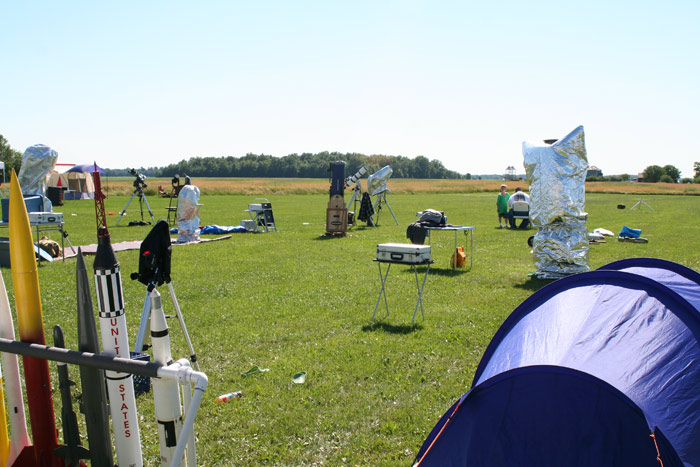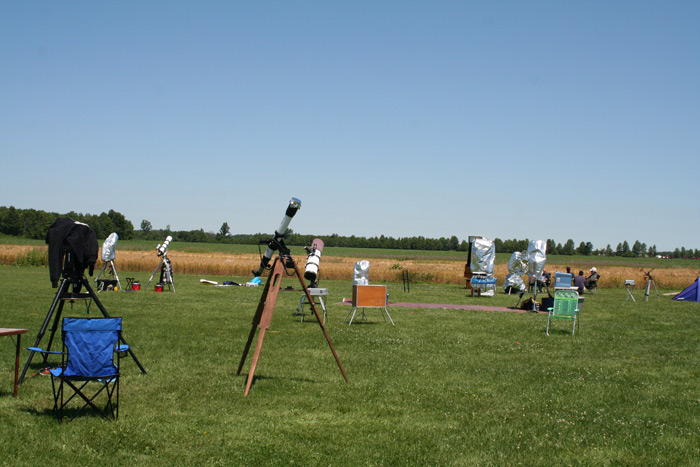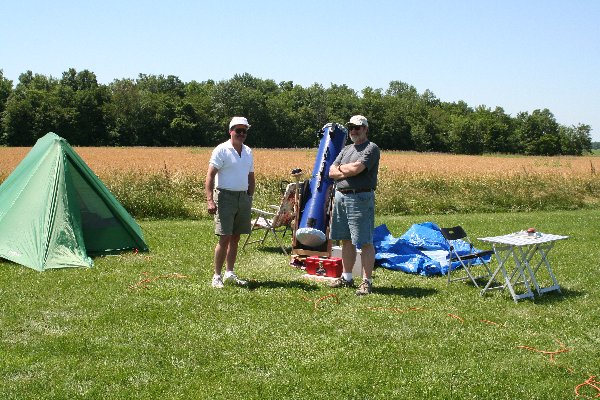
2011 07 23 Celebration of the Sun

•July 24, 2011 • Leave a Comment

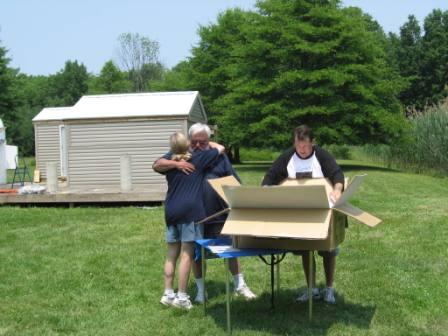
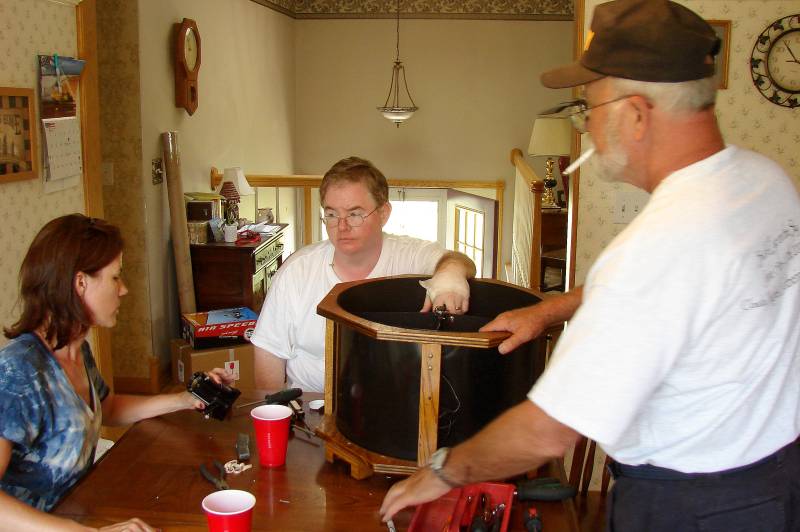
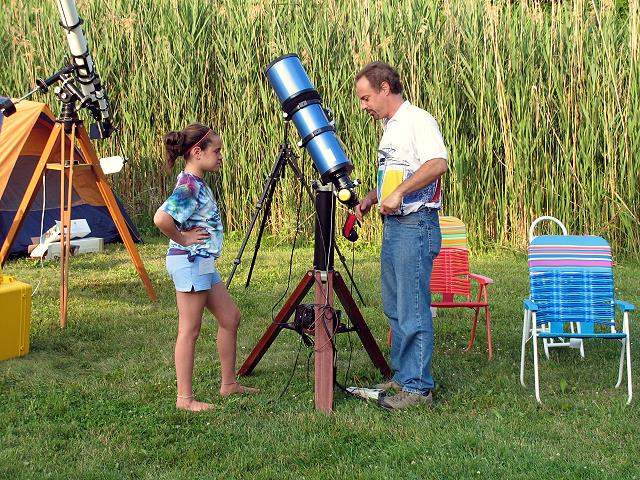
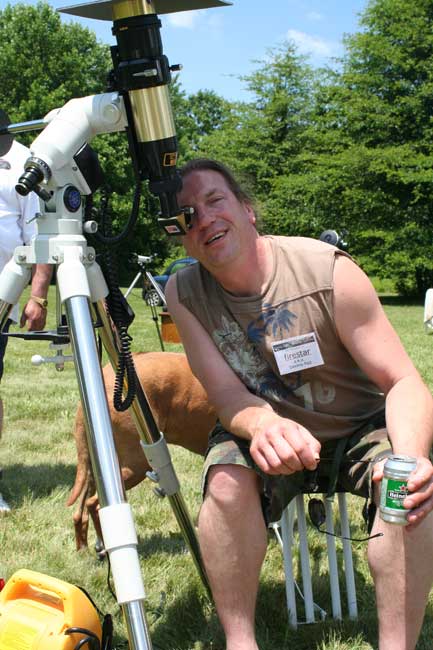
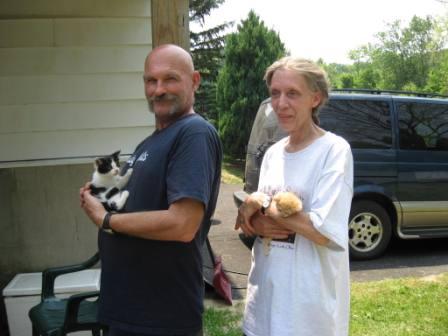
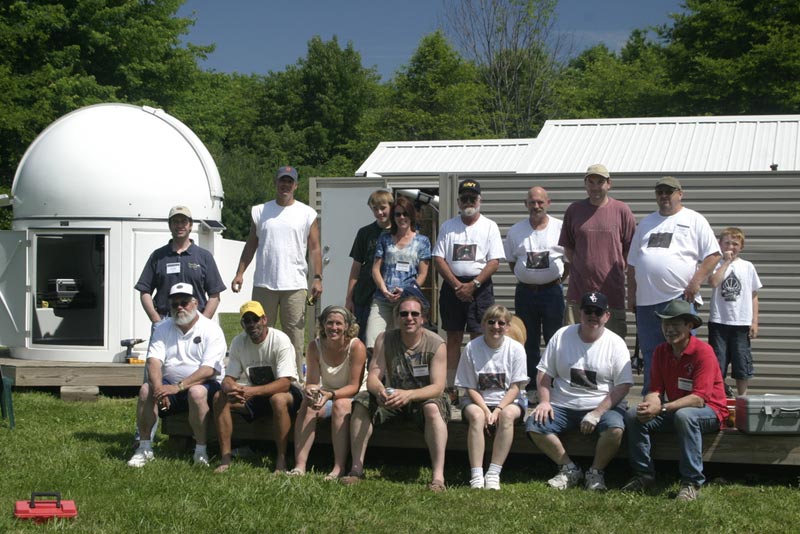
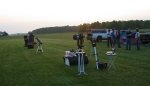
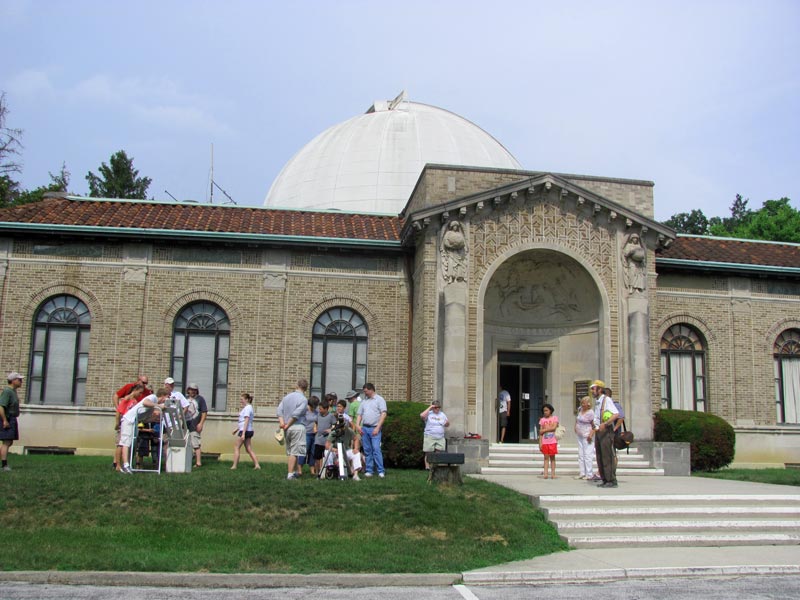
Perkins Observatory – OWU held a series of programs in honor of the Sun. I’ve been meaning to attend the past couple of years, but this year Paul and I were finally able to go.

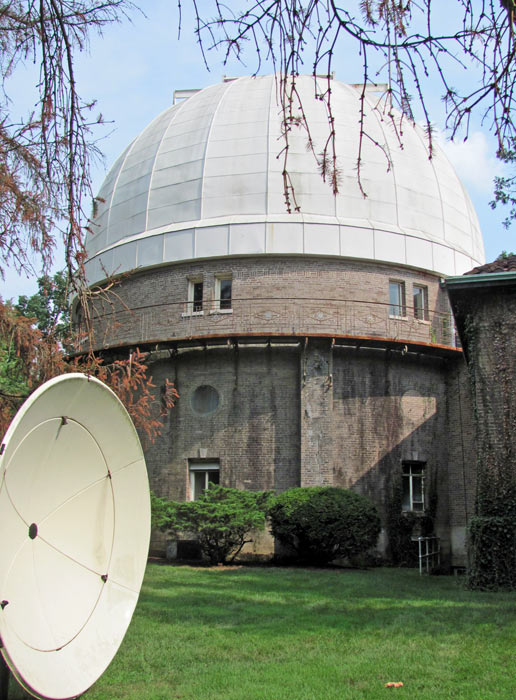
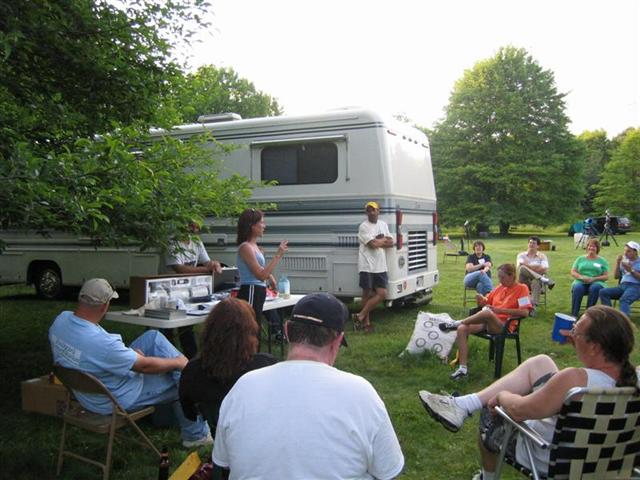
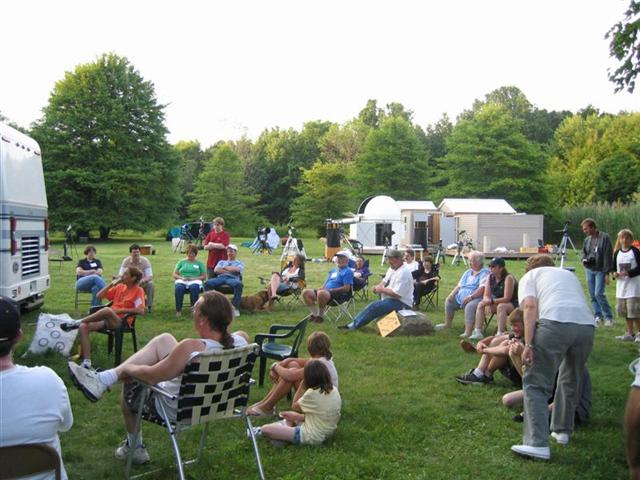
The afternoon started off by visiting with a member of the Columbus Astronomical Society that we hadn’t seen for a few years, a quick look around the observatory, and then making ourselves comfortable in the old lecture room where I’ve had the pleasure of giving an astronomical sketching presentation in the past. I was pleased to see several children attend the program with their parents and grandparents.

We were given a Power Point presentation of solar features as well as a little history of solar observing. They kept it light and entertaining, although still very interesting. I’m hopeful that the program will spark an interest in solar observing for those that attended.

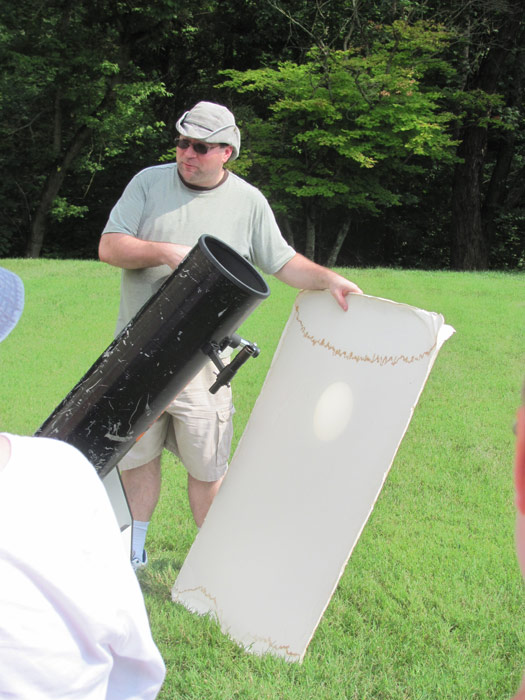
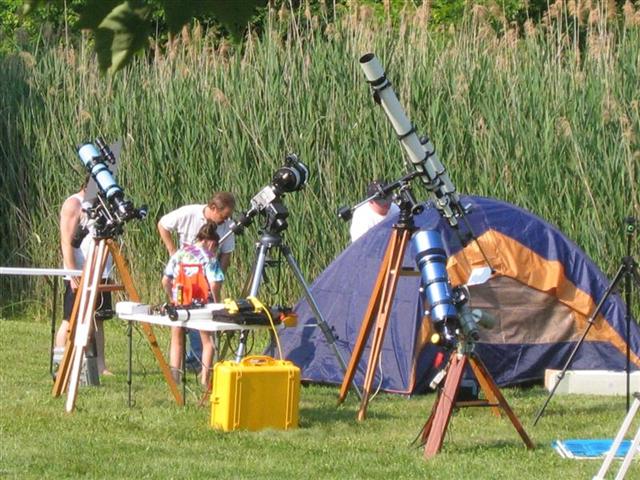
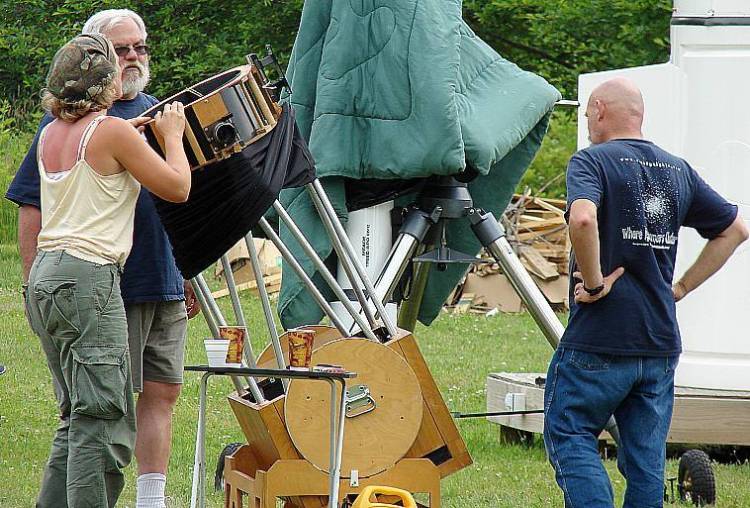
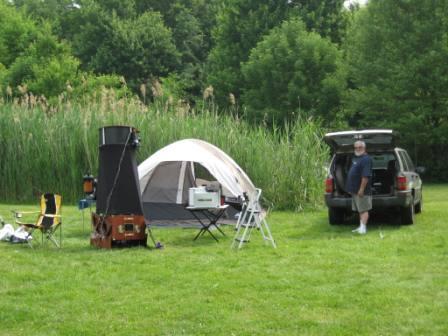
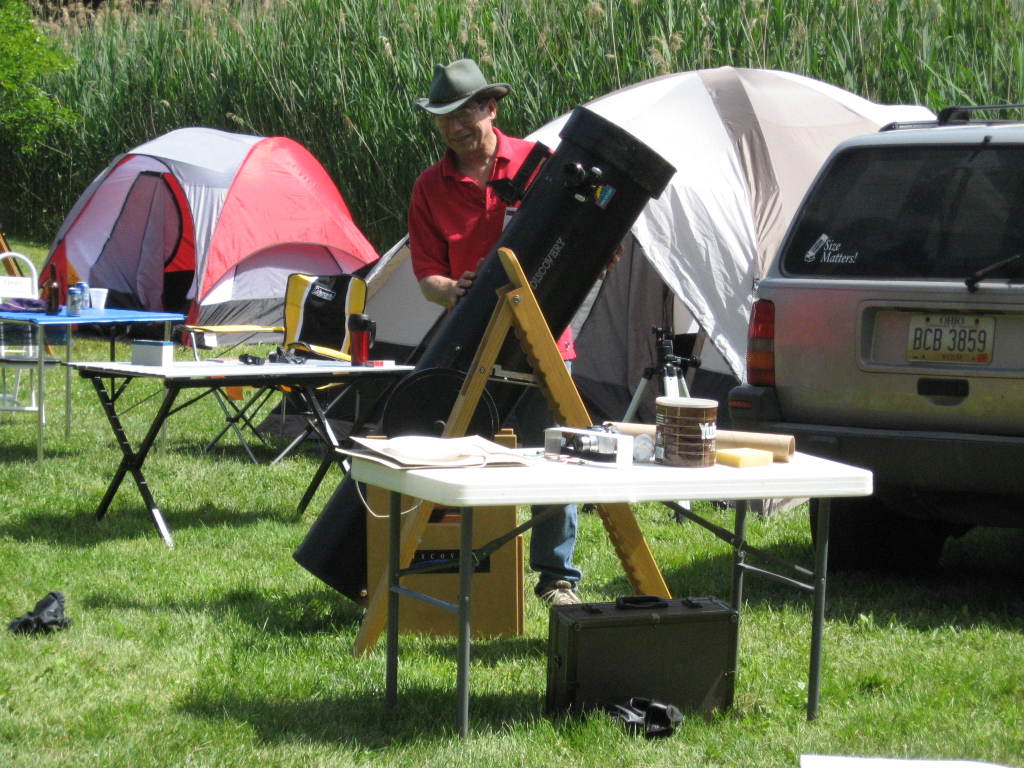
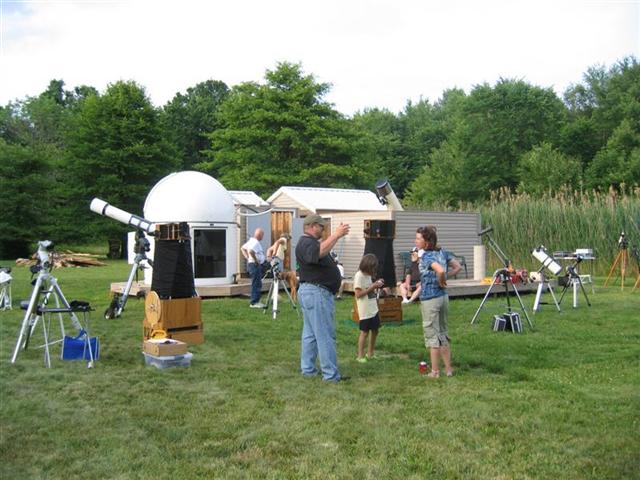
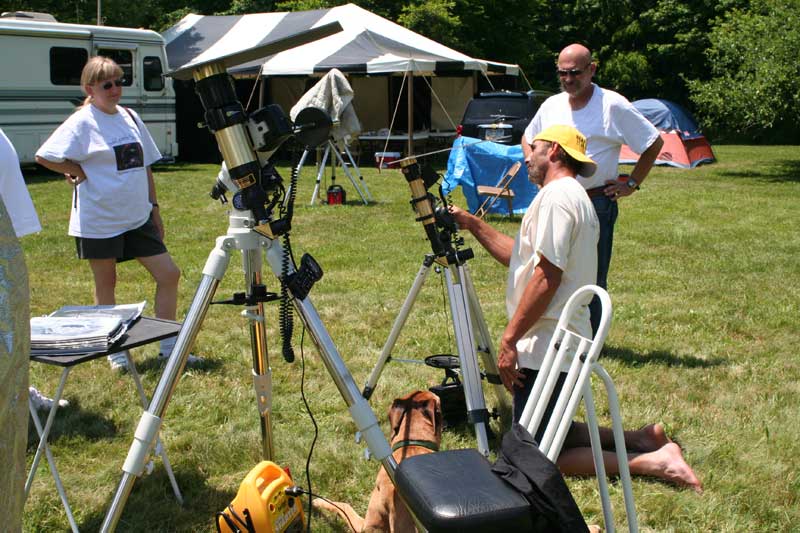
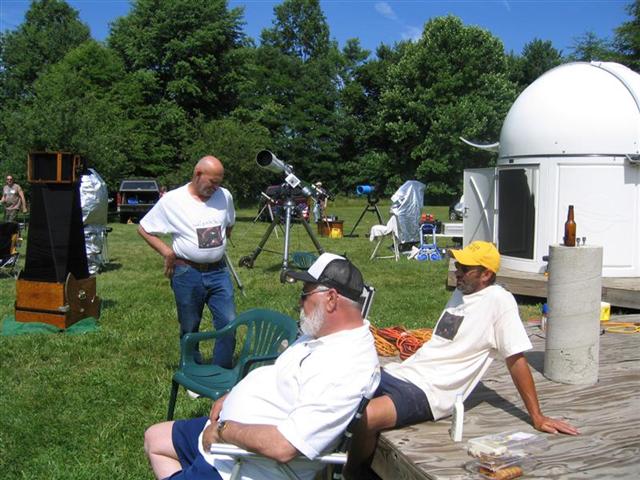
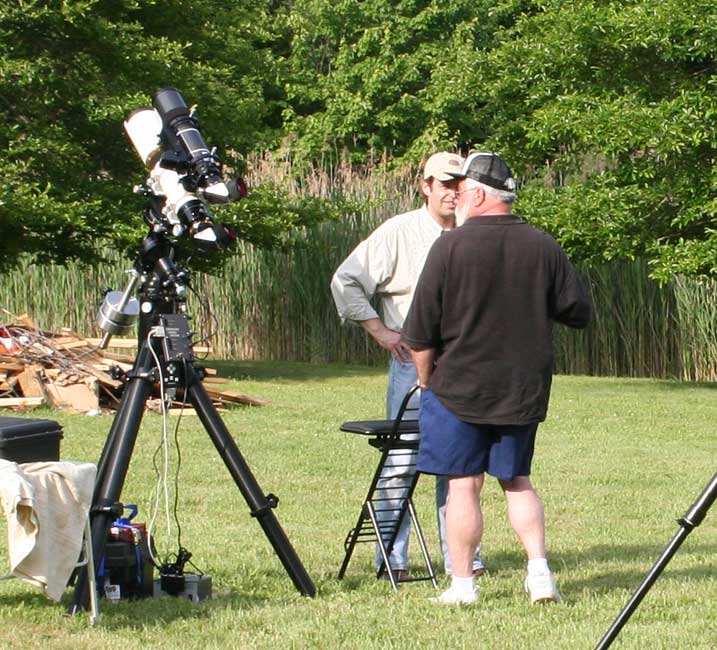
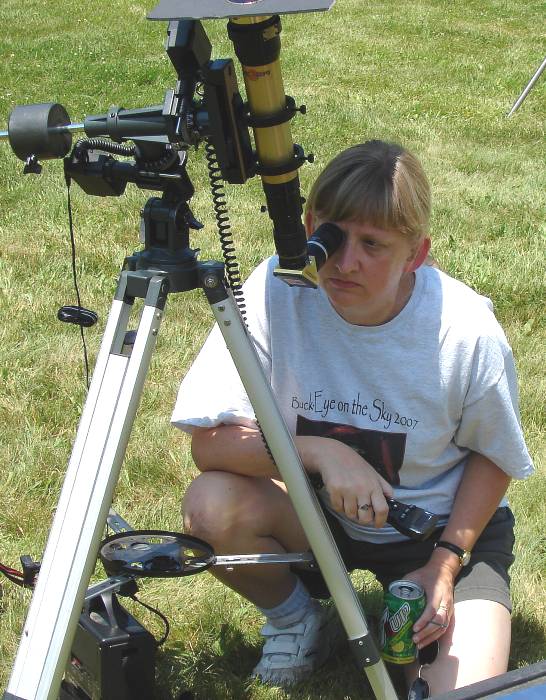
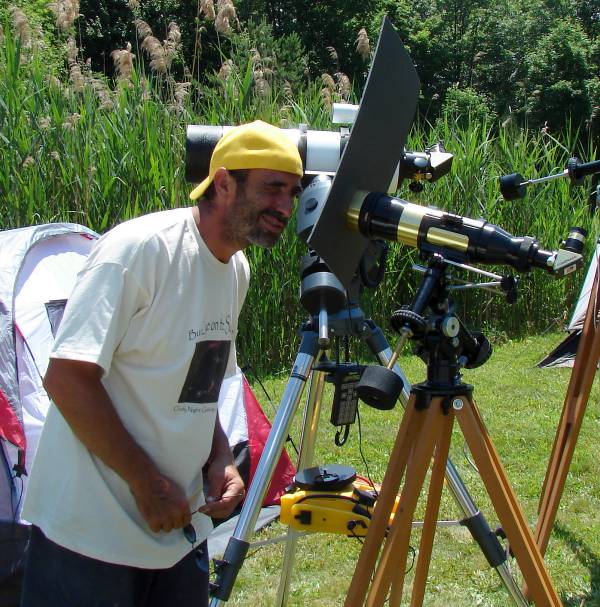
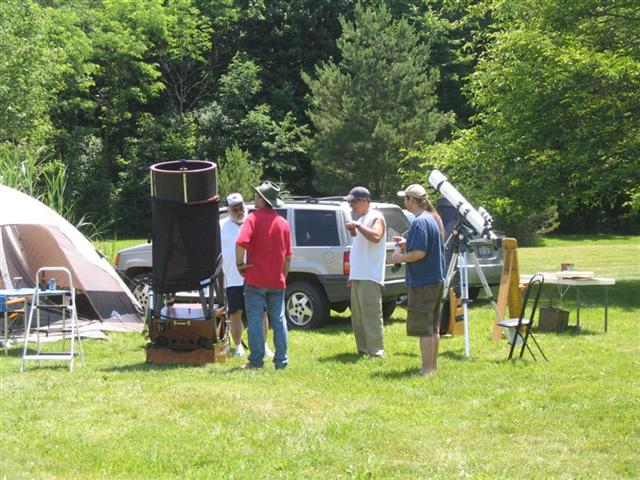
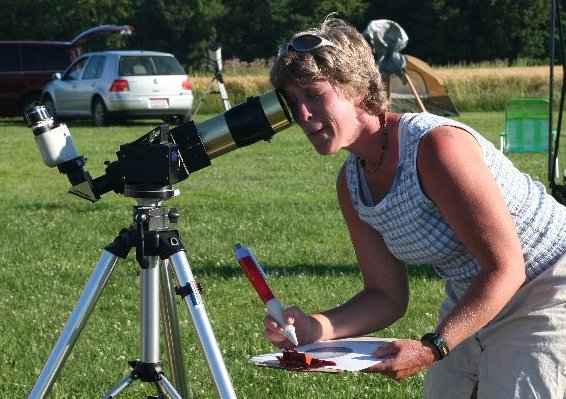
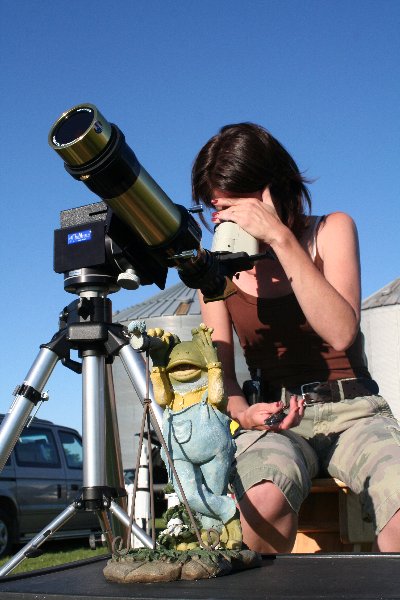
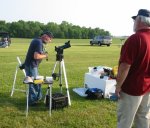
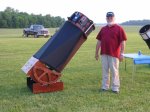
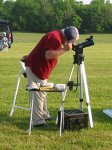
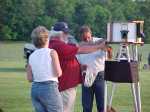
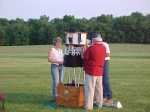
After the initial presentation, there were three telescopes set up for viewing: one for projection with an 8″ reflector, a Solarmax 60mm, and then a homemade 6-8″ solar “reflector” without a mirror reflective coating that was made for solar observing. A demonstration was given on the dangers of solar observing without proper equipment by holding a piece of bark behind the eyepiece and how quickly it scorched and started smoking.

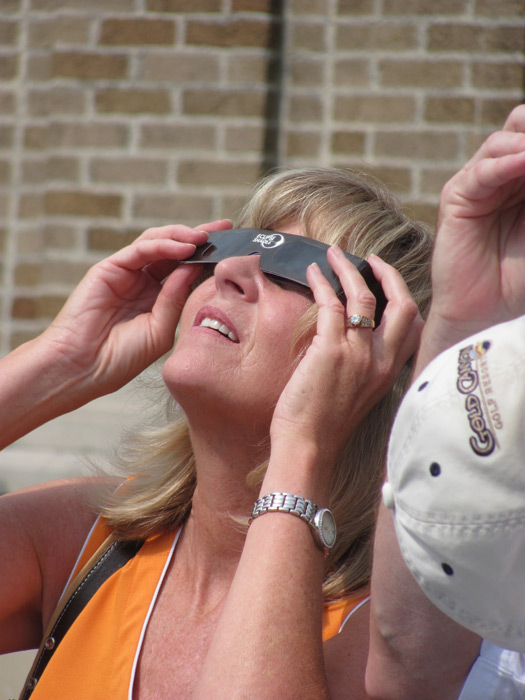
People were explained the color spectrum by means of solar glasses along with the help of rainbow colored suspenders – wearing the glasses, we could see that the main spectra were the colors green and red. The Sun is portrayed yellow, so is it a coincidence that yellow is smack dab in the middle between green and red in the color spectrum?
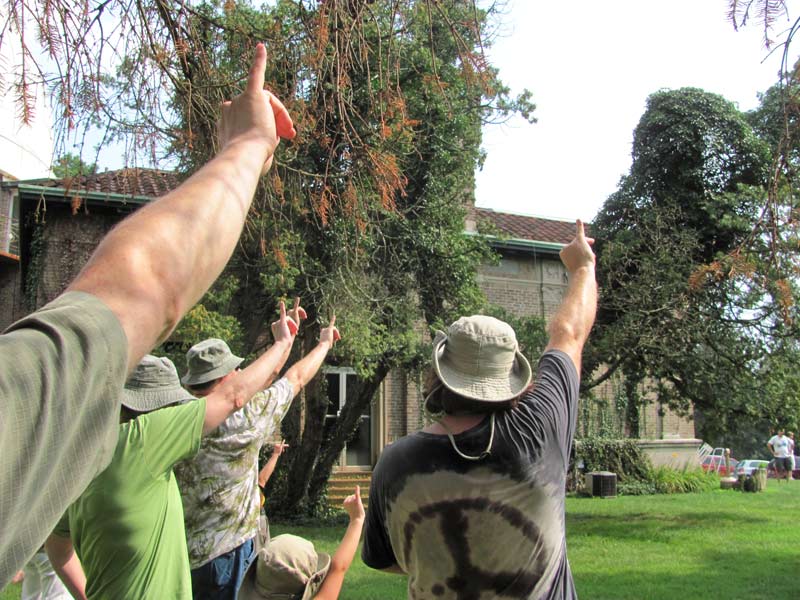
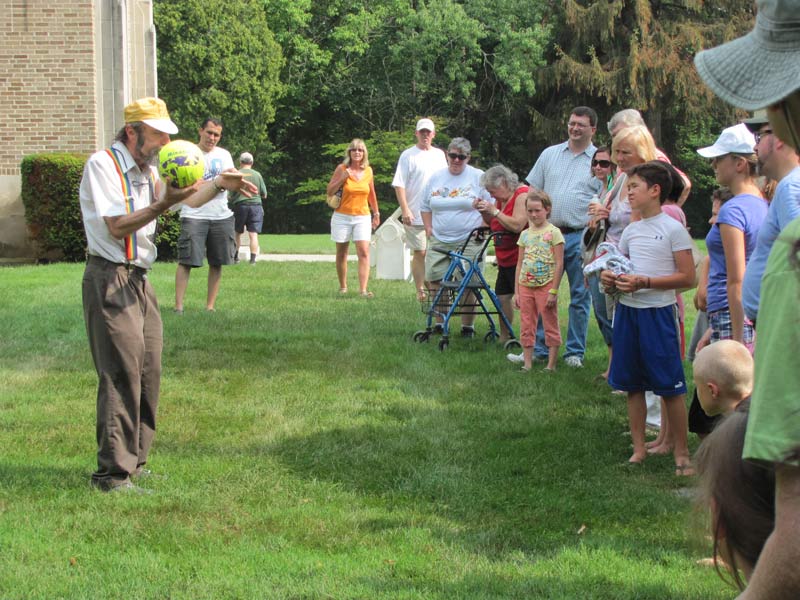
Following the solar viewing, everyone learned how to put the size of the Sun into perspective, not only with regards to how large it is compared to Earth, but also to other stars and how large it is “actually” is visually to us. A yellow soccer ball was put on the ground and we stood in a line and walked a measured amount away from it as a ratio of how far Earth is from the Sun. Each person was asked to hold up their pinky and align their pinky nail next to the soccer ball. The soccer ball’s size represented the size of the Sun, which was just smaller than my fingernail. We then held our pinky up to the sky to see just how large the Sun would be in the sky. It, of course, appears larger because of the brightness, but after putting on the solar glasses and judging its size with our pinky finger nails, the size was marginally smaller than what one would think!

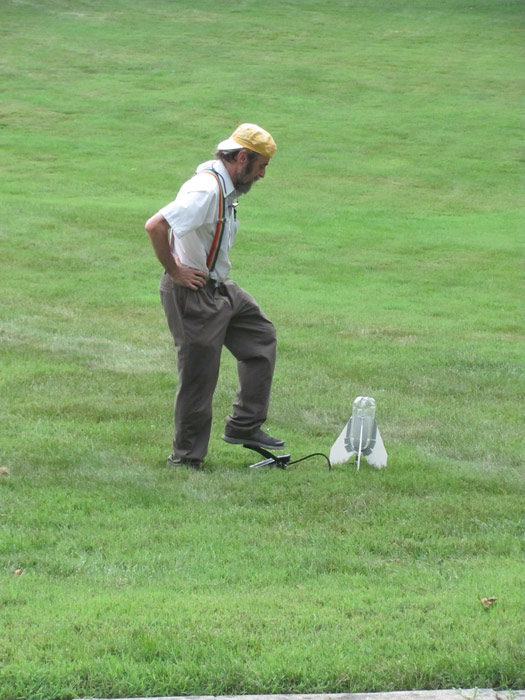
We were given a very entertaining lesson on rocket launching safety and then headed outside to experience the excitement of setting off rockets!

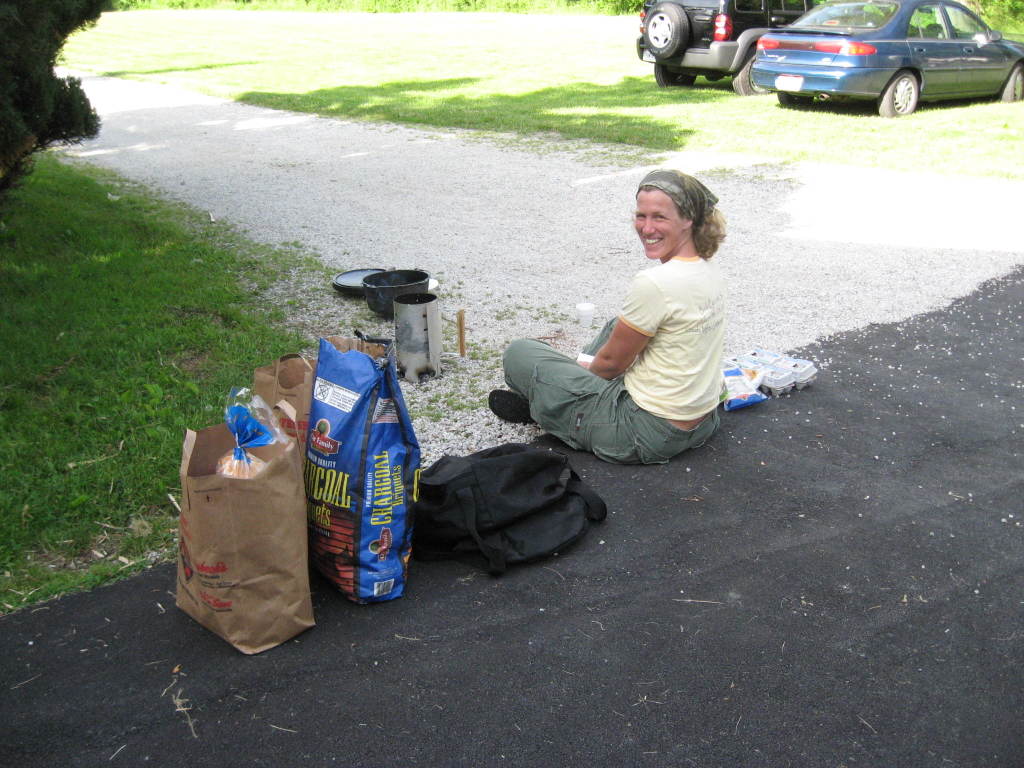
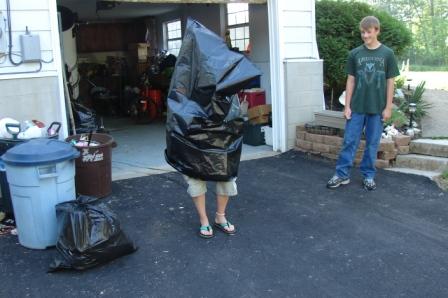
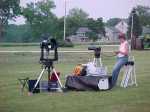
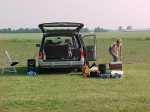
Two were set off. One used the electric from his car battery as an igniter. This one (shown in the photo) was made from a plastic soda bottle, water, and air. The pressure of the air combined with the compressible water was used to launch the rocket. (Hint: we were told that when he was ten years old and experimented, he found that jello worked better than water!)
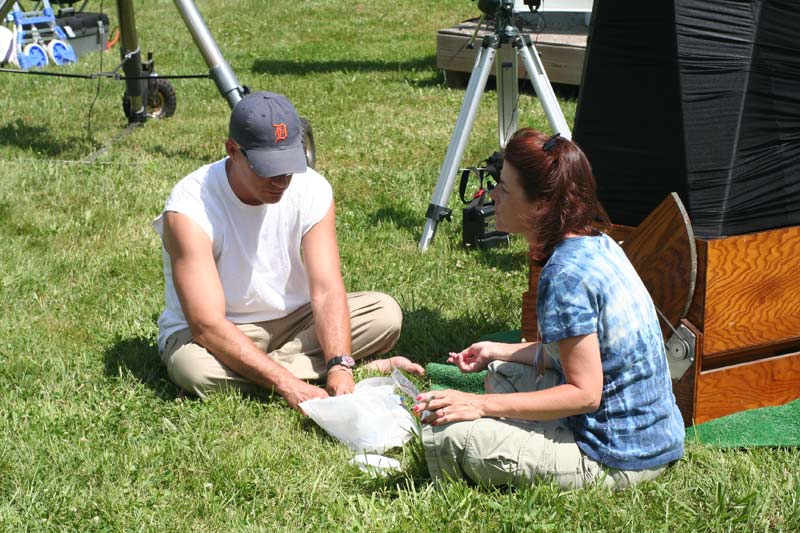
Not part of the program, but a very fun addition to the observatory, was a pair of whispering disks. They were about 40 paces from each other. Two people can hold a conversation with each other, each talking in front of his/her opposing disk…as shown by these siblings. I wish I could caught on camera the looks on their faces when they discovered the disks actually worked!

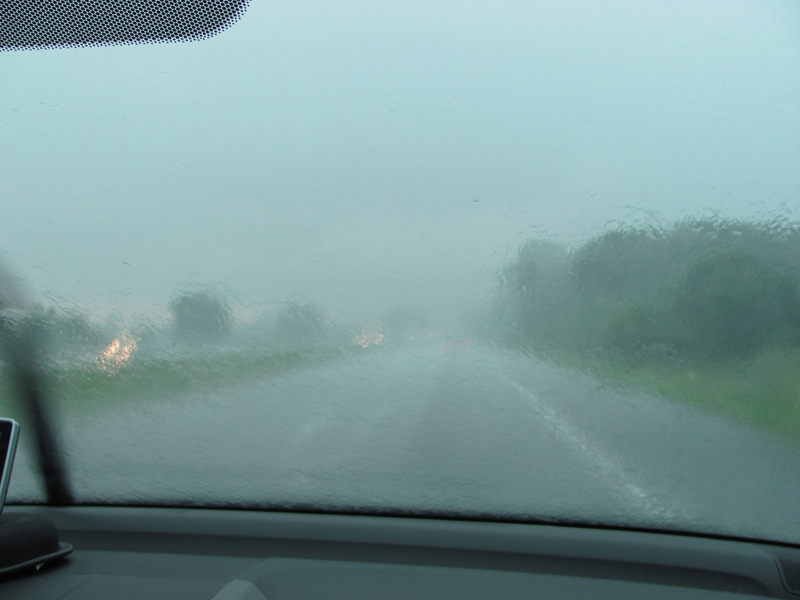
The final portion of the program was a tour of the observatory. Paul and I had taken a tour a few years ago and decided to quietly slip away for the journey home. We ran into quite a bit of rain on the last stretch of highway coming out of Columbus. Looks like the program was timed just right.

What a very enjoyable afternoon spent with the focus on my favorite star. And even more so, watching others being introduced to our Sun for the first time! Thank you members of Perkins Observatory and CAS.
There’s Just Something About CN Amateur Astronomers

•July 13, 2011 • 2 Comments

Many times we become members of an online community hoping to find others that share a common hobby with us. I’d like to take this a step further in saying not only share, but to be courteous, friendly, and never to belittle a person no matter how silly or simplistic their questions may appear to those that are more experienced in the hobby. I’ve joined a few forums myself over the years where immediately I knew the community wasn’t for me. In particular, an aviation forum (back in my flying days) had members that would argue any post made regardless if they knew the topic well or not. Gardening forums (you’re probably wondering how a gardening forum could turn sour) where members, believe it or not, argued over compost mixtures and bed preparations.
It wasn’t until Paul found Cloudy Nights Telescope Reviews that I finally felt a sense of comradery and welcomeness throughout an online community. I find that most amateur astronomers are generally a great bunch, but on Cloudy Nights, the gentle leadership of the administration team and the moderators quickly and quietly keep the squabbles to a minimum. Add that to the great membership (now over 50,769 registered users) and you have one of the most informative and supportive communities out there at your fingertips.

I’ve had the pleasure to meet face to face with a quite a few CN members over the past several years from around the world either through star parties, trade shows, or just to have dinner with them. Each time it feels like meeting up with an old friend. No matter what your walk of life, you have something special in common that draws you together…astronomy. People gladly share their experience, knowledge and equipment with each other, and in some instances, even our homes.

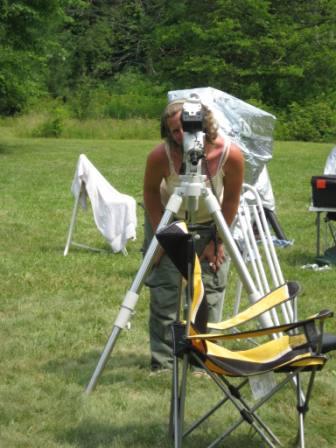
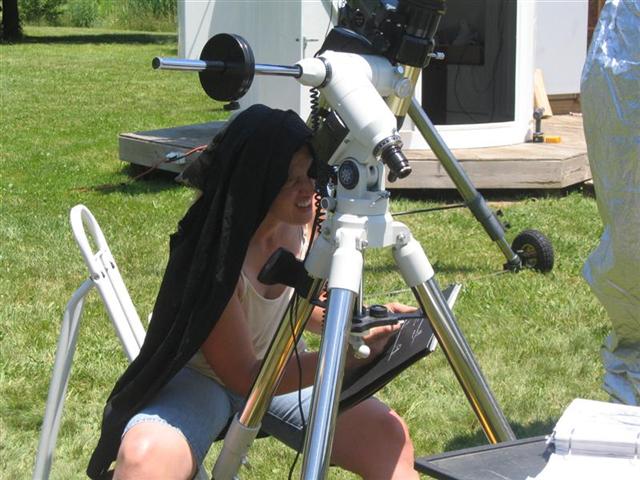
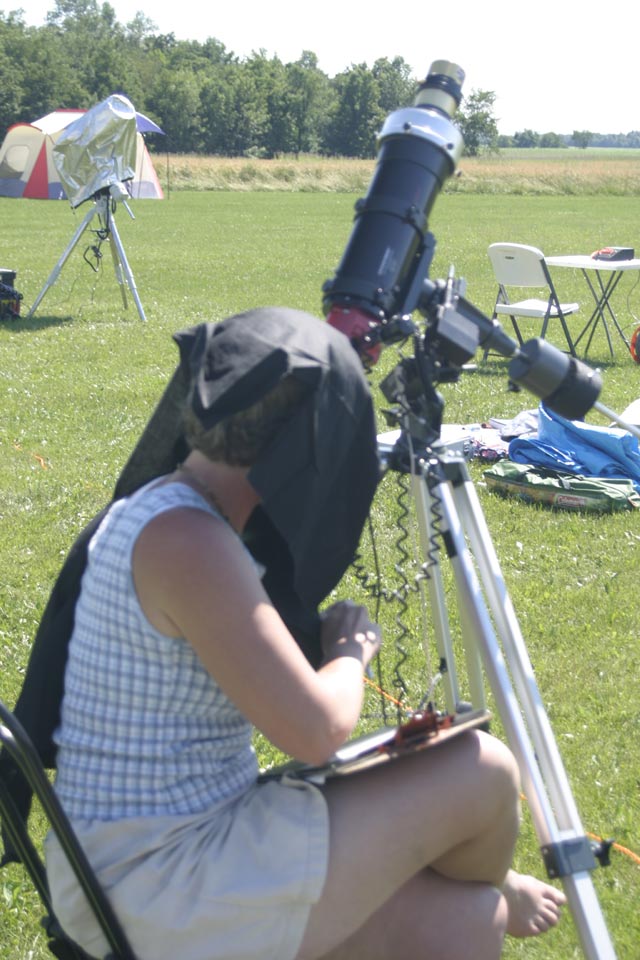
Sure we can discuss the likes of equipment or the universe, but what I’ve especially noticed is the good-hearted fun that everyone seems to have in the process. Stories are shared about the strange, suspicious looks we get from the neighbors while quietly sitting behind telescope outside alone in the dark (in my case, sitting with a cloth covering my head with a telescope pointed to the Sun) or the responses we hear after showing someone Saturn for the first time during outreach.

Most of the CN articles and reviews are of a more serious nature. But this morning, I stumbled upon a light-hearted article by Terrance Hannan that truly brings to light the spirit of the Cloudy Night’s community…just by reading their signature lines!

50 Cloudy Nights Signatures by Terrance Hannan

I’m very thankful for Cloudy Nights!

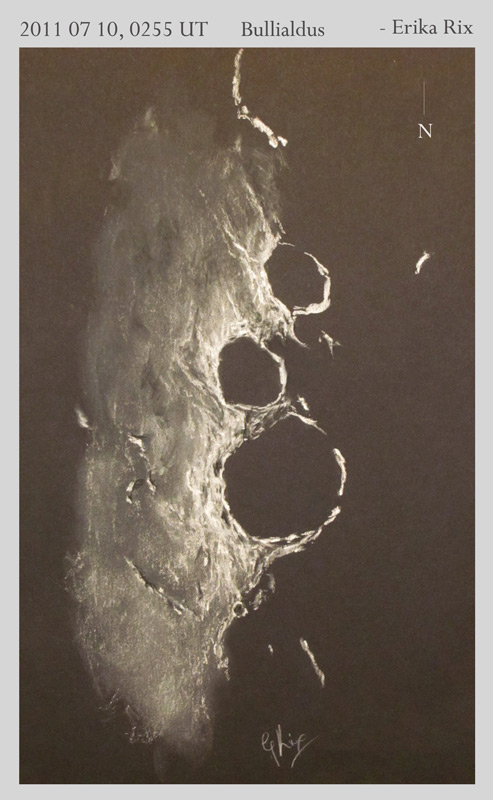
2011 07 10 – Bullialdus

•July 10, 2011 • Leave a Comment

Bulllialdus: Complex crater from Copernician period (-1.1 billion yrs to present day), Lat: 27.7 deg south, Long: 22.2 deg west.

Zhumell 16”, 21-7mm Zhumell, 257x, no filter
Temp20C, 92% humidity, S: Antoniadi III, T: 2/6
Eyepiece sketch on Strathmore Artagain paper, Conte’ crayon, charcoal
Phase: 65.5deg, Lunation: 8.75d, Illumination: 70.7%
Lib. Lat: +5deg21’, Lib. Long: +2deg21’
Az: 212deg51’, Alt: 23deg30’

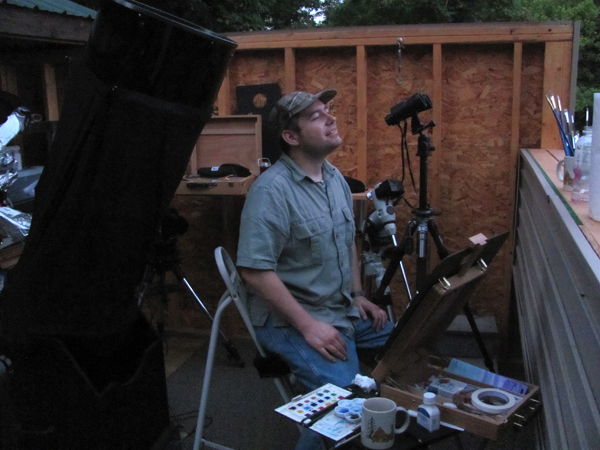
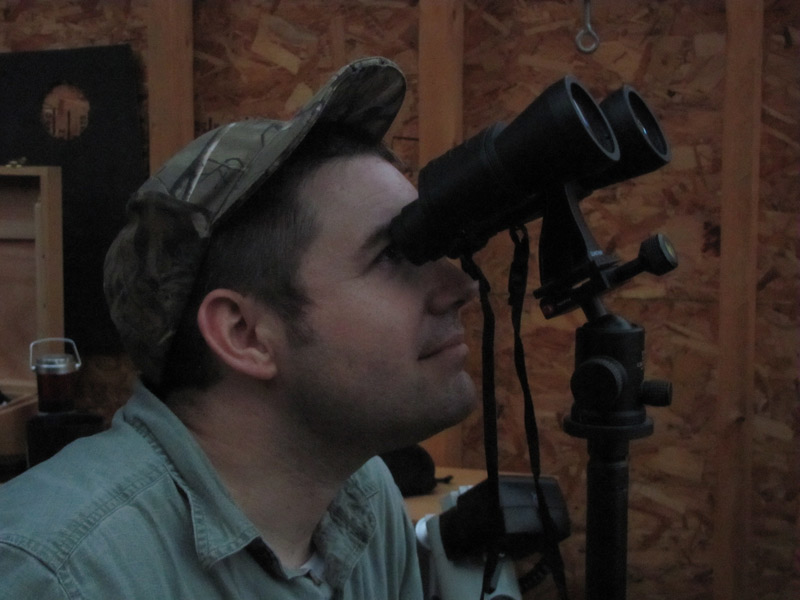
I’ve been meaning to try my hand at painting the Moon in watercolor for quite some time. Up until tonight, I’ve never tried using watercolors at the eyepiece. Figuring it would be easier for me to use binoculars instead of my 16″ reflector (without a tracking platform), I set up my tripod and paints.

Paul took a break from imaging to have a peek through the binoculars for a full phase view.

I masked off the Moon on my watercolor paper and began with a light blue background to match the late evening skies. The blue water was streaking across the vast backdrop off my painting. Not able to correct it, I began again with a clean sheet of paper. This time, I had the backdrop nearly perfect but then when I tried rubbing the masking off of the limb of the outlined Moon, the grain of the paper ripped and became rough. {sigh} Third time was a charm as I overcame the streaking by laying my sketching board flat on my lap and then waited until the backdrop was dry before attempting to remove the masking.

Paul Rix

By this time, I felt a little pressured to complete the sketch while it was still light enough to see the sketch pad without artificial light. The lunar details were suffering, not only because I felt rushed, but also because I’m not a very good painter and need to practice!  I forced myself to continue despite the poor results until I felt very confident that there was no way I could salvage the painting (despite Paul’s encouraging words while sitting behind his telescope). I chalked up the three failed watercolor paintings wadded up in the trash can  as a good introduction to painting at the eyepiece! It was time to put the paints away and start a proper sketch.

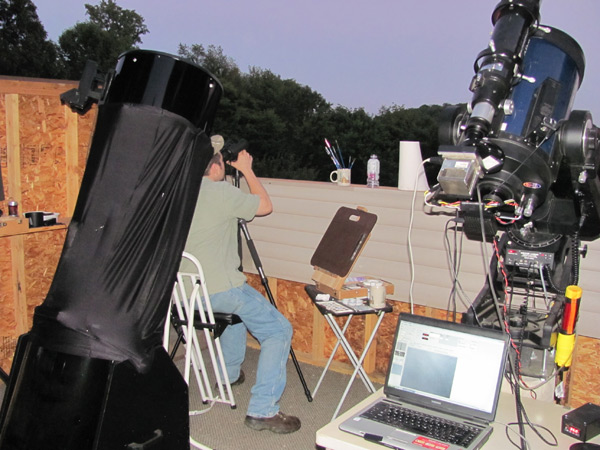
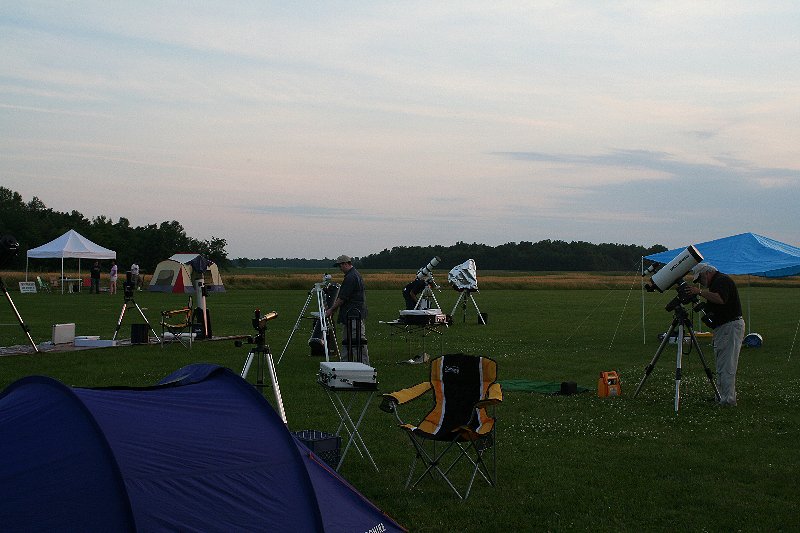
Paul's imaging gear to the right, my gear to the left. Paul's taking a peek.

My first thought was to get out my Rite in the Rain paper and charcoal, but  that terminator line was looking very dramatic and I decided to try another lunar sketch with black paper and white pastels. I chose the white on black because it can be a lot quicker to draw highlights than to draw shadows and I knew there would be a race against time to sketch on the terminator line.

There comes in a time in almost every lunar sketch where I feel like giving up, that the details just aren’t being caught on paper. But persistence usually pays off and I continued until the Moon moved behind the pig nut trees to the western boarder of our property. The paper size is 9″x12″.

There’s just something about Bullialdus that keeps me coming back. This is my third time sketching it along with its two companion craters. For more details about this complex crater, have a look into my report on Dec 4th, 2010 .

Something didn’t really look right to me during my observation. It was only when I called it a night and came back in the house that I realized that Bullialdus A looked a lot larger (and Bullialdus B for that matter) than normal. There’s not a real sharp northern edge to Bullialdus A. It almost has a plateau-like bridge connecting it to the crater Bullialdus. The lighting played against that (or that explanation seems reasonable to me) to make it appear larger than normal.

BEOTS 2007

•July 7, 2011 • Leave a Comment

First there were 5 (Sky Tour 2005). Then there were 17 (Sky Tour 2006). We projected the year 2007 to have even a larger gathering of Cloudy Nights members to attend the Sky Tour event. But as the date got closer, disaster struck. We had news that the event wasn’t going to happen in 2007. That meant we had no place to meet up for our “annual” gathering. Paul and I had moved into town for a few years to be closer to my grandmother (Nanny) so we certainly couldn’t have it at our place. John and Jim also lived in town. Thankfully Scott had a nice place with some land and he and his family welcomed the group with open arms to the “Horstman Observatory Cluster” for what sparked the beginning of the “Buck-Eye on the Sky” annual summer star parties.

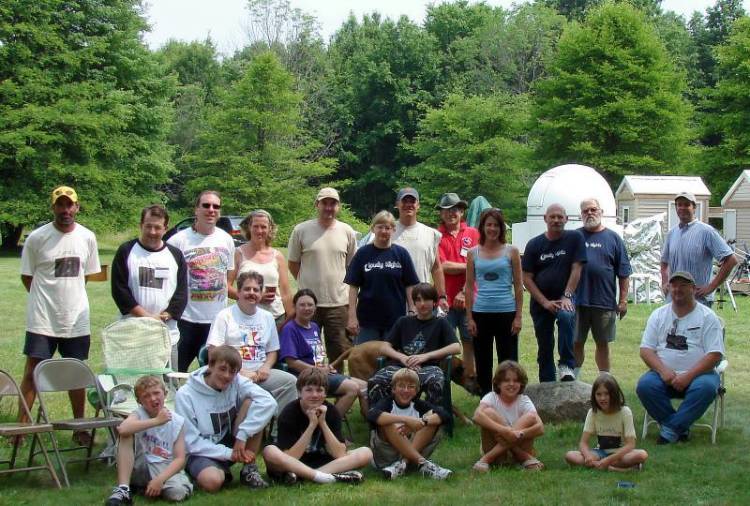
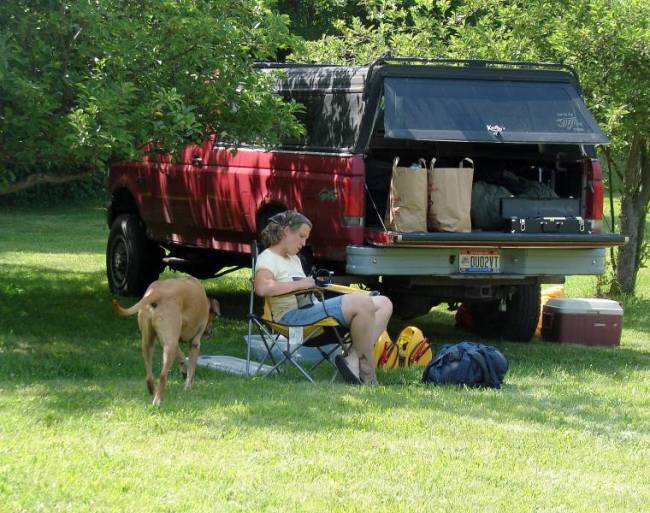
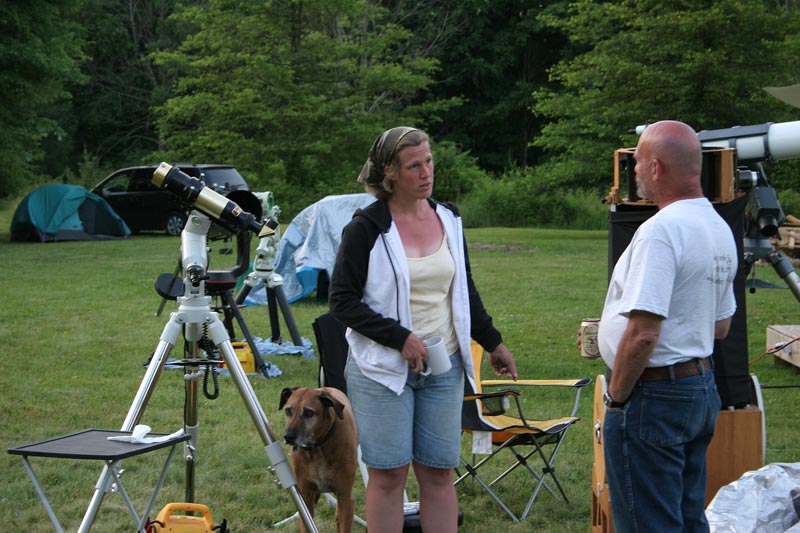
The first annual BEOTS star party had over 40 people on both nights and friends from several states made the journey. Paul couldn’t make it, but my astro dog, Riser, went with me. Unfortunately he’s no longer with us and very much missed.


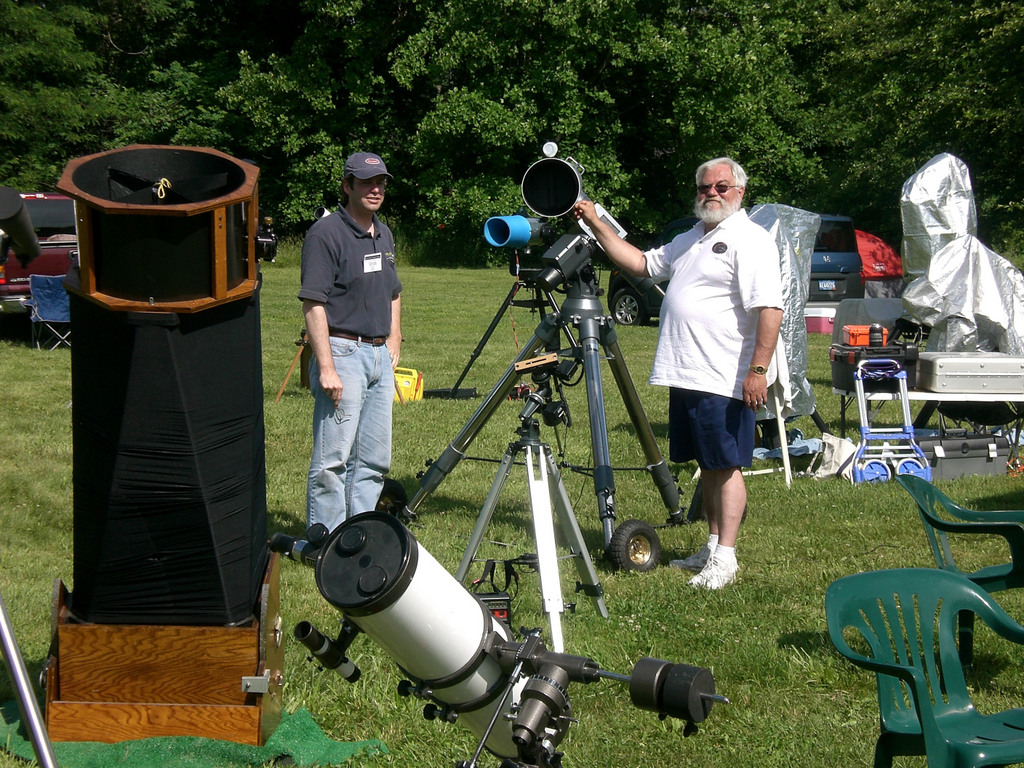
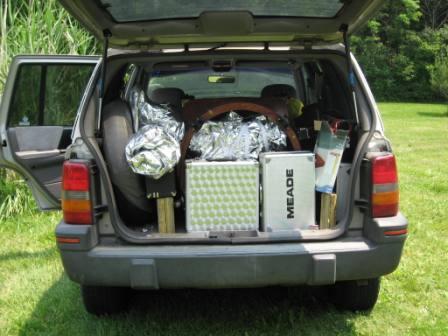
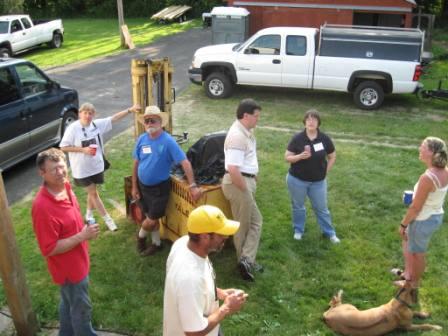
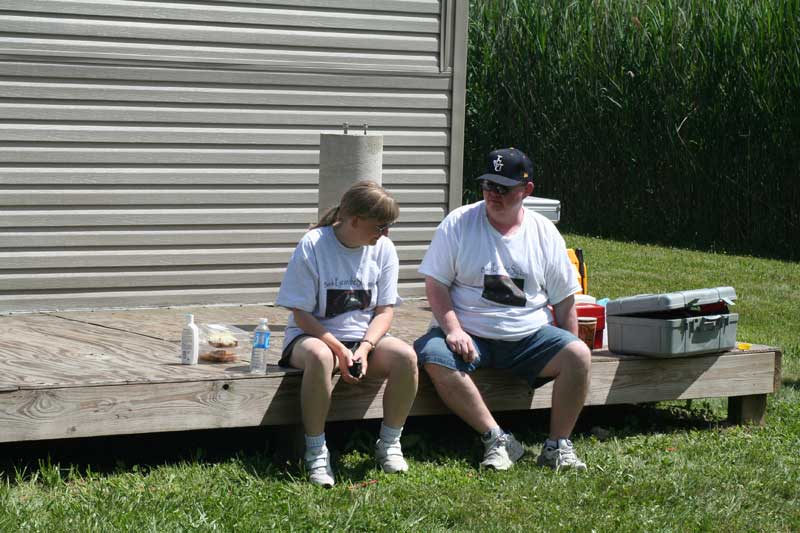
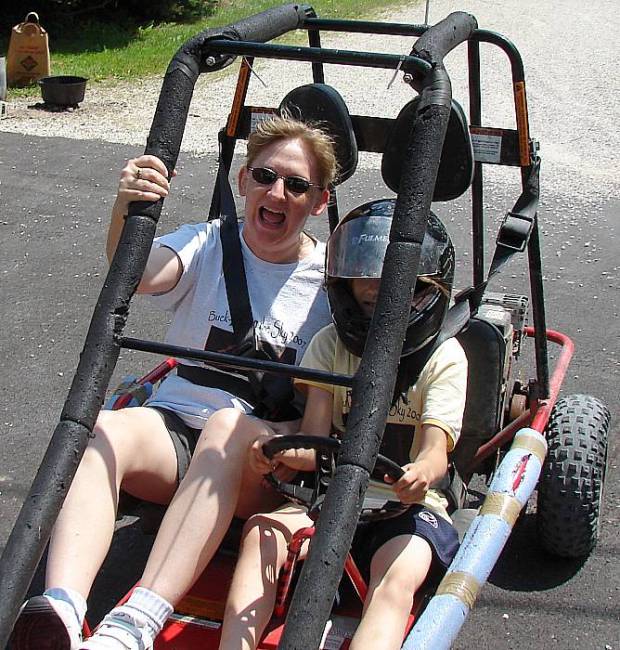
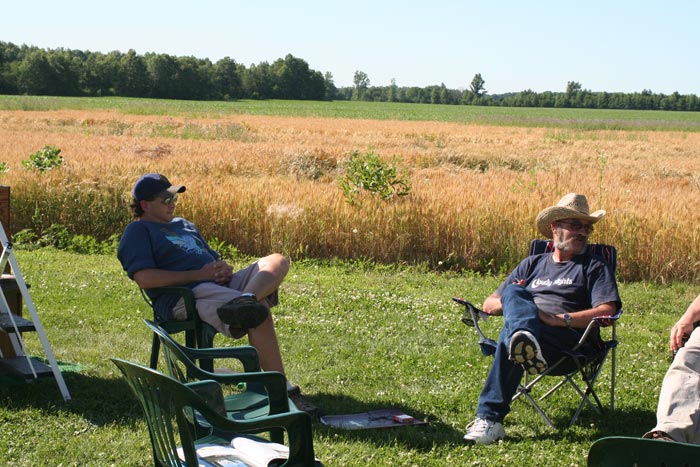
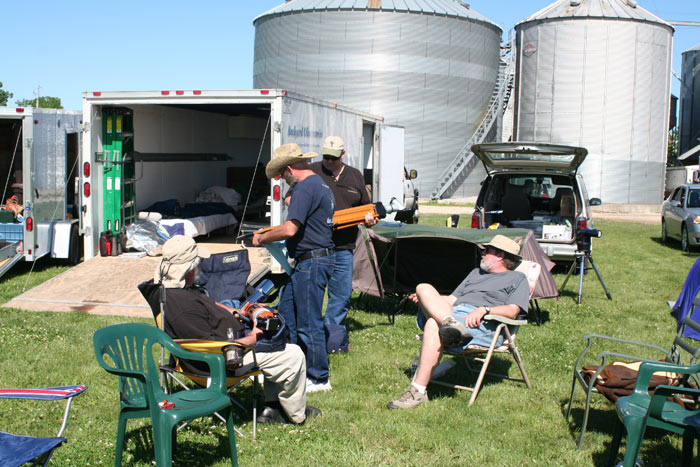
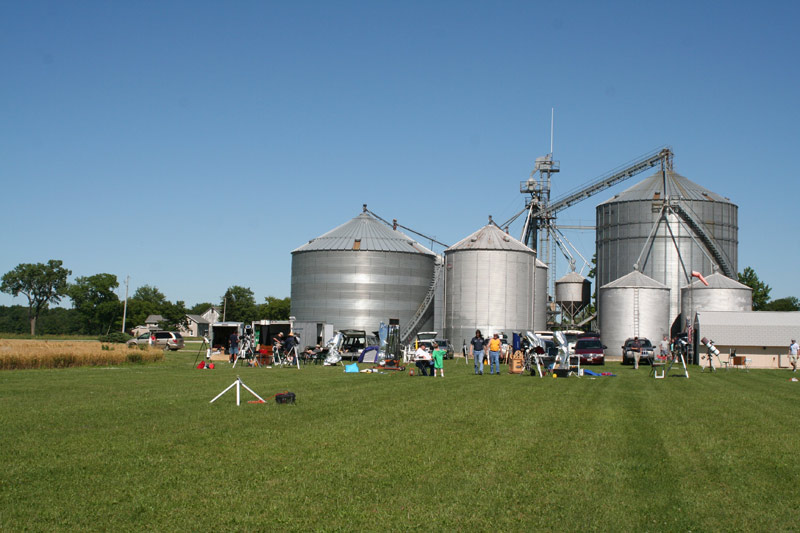
I’ll let the photos speak for themselves, but some of the highlights were Mike R’s chili, solar observing, raffling prizes (introduction of the fashionable, studly man-bag), watching my sista Steph H riding around in a go-cart with Nikki H, kisses from Rusty’s not spoiled rotten Golden Retrievers (Maggie and Casey), and the kitten party favors. Above all else, the hospitality of the Horstmans and the friendship of all who attend (whether old or new) is what makes BEOTS so fabulous. It’s a relaxed environment where everyone is made to feel completely at home and it shows just by seeing everyone laughing and having a great time both on and off the observing field. It’s one of those star parties that if we have clear skies, it’s a bonus…but certainly not needed to enjoy ourselves!

Thank you, Scott, Diane, Nikki, and Jason, from the bottom of our hearts for hosting this event!

(The photos are credited to various BEOTS friends…unfortunately, I can’t remember who took what!)

2011 06 27 – NGC 5322 / H 1. 256 / UGC 8745

•July 6, 2011 • Leave a Comment

This is a type E3-4 galaxy, 06.1’ x 4.1’, m10.2v, SB 13.6 found at 13h49.3m +60°12¢ in Ursa Major. Distance is ~100 million light years. It was slightly elongated with diffuse edges and a concentrated core.

NGC 5322 image from the NGC IC Project

click for inverted view

It’s always fun to study galaxy morphology and classification. In the case of NGC 5322, it’s an elliptical galaxy somewhere between the middle of circular and highly elongated in shape. In other words, oval leaning toward elongated. Generally, elliptical galaxies show very little to no structural details other than a brightened nucleus. They gradually diffuse outward from the nucleus into a halo with no definite edges.

Classification and Morphology of External Galaxies By G. De Vaucouleurs

Sky Tour 2006

•July 6, 2011 • 2 Comments

Following Sky Tour 2005, our little group of Cloudy Night members expanded from 5 in 2005 to 17 observers in 2006. I’m not certain if our group outnumbered the club members there that hosted the Sky Tour event, but they welcomed us graciously regardless.

This time, we had a few people from other states join in (other than Jim Winter who is one of the original five from 2005 that lives in PA), such as my buddy Scott Kroeppler and his two kids from Arizona, friends Tom Trusock and Gary Gibbs from Michigan, and Rick B from Illinois. If anyone wonder’s how the word gets around for such events, you can take a peek into our thread that started 1/22/06 on Cloudy Nights.


Back row, left to right: Zach, John, Jim, Lenny, Patrick, Paul, Tom and Dave
Front row, left to right: Erika, Diane, Scott H, Rick, Gary, David, Scott K, Katie, and Andy

And to nab a post of mine from CN in 2006:

Here’s Paul (not my Paul, but a great guy nevertheless). He’s one of the ones from the club that hosts this shindig. It’s such a good time and it’s people like him that make it that way. They include us in and welcome us with open arms, making us feel right at home.

Here’s the club house and shelter house. It looks like they’re getting ready to grill supper for us all. In the club house, we set up our images with the others for everyone to view and look through on their spare time. They also have non stop coffee…and if the pot’s empty, we could just start a fresh batch in the 30 cup percolator.

We had the same cook as the year before, and it made my day to see him. He comes around with a paper plate and a pen to take everyone’s orders.

Paul was able to grab an image of the Trifid Nebula and Lenny let me test drive his DS SM 40 on a Celestron 102mm (if memory serves me right) for a solar sketch.

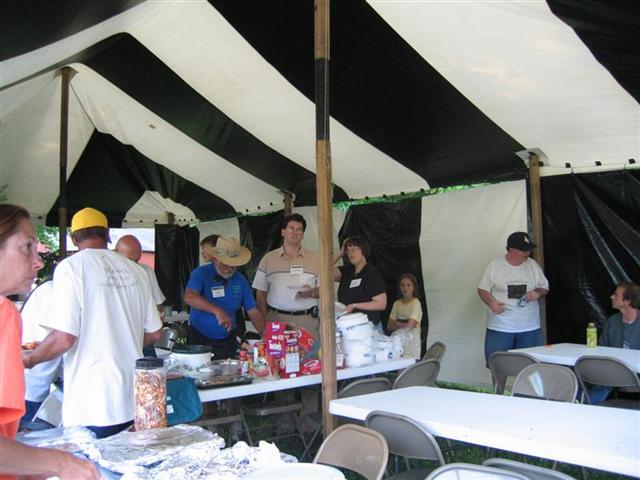
Above all else, it was a great weekend of friendship, observing, and laughs. We tried out each others’ gear, sat around and told stories, great food, a presentation from a gentleman from NASA who showed up with his two girls, and basically just enjoyed each others’ company and the night (and day) skies!

Sky Tour 2005

•July 5, 2011 • 2 Comments

I just got back from the 5th annual star party called BEOTS, aka. Buck-Eye on the Sky. It’s hosted by friends of ours, Scott and Diane Horstman here in Ohio. Rather than start with the latest star party, I’ll begin with how it all started in 2005. Here’s to a trip down memory lane!

Paul and I joined Cloudy Nights Telescope Reviews in 2004. We had just purchased a refurbished Meade ETX-70AT and soon after a used 10″ Meade LX200 Classic. We’d never been to a star party before and joined a thread about a fairly local one here in Ohio called Sky Tour in Bellevue. We virtually met John Crilly and Jim Winter on that thread and agreed to meet up for the star party. Scott Horstman was the fifth member of our group (a friend of John’s) who showed up later that night.

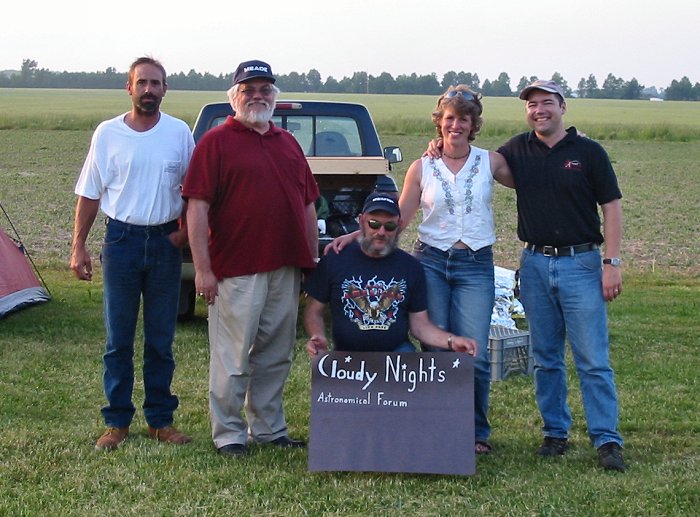
Left to right: Scott Horstman, John Crilly, James (Jim) Winter, Erika Rix, Paul Rix

The club that hosted the star party welcomed us graciously and various members strolled over during the night to share views and for all of us to get to know each other better. The food was terrific and as I remember, the man who was in charge of the grill did a great job cooking to our orders! At the picnic table while eating our food, I found out what John did for a living when I told him how long Paul and I were married, to which he replied something along the lines of, “I can fix that for you.” If you can’t guess, he’s a lawyer. With that sense of humor, there was no doubt we all would become friends!

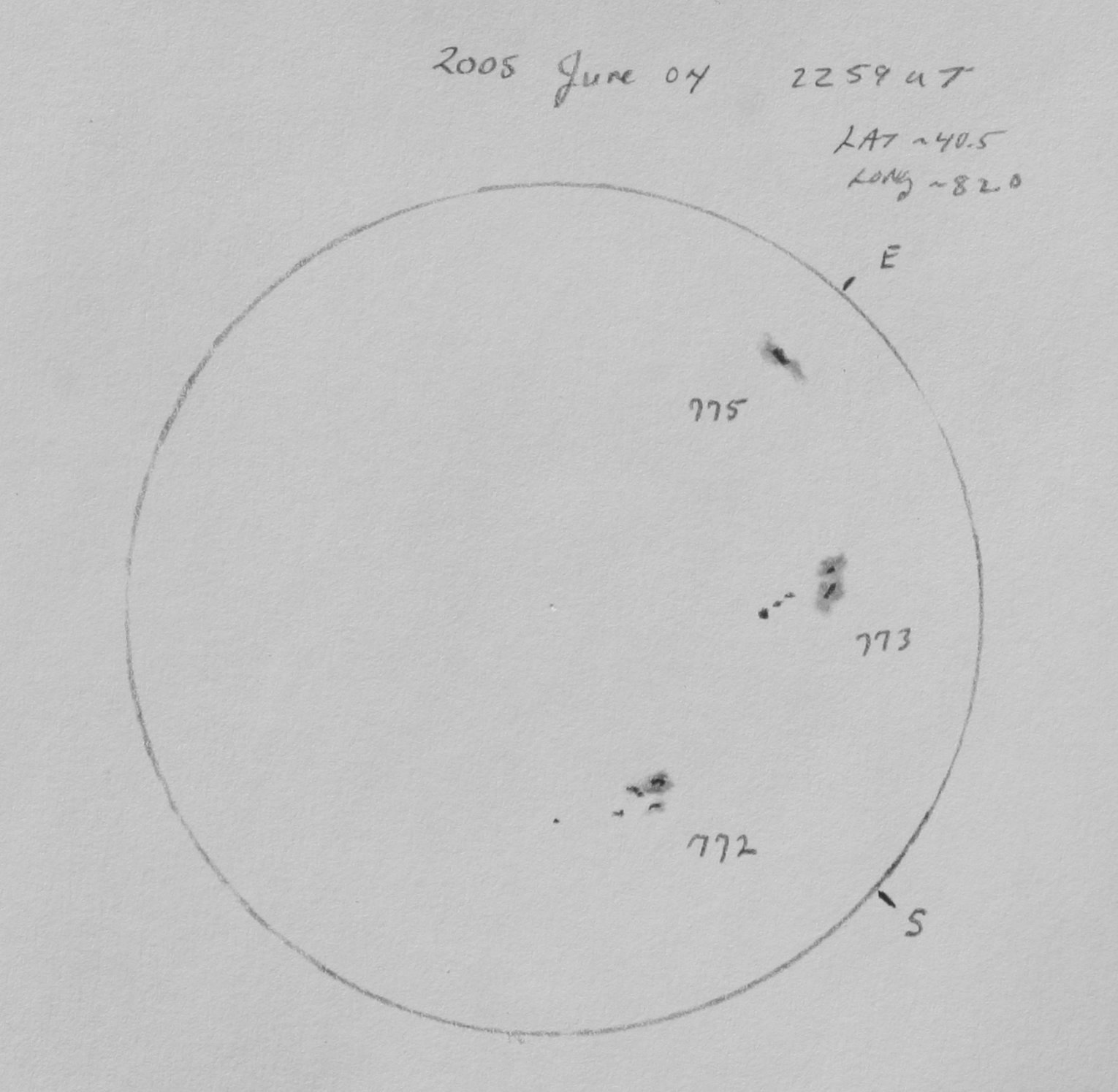
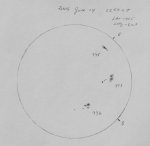
We enjoyed white light views with the “mighty” ETX-70. I even have the sketch from that day. John may not know it, but he gave me a bit of advice regarding solar sketching. He told me that there’s a tendency for sketchers to oversize sunspots. And he’s right! Without realizing it, it’s a very easy thing to do and a good chance I’ve done it in the sketch below. By keeping that in mind, I try to be very careful about depicting accurate sizes on the features. Now if anything, I sometimes tend to overcompensate and make the active regions a little smaller than they really are.

After supper, Scott pulled in and set up “Stella”. I was struggling with the ETX and Paul was imaging with the LX200. I never did get along with a those little finder scopes (a red dot finder would be much better), although I think now I could manage if I’d give it another chance. Truth be told, I enjoy a Telrad and will put them on the smallest scope even if it looks incredibly silly. I eventually covered the ETX and Scott gave me a tour of the skies with his dob. I’ll never forget how peaceful it was using that scope and how connected I felt with the night skies. I knew that some day, I’d have to get a dob of my own.

There was a dog there, and if memory serves me right, it could have been an border collie. I know that some people would rather not have dogs around while observing, especially at star parties, but to me it wouldn’t feel right without a canine companion around. Little things like that make star parties special.

I remember looking through Jim’s refractor and enjoying the views of Jupiter. And John, well, he’s so knowledgeable and fun to be around that he practically bent over backwards answering questions and making sure we enjoyed ourselves…not that he’d own up it or possibly even realized it. 🙂

Our first star party was a terrific experience all around and if anyone out there hasn’t had the opportunity to attend a star party, I would suggest hunting down a few local ones in your state. Cloudy Night’s site is a great place to start: Astro Outreach, Clubs and Star Parties

2011 06 30 – SW Prom by Dave Tyler

•July 3, 2011 • Leave a Comment

A solar friend from the UK, Dave Tyler, took this image of the SW prominence on June 30th, 2011. His image was taken at 0757 UT, ~ 6 1/2 hours prior to my sketch of that same area. He told me during our correspondence regarding this region, “Yes it was faint , I had to drop down to a slow camera speed to capture it. I tended to ignore all the others as this was such a gem.” And a gem it was!

Dave has an incredible talent for capturing amazing detail in his images. He uses an AP130 with a Coronado 90 etalon and Daystar ATM .65A and his camera is a Flea3.

sun2011june30 by Dave Tyler

Photo Credit: Dave Tyler, UK

This was a very large, faint and fine prominence, it seems to have “erupted” from the bright region on the limb (shown in negative on the disc)

For more of Dave’s images, please visit: Dave Tyler’s Astrophotography.

As a visual observer/sketcher, I really have to work to pull the faintest details from my view. In my Coronado, I center the feature I’m concentrating on to the areas in my field of view that will show the best detail. Little adjustments are then made to the etalon. Faint details will pop out during these adjustments.

Eyes can detect movement of faint objects against a dark background easier than they can if the features are still. I gently slew the scope side to side so that my target is slightly moving. Once I notice the fainter features, I stop the scope movement and really concentrate on the new faint areas that caught my attention.

2011 06 30 – Solar h-alpha, SW prominence

•June 30, 2011 • Leave a Comment

At first glance, this SW prominence only showed a clear view of its northern leading edge and part of its upper arch. To the south, there was a very bright, segmented area of prominence. Transparency was very poor, but on moments of clearing up, I was able to bump up the magnification to show the very light detailed structure of plasma holding it all together. Then yet further to the south, a tall slender area of prominence forked at the tip and its filament reached into the solar disk in three areas, with the northern one being the longest. Again, I could see faint structures of prominence reaching southward from the segmented prominence.

There were three prominent plage areas reaching east to west, hinting at three active regions, although currently only NOAAs 11243 and 11242 are listed. A very bright segmented prominence to the NW resembling a caterpillar was accompanied by a similar looking filament about 40 degrees off the limb on the solar disk. Paul is headed out now with his imaging gear. I’m looking forward to seeing the results.


Sketches created scope-side with black Strathmore Artagain paper, white Conte’ crayon and pencil, Derwent charcoal pencil, black oil pencil.

2011 06 29, NGC 5962/H 2. 96/UGC 9926

•June 29, 2011 • Leave a Comment

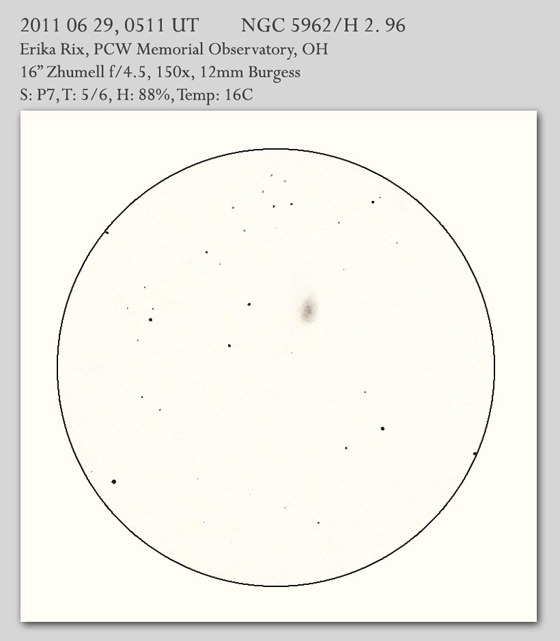
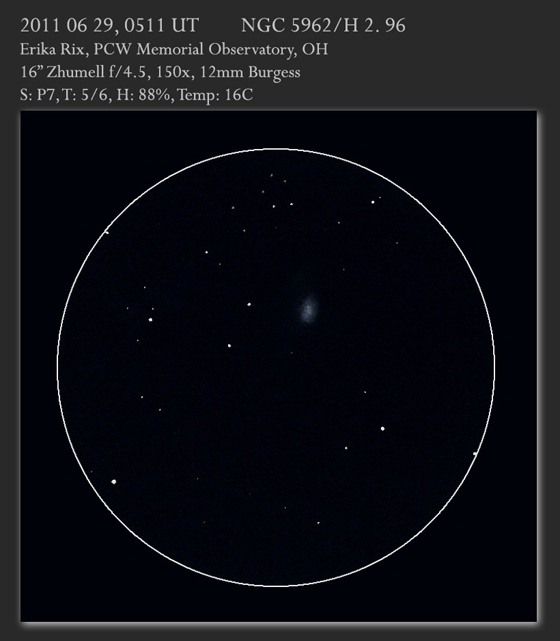
This is a type SA(r)c II-III galaxy, 02.6’ x 1.8’, m11.3v, SB 12.9 found at 15h36.5m +16°37¢ in Serpens Caput. Distance is ~97.85 million light years. It had diffuse edges and a slightly stellar core at 225x, elongated.

This was a fairly easy target to spot with my 13mm Ethos. After studying the field stars around this galaxy, I popped in the 12mm Burgess to limit the number of stars around my target for the sketch. I eventually put in my 8mm TV Plossl in an attempt to pick out stars within the core.

In the article linked below, you can find out more about SA(r) classification:

Type II Morphology for Classification and Morphology of External Galaxies – by By G. De Vaucouleurs

SA (r) : has a small, sharp, very bright and round nucleus isolated in the center of a circular ring at the edge of which emerge many tightly wound filamentary spiral arms or arcs; the nucleus and ring often merge and disappear in the over-exposed image of the central bulge (as illustrated), but the high multiplicity of the spiral pattern is usually sufficient for identification; a weak outer ring (R) made up of many closely coiled spiral arcs is often present in early stages of this sequence.

Here’s a nice photo with a map of the surrounding star names developed by Ed Walendowski and Steve Reilly. Just put your cursor over the image for the pop up information.

My Sky Map Org. – by Ed Walendowski and Steve Reilly

Click on the image to the left for a larger inverted view.