2012 10 19 – NGC 6503 / UGC 11012

•October 22, 2012 • Leave a Comment

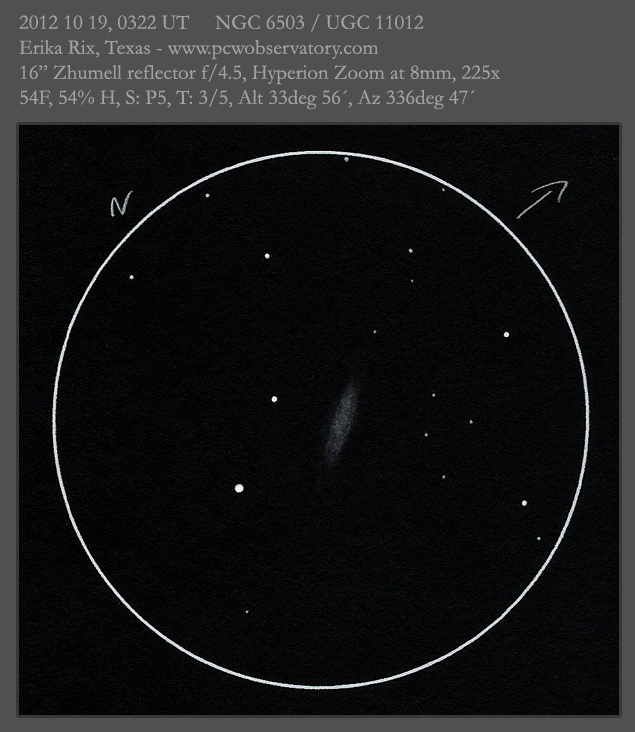
2012 10 19, 0322 UT NGC 6503 / UGC 11012
16” Zhumell reflector f/4.5, Hyperion Zoom at 8mm, 225x
54F, 54% H, S: P5, T: 3/5, Alt 33deg 56´, Az 336deg 47´

Spiral galaxy in Draco, 17h49.4m +70deg09´, Type SA(s)sd III, 7.3´ x 2.4´, m10.2v, SB 13.2

This non-barred edge on spiral galaxy was an easy spot just ~2 degrees east of Omega Draconis and ~2 degrees SSE of Psi Draconis. It sits just 0.02 arcminutes west of an 8.6m star, HIP87295. At 225x, it has a lenticular shape reaching WNW to ESE, mottled and oblong brightened center with vaguely peripheral edges. The ends were a little more diffuse.


For other views, please check out:

Observation by Bill Ferris
NIGC/IC Project

Eyepiece sketch on white photocopy paper with black super-fine felt tipped pen for and #2 pencil, blending stump for the nebulosity. Template is from the Astronomical League.

before inverting sketch

*Below is a sketch of NGC 6503 that I rendered in August 2007 using an ED80. I couldn’t find any field notes for this observation.

2012 10 11 – Jupiter and Europa

•October 22, 2012 • Leave a Comment

2012 10 11, 0700-0730UT – Jupiter
Zhumell 16” reflector(f/4.5) non-driven Dobsonian mount, 12mm Burgess, 2x Barlow, 300x
Temperature: 14C, Humidity: 88%, Seeing: Antoniadi II, Transparency: 4/6
Filters: 82A blue, 21 Orange


White card stock, graphite – colorized in Photoshop CS2

NPR: two lightened areas toward center and slightly east of center. Center area was the larger of the two. Bluish hue with tanned areas. Slight banding.
NNTeB: Very faint, more apparent to the east and west, reddish tan.
NTeB: Very distinct. Smokey blue edges to the southern edge, darkened blotches to the northern edge. Darkened reddish-brown riff to the preceding quarter of belt.
NEB: Bluish southern edges, festoons becoming fainter-orange reaching up to EB. Lightened yellow/orange areas to the upper eastern quarter of belt with a very dark bluish-brown blotch to the southern edge near eastern limb. Darkened strand to the northern portion of preceding half of belt.
EB: Blue and orange strands with oblong area to the inner quarter of eastern half that is darkened along the areas western edge coming to a point.
SEB: Smokey blue edges with darker brownish-salmon colored band in the middle. Lightened ovals to the northern areas, especially near the eastern limb.
STeB: Very faint, more apparent to the east and west, smokey blue.
SSTeB: Very apparent to the preceding third of the disk with it becoming lightened dramatically leading to the east.
SSTeZ: Darkened areas, hard to distinguish from SPR.
SPR: Streaks of blue/gray/and reddish tones.
Blue-gray limb darkening, lighted to the SE.

NPR – North Polar Region
NNTeB – N. Northern Temperate Belt
NTeB – Northern Temperate Belt
NEB – Northern Equatorial Belt
EB – Equatorial Band

SEB – Southern Equatorial Belt
STeB – Southern Temperate Belt
SSTeB – S. Southern Temperate Belt
SSTeZ – S. Southern Temperate Zone
SPR – South Polar Region

2012 10 19 – NGC 221 / M32 / UGC452 / Arp 168

•October 21, 2012 • Leave a Comment

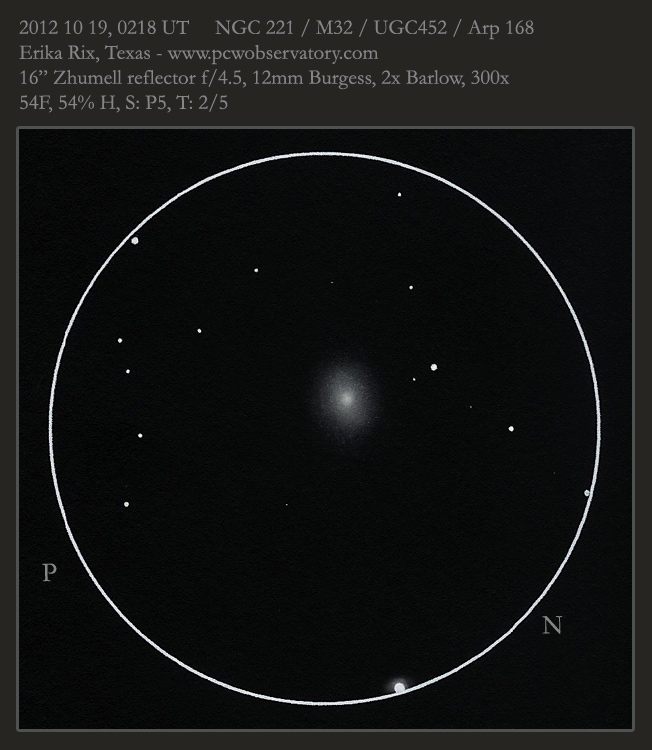
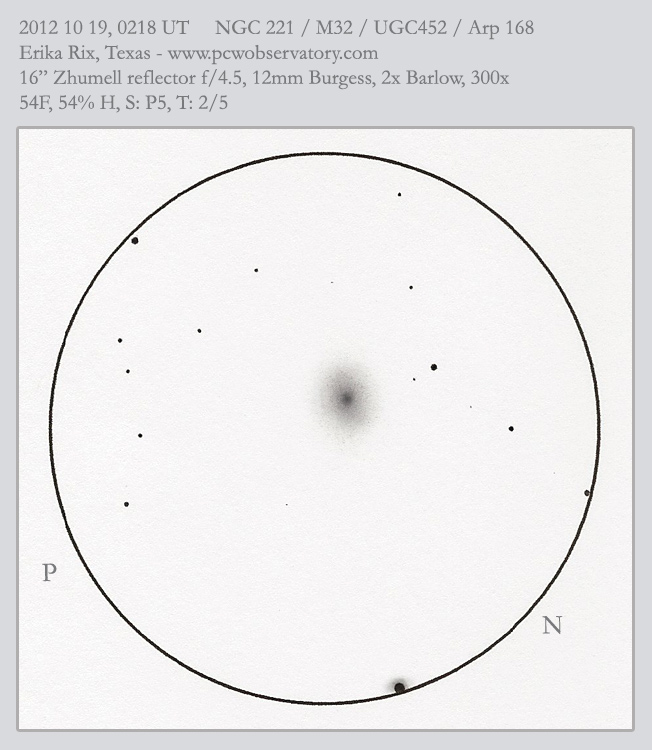
2012 10 19, 0218 UT NGC 221 / M32 / UGC452 / Arp 168
Erika Rix – Liberty Hill, Texas
http://www.pcwobservatory.com
16” Zhumell reflector f/4.5 on a non-tracking Dobsonian mount
12mm Burgess, 2x Barlow, 300x
54F, 54% H, S: P5, T: 2/5
Alt 50deg 58´, Az 61deg 30´

Dwarf satellite elliptical galaxy of M31 in Andromeda, 0h 42.7m, +40deg52´, Type cE2, 011.0´ x 7.3´, m8.1v, SB 12.7

Located SE of M31. Very brightened nucleus that gradually become diffuse and is elongated NNW to SSE. It’s suggested that M31’s tidal field has pulled some of the outer layer away from M32, transforming it into its elliptical shape. The brightened center of this galaxy is the result of stars concentrating around its supermassive black hole.

Taken from Universe Today:

“By probing deeply into Messier 32, we’ve learned this little galaxy is home to mainly mature red and yellow stars. And they’re good housekeepers, too… because there’s practically no dust or gas to be found. While this seems neat and tidy, it also means there isn’t any new star formation going on either, but there are signs of some lively doings in the not too distant past. Because M32 has shared “space” with neighboring massive M31, the strong tidal field of the larger galaxy may have ripped away what once could have been spiral arms – leaving only its central bulge and triggering starburst in the core. “

Information on black holes: Wikipedia – Black Hole

Eyepiece sketch before inverting


Eyepiece sketch on white photocopy paper with black super-fine felt tipped pen for and #2 pencil, blending stump for the nebulosity. Template is from the Astronomical League.

2012 10 20 – Hergenrother (168P)

•October 21, 2012 • Leave a Comment

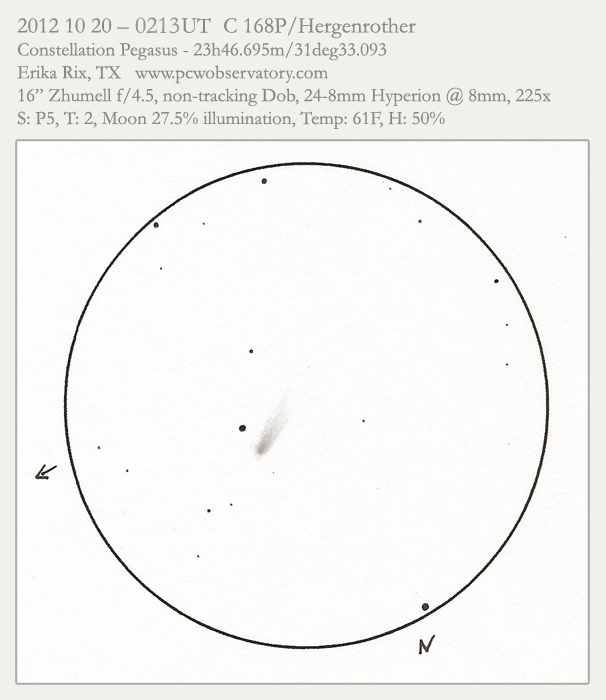
2012 10 20 – 00213 UT C 168P/Hergenrother
Constellation Pegasus – 23h46.695m/31deg33.093′
Location: TX
16” Zhumell f/4.5, non-tracking Dob, 24-8mm Hyperion @ 8mm, 225x
S: P5, T: 2, Moon 27.5% illumination, Temp: 61F, H: 50%

Moon to the West at 4.59 d lunation with illumination of 27.5% washed out details of comet and nearby faint stars. Comet appeared smaller because of this.

Eyepiece sketch created on white photocopy paper, super-fine felt tipped artist pen, #2 pencil, 0.5mm mechanical pencil, blending stump.

eyepiece sketch before inverting

2012 10 19 – C 168P/Hergenrother

•October 19, 2012 • Leave a Comment

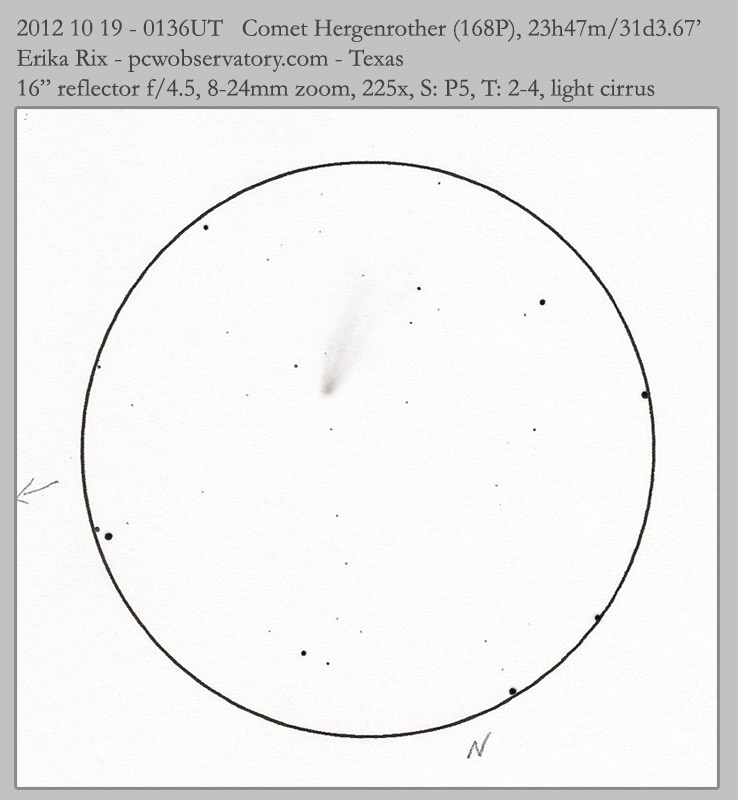
2012 10 19 – 0136 UT C 168P/Hergenrother
Constellation Pegasus – 23h47m/31°3.67¢
Location: Liberty Hill, TX
16” Zhumell f/4.5, non-tracking Dob, 24-8mm Hyperion @ 8mm, 225x
S: P5, T: 2-4, light cirrus, Temp: 54F, H: 54%

At the beginning of the session, the crescent Moon was still in the western sky and the skies weren’t not ultra dark since it was still fairly early. Pegasus was ~50° altitude to the East. Bands of cirrus clouds moving in from the South. Transparency started off poor but improved as the night progressed.

With magnification at 75x, the comet looked like a small, fuzzy shuttlecock and was dimmer than the main stars in the FOV. Increasing power to 225x and with averted vision, the tail appeared split with the center the longest reaching to the SE – very diffuse to the sides. Brightened coma elongated slightly NW to SE.

Original view before inverted:

Eyepiece sketch using AL template on white copy paper, #2 pencil, 0.5mm mechanical pencil, extra-fine tipped felt tipped artist pen, blending stump.

2012 09 21 – NGC436/H 7.45

•October 7, 2012 • Leave a Comment

2012 09 21, 0500 UT NGC436/H 7.45
Erika Rix – Texas

16” Zhumell reflector f/4.5 on a non-tracking Dobsonian mount, Baader Planetarium Hyperion 8-24mm Mark III (observation at 75-225x magnification – sketch at 225x)
73F, 57% H, 6 mph winds SSE, clear, Pickering 6, T 4/6
Alt 49deg 38´, Az 32deg 30´

Open cluster in the constellation Cassiopeia, 01h 15.m, +58deg 49´, Tr Type I 2 m, m5.0´, m8.8v, Also cataloged as: Cr 11, OCL 320, Mel 6, GC 244, Lund 320

Open clusters NGC 457 and NGC 436 barely fit into the FOV using a 13mm Ethos. NCG 436 rests 50´ N of Phi, 40´ of NGC 457. At 225x magnification, I counted 34-35 stars that could be associated with this cluster, tacking on a handful of others in the vicinity. There were three stars forming a strand in the southern region of the cluster with magnitudes 9.62-11.34, the brightest in the center. Starting from the western star of that strand, another strand of stars curves south to north with several multiple stars clustering off the S-N strand to the west.

I’ll have to make a point to sketch the pair of clusters, NGCs 457 and 436, together using the AT Titan some day.

Eyepiece sketch on white photocopy paper with black felt tipped pen for brightest stars, #2 pencil for medium-magnitude stars, and a 0.5mm mechanical pencil for the faintest stars, blending stump for the nebulosity. Template is from the Astronomical League.

2012 09 21 – NGC 457/H 7. 42

•October 6, 2012 • Leave a Comment

2012 09 21, 0547 UT NGC457/H 7.42 – Owl Cluster
Erika Rix – Texas, USA
16” Zhumell reflector f/4.5 on a non-tracking Dobsonian mount, Baader Planetarium Hyperion 8-24mm Mark III (observation at 75-225x magnification – sketch at 75x)
73F, 57% H, 6 mph winds SSE, clear, Pickering 6, T 4/6
Alt 54deg 40´, Az 28deg 2´

Open cluster in the constellation Cassiopeia, 01h 19.1m, +58deg 20´, Tr Type II 3 r., m13´, m6.4v, dist. 9.3 kly, 150 stars of magnitudes 12-15, aka: Cr 12, Mel 7, OCL 321, Lund 43, h 97, GC 256, Caldwell 13, and “Kachina Doll Cluster

The pair of open clusters, NGC 457 and NGC 436 barely fit into the FOV using the 13mm Ethos. Swapping eyepieces to the Hyperion, NGC 457 fit snuggly at 75x magnification. It had a very obvious bird shape and wasn’t difficult to see how it was dubbed the Owl Cluster. Phi Cassiopiea was stunning and the sketch did a very poor job reflecting its glow.

Eyepiece sketch on white photocopy paper with black felt tipped pen for brightest stars, #2 pencil for medium-magnitude stars, and a 0.5mm mechanical pencil for the faintest stars, blending stump for the nebulosity. Template is from the Astronomical League.

2012 10 04 – Hercules and Atlas

•October 5, 2012 • Leave a Comment

2012 10 04, 0500 UT – 0636 UT Hercules and Atlas
Erika Rix, Texas – http://www.pcwobservatory.com

AT6RC f/9 1370mm, LXD75, Baader Planetarium Hyperion 8-24mm Mark III (FOV 68 degrees at 171x), no filter
69F, 70% H, light breeze, lightly scattered, Antoniadi III, T 4/6
Alt: 31deg 14´, Az: 84deg 58´ to Alt: 51deg 28´, Az: 97deg 02´
Phase: 314.8 degrees, Lunation: 18.12 d, Illumination: 85.2%
Lib. Lat: +00:26, Lib. Long: +00.35

Hercules
Type: crater
Geological period: Eratosthenian (From -3.2 billion years to -1.1 billion years)
Dimension: 71km
Height: ~3000 meters
Steep slopes to west, terraced walls to east. Flat floor with hills and crater E.

Atlas
Type: crater
Geological period: Upper Imbrian (From -3.8 billion years to -3.2 billion years)
Dimension: 90km
Height: ~2800 meters
Steep slopes, central mountain, rugged floor, terraced walls.
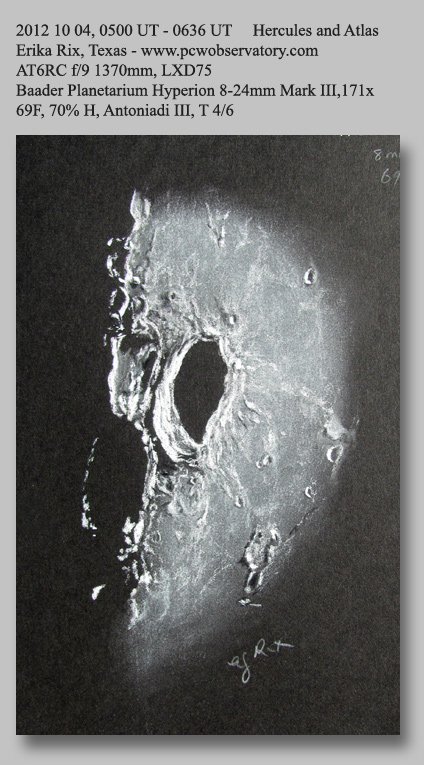


Eyepiece sketch on black Strathmore Artagain paper, white Conte’ crayon and pencil, black oil pencil.

It’s really fun to race against time while sketching along the terminator during the waning gibbous phase. I sound like a broken record stating that it’s much easier when sketching in the highlights on black paper instead of the shadows on white while working along the terminator, especially when the feature can be swallowed up by shadow.

My first sketch of this pair of craters was in 2005.

Atlas and Hercules – 2005 02 27

It was one of my first astronomical sketches and I struggled to record the observation as accurately as I could – just like I do today. It was with the support of other lunar sketchers on the Cloudy Nights Telescope Reviews forum that gave me the confidence to pursue this faucet of astronomy.

Working out the eyepiece combo with the magnification, the 2005 sketch was done with the ETX70AT. The two observations are nearly the same with regards to lunation and time of night plus altitude and azimuth figures. The big exception is in libration.

2012 10 04: Lib. Lat: +00:26, Lib. Long: +00.35
2005 02 27: Lib. Lat: -00:50, Lib. Long: -05.04

This is a very good example how libration affects the view we see on the Moon. As a side note to help put things into perspective of what you can expect to see through a telescope at 171x magnification, crater Hercules H is 7km wide.

Reference material:
Rukl 14 and 15
Wood, C., The Modern Moon: A Personal View, Sky Publishing Corporation, Cambridge, MA 2003, pg 72
Lunar Orbiter Photo of Atlas and Hercules region

Labelled version:

October 2012 Issue – Sidereal Times

•October 5, 2012 • Leave a Comment

The October 2012 issue of Sidereal Times for the Austin Astronomical Society is now available for download.

Click the following link for the PDF version: October 2012 issue (3.9 MB)

Inside this issue, you’ll find:

President’s Corner
GA and EC Minutes
Presenter Details
Member Services Update
Outreach Events
Image of the Month
New Members
Treasurer’s Report
Observing Targets
Developing a Dark Site
Phil and Skip’s Excellent Astro Adventure
Guest Spotlight
Member Gallery
EZ Gazer Review
ATIK Off-Axis Guider Review
Endeavour’s Fly By
Eldorado Star Party
Contact Info
Renewing Membership

Please contact me if you’re interested in joining the club or wish for more information! It’s a very active club and has a great outreach program.

2012 09 21 – M1/NGC 1952

•October 4, 2012 • Leave a Comment

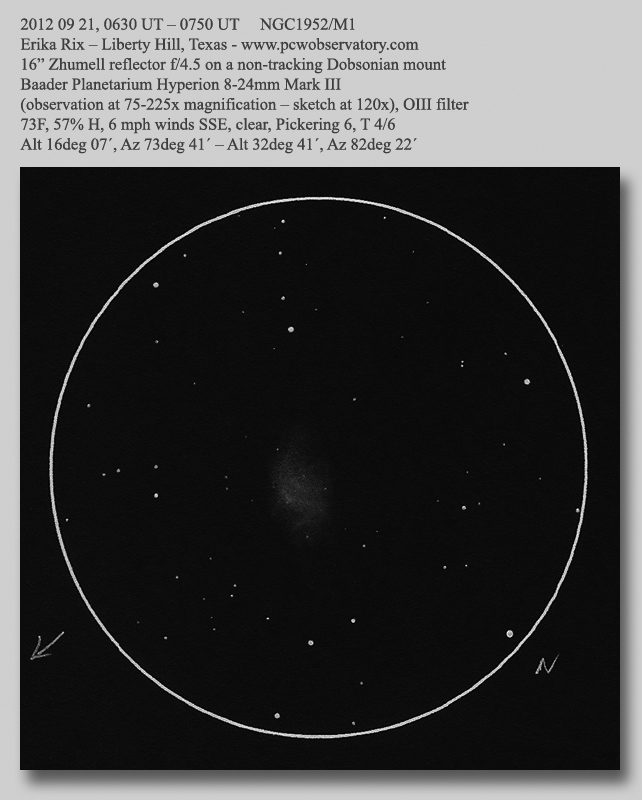
2012 09 21, 0630 UT – 0750 UT NGC1952/M1

16” Zhumell reflector f/4.5 on a non-tracking Dobsonian mount
Baader Planetarium Hyperion 8-24mm Mark III
(observation at 75-225x magnification – sketch at 120x), OIII filter
73F, 57% H, 6 mph winds SSE, clear, Pickering 6, T 4/6
Alt 16deg 07´, Az 73deg 41´ – Alt 32deg 41´, Az 82deg 22´

Supernova Remnant in the constellation Taurus, 05h 34.5m, +22deg 01´, 06´x4´, distance 6500 ly. Apparent magnitude 9.

Before inverting

The Crab Nebula gets a bad rap as having disappointing views with little structural detail. It leaves me scratching my head. Sure, it’s not the spectacular view of M13 or M42, but it’s pretty special in its own right as a remnant of a supernova event witnessed and recorded in 1054 A.D. that was visible for many months. It continues to expand at a rate of 600-1000 miles per second (depending on which source you read). A pulsar was detected within it in 1968 and has been used to study a number of celestial bodies that transited it.

It can be difficult to pull detail out M1 when lower on the horizon or at lower aperture. Even with it higher in the sky, you might only see an oblong haze with a brightened center using a smaller scope, as is the case when I use a 6” RC. Under decent skies with a larger telescope, the filamentary detail begins to appear. In this observation using a 16” reflector, it helped to use an OIII filter for contrast. I started the observation when the target was only 16deg in altitude. I worked on plotting my anchor stars so that when it rose higher in the sky, the FOV structure would already be in place so that I could just concentrate on M1 itself with the faintest stars as the finishing touch.

I spent a great deal of time with my red sketching light turned off to maximize dark adaption. As filamentary structure became apparent, I found myself thinking this supernova remnant was one of the most beautiful objects I’ve observed. Perhaps it’s because I’ve scratched the surface of its history. Perhaps it was the thrill of a successful hunt for details. In the end, it’s all about appreciating the moment.

Eyepiece sketch on white photocopy paper with black felt tipped pen for brightest stars, #2 pencil for medium-magnitude stars, and a 0.5mm mechanical pencil for the faintest stars, blending stump for the nebulosity. Template is from the Astronomical League.


Other related posts regarding supernovae can be found here:

2011 03 03, M1/NGC 1952
2011 06 27 – M51/NGC 5194, NGC 5195/H 1.186, Supernova 2011dh