2012 09 04 – Western Edge of Mare Crisium

•September 4, 2012 • 2 Comments

2012 09 04, 0330 UT – 0615 UT Mare Crisium
Erika Rix, Texas – http://www.pcwobservatory.com

AT6RC f/9 1370mm, LXD75, Baader Planetarium Hyperion 8-24mm Mark III (FOV 68 degrees at 171x), no filter
84F, 56% H, winds gusting 5-10 mph, clear, Antoniadi IV increasing to II, T 3/6
Alt: 11deg 43´, Az: 83deg 22´ to Alt: 46deg 21´, Az: 105deg 21´
Phase: 318.4 degrees, Lunation: 17.48 d, Illumination: 87.4%
Lib. Lat: -03:07, Lib. Long: +03.74

Type: Sea (Sea of Crisis)
Geological period: Nectarian (From -3.92 billion years to -3.85 billion years)
Dimension: 740km
Floor: lava-filled and is ~ 1.8 km below lunar datum
Outer rim: ~3.34 km above lunar datum
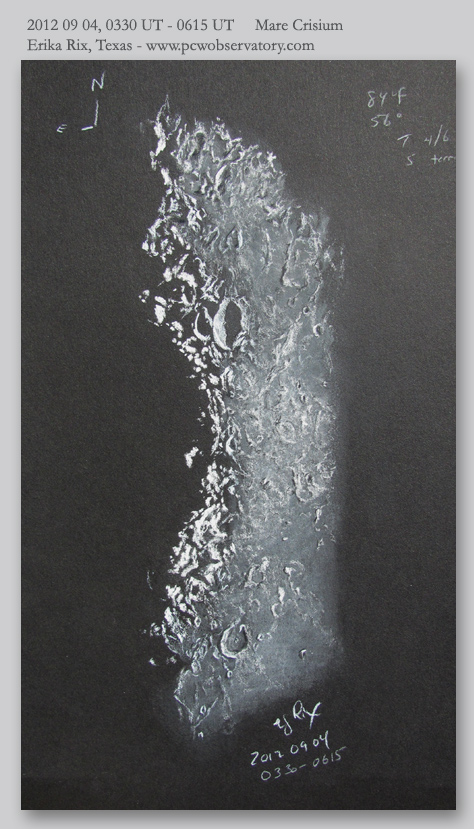
Eyepiece sketch on black Strathmore Artagain paper, white Conte’ crayon and pencil, Derwent watercolor pencil, black charcoal, black oil pencil.
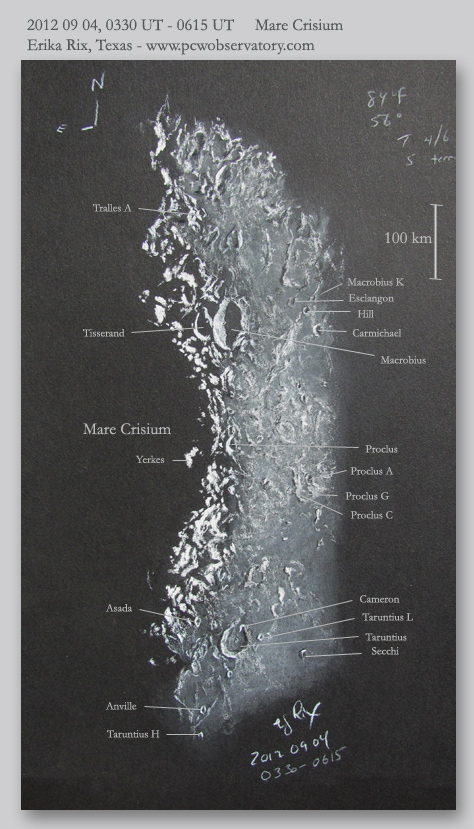
Labelled Version

The evening started off with DSO hunting while waiting for the Moon to come up, even though the stars were and faint galaxies were starting to wash out from the moonlight rounding the eastern horizon. I started a sketch of M12 that will have to wait for another night to complete when the Moon isn’t so much of a factor.

Once the Moon rose between two short junipers behind me, I switched to black paper and scanned the terminator. Mare Crisium looked like it was taking a bite out of the Moon. I’ve always been a bit intimidated at sketching rough terrain, but took a stab at it nevertheless. Sketching in the highlights makes it incredibly easier in fast moving areas such as along the terminator. The trick is to have very sharp pencils at hand, and I made sure of that during set up before it got dark outside – although I did have to resharpen once or twice during the session (as well as stand up and stretch.) It was a rush against time to render the basin’s western edge before the shadows swallowed the view.

I began with the inner ridge line along the terminator, marking each highlighted crest individually with a very sharp Conte’ pastel pencil. Then as quickly and accurately as I could, started working my way west, alternating between the Conte’, charcoal, Derwent and oil pencils, focusing first on the highlights, then the shadows, followed by albedo.

Of particular interest, Crisium sports the crash landing site(although not visible from last night’s lunar phase) of the Soviet’s Luna 15 in 1969 and the landing site of Luna 24, 1976, when soil samples where successfully brought back to earth.

This was my first time observing the Moon with the AT6RC and once seeing sharpened up, the views were crisp and clear with good contrast. It’s especially good that we’ve never had to collimate this scope and I’m looking forward to trying it out on Jupiter soon.

For comparison, below is the image taken of Mare Crisium from the Lunar Orbiter. The view will look slightly elongated from Earth’s perspective.

Photo Credit: Lunar Orbiter iv_191_h3
September 2012 Issue – Sidereal Times

•September 1, 2012 • Leave a Comment

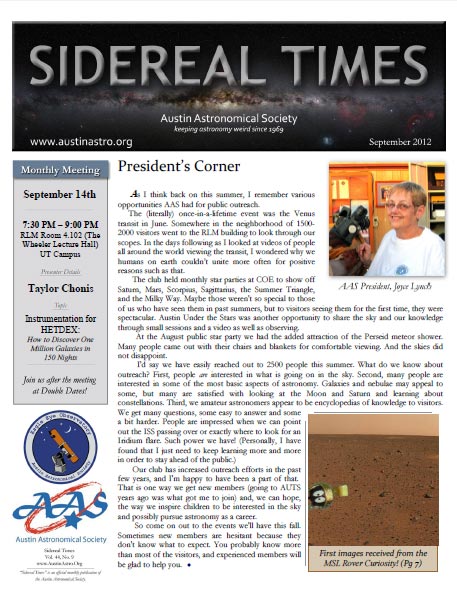
The September 2012 issue of Sidereal Times for the Austin Astronomical Society is now available for download.

Click the following link for the PDF version: September 2012 issue (5.9 MB)

Inside this issue, you’ll find:

EC Minutes
Treasurer Report
Member Services Update
Equipment Update
AL News
Larry Forrest
Observing Targets
MSL Curiosity
Sir Bernard Lovell
Astro App Reviews
Guest Spotlight
Neil Armstrong
Royal Dominion Astro Obsy.
Eldorado SP
AAS Event Photos
Image of the Month
Member Gallery
Scopebuggy Review
Eyepiece Review
Contact Info
Joining/renewing AAS
COE Discount

Please contact me if you’re interested in joining the club or wish for more information! It’s a very active club and has a great outreach program.

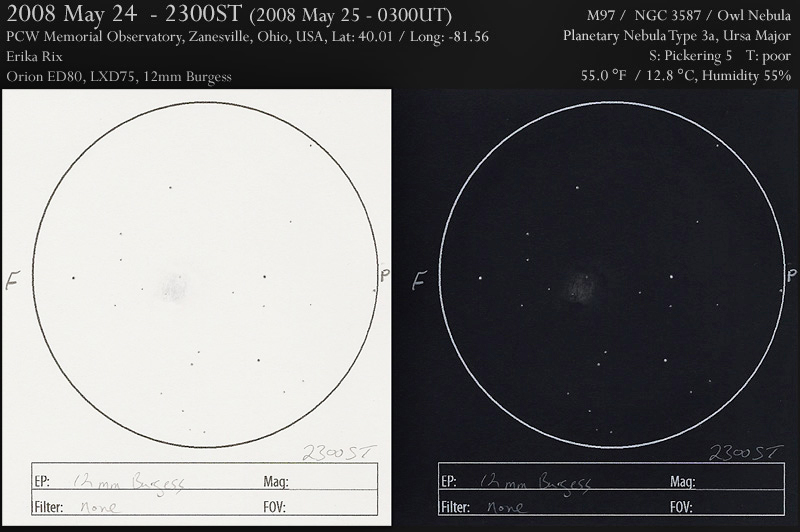
2008 05 24 – M97 and M108

•August 31, 2012 • Leave a Comment

Report and sketches from the crypt:

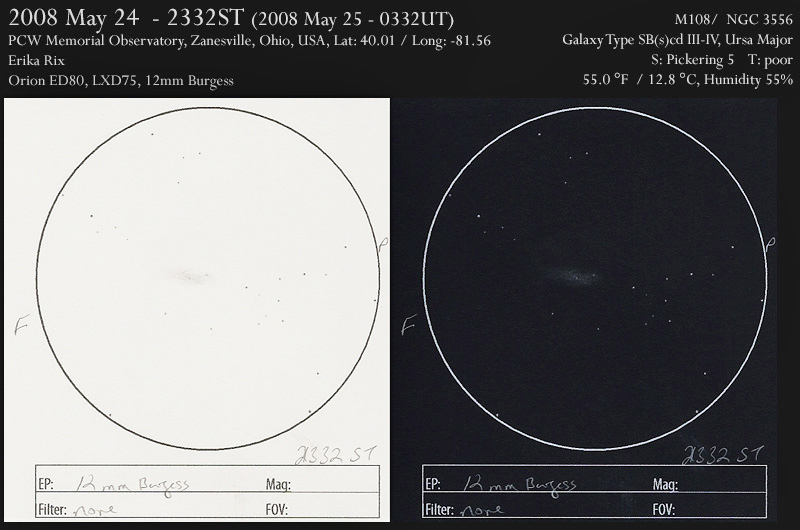
2008 05 24, 2230ST – 0030ST (2008 05 25, 0230UT – 0430UT)
PCW Memorial Observatory, Zanesville, Ohio, USA
Erika Rix

Temp: 55F/12.8C
Winds: calm
Humidity: 55%
Seeing: Pickering V
Transparency: Poor

Equipment:
Orion ED80 w/diagonal, LXD75, 20mm TV Plossl, 12mm Burgess, NSOG 2-399 for reference material, Pocket Atlas

Sketch Media:
Copy paper, Jeremy Perez’ DSO templates, .5mm mechanical pencil, graphite stick

M97 (NGC 3587) (Owl Nebula)

Started the observation off with a 20mm TV plossl. The planetary nebula was barely noticeable as a faint fuzzy patch just to the left of 3 brighter stars. Conditions were too poor to view with the 8mm TV plossl so I settled with a 12mm Burgess.

The fainter stars were twinkling, making it difficult to render all of them accurately, so I stopped with the brighter stars. The few stars I added near the edge of the nebula were so faint that I’m not sure I’ve got them properly placed. I’ll look it up later to compare my drawing with my Starry Night’s software.

A satellite moved from west to east in the FOV at the end of this observation.

M108 (NGC 3556)

This galaxy was much easier to find after my eyes were better adjusted to the darkness. I had my red light a little too bright after writing in my notes from the previous target. This galaxy was very faint with patchy appearance. There was a larger patch to the eastern portion, smaller patch to the western.

2007 08 11 – NGC 5907/H 2.759/UGC9801

•August 31, 2012 • Leave a Comment

Sketch from the crypt

2007 08 11 – 0340 UT – NGC 5907/H 2.759/UGC9801

PCW Memorial Observatory, Zanesville, OH
Orion ED80, LXD75, 21-7mm Zhumell

Galaxy, Sc II
Constellation: Draco
Size: 12.6’x1.4′
m10.7v, sb13.6
15h 15m 54.0s, +56º 19′ 45″
Discovered by William Herschel in 1788

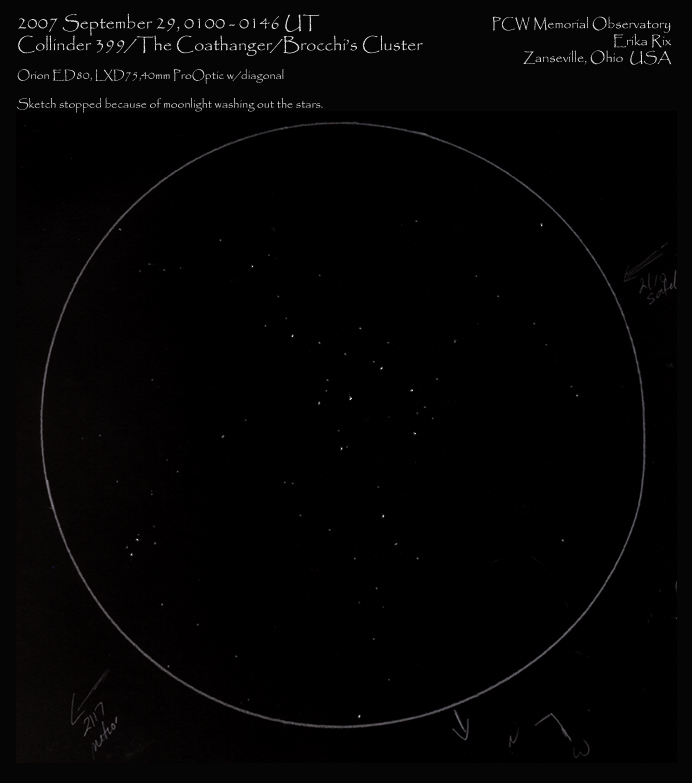
2007 09 29 – Collinder 399

•August 30, 2012 • Leave a Comment

Sketch from the crypt

PCW Memorial Observatory, Zanesville, Ohio USA
Orion ED80, LXD75, 40mm ProOptic w/diagonal
Sketch media: Rite in the Rain paper, #2 graphite pencil, 0.5mm and 0.3mm mechanical pencils
Incomplete sketch due to moonlight washing out the stars

Collinder 399 (aka the Coathanger Cluster, Al Sufi’s Cluster, and Brocchi’s Cluster
Cr 399 is comprised of three dozen stars that spread over a degree of sky. Found in the constellation Vulpecula at 19h25.4m +20deg11′

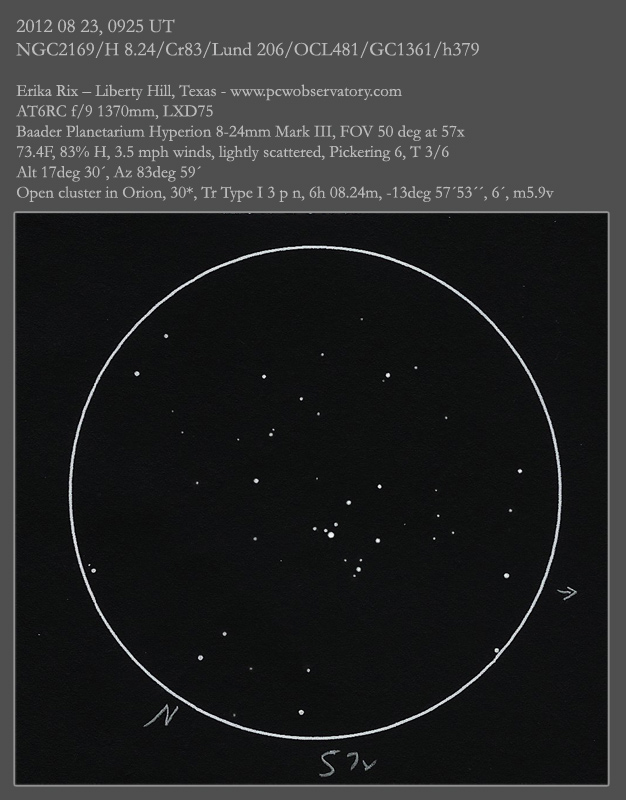
2012 08 23, 0925 UT NGC2169/H 8.24/Cr83/Lund 206/OCL481/GC1361/h379

•August 26, 2012 • Leave a Comment

2012 08 23, 0925 UT – 1024 UT NGC2169/H 8.24/Cr83/Lund 206/OCL481/GC1361/h379

AT6RC f/9 1370mm, LXD75, Baader Planetarium Hyperion 8-24mm Mark III
(FOV 50 deg at 57x and 68 degrees at 171x)
73.4F, 83% H, 3.5 mph winds, lightly scattered, Pickering 6, T 3/6
Alt 17deg 30´, Az 83deg 59´ – Alt 30deg 0´, Az 91deg 20´

Open cluster in the constellation Orion, 30*, Tr Type I 3 p n, 6h 08.24m, -13deg 57´53´´, 6´, m5.9v

There are several references that state NGC 2169 was first discovered by Giovanni Batista Hodierna before 1654. William Herschel independently discovered and cataloged this open cluster in 1784 using an 18.7 inch reflector.

NGC 2169 was easy to locate in a 6” scope at 57x magnification by the condensed bright double pair of stars that run nearly north to south, forming a bright trapezium NW to SE ~3´ x 4.3´ in size. A more thorough look revealed two sub-groupings within this cluster. Both groups had 5 stars each in them with only 3.18´ separating the brightest northern star in each sub-group to the respective brightest southern star. Two pairs of stars were located 7-10´ to the north and northwest in the FOV. A chain of stars ran northwest to southeast just inside the FOV to the west with a second long chain of stars running north to south about 8´ to the east of the cluster.

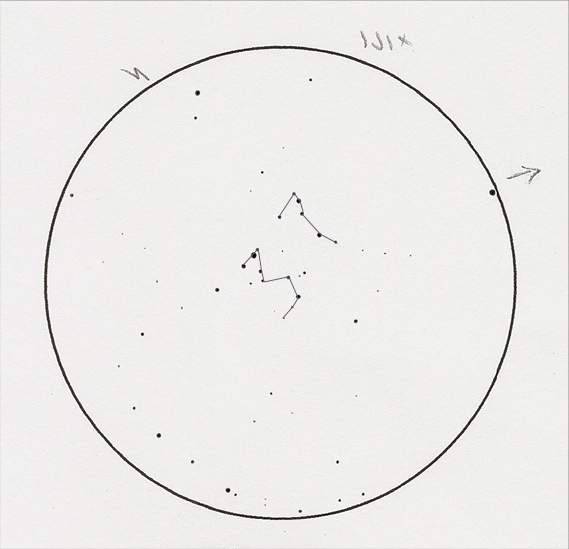
View that has been flipped vertically to show the number “37”

At 171x magnification, 14 stars were observed in the eastern sub-group, forming the number “3”. There were 6 stars in the western sub-group that formed the number “7”. Close to 26 stars were observed within this grouping at 171x using a 6” RC, assuming my measurements were correct.

The brightest northern star in the number “3” looked slightly elongated and is actually Struve 848 (7.5/8.0 at 2.5″). Struve 844 (8.8/9.9 at 24″) makes up the two northwestern stars of the number “7”.

Sketches created with AL templates, #2 graphite pencil, super-fine Faber-Castell Pitt artist pen “S”, 0.5mm mechanical pencil.

Location of NGC2169:

Screenshot from Starry Nights Pro Plus 5

2009 11 12 – NGC7479/H 1.55/UCG 12343 and NGC7814/H 2.240/UGC 8

•August 24, 2012 • Leave a Comment

Report and sketch from the crypt:

2009 Nov 12, 0230-0600 UT
PCW Memorial Observatory, Ohio
Erika Rix

Zhumell 16”, AT Titan 38mm, 21-7mm Zhumell
Temp: 2.7C, H: 79%
P: 8, T: 5/6
Clear, calm

This was first light for the Zhumell 16”. Paul and I assembled it earlier today and I was able to get a quick view of the Dumbell and Jupiter with its moons before supper. Later, Paul was with the LX200 imaging the Pinwheel galaxy and started my session with the Zhumell in Pegasus for some galaxy hunting. I was able to grab a sketch of NGC 7479, a barred spiral galaxy, and NGC 7814, a lenticular galaxy using the zoom EP at 21mm. 7479 had a hint of two faint stars in the middle of it and the end of the galaxy appeared to wrap upward and around the stars. 7814 had two sets of faint stars to either side of the SE portion of the galaxy. At first this galaxy appeared to be a slightly elongated circle. After observing it a little longer, it became oblong with a brighter core.

Sticking the 38 Titan back in the eyepiece holder, I couldn’t resist a scan of the Milky Way. The double cluster had never looked so brilliant with an abundance of stars like I’ve never seen before. With that eyepiece, you almost feel like you’re falling through it for an up-close view (thank you again, Astronomics!). Heading toward Orion, M42 expanded further out visually and with a bluish hue. NGC 2024 looked like the head of a crescent wrench and M45 practically lit up my face through the WA eyepiece with a tinge of green.

Auriga and the local area were packed full of the usual treats: NCGs 1907, 1912, 1960, 2099, 1893, and 1778 to name a few.

The Crab nebula (M1) was very bright and the notch could be detected, although I didn’t spend enough time with it to explore any filamentary details within it.

2012 08 23 – NGC6475 /M7

•August 23, 2012 • Leave a Comment

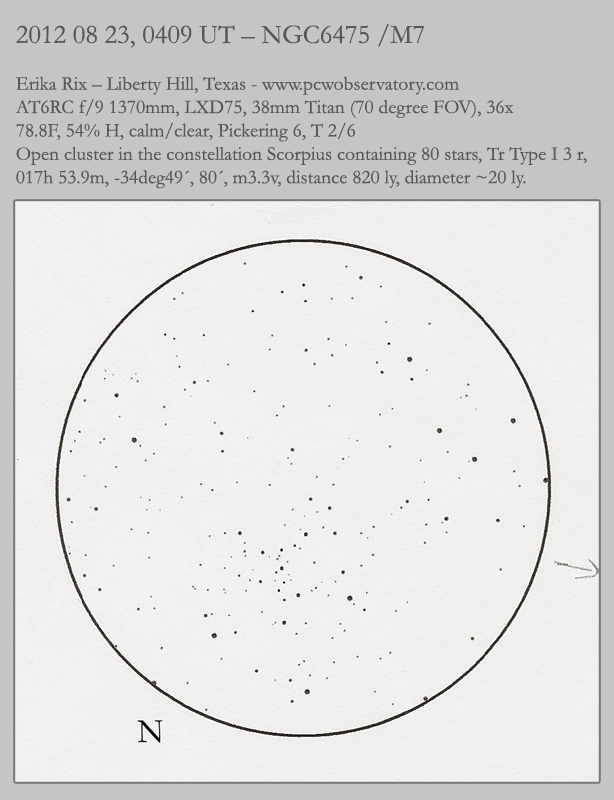
2012 08 23, 0409 UT – NGC6475 /M7
Erika Rix – Liberty Hill, Texas
AT6RC f/9 1370mm, LXD75, 38mm Titan (70 degree FOV), 36x
78.8F, 54% H, calm/clear, Pickering 6, T 2/6

Open cluster in the constellation Scorpius containing 80 stars, Tr Type I 3 r, 017h 53.9m, -34deg49´, 80´, m3.3v, distance 820 ly, diameter ~20 ly.

In the 2nd century A.D., Ptolemy noted M7 and M6 as little clouds (unaided eye). Charles Messier cataloged it in June 1764. It’s located as a brightened haze between the “sting of Scorpius” and the handle of the teapot asterism in Sagittarius, just SE of M6.

M7 was fairly low on the horizon just above the sky glow from Austin to the south. Altitude was 28 degrees at the beginning of the sketch then lowered to 19 degrees by the end of the observation. The wide FOV of the 38mm Titan gave wonderful views nonetheless. The faintest stars were difficult to see and I detected them with averted vision. Once they were located, I could see them straight on. The center of the open cluster was “cross-shaped” at first site. Once the fainter stars were plotted in the sketch, the cross turned into two arcs touching in the middle (one facing north, the other south) with opened ends pointed away from each other. I wish I could say that star color was noted, but other than a couple that perhaps had slight orange tinges, they were all fairly similar color-wise to me. There were several pairs and triplets of star in the cluster.


Sketch created with AL template, #2 graphite pencil, super-fine Faber-Castell Pitt artist pen “S”, 0.5mm mechanical pencil.

2006 11 25 – M34/NGC1039

•August 23, 2012 • Leave a Comment

Report and sketch from the crypt:

The equipment used was an LXD75 German Equatorial mount with an Orion ED80 and Telrad in a very light polluted small town.

2006 11 25, 0050-0145 UT
M34, NGC1039
02h42.0m + 42deg47’
Star count: 60
Diameter: 35’
Apparent magnitude: 5.2 visual with the brightest star 7.33 visual
Approx. magnification: 30x

Open Cluster in Perseus discovered by Charles Messier in August of 1764. It is classified under the star cluster Trumpler system, which is a three part code that takes degree of concentration, range in brightness of the stars within the cluster, and degree of richness. M34 has been assigned Tr type II3m. Basically this means that according to Trumpler classification, M34 is detached and has weak concentration toward the center of the cluster, large range in brightness, and moderately rich with between 50-100 stars. It is thought that M34 is ~180 million years old and 1500 LY away.

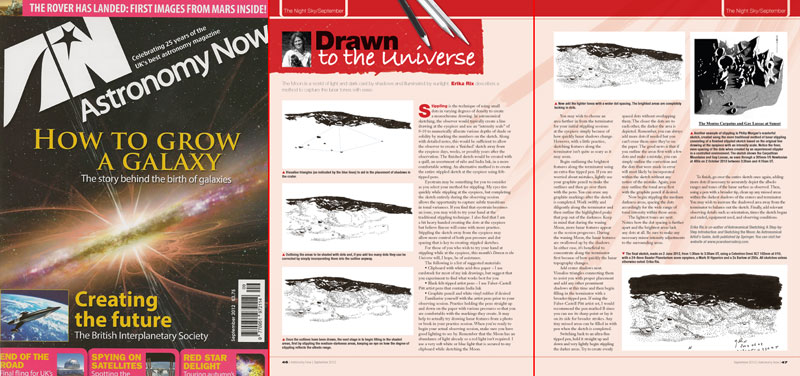
Astronomy Now magazine: “Drawn to the Universe” September 2012 issue, Lunar Stippling

•August 22, 2012 • Leave a Comment

Astronomy Now magazine

“Drawn to the Universe”
September 2012 issue – The Moon
Target – Babbage and South
Media – felt-tipped artist pens on white card stock

Link to observation report: 2012 06 02 – Babbage and South

Archive for the ‘Drawn to the Universe’ Category