Mars 2005-2010

•July 1, 2010 • Leave a Comment

I’m not an experienced Mars observer.  My sketches certainly reflect that lack of experience. The works of planetary observers such as Sol Robbins, Carlos Hernandez, and Kris Smet (to name a few) have been an inspiration to me, and I’m hopeful to spend more time with Mars during the next apparition and even purchased a new set of Mars filters at NEAF this year in anticipation.

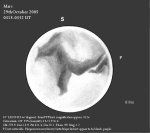
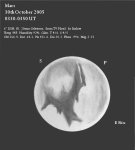
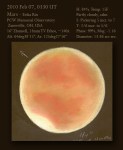
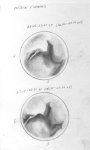
To set the bar for improvement, here are my sketch observations from 2005-2010. Pitifully few as they are, I have observed Mars far more than I took the time to record my observations.  I really struggled with seeing the subtle details at first and then struggled even more rendering them true to contrast on paper while sketching with just a little head lamp in the dark next to my telescope.  Obviously, Mar’s features aren’t nearly at contrasty as what my earlier sketches portray.
The pastel sketch was my latest and I feel my best rendering so far. The use of color seemed to bring out the subtle details easier than using contrast in monochrome.

The following report came from one of my past observations. I have to smile (and roll my eyes) at the flamboyancy the report I had written.   Still, I can remember to this day how enjoyable that session was.

2005 09 05

Mars Sept 05 2005

Finally! Before everyone gets the wrong idea, I have viewed Mars before….but that’s a huge difference than actually sitting down for over 3 hours and actually studying it. Which is exactly what I did this morning.


At 4:15am an internal alarm went off in my body and I sat straight up in bed and looked at the clock. Was I too tired to get up? Well maybe I should take a look outside before I make up my mind. So a little stroll outside with the dogs made my mind up quickly. It was beautiful and crystal clear. Paul was such a sweetheart, waking up too to help me set up (actually he set up nearly everything while I looked up recent threads in the sketching forum for tips to use this session).


The Big Fella (10″ LX200) was to accompany me this morning, along with a 3xBarlow, 20mm & 8mm EP’s, and a diagonal. Also used were 3 different filters, used separately from each other. The first 30 minutes of the session was used to begin my outline of the sketch as the scope was not cooled down enough for a crisp view. But gradually Mars’ surface cleaned up enough that mares Chronium, Sirenum and Cimmerium could be drawn. Changing filters, more features were added. And then final details with the 8mm, changing filters yet again.


Taking a quick break for another cup of coffee and stretching out my back and legs, I was now ready for another plunge into Mars. It was so peaceful outside, moving my chair now and again more to the East as The Big Fella turned his face more to the West, tracking Mars steadily for me. Time seemed to swiftly pass by and the more engrossed I was in the view, the more detailed it became.


Birds were now starting to wake up…Cardinals always seem to be the first to sing their songs. And as I looked up from the EP, the sky was becoming light blue with Sol on its way. There was still time to enjoy Mars and I planned to enjoy my little holiday as long as I could.


Morning had finally ended my session, and as I drifted back to Earth, I wondered at the name Mars. With the peacefulness and enjoyment I had with him this morning, being named after the god of war somehow didn’t seem appropriate. But who am I to question the Gods?
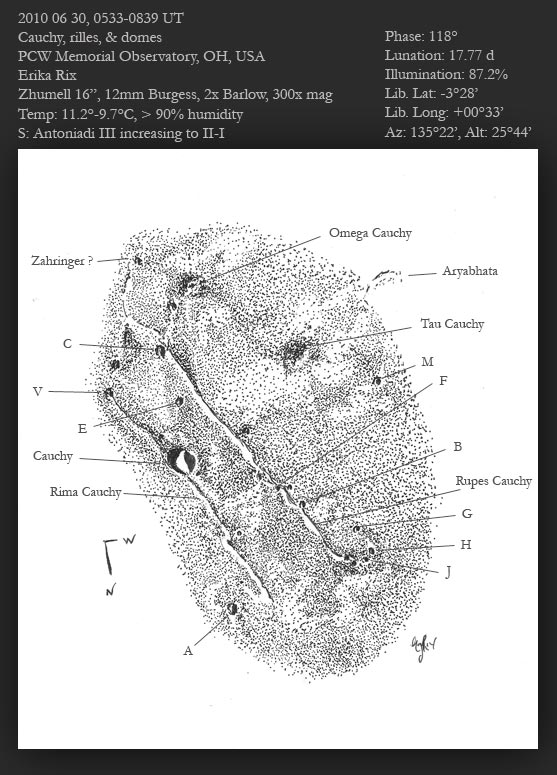
2010 06 30, Cauchy

•June 30, 2010 • Leave a Comment

2010 06 30, 0533-0839 UT, Cauchy, rilles, & domes

PCW Memorial Observatory, OH, USA, Erika Rix

Zhumell 16”, 12mm Burgess, 2x Barlow, 300x mag

Temp: 11.2°-9.7°C, > 90% humidity, S: Antoniadi III increasing to II-I

Phase: 118°

Lunation: 17.77 d, Illumination: 87.2%

Lib. Lat: -3°28’, Lib. Long: +00°33’

Az: 135°22’, Alt: 25°44’

The simple crater Cauchy is located in Mare Tranquillitatis and sports Rupes Cauchy and Rima Cauchy on either side of it.  Even though the fault and rilles were interesting to study, the two domes located to the SW of Cauchy is what brought me to this area tonight. Omega Cauchy’s little summit crater was even visible as seeing increased.  I’ve accidently sketched Tau a little larger than it appeared through the eyepiece. I couldn’t erase since I was working with ink.

The sketch was created scopeside on Rite in the Rain paper and ultra fine permanent marker. This was very fun to do, but I believe next time, I’ll need to wear my reading glasses. All those dots were running into each other visually by the time I finished the sketch.

2010 06 25, Mons Rumker -Stippling

•June 29, 2010 • Leave a Comment

2010 06 25, 0229 UTLunar Dome

Mons Rumker

PCW Memorial Observatory, OH, USA

Erika Rix

Zhumell 16”, 12mm Burgess, 2x Barlow, 300x

Phase: 16.2°

Lunation: 12.64 d

Illumination: 98%

Lib. Lat: 3°37’

Lib. Long: 5°33’

Az: 153°57’, Alt: 19°25’

One of the joys of the types of observing sessions I do is trying new techniques and media to sketch the objects I view (except for my solar sketches….I’ve sort of settled for the comfortable ol’ shoe feeling of my black paper and Conte’). I’ve played around with quills and India ink for years, actually since I was in my early teens. The thought of having an open bottle of India ink next to me in the dark while observing was a not appealing. In fact, as messy as I am with ink, nothing within a 10’ radius would have been safe from being splattered black, including my optics.

I’ve been studying some of Harold Hill’s beautiful sketches and fancied trying my hand at stippling for lunar observations instead of my typical charcoal or pastels. I believe the norm is to do a schematic sketch in pencil and label it with a legend. The idea of this is to bring the sketch back inside and stipple over it with the quill and ink in the comfort of your home with light. If you took care with your notes and the labeling, you could even do this days later.  It takes me long enough to write my reports and record all the data from my sessions and I don’t relish the idea of spending extra time working on a sketch once my session at the eyepiece is over.  Above all, I certainly don’t trust my ability to redraw (or draw over a schematic sketch) using a shading legend, which is one reasons my sketches are completed at the telescope. I want to ensure that there is no chance of me messing up (adding details, misplacing markings, wrong shadings…) the details that I actually see during my session.

Taking all that into consideration, a good alternative to India ink is using a marker. Grabbing what I could find on hand, I used white card stock paper and a permanent marker with a finer point. Since this was my first attempt, I went ahead and tried the schematic sketch with labels first of Mons Rumker. I ended up with lines and numbers all through the sketch so that soon I was unable to make neither rhyme nor reason of the sketch itself.

Next, I tried drawing the dome with a pencil as if I were making a quick regular sketch of it. Then I redrew it inside the house using the marker for stippling. Although it was kind of fun, if I’m going to do a sketch with a pencil anyway, what’s the point of doing it all over again with stippling?  Plus, I accidentally inverted my craterlets in the re-sketch.  The final straw was when I showed the stippled sketch to Paul, my husband who is also an amateur astronomer, and after studying it for a moment, he asked me what it was.

Certainly this was my first attempt, and I’ve learned from it. Harold Hill is a master and I’ve got a lot of work ahead of me. But the first step is to actually do it. The second is doing it again and again. Throw in a few tweaks to the media or techniques, and maybe someday I’ll have a recognizable lunar object in my stippled sketch.  I’ve already purchased ultra fine permanent markers and am going to switch to my favorite nighttime paper, which is Rite in the Rain.  My next session for stippling will be completely done at the eyepiece now that I’ve had a good practice session.

2010 June 21, Timocharis

•June 21, 2010 • Leave a Comment

0300 UT

Timocharis


PCW Memorial Observatory, OH, USA

Erika Rix

Zhumell 16”, 8mm TV Plossl, 225 x

Phase: 64.8

Lunation: 8.66. d

Illumination: 71.3%

Lib. Lat: 7°30’

Lib. Long: 4°47’

Az: 215°14’, Alt: 27°21’

This complex crater has a crushed central relief and the area was completely enveloped with shadow.  I could make out some of the western terraced walls within the crater. Heinrich (9.5 km), B (5 km) and C (4 km), were very clear as well as a small portion of the wrinkle ridge to the southeast.  Timocharis was formed  ~ 3.2 to 1.1 billion years ago during the Erathosthenian period. Height is estimated to be 3110 meters.  Faint small rays can be spotted with decent seeing conditions.

Sketched scopeside on black Strathmore Artagain paper, charcoal, black wax pencil, white Conte’ crayon and pencils.

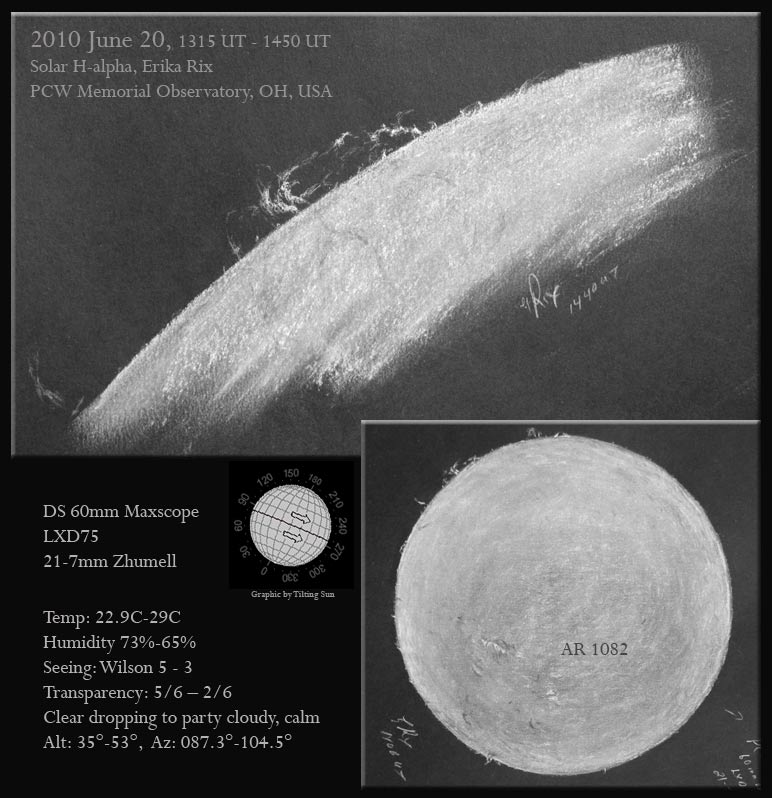
2010 06 20, solar

•June 20, 2010 • 1 Comment

2010 June 20, 1315 UT – 1450 UT
Solar h-alpha,
PCW Memorial Observatory, Zanesville, Ohio USA – Erika Rix

DS 60mm Maxscope, LXD75, 21-7mm Zhumell,
H-alpha sketch created scopeside with black Strathmore Artagain paper, white Conte’ crayon and pencil, Derwent charcoal pencil, black oil pencil.

Temp: 22.9C-29C, Humidity 73%-65%
Seeing: Wilson 5 – 3, Transparency: 5/6 – 2/6
Light cirrus, Alt: 35°-53°, Az: 087.3°-104.5°

2010 06 08 – H alpha full disk

•June 8, 2010 • Leave a Comment

2010 June 8, 1541 UT
Solar h-alpha
PCW Memorial Observatory, Zanesville, Ohio USA – Erika Rix

DS 60mm Maxscope, LXD75, 21-7mm Zhumell
H-alpha sketch created scopeside with black Strathmore Artagain paper, white Conte’ crayon and pencil, Derwent charcoal pencil, black oil pencil.

Temp: 24C, Humidity 46%
Seeing: Wilson 2, Transparency: 3/6
Light cirrus, Alt: 62.1, Az: 120.1

Bright plage to the SW, in the shape of a thicker horseshoe with a thinner one attached facing the opposite direction, could indicate a new active region forming according to Spaceweather.com. I could see fainter crooked lines of plage scattered about that area and then another plage area just 30° E of it. Two more plage areas were located in the NE quadrant, one just inside the limb ~20° of the larger bright prominence region.

The smaller of that set of prominences in the NE continued inward from the limb forming a faint, but distinct filament extending to the W. The other significant prominence region was to the NW. It was very faint, but at moments of steadier seeing, I would say it was the largest of the proms during my observation, both in height and width. Faint portions of it extended to the N and could have possibly connected to the very small bright prominence ~10° N of it.

The best parts for me today were the lines of filaments in the NW quadrant. Depending on the placement of it in my FOV and the tuning, depths of it changed dramatically as well as the outer portions of the shapes. It kind of reminded me of a pair of Loch Ness monsters peeping in and out of the Chromosphere. I certainly didn’t do them justice in the sketch, but they were a joy to observe.

Contact/Feedback Form

•June 5, 2010 • 3 Comments

Please feel free to use the form below for any comments, suggestions, questions, or just to say hello! I’ll get back to you as soon as I can.


← Back

Thank you for your response. ✨

2010 05 10, H-alpha filaments

•May 10, 2010 • Leave a Comment

A blast from the past in 2010

2010 May 10, 1355 UT – 1610 UT
Solar h-alpha featuring filaments – Erika Rix
PCW Memorial Observatory, Zanesville, Ohio USA
DS 60mm Maxscope, LXD75, 21-7mm Zhumell

H-alpha sketch created scopeside with black Strathmore paper, white Conte’ crayon and pencil, white Prang watercolor pencil, Derwent charcoal pencil, black oil pencil.

T: 5°C-11°C, H: 45%
S: Wilson 3, T: 3.5/6
Clear/slightly hazy, light breeze
Alt: 40.3-62.8, Az: 101-139.7

Paul had a late night imaging so I brought the dogs outside with me, puppies included, to keep it quiet in the house for him. This, of course, meant lots of extra paws running around the observatory floor instead of just the steady snoring of Riser, my regular observing buddy. The views were shaking so badly that I finally gave up and tore down the rig, resetting it back up in the grass. I should have done that to begin with I suppose since seeing wasn’t the greatest and would have been a lot worse in the observatory, especially with the temps rising so quickly after our freeze last night.

There were quite a few features to concentrate on, but what really caught my eye were two areas of filaments in the NE quadrant. The transparency and seeing were just poor enough that I really struggled with pulling any detail out of the prominences on that section of the limb. I didn’t want to miss out trying to capture them as they reached inward across the disk, forming a beautiful display of soft looking filaments. Then even further inward reaching toward the center, the details were sharper with the next set of filaments.

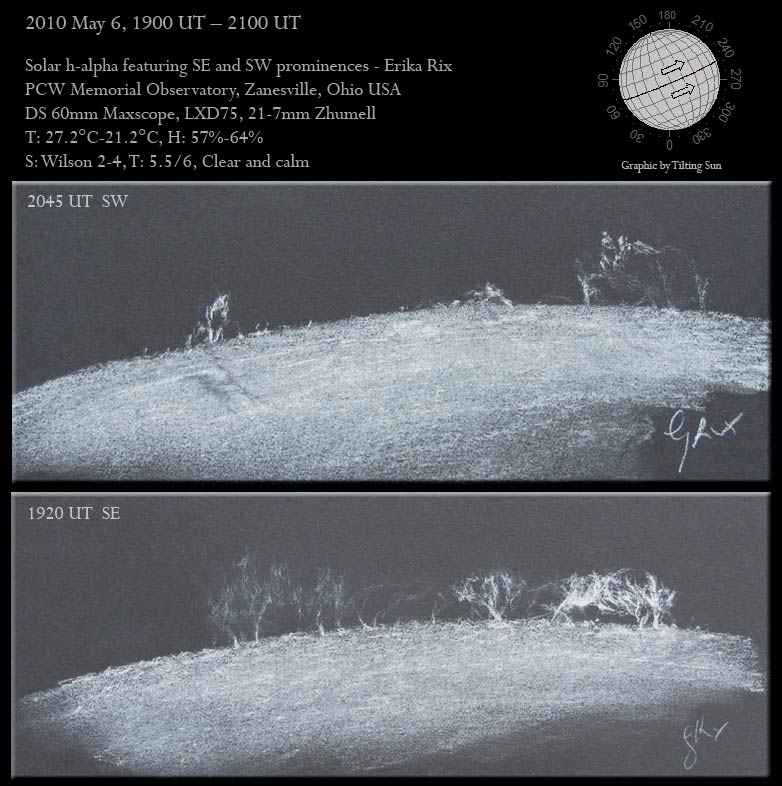
2010 05 06 H-alpha prominences

•May 6, 2010 • Leave a Comment

A blast from the past in 2010

2010 May 6, 1900 UT – 2100 UT
Solar h-alpha featuring SE and SW prominences – Erika Rix
PCW Memorial Observatory, Zanesville, Ohio USA
DS 60mm Maxscope, LXD75, 21-7mm Zhumell

H-alpha sketch created scopeside with black Strathmore paper, white Conte’ crayon and pencil, white Prang watercolor pencil, Derwent charcoal pencil, black oil pencil.

T: 27.2°C-21.2°C, H: 57%-64%
S: Wilson 2-4, T: 5.5/6
Clear and calm
Alt: 58.5-37.8, Az: 229.2-259.9

I set up outside of the observatory today since the Sun was moving over the SW tree line and I didn’t want to rush my observing session. I had planned on putting in the cold crops in the garden but just couldn’t resist observing instead.

The active regions and filaments were tempting, but it had been so long since I’ve done close up prominence studies that I decided to concentrate on two limb areas instead. At the beginning of the session, the SW had a larger prominence that looked like a comma hovering over a crooked finger. I decided to move to the SE limb instead because what appeared to be a very bright hedgerow prominence with a smaller prominence beside it, turned out to a very wide set of prominences connected together, with over half of it so faint it was difficult to tease the detail out with the poorer seeing conditions at the beginning of the session.

Seeing gradually improved and I decided to go for a second sketch and just couldn’t help nabbing that comma prominence. It had already changed its shape to where it was no longer a comma, but a large loop instead. I was only able to make out the faintest portion of the loop with my Sol-Survivor cover completely shut around my head and eyepiece.

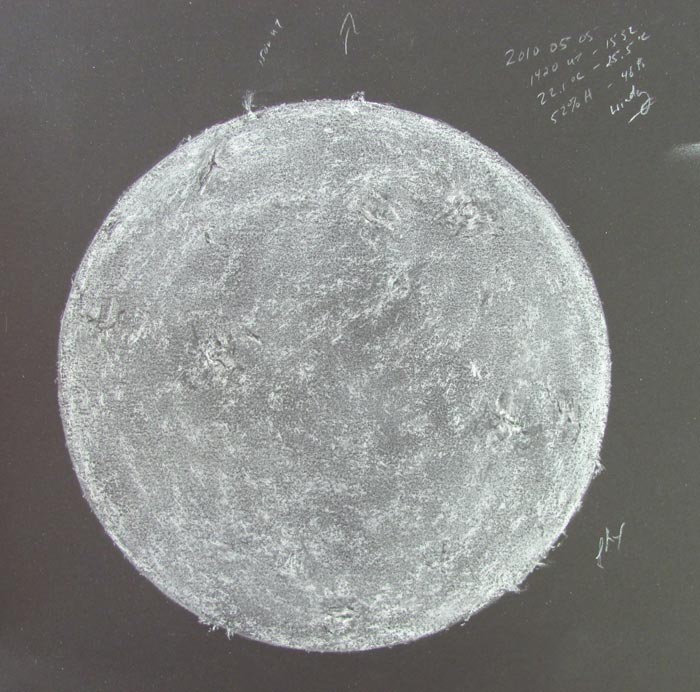
2010 05 05 – ARs 11069, 11067, 11068

•May 5, 2010 • Leave a Comment

A blast from the past in 2010

I must have been in a hurry the day I recorded the Sun. It would have been at PCW Memorial Observatory with my double stacked Maxscope 60mm on an LXD 75 mount. Looking at that date on


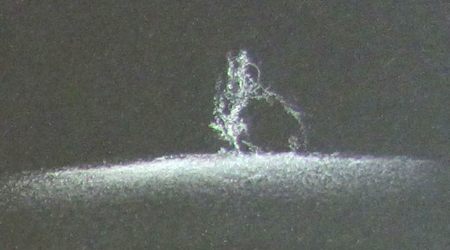
Speaceweather.com (May 5, 2010), it appears that active regions 11069, 11067, 11068 were present. Looking at my sketch, there was a fast-moving prominence ~ at 250 degrees PA (11:30 o’clock on the sketch). I noted the time above it which means that I started a sequence to record that particular prominence.

The winds must have been too much for me to continue on. I managed a close up of that prom, but didn’t go any further than that and failed to write a report.