M92 (NGC 6341), 2010 07 14

•July 14, 2010 • Leave a Comment

Sketch created scopeside with white photocopy paper, #2 pencil and black marker.

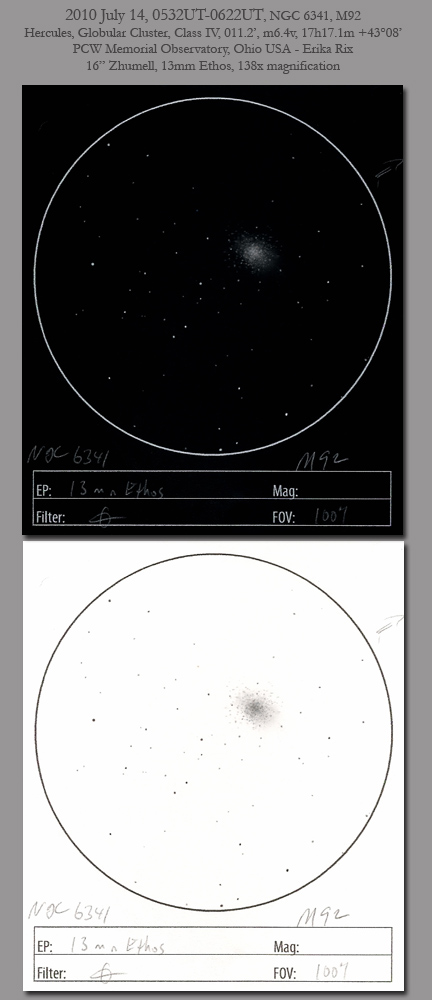
2010 July 14, 0532UT-0622UT

NGC 6341, M92       Constellation Hercules, ~25,000 LY away

Globular Cluster, Class IV, 011.2’, m6.4v, 17h17.1m +43°08’

Luminosity 150,000 suns, diameter 80 light years

PCW Memorial Observatory, Ohio USA – Erika Rix
16” Zhumell, 13mm Ethos, 138x magnification

H: >90%, Temp: 19.3°C

Johann Bode discovered this globular cluster in 1777. Charles Messier added it to his catalog 1781. Reading about this cluster in my NSOG vol. 2, it’s interesting to find that this cluster is only about 60% luminosity of the globular cluster M13 found in the keystone of Hercules. The stars lack the abundance of iron and other elements heavier than H and He, which means that it most likely would have been formed before those heavier elements were introduced into our Galaxy. Even though globular clusters are the oldies of our Galaxy, the deficiency of a rich iron and heavy elements makes M92 even older by globular cluster standards.

M92 appeared almost elongated and irregular with a very dense bright core and resolved abundance of stars that spread as it reached outward.

Here is a stunning image of M92, taken by Daniel Bramich (ING) and Nik Szymanek.  http://www.ing.iac.es/PR/science/m92_high.html

Lunar Aureoles

•July 13, 2010 • 1 Comment

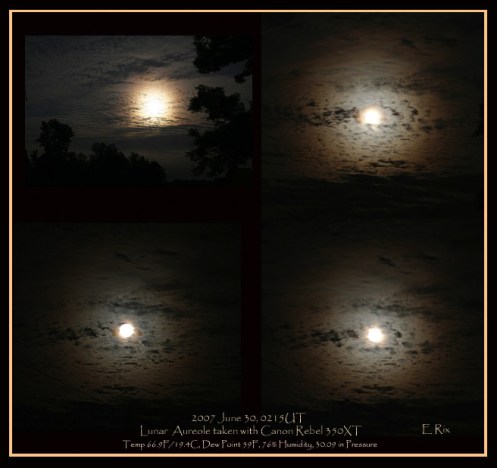
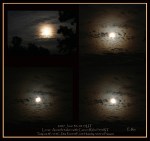
I never tire of atmospheric phenomena, whether it be during the day or night.  Thankfully we can view coronae (or simply the center versions called aureoles) not only with the Sun, but also with the Moon.

Light is diffracted by tiny droplets of water in the atmosphere creating these beautiful scenes.  The droplet size, shape, and light wavelength all determine the outcome of the corona.  The smaller the water droplets in the atmosphere, the larger the diameter of the ring around the Moon or the Sun.

Aureole means “golden crown of light”.  If you look closely at photos of the moon, you’ll see the beautiful golden crown that surrounds it.  I almost always see this during higher humidity nights at a high luminosity when the scattered clouds create a magnificent show.

For more information, please explore Les Cowley’s website “Atmospheric Optics”:  http://www.atoptics.co.uk/droplets/corona.html

If you’d like a little fun creating your own phenomena simulations, check out Les’  IRIS software:   http://www.atoptics.co.uk/droplets/iris.html


NGC 5448 (H 2. 691) – 2010 07 13

•July 13, 2010 • 2 Comments

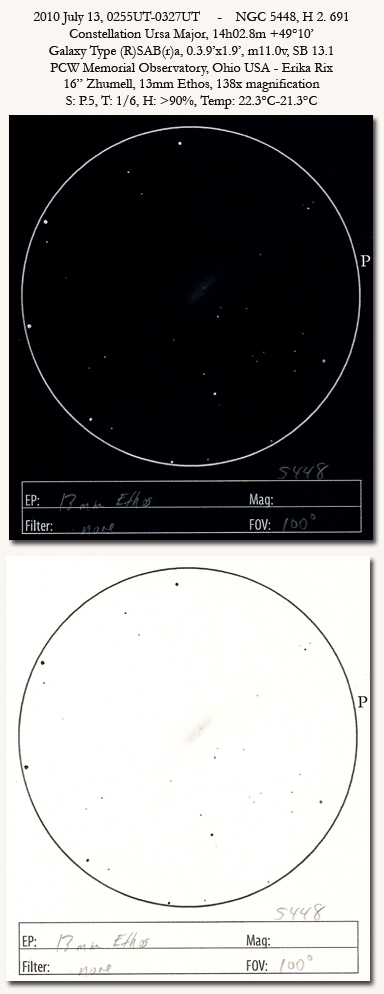
2010 July 13, 0255UT-0327UT

NGC 5448, H 2. 691, UGC 8969       Constellation Ursa Major

Galaxy Type (R)SAB(r)a, 0.3.9’x1.9’, m11.0v, SB 13.1, 14h02.8m +49°10’

PCW Memorial Observatory, Ohio USA – Erika Rix

16” Zhumell, 13mm Ethos, 138x magnification

S: P.5, T: 1/6, H: >90%, Temp: 22.3°C-21.3°C

Photo image:  http://cosmo.nyu.edu/hogg/rc3/NGC_5448_UGC_8969_IRAS_14009+4924_irg.jpg

This galaxy is about 2’x0.5’ and runs ESE-WNW. The core looked stellar. A 13th magnitude star lies 4.25’ south of it. Appeared faint and smooth with no definite edges.

“A Bar Signature and Central Disk in the Gaseous and Stellar Velocity Fields of NGC 5448”: http://cdsweb.cern.ch/record/885913/files/0509642.pdf

Sketch created scopeside with white card stock, #2 pencil and an ultra fine black marker.


NGC 5473, H 1. 214 – 2010 07 12

•July 12, 2010 • 4 Comments

2010 July 12, 0331UT-0417UT

NGC 5473, H 1. 214, UGC 9011 Constellation Ursa Major
Galaxy Type SA(s)cd pec IV-V, 0.6’x4.9’, m10.8, SB 14.3

PCW Memorial Observatory, Ohio USA – Erika Rix
16” Zhumell, 12mm Burgess, 150x magnification

S: P.7, T: 2/6-0/6, H: 83% – >90%, Temp: 20°C-19.3°C

After locating M101 as a reference point, I pointed the telescope to where I thought NGC 5473 should be. I noticed a short chain of stars with a faint diffused glow at the following end. Moving the scope around, the glow remained in the same aligned position with the stars so I knew I had found at least one of the galaxies in the area and didn’t have a photo/sketch of 5473 in my reference books to look it up. It would have to wait until I came back inside to search the Web for confirmation.

The center of the target had a star nearly in the center with another just outside of it to the NE. The problem is, both NGC 5473 and 5474 have a 13th magnitude star on the NE edge of the galaxies. Looking directly at the galaxy, it appeared round, but using averted vision, it was actually a little oblong, brighter in the middle and then fading as it reached outward.

The views were getting dimmer and the roof of the observatory was the culprit, I was unable to push it further back and had to try to finish my star field with less than half of the mirror’s capability. I walked away from the eyepiece to cross-reference my target with a star map. I wanted to make one last attempt at confirming my target with the star references as it related to M101 (I could fit both M101 and NGC 5473 in my FOV with my 13mm Ethos), but by the time I came back to the scope, not only was the roof hindering my views, but the clouds had obscured the whole area.

A few coyotes were crying out in the distance. Thankfully my observing buddies, Riser, Buttercup and 4-month-old Freckles (who has taken quite a shine to Riser) didn’t seem to take any notice of them and continued sleeping on their duvet a few feet away from me in the observatory.

It’s very frustrating not being able to confirm a target on the spot and even more so when you’re back inside and having no success finding information on it from the Internet to do so. Exhaustion and frustration finally won over and I decided to try again in the morning. Looking at numerous images and star fields on the Net, I finally came across the image that confirmed my target as NGC 5473.   http://www.ngcicproject.org/DSS/n/5/n5473.jpg It was one of the images from the Herschel (NGC/IC) project.

2007 06 09 prominence sequence

•July 9, 2010 • 4 Comments

The Sun is a giant ball of gas and is in constant motion. Prominences are structures of gas suspended over the Sun that are held in place by opposing magnetic fields. Looking through a solar filter with an H-alpha bandwidth, you can view prominences off the limb. These structures are called filaments when you see them scattered across the solar disk itself.

There are two general categories of prominences: active and quiescent (quiet). “Active” would include solar flares, sprays, surges and loops. “Quiescent” includes your typical day-to-day views of prominences that move slowly. A solar flare (not to be confused with a coronal mass ejection) can occur within a matter of seconds whereas an erupting quiescent prominence may occur over the span of a few hours.

The temperature of a quiescent prominence is ~10,000 degree C and can live for months. A typical solar observing session may show several prominences of various shapes and sizes scattered across the limb. At first glance they appear…well…quiet and unchanging.  A quick glance an hour later and you think to yourself that perhaps it changed slightly, but you’re just not sure.  If you’ve ever tried to sketch one, though, you may have noticed that after several minutes, the shape of the prominence in your sketch looks a little off. You may even reach for an eraser to correct it. As you continue your sketch, your frustration builds up because you’ve noticed that you’ve done it again.

The problem isn’t with your sketching ability but rather because the prominence itself is changing that rapidly. Like a formation of clouds on a calm day, the changes are subtle, but they’re most definitely there.  If you work on increasing your sketching speed for prominences, you’ll overcome that problem.

This sketch sequence shows the changes of a prominence over the course of 3.5 hrs.  I’ve enjoyed recording such sequences over the span of several days, sometimes weeks when I include the disk features as well.

Alan Friedman, a fellow solar observer and amazing imager, was very kind to create an animation of this sketch sequence for me.

20070609 prominence sequence

Observation report from 2007 June 09:

2007 06 09, 1500-1945 UT –      PCW Memorial Observatory, Ohio – Erika Rix

Internally Double stacked Maxscope 60mm with 8mm TV Plossl, LXD75

Seeing above average with only a few moments of quivering, transparency above average, temps 66.9 °F / 19.4 °C to 75.9 °F / 24.4 °C over course of observation, winds from North at 6.9 mph / 11.1 km/h, clear, humidity starting at 49% going down to 31%.

This was to be my first solar session in the new observatory. It will be strange not having the LXD75 in my living room anymore, but the most loved Maxscope will still remain in the house with me when I’m not observing. Riser and Buttercup (the two younger dogs) kept me company during the session today. Buttercup was the guarding the door (I’m sure anyone could have bribed her a dog cookie and she would have happily let them in) and Riser found a shady spot behind my truss dob.

I started off with putting the Thousand Oaks white light filter on the LX200. Now that the LX200 has its own pier so that I don’t have to tear down and set it up, I finally had a chance for first light on this filter since we bought the scope used a few years back. Wouldn’t you know it wouldn’t seat properly on the OTO because of the brackets for mounting the ED80 on the scope? I’ll have to see about fixing that situation soon. In the mean time, I can always resort back to the ETX70.

On to the fun part, now…the Maxscope views.

The flare activity this morning had pretty much subsided by the time my session took place. I was disappointed, but AR0960 was still showy with AR0959 accessorizing it nicely. There was thin plage marking 959 as well as plage just East of the center of the disk, and also very thinly following the path of a long slender filament just inside the Eastern limb. Add the remarkable plage details in AR0960 to that, and you have a straight line of interrupted plage going from East to West.

The two spots within 960 were easy to spot as black dots. There was a third dot just North of them that I first thought was another spot to that region. But I’m pretty sure it was a little piece of filament having compared my sketches to other images afterward.

When tuning, I could easily pick out several other filaments across the disk even though they were very slender and short, almost like little crooked crosshairs of an eyepiece. There were five definite prominences with a few little hints of others on the limb. The huge prominence that was evident on the NW limb earlier this morning was no longer there that I could see. However, the “pick of my pleasure” prominence was the presence of an “m” shaped faint one on the NE limb. And this, my friends, became the start of a three and a half hour project for me today. It made no matter that I had lots of chores to do. Astronomy comes first…at least today.

The series for this one prom was rendered in two sessions. An hour with 1 minute intervals, an hour and a half break so that I could at least get the riding mower part of the grass cutting done, and then another hour session with 10 minute intervals again. I would have loved to spend the entire day doing this, but I was starting to get sunburn on my farmer’s tan legs and feet that today sported sandals instead of sneakers. Nevertheless, perhaps 12 sketches of the same prominence were enough to show how dynamic the Sun is over such a short period of time.

Sketches were done with black Strathmore paper and colored Conte’ crayons for the full disk, white Conte’ for the prominence sequence.

M10, NGC 6254 – 2010 07 08

•July 8, 2010 • Leave a Comment

2010 July 8        M10, NGC 6254

PCW Memorial Observatory, Zanesville, Ohio USA – Erika Rix
16” Zhumell, 13mm Ethos

Globular cluster in the constellation Ophiuchus, 16h57.1m – 04°06’

015.1’, m6.6v, ~15,000 light years away

According to the “Night Sky Observer’s Guide” (Kepple and Sanner), Charles Messier discovered this beautiful cluster on May 29th, 1764…a day before he spotted the globular cluster M12 located at 16h47.2m – 01°57’.  I am very rusty at sketching globulars. Alright, I admit, I was never very good at sketching them in the first place.  After 2 attempts at catching this target on paper and an hour and a half later, I put my pencil down and decided to just soak in the views instead. A few misplaced stars (and believe me there were a wondrous amount of them in just the cluster alone, let alone the star field around it) throws the whole sketch off.  I will try again another day.

What I remember most about this cluster were the five bright stars that ran in a straight line through the middle of it. Extending further from each end of that strand were more stars that, overall, created a shallow “S” as it reached out from the mass of stars in the cluster.   I’ve gone ahead and included my unfinished sketch in this post to show the “S” curve.

At 0311 UT, a satellite crossed the FOV west to east just north of M10. Then at 0324, a bright fireball appeared to dissipate nearly as fast as it came to view entering the FOV from the east and became dark just prior to reaching the southern tip of the “S” curve.

I had a hard time finding a good image/sketch on the web that most resembled my view. I finally came across this excellent image from www.suffolksky.com by Hersey.

http://www.suffolksky.com/wp-content/uploads/2010/07/m10-07042010-16×60-at66-croplevel.jpg

Notice the long strand of stars, starting with the five in the middle of the image and then reaching out on either end to form the curves. In his image, the strand runs north to south. The view was stunning through my eyepiece and the longer I looked at, the more stellar the cluster became.

For more information, you can read about M10 on Universe Today website: www.universetoday.com/guide-to-space/messier-objects/messier-10

M57, NGC6720 – 2010 07 07

•July 7, 2010 • Leave a Comment

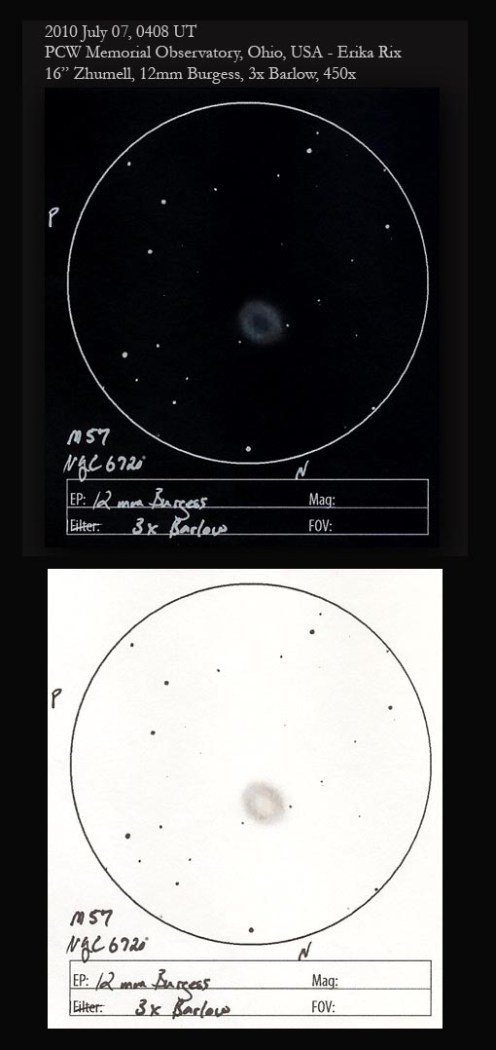
2010 July 7, 0408 UT  –  M57, NGC6720, the Ring Nebula

Constellation Lyra, Planetary Nebula Type 4+3, 0>71”, m8.8v, ~1500-2000 light years away

PCW Memorial Observatory, Zanesville, Ohio USA – Erika Rix

16” Zhumell, 12mm Burgess, 3x Barlow, magnification 450x

Sketch created scopeside with white photocopy paper, #2 pencil, ultra-fine black marker. Template from http://www.perezmedia.com.

M57 never fails to please, just like other objects such as the Double Cluster, M13 and M27. This is the first time I’ve used the 16” on this planetary nebula and took advantage of the aperture to increase magnification. I was particularly interested in looking for structure within the ring as well as a richer star field. It most likely wasn’t the optimal magnification to use, but seeing was rock steady and I was itching to give it a try.

This object resembled a scrunched up American football, not quite as oblong, but most certainly not completely round. The two ends were fainter than the middle portions of the ring, which had strands of brightened areas to the NW and SE sections of the ring. There was one particular area to the northern area of the ring that could have passed for a star, but not defined. It was more or less just a bright spot within the ring. The center of the nebula was a hazy darker gray, also appearing oblong. I couldn’t detect the ever-elusive central star.

Ring Nebula

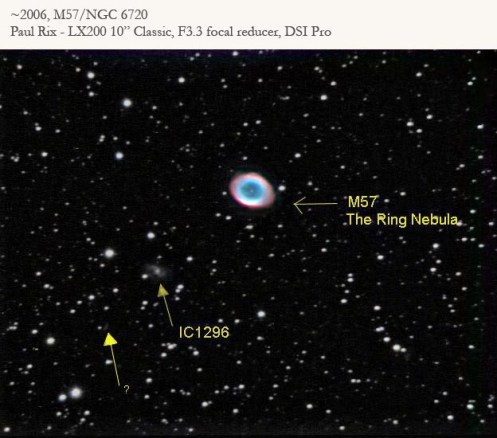
Paul imaged M57 in 2006 using the LX200 10” classic, a 3.3 focal reducer, and a DSI Pro. He managed to catch IC1296 in the process. You can see where an image allows more light for deeper viewing through frames that can be stacked or exposure times that can be lengthened. This image makes a great comparison between what can be viewed visually and what can be caught with the use of imaging gear in instances such as deep sky observing. I’m very fortunate that my husband enjoys this hobby as much as I do. It becomes almost a two for one scenario. Not only do I get to enjoy my relaxing eyepiece time, but I also get to enjoy his images that compliment my eyepiece views.

Two imagers, 10 and 8 day old Moons

•July 5, 2010 • Leave a Comment

It’s obvious that I’m not the imager of the family but it’s fun to take a photo now and again with my Rebel and tripod.

4 years later (minus a few weeks), Paul imaged the 8.6-day Moon with the ED80 and DSI III Pro. Notice the libration differences between the two images allowing us to see more (or less) features near the limb on any certain day or time.

Regardless if it’s a waxing or waning stage, a closer look at a full phase image is so peaceful and solitary that it begs to be gazed at. It’s no wonder a person can sit down with a pair of binoculars or telescope and lose track of time soaking in the details as the hours drift by.

2010 07 03 – NOAA11084

•July 3, 2010 • Leave a Comment

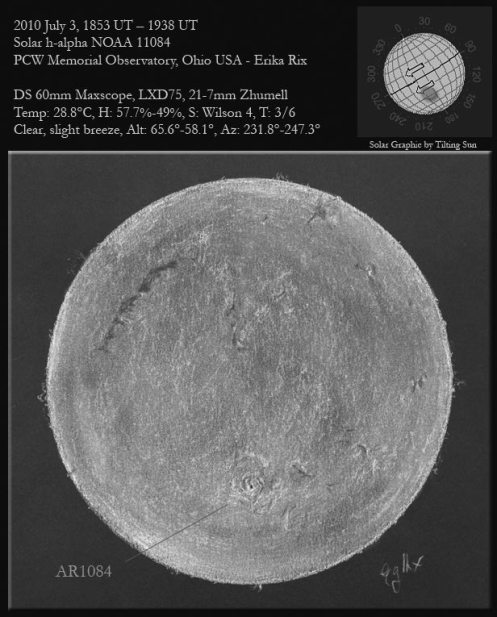
2010 July 3, 1853 UT – 1938 UT

Solar h-alpha NOAA 11084
PCW Memorial Observatory, Zanesville, Ohio USA – Erika Rix

DS 60mm Maxscope, LXD75, 21-7mm Zhumell
Temp: 28.8°C, Humidity 57.7%-49%
Seeing: Wilson 4, Transparency: 3/6
Clear, slight breeze, Alt: 65.6°-58.1°, Az: 231.8°-247.3°

H-alpha sketch created scopeside with black Strathmore Artagain paper, white Conte’ crayon and pencil, black oil pencil, Prang white watercolor pencil

It appears that I missed seeing a dual pair of CMEs (coronal mass ejections) on the Sun today. It took at place at 1154 UT. My session began at 1853 UT.  Fantastic footage of it can be seen here by SOHO coronagraph. http://www.spaceweather.com/swpod2010/03jul10/cme_c2_big.gif?PHPSESSID=kljak6da6ng8ifu6v1gf6p7ch3

AR 1084 still looks like a spiral galaxy (or a chicken eye with the wide yellow/pink skin wrinkled around the pupil).  A fantastic filament/prominence reached over the limb in the SW. The filament was thick and fibrous reaching out to the west and on either end, long and slender.

Riser, my regular solar buddy, aka 14-year old Rhodesian Ridgeback, took a pretty hard fall today and had to watch me observe from a distance in the comfort of the shade at the top of the hill. He’s resting comfortably now on a very thick duvet. Poor ol’ boy.

2010 07 02 – NOAA 11084

•July 2, 2010 • Leave a Comment

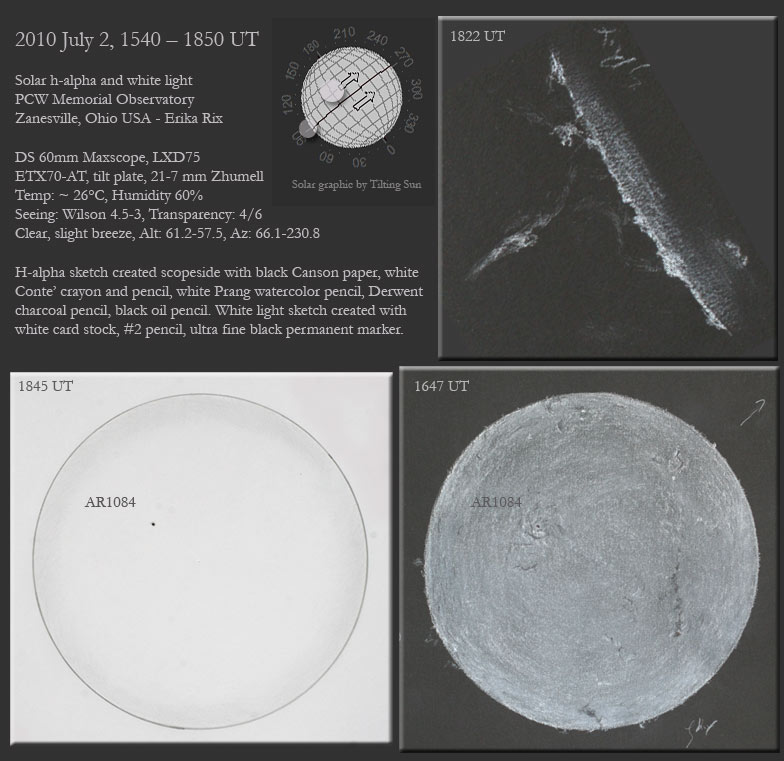
2010 July 2, 1540 – 1850 UT

Solar h-alpha and white light – NOAA 11084

PCW Memorial Observatory, Zanesville, Ohio USA – Erika Rix

Solar h-alpha and white light – NOAA 11084

DS 60mm Maxscope, LXD75, 21-7mm Zhumell, ETX70-AT, tilt plate

Temp: ~ 26°C, Humidity 60%, Seeing: Wilson 4.5-3, Transparency: 4/6

Clear, slight breeze, Alt: 61.2-57.5, Az: 66.1-230.8

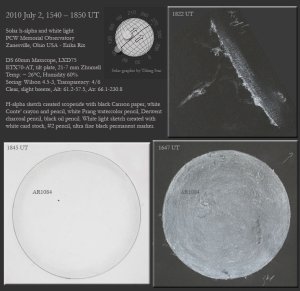
H-alpha sketch created scopeside with black Artagain paper, white Conte’ crayon and pencil, white Prang watercolor pencil, Derwent charcoal pencil, black oil pencil. White light sketch created with white card stock, #2 pencil, ultra fine black permanent marker.

NOAA 11084 in the SSE quadrant looked almost like a spiral galaxy on the Sun. It was only after I came inside from my session that I looked it up on Spaceweather and read that the images from SDO (http://sdo.gsfc.nasa.gov/data/) showed a “pinwheel canopy” over the sunspot in that region. The image from SDO is stunning and it was pretty exciting to see the comparison of that image with the views from my Maxscope. The swirl (if putting a cardinal orientation to the disk) made its way outward from west to north, to east, and so forth. In the center was the sunspot itself. The next layer beyond the sunspot was a brighter ring encircling the spot. From there the magnetic lines reached outward in long swirls.

Off in the NW quadrant, the very long filament appeared to be in sections, connected by thin strands. There were several filaments, but two thicker ones reached over the limb forming smaller bright prominences, one ~30°pa and the other ~110°pa.  Of all the prominences scattered about the limb, the impressive views were on the Eastern limb. I wish I had done a series of close up prominence sketches from the Eastern limb. They changed quite a bit over the course of my observations today. There is one close-up sketch of the center prom within that group that I completed in between the full disk sketch and my white light observation.

In white light, I could find no faculae. The umbra of the spot in 1084 was a little rough and flattened slightly. At first glance it looked almost perfectly round. The penumbra’s fibrils were detectable and the outer edge of the penumbra was flattened a little on the eastern border.

Paul joined me for the latter portion of my session and hooked up his DSI III Pro to the Maxscope while I studied the white light view with the ETX.

I haven’t a clue what the temps were today during my session. My thermometer/hydrometer went missing shortly after I set up my gear and I later found it with the sensor chewed off…compliments of Freckles, the youngest 4-legged member of our family.