2011 08 27 – C/2009 P1 & M71

•October 28, 2011 • Leave a Comment

2011 08 27, 0130UT-0300UT – C/2009 P1 (Garradd) near M71 (NGC 6838)
PCW Memorial Observatory, Ohio, USA, Erika Rix

Discovered 2 yrs ago by Gordon Garradd in Australia, C/2009 P1 was at 17th magnitude and predicted to brighten to a magnitude of 6 as it approaches the Sun. It reaches perihelion on December 23rd at 1.55 au. Sky and Telescope provided a printable finder chart for Comet Garradd from September through early February 2012 for easy tracking. Sky and Telescope Garradd Finder

Comet Garradd was near globular cluster M71
Constellation – Sagitta
Radius: 9999 meters
Apparent magnitude: 8.17
Orbit size: 1.5506 au
Distance from Earth: 1.3956 au
Distance from Sun: 2.2125 au
RA: 19h 53.167m Dec: 19:0.658

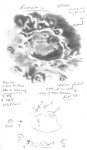
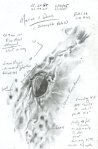
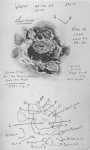
Sketch details: Garradd is to the left in the sketch, M71 to the right. Sketch created on card stock, 0.5mm mechanical pencil, #2 pencil, blending stump, ultra fine black permanent marker.

My sketch is unfinished and unfortunately, I wasn’t able to get to the report sooner and discovered I had omitted details about the observation such as which eyepiece I used and sky conditions. I believe I used a 13mm Ethos looking at the FOV and the air was saturated from humidity. Visually, the coma was bright with a concentrated nucleus and I was unable to see a tail. Looking at photos from imagers, there was a faint dust tail as well as ion tail reaching toward M71. I wish I could remember the sky conditions that night as the tail should have been apparent visually under good conditions. The dense star field may have played a part in it.
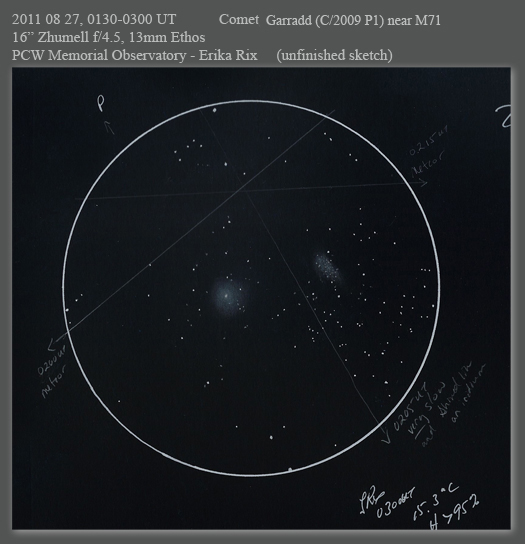
inverted view

For a good thread by observers tracking Garradd, visit Cloudy Nights. CN Planetary and Solar System: Garradd thread

M71 (NGC 6838) globular cluster, discovered in 1746 by Phillipe Loys de Cheseaux, cataloged by Messier in 1780.
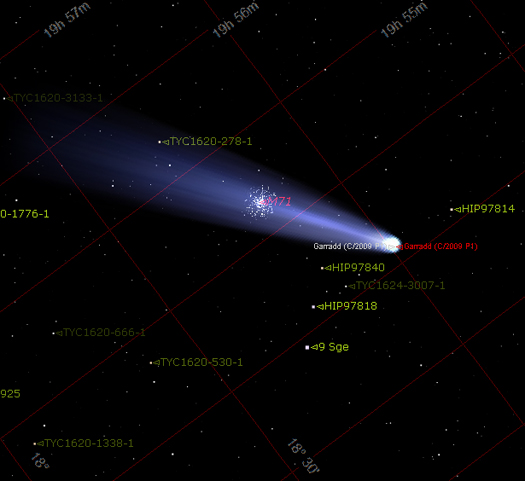
Screen shot from Starry Nights
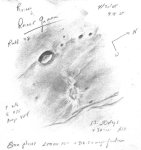
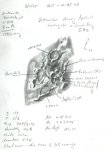
2011 10 07 – Eratosthenes

•October 7, 2011 • 1 Comment

2011 10 07, 0330UT Eratosthenes
PCW Memorial Observatory, OH, USA, Erika Rix
Eratosthenes: Complex crater from Eratosthenian geological period (from –3.2 billion year to –1.1 billion years)
Lat: 14.5 deg N, Long: 11.3 deg W

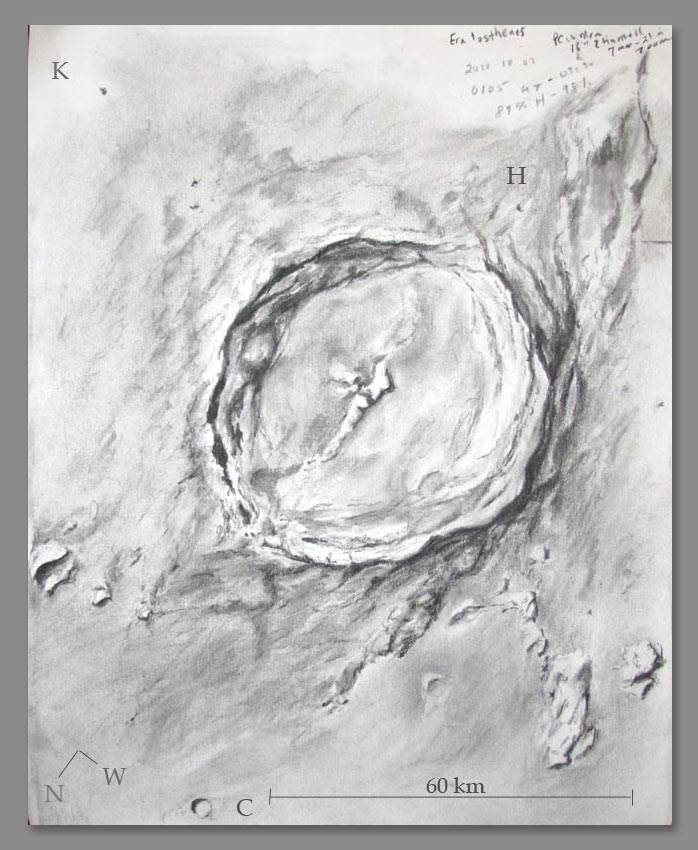
Zhumell 16”, 21-7mm Zhumell, 257x, no filter
Temp14C, 89% increasing to 98% humidity, S: Antoniadi II, T: 6/6
Eyepiece sketch on Rite in the Rain paper, charcoal
Phase: 54.3 deg, Lunation: 9.68d, Illumination: 79.1%
Lib. Lat: -05:01, Lib. Long: +05:37
Az: +246:38, Alt: -07:34

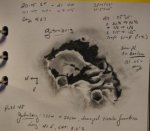
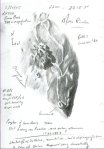
Eratosthenian geological period includes fairly young, non-rayed fresh craters. I did notice a Copernican ray to the N of Eratosthenes and several patches of lightened areas within the surrounding areas. Eratosthenes has very steep, tormented walls and is approximately 60km x 60km wide. It has an elongated central mountain with several summits. Its morphology is very similar to impact crater Copernicus, but its rays most likely deteriorated from weather and age.

The distance of this crater from the terminator made it perfect for studying the floor and terraced walls. The western floor edge was difficult to differentiate from where the upslope began for its wall. It appeared to be more a lightening with a few darkened lines.

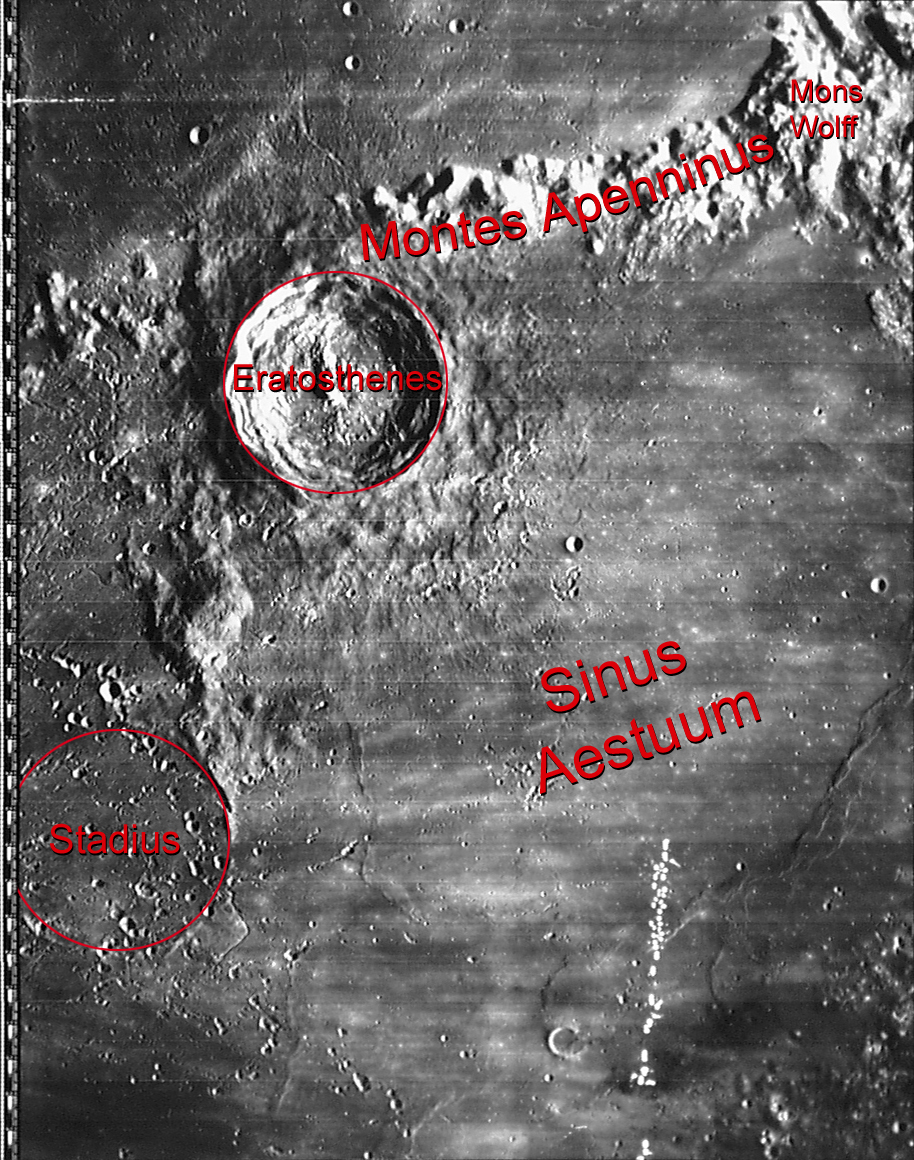
For comparison, here is an image from the Lunar Orbiter (through the Lunar and Planetary Institute site). My sketch is the eyepiece view from my telescope and will need to be rotated 180 degrees to match the Lunar Orbiter image.

Lunar Orbiter: IV-114-H2 (from the Lunar and Planetary Institute site)

2011 08 26 – Solar h-alpha, NE Prominence and NOAAs 11277 and 11279

•August 26, 2011 • Leave a Comment

We went from one designated active region yesterday to six today: 1271, 1272, 1275, 1277, 1278, and 1279. From yesterday’s observation with what looked like a new active region forming, today has been designated as active regions 1277 and 1279. I’ve sketched them both along with a beautiful extensive prominence slightly north of them. An area of prominence was observed yesterday in that same area.

Sketches created scope-side with black Strathmore Artagain paper, Conte’ pastel crayon, Prang color pencil, black oil pencil.

The view I did manage today of the solar disk was loaded with plage and filaments. The clouds made sketching nearly impossible today so I eventually packed up even though I had planned on doing a full-disk sketch in both h-alpha and white light. It’s due to clear up again tonight, so I may try to observe comet C/2009 P1 (Garradd).

Here’s a link to what’s happening on the Sun today: Spaceweather 2011 08 26 A coronal hole has opened up earlier this morning and solar wind should reach Earth in a few days. Anyone living up north should be on the look out for aurora activity.

Of particular interest to me is that a paper has been released in Science magazine: Detection of Emerging Sunspot Regions in the Solar Interior I initially found a post by Tony Phillips on the NASA Science News site regarding it. NASA Science News, Aug. 2011 Sunspot Breakthrough. Fascinating stuff. When sunspots are approximately 60km below the surface of the Sun (about 2 days away from emergence), they can sometimes be detected by “time-distance helioseismology2,” or in other words acoustic measurements via vibrations on the surface.

Submerged sunspots have a detectable effect on the sun’s inner acoustics—namely, sound waves travel faster through a sunspot than through the surrounding plasma. A big sunspot can leapfrog an acoustic wave by 12 to 16 seconds. “By measuring these time differences, we can find the hidden sunspot.” Ilonidis says the technique seems to be most sensitive to sunspots located about 60,000 km beneath the sun’s surface. The team isn’t sure why that is “the magic distance,” but it’s a good distance because it gives them as much as two days advance notice that a spot is about to reach the surface.

So far 5 have been detected before submergence, 4 by SOHO and 1 by SDO. This could really be a breakthrough for space weather forecasting!

2011 08 25 – Solar h-alpha, western prominences, NOAA 11271

•August 25, 2011 • Leave a Comment

2011 08 25, 1800UT-1900UT

NOAA 11271 covered quite a large area on the NW quadrant with plage and a few filaments. There’s a new active region coming around the bend on the eastern edge without a designation. A smaller, condensed circular plage area is to the SE of the solar disk.

There were clear skies while setting up, then changed to overcast skies immediately following. I finally got about an hour’s worth of observing in between the scattered clouds later in the day. Even scattered clouds can make sketching prominences difficult because prominences change so quickly that every minute counts. If I’m forced to stop sketching for a few minutes because of cloud cover, often the sketch will need go unfinished because the sketch is too different to the current view when the clouds move away. The differences may be small, but they are certainly there.

A full disk sketch doesn’t seem to be so rushed as far as changes go. The reason is because you’re sketching a larger area, focusing on the overall object instead of zooming in for a close up sketch. The changes in structure aren’t so obvious. Because of this, I had to wait patiently while big, fluffy clouds (dark on the bottom and brilliantly white around the edges and tops) floated by in between markings for the full disk sketch.

Sketches created scope-side with black Strathmore Artagain paper, Conte’ pastel crayon, Prang color pencil, black oil pencil.

2008 Sketching Presentation at Perkins Observatory

•August 16, 2011 • Leave a Comment

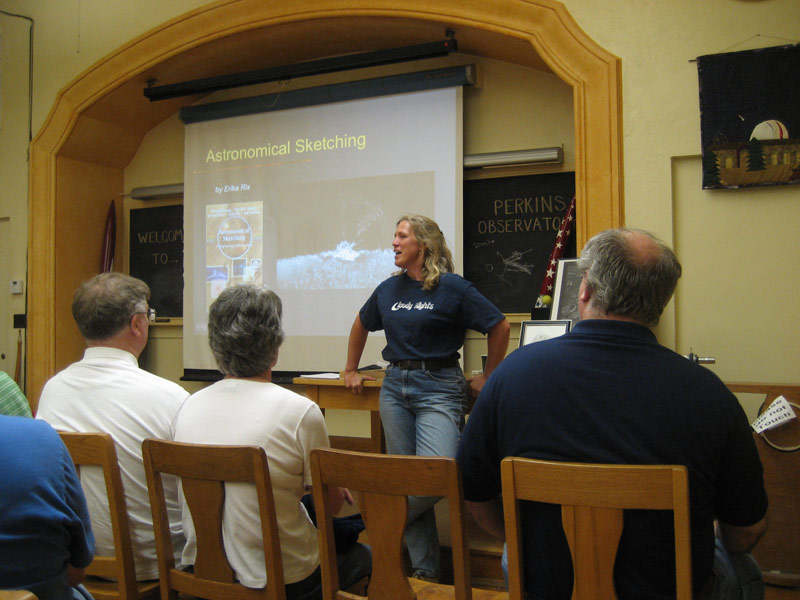
What a great night spent with the Columbus Astronomical Society (CAS) at Perkins Observatory – OWU in Delaware, OH in 2008. I was invited to give an astronomical sketching presentation for the club and enjoyed a meal out before hand with one of the members and his terrific family and then a tour of the observatory.

Non-animated version: Power Point Sketching Presentation 2008 (3.9MB)

It’s said that recording astronomical observations began in the ice age by marking the number of moons into bone. Visual observations continued to be recorded through time with the works of early astronomers such as Aristarchus, Ptolemy, Copernicus, Aristotle, and Kepler.

Many of us have our own mentors that help us in the pursuit of perfecting our techniques for recording observations. Galileo, known as “father of modern observational astronomy” continues to be a mentor through his dedication and astronomical findings in the late 1500’s and early 1600’s. With his discovery of Jupiter’s satellites, studies of sunspots, increased magnifications of telescopes, Saturn’s rings, it is no surprise that many follow his lead. His visual observations and ability to record his findings through notes and sketches provide an exemplary format for us to follow.

With today’s technology, we are able to produce magnificent images with cameras allowing us to gather more light, seeing deeper in space than what the naked eye can discern. However, sketching has many benefits as well and in fact, imagers and sketchers compliment each other.

It’s always a little exciting driving up to an observatory. I love walking up the steps and through those big doors. To the right is the library stuffed with books, computers, telescopes and other astronomy paraphernalia. What I would give to have a library like that in my own home. To the left is a wood-floored room filled with chairs and a little stage. Walking through the entrance way, you can go up the steps to the observatory or down the steps to other rooms filled with learning aids and the ATM room where the likes of mirrors can be grinded for your own scopes.

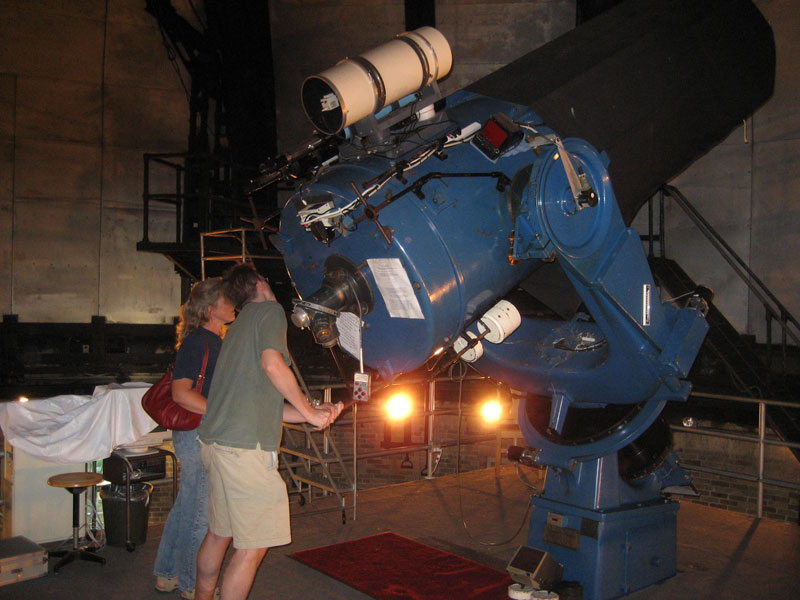
32" scope at Perkins

The original 69″ mirror that was casted in 1931 for Perkins was moved (along with the scope) to Lowell Observatory, eventually trucked to COSI, and then made its way back home to Perkins in 1999. They have a sweet 32″ set up for observing in the dome now. I was amazed at how easy it was to move manually.

Getting to the presentation, we touched on all areas of visual observing: planetary, asteroids, comets, solar, lunar, DSOs. Several of my sketching friends kindly allowed me to use their drawings (in addition to my own) to show the varied techniques and to touch on the extent of work that can be done through observation sketches.

An example would be sketch sequences over a period of time…including days or weeks of daily sketches. Rich Handy did a wonderful ingress sequence of the August 28th 2007 lunar eclipse. I then created a simple animation of his sketches to simulate the feel of the eclipse.

Total Lunar Eclipse by Rich Handy

Another collaboration took place with a sequence of sketches that I drew for this very lively prominence. Alan Friedman put it into an animation for me.

20070609 prominence sequence

Pretty much the next best thing to spending a night (or day) under the stars observing is being able to share it with others!

2005 – Collection of Lunar Sketches from the Archives

•August 15, 2011 • Leave a Comment

Everyone has to start somewhere. This is a collection of my first lunar drawings at the eyepiece. I started off with just a pencil and copy machine paper, then progressed to Rite in the Rain paper with charcoal.

Most of the observing sessions were completed with an ETX70-AT, 10″ LX200 Classic, and a 6″ reflector on a Dobsonian mount. There will be partial observing reports on most of the sketches when clicked on. I removed most of the flamboyant writing that I used to do…{cringing from embarrassment}.

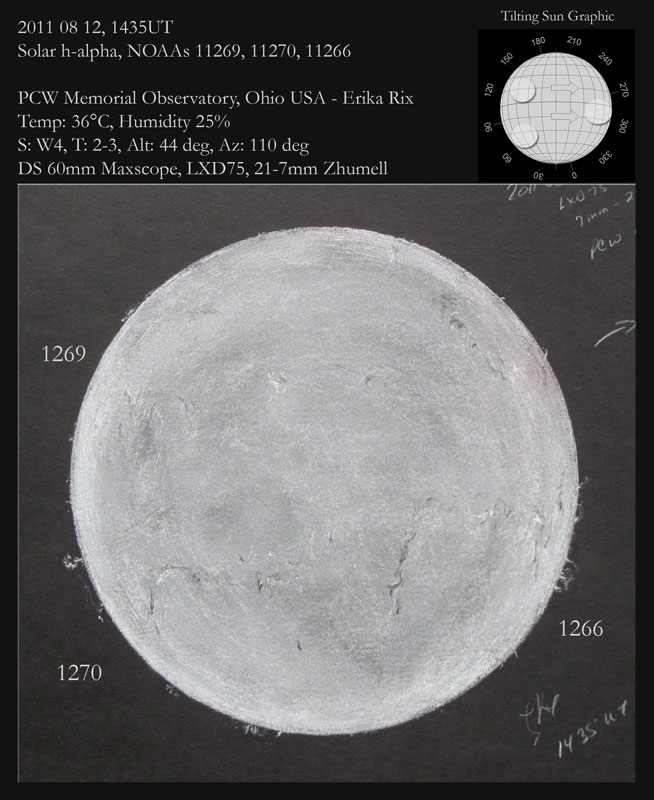
2011 08 12 – NOAAs 11269, 11270, 11266

•August 14, 2011 • Leave a Comment


Sketch created scope-side with black Strathmore Artagain paper, Conte’ pastel crayon, Prang color pencil, black oil pencil.

With Perseids taking front center stage, I almost feel like I’m rooting for the underdog by solar observing. This is compounded by the fact that the Sun is spotless today (8/14/11) as if to counteract the full Moon during the peak of the Perseids over the weekend. Regardless, I’ll take a bit of time behind my Maxscope any day.

If anyone would like a peak at the Perseid numbers reported thus far, check out the IMO site: Perseids 2011: visual data quicklook.

The other day, I posted a few of the major areas of prominence on the limb from 2011 08 12 Solar Prominences. One was near AR 1266 and the other was near AR 1270. The one on the eastern edge was more compact width-wise but very bright and dense to the southern edge. It changed quite a bit and seemed to grow in height over the course of my session. There were very faint tendrils of plasma reaching across to the northern denser section of that area.

The area of prominence on the western limb was tricky to catch in the form of sketch as it moved quickly and was very wide. It reached a span of about 35 degrees or more.

The showstoppers, in my opinion, were the numerous filaments across the disk in both hemispheres but especially the northern. The three active regions were very evident with the amount of plage. Adjustments in the etalons were made to bring various features in and out of view in an effort to wring the most detail out of the session.

I joined Twitter today. It wasn’t something I planned on doing, but with a little encouragement from a brother-in-law, I decided to join on a whim. One of my first searches was for SDO (yeah, I’m so predictable). For grins, as well as for those of you that haven’t really spent much time with the Sun, here are a few fun links that SDO tweeted.

How big is the Sun?

Why is the Sun so hot?

What are Sunspots?

Just think. The Sun is an average star formed about 4.6 billion years ago. Although it is the center of our solar system, it is only one star in our galaxy that contains hundreds of billions of stars. Then think about all the other galaxies out there in the universe. Amazing how we can get caught up in our own little worlds when we’re such a minute existence in the grand scheme of things.

20110812 – Solar Prominences

•August 13, 2011 • 1 Comment

The solar limb was busy with scattered prominences yesterday. I dusted off my colored Conte’ pastel crayons and Prang color pencils for this session. I normally like the comfort of my grey shades, so it was a little bit of a challenge for me to render the crisp, faint details of the prominences in a media that I just don’t have much experience using. The upside is that after photographing the sketches, there was little adjusting to do in Photoshop compared to doing a monochrome sketch and then trying to digitally colorize it. The only adjustments I made were using the “shadow/highlight” tool.

I still believe that monochrome sketching shows the faintest details in prominence structure in the sketch, but color lends itself to other details that would have otherwise been missed…such as a truer representation of the color we see visually as well as how difficult it can be to observe the faintest structures of prominences.

I have a full disk sketch that I still need to upload from yesterday’s session, but have run out of time before needing to get for work this afternoon.

The paper used is my normal Strathmore Artagain.

2011 08 01 – Solar h-alpha, NOAAs 11263, 11260, 11261, 11265

•August 13, 2011 • Leave a Comment

This sketch was from a solar session that was cut short. Unfortunately, I have no notes concerning this observation. For more info on the Sun that day, you can view the archives from Spaceweather.com. 20110801 Spaceweather


Sketches created scope-side with black Strathmore Artagain paper, white Conte’ crayon and pencil, Derwent charcoal pencil, black oil pencil.

2011 08 10, Delisle and Diophantus

•August 10, 2011 • Leave a Comment

2011 08 10, 0110-0208 UT Delisle and Diophantus
Geological period: Eratosthenian (-3.2 billon years to –1.1 billion years), Rukl 19

PCW Memorial Obsv., OH – Erika Rix
Zhumell 16” f/4.5 on a Dobsonian mount, 7mm Zhumell, no filter, 257x

Temp: 22.8 C, 79% H, Clear turning to 70% overcast with lightening and thunder, T: 5/6, S: Antoniadi II
Phase: 44.4 deg, Lunation: 10.27 days, Illumination: 85.7%, Colongitude: 40.2deg
Lib Lat: -00deg24m, Lib Long: +05deg35m
Alt: +24d21m, Az: +161deg13m


Eyepiece sketch on white cardstock with charcoal. Unfinished sketch due to lightening, thunder, and overcast skies rolling in.

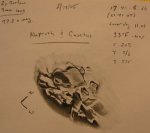
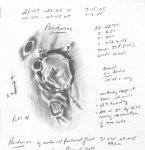
Located in Mare Imbrium, Delisle (27 km) and Diophantus (19 km) are both relatively young impact craters. Delisle has a tormented floor with central mountains, sharp rim and high walls with a height of ~2550 m. Diophantus looks to be a simple crater with sharp rims, steep wall with a height of ~2970 m, and craterlet Diophantus C to the SW.

There is slight elongation of the features during my observation due to this area’s position near the northern lunar limb. You can see the obvious difference when compared to Apollo’s Image below. My eyepiece view will need to be rotated 180 degrees to match the orientation of NASA’s image.

Apollo Image AS15-M-2075

Photo Credit: NASA

Rima Diophantus and crater Louise were not apparent, although Louise’s ray reached E-W extending beyond Diophantus B and a hint of it reaching to Artsimovich. A scalene triangle-shaped patch seemed to form a plateau between Diophantus, eastern edge of Mons Delisle, the SW edge of Delisle, and the western edge of Louise. Fedorov was only noticeable by the shadowing just north and south of it. Artsimovich was very obvious with its deep shadow. Diophantus, although only 6 km, was very clear as well with brightened areas extending north and south of it.

Additional reading:
Lunar and Planetary Institute, Apollo Image Atlas – AS15-M-2075
APOLLO OVER THE MOON: A VIEW FROM ORBIT (NASA SP-362)