New Sketching Column for Astronomy Magazine

•November 26, 2012 • Leave a Comment

Astronomy magazine now has a regular monthly column dedicated to astronomical sketching, starting with the January 2013 Issue, that is now available for purchase. Astro sketcher and editor of Astronomy, Dave Eicher, had a terrific page in the magazine called “Deep-sky Showcase.” The new sketching column, called “Astro Sketching”, will be in the same spirit, showcasing two celestial eyepiece sketches each month as well as “how to” articles on occasion during the course of the year.

Sketching your observations is a terrific means of honing your observing skills, as well as providing visual recordings of your observations. It’s my hope that this column will spark interest in sketching at the eyepiece and help observers overcome their trepidation of drawing their observations as well as sharing them with others! Please feel free to contact me via the comments section of this post or the Contact/Feedback Form on this site if you have any questions on astronomical sketching or have target ideas for the new column! I’d love to hear from you and am more than happy to share sketching techniques to help get you started. Astronomy magazine also has community forums you can subscribe to where we can participate in sketching/observing discussions, among other astronomy related topics. Please also feel free to post your sketches in Astronomy’s Sketches from the Telescope gallery!

The first column targets will be Winter Clusters.

20121124 – ARs 1616, 1618, 1619, 1620

•November 26, 2012 • Leave a Comment

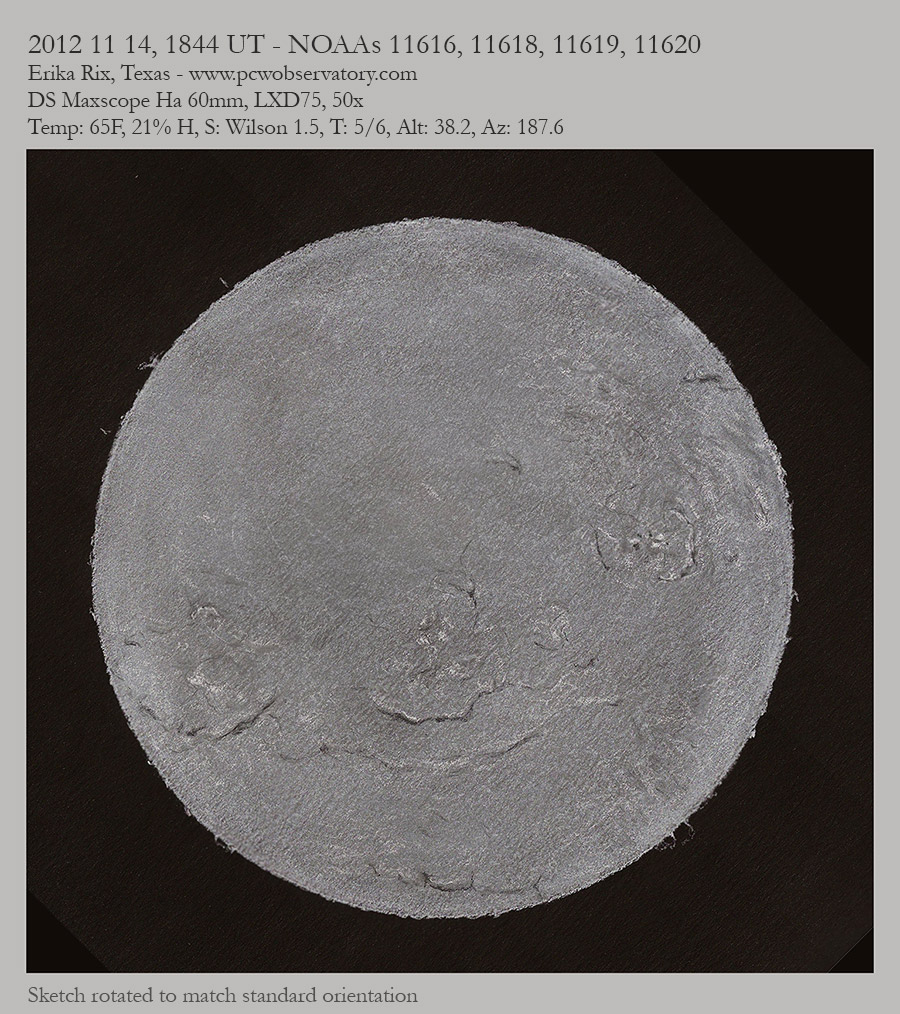
Active region 1618 was the one to watch this past week. It was decaying the past few days before this observation two days ago but still contained a ‘beta-gamma-delta’ class magnetic field that could result in X-class flares (per Spaceweather.com). This AR is still hanging in there just inside the western limb but 1620 has stolen the show and is growing.

Below are two more comparisons of hydrogen alpha views compared to white light. Sketched at the eyepiece on the 24th.


Hydrogen alpha sketch created with black Strathmore Artagain paper, white Conte’ crayon and pencil, white Prang pencil, black oil pencil, charcoal pencil.


White light sketch created at the eyepiece with white card stock, felt-tipped black artist pen, charcoal pencil, black oil-based pencil.

Labelled version with active regions identification

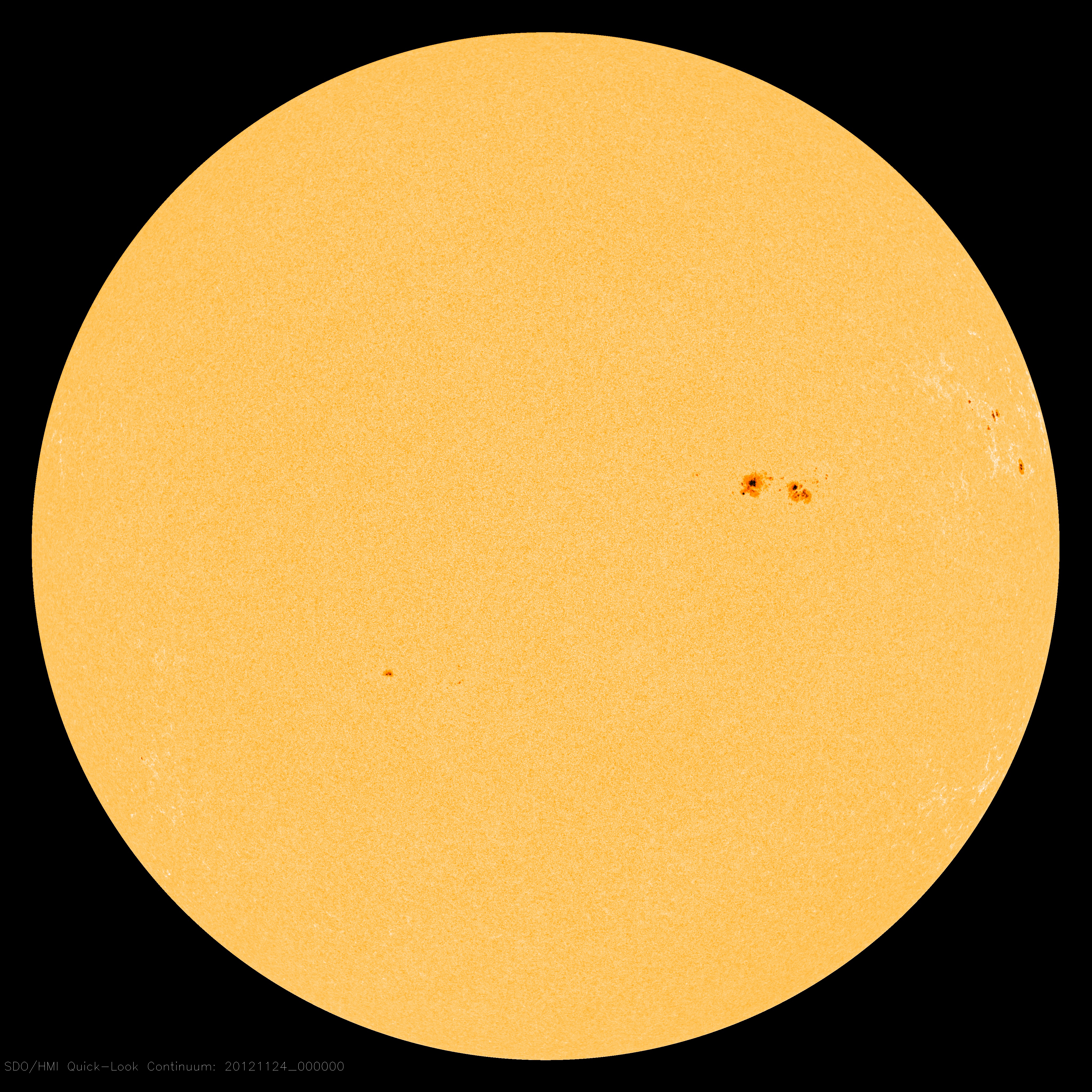
The image below is an image from SDO/HMI for further comparison. It would have been captured within 24 hours of my observation.

Photo credit: SDO/HMI via Spaceweather.com

20121118 – Sun in Hydrogen Alpha

•November 25, 2012 • Leave a Comment

“But she’s a sketcher!”

Yes, but now and again, it’s fun to try my hand at imaging. Having recently acquired a Canon EOS 60D through a rewards’ deal (love it when I feel like we get something for free!), I was eager to have a play with using it at the telescope. It hasn’t been modded for astro-imaging and to tell you the truth, that sort of an upgrade would be lost on someone who prefers pencil and paper – in other words, someone like me. It took a 2.5x Barlow to reach focus and as you can see, the focus is still soft. There’s a way to hook the camera up to my laptop as a means of achieving a crisp image and some day, I’ll have my astro-imaging husband, Paul, show me the ropes. He was kind enough to spend the little bit of free time he has these days processing my images for the finished photo below.

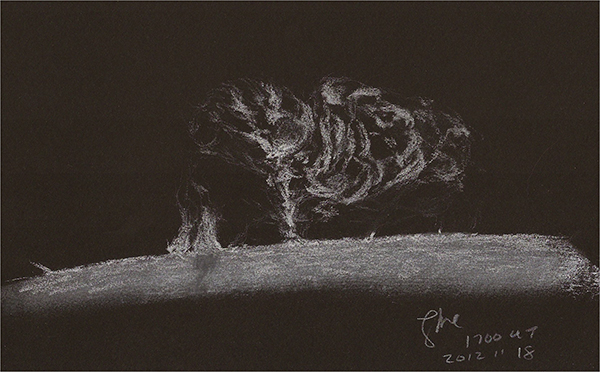
There were nine active regions scattered across the disk that day: ARs 1610-1616, 1618 and 1619. For some reason, I didn’t pull out my white light rig for a comparison and didn’t record good notes that day as a refresher. I do recall the very large prominence on display that day. It’s located at the 12 o’clock position on the image above. Shortly after taking the photo images of the Sun with my Canon, I grabbed a quick sketch of that prominence. Later that day, the prominence’s magnetic field lost its integrity and the prominence broke free and drifted off the limb. I had to work quickly because we know how fast prominences change. Generally my prominence sketches take me 5-10 minutes, or thereabouts, to sketch. That’s easier done when the prominence is small. This beast was so large and intricate that my sketch lacks finesse.

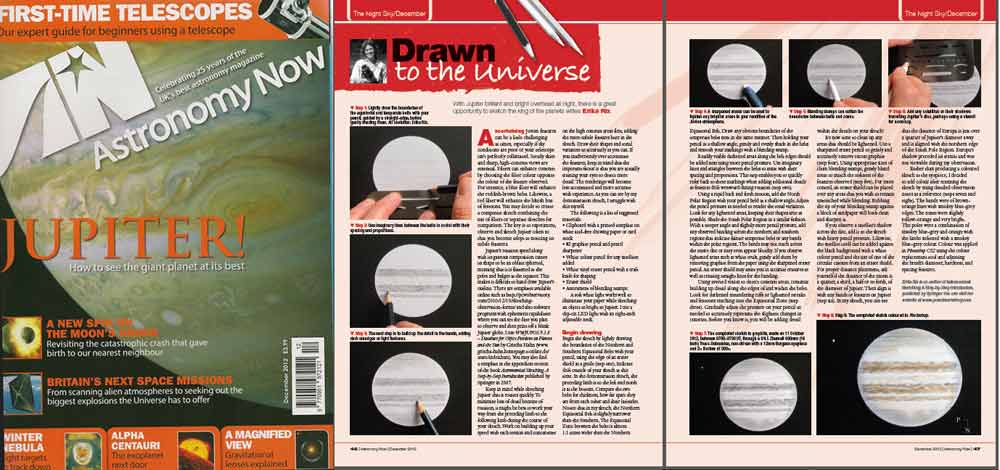
Astronomy Now magazine: “Drawn to the Universe” December 2012 issue, Jupiter and Europa

•November 24, 2012 • Leave a Comment

Astronomy Now magazine

“Drawn to the Universe”
December 2012 issue – Planetary
Target – Jupiter and Europa
Media – White card stock, graphite – colorized in Photoshop CS2

Link to observation report: 2012 10 11 – Jupiter and Europa

Archive for the ‘Drawn to the Universe’ Category

2012 11 14 – White Light/H-alpha Comparison

•November 23, 2012 • Leave a Comment

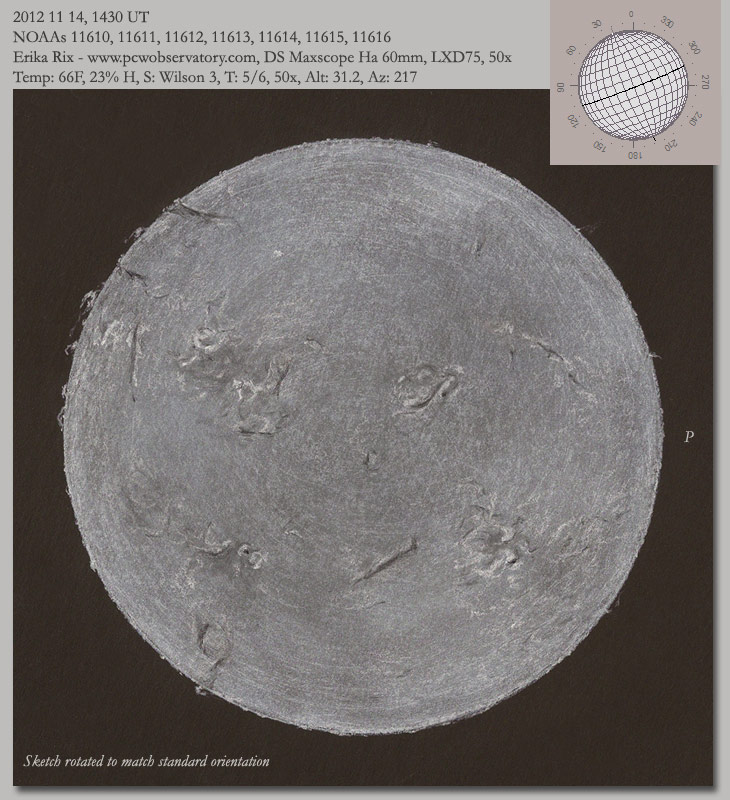
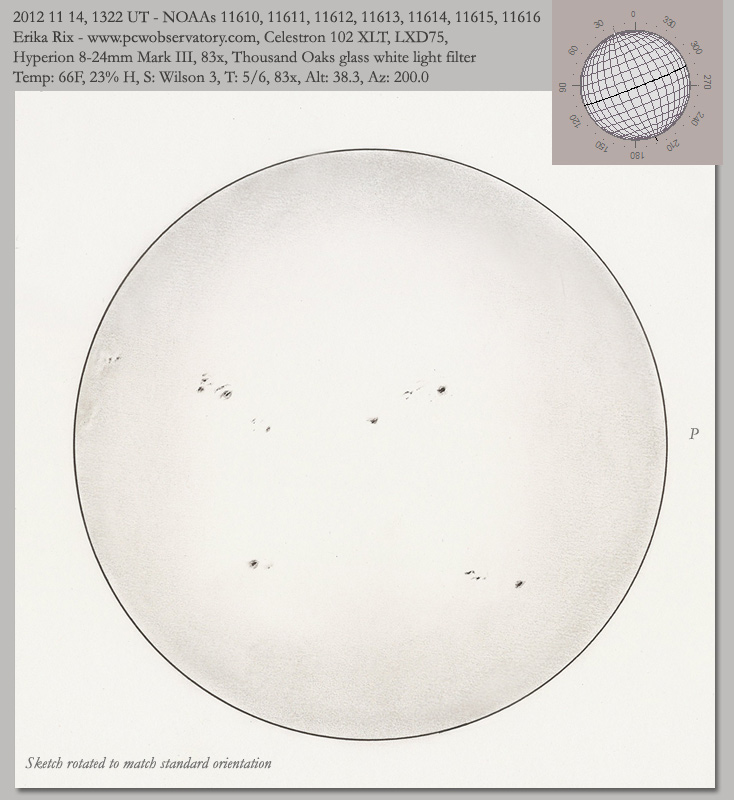
In the wake of the beautiful solar eclipse photos and reports from the 13th, the Sun was putting on spectacular shows in both hydrogen alpha and white light along with several M-class flares and auroral activity for the Northerners. Living in Texas, I missed out on both the eclipse and the Northern Lights but the views from my backyard through my solar filters gave me an appreciative fix regardless.

The chromosphere of the Sun can be viewed in the hydrogen-alpha spectral line that is centered on 6562.8 Angstroms by using a very narrow bandwidth filter such as a hydrogen alpha filter set or a spectrohelioscope. The photosphere can be viewed with a white light filter that transmits the entire visible spectrum of light but at a level that is safe for us by blocking out 99.999% of all available light. Other methods for viewing the photosphere include projection viewing where you project the solar image on a wall or other backdrop instead of viewing the Sun directly through the eyepiece. What an observer can expect to see in a hydrogen alpha (Ha) filter is quite different than what is seen in white light (as you can see from the comparison sketches below). For a better understanding of the “layers” of the Sun, please see the link from AstronomyOnline.org. Another informative site for what you can expect to see in hydrogen alpha can be found on The Prairie Astronomy Club site and is an article written by David Knicely called “Observing the Sun in H-alpha.”

The first sketch  below of the chromosphere was rendered at the eyepiece while using a dedicated hydrogen alpha telescope, an internally double-stacked Coronado Maxscope Ha 60mm that has a very narrow bandwidth of close to 0.45A. The amount of disk detail that can be seen with this telescope is very high and contrasty. In the sketch below, you can see several active regions across the disk with brightened plage, sunspots within the plage, filaments and prominences (which are filaments that reach over the limb). Visually, I could see a mottling appearance from the chromospheric network.
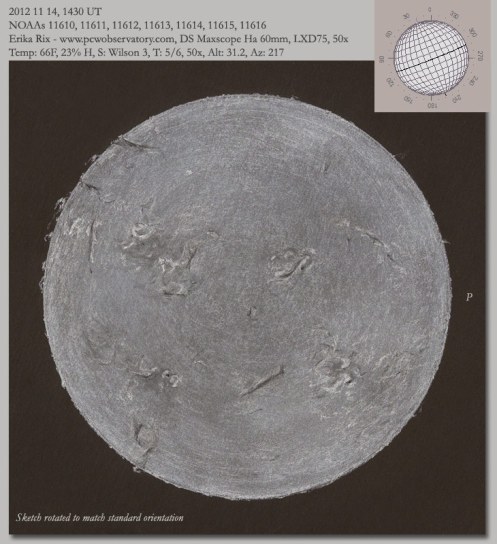

Hydrogen alpha sketch created with black Strathmore Artagain paper, white Conte’ crayon and pencil, white Prang pencil, black oil pencil, charcoal pencil.

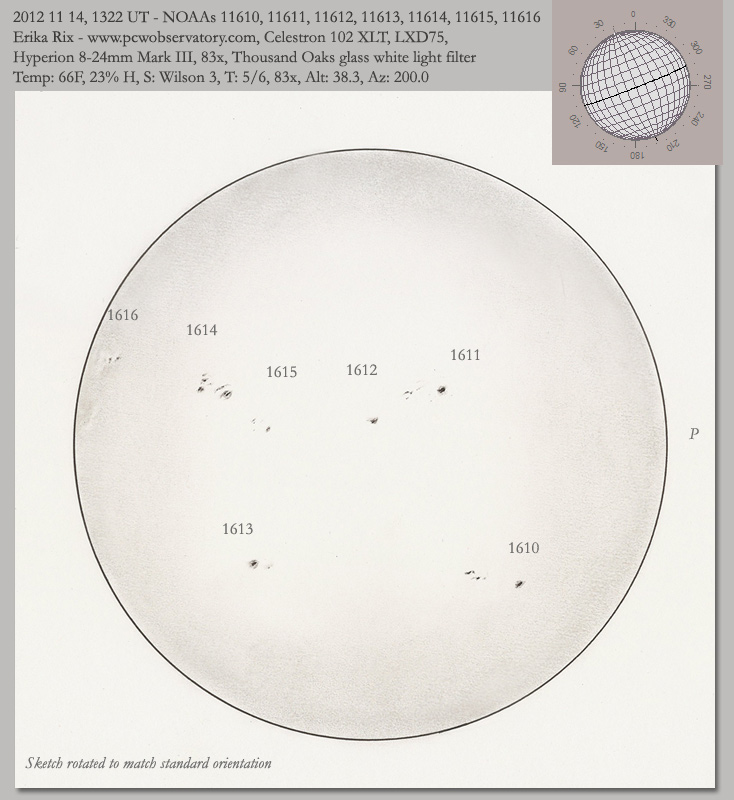
The following sketch of the photosphere was created at the eyepiece using a glass white light filter in front of the objective lens of a refractor. Features rendered in this sketch are faculae to the 9 o’clock position of the disk, sunspots, and limb darkening. Visually, and as shown in this sketch, you can expect to see more detail within the sunspots while viewing in white light than you can in h-alpha. Note that most of the sunspots have both penumbrae and umbrae. When seeing conditions are above average, you may see granulation in white light.

White light sketch created at the eyepiece with white card stock, felt-tipped black artist pen, charcoal pencil, black oil-based pencil.

Labeled version with AR numbers

Blow is a comparison with an SDO image of the Sun’s photosphere taken within 24 hours of my observation.

Photo credit: SDO/HMI via Spaceweather.com

2012 11 15 – NGC 7092 / M39

•November 16, 2012 • Leave a Comment

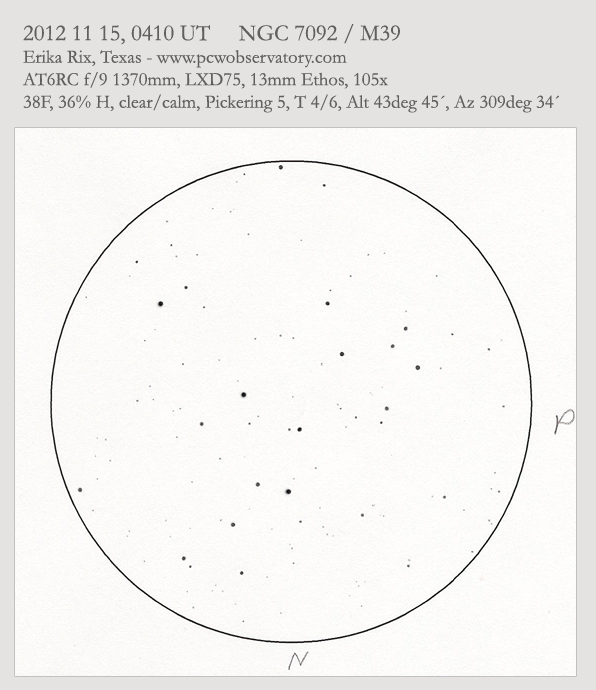
2012 11 15, 0410 UT NGC 7092 / M39
Erika Rix, Texas
AT6RC f/9 1370mm, LXD75, 13mm Ethos, 105x
38F, 36% H, clear/calm, Pickering 5, T 4/6
Alt 43deg 45´, Az 309deg 34´

Open cluster (galactic cluster) in Cygnus, 21h 31.9m, +48º 26′, 31’ angular size, 4.59 apparent magnitude

Discovered by Messier in 1764. It’s approximately 800 ly distance from Earth and is 200-300 million years old.


Eyepiece sketch on white photocopy paper with black super-fine felt tipped pen for and #2 pencil, blending stump for the nebulosity. Template is available on the template page of this site.

Sketch before inverting

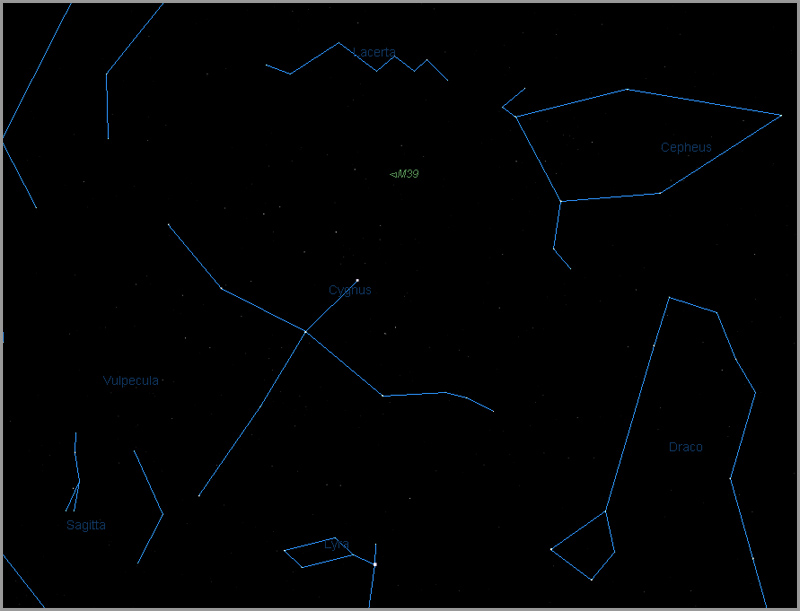
M39 is an easy-to-spot open cluster in Cygnus, ~9 degrees NE of Deneb. Three stars of 6.81, 6.56 and another 6.81 magnitude, make a chain NNW to SSE with 7.62 – 8.78 magnitude stars forming a chain NNE to SSW. There are several pairings of stars within this 30+ star grouping.

Screen shot from Starry Night Pro Plus 5 – location of M39


Related links:
M39 info on SEDS
The Space Motion of the Galactic Cluster NGC 7092
Authors: Lloyd Evans, T. & Meadows, A. J.
Journal: The Observatory, Vol. 84, p. 148-152 (1964)
Bibliographic Code: 1964Obs….84..148L

Open cluster info on Wiki

General Observing Form

•November 9, 2012 • 7 Comments

I’ve just created a general observing form to add to the Observing Forms/Templates page. Please feel free to print, download, or share copies of the following forms for personal or club non-profit use.

Click here for a pdf version of the form.

November 2012 Issue – Sidereal Times

•November 2, 2012 • Leave a Comment

The November 2012 issue of Sidereal Times for the Austin Astronomical Society is now available for download.


Click the following link for the PDF version: November 2012 issue (4.43 MB)

In this issue, you’ll find details on the November meeting that includes an astronomical sketching presentation and the Practical Astronomy hands-on workshop for sketching accurate star fields, clusters, and nebulae; event dates and info on the Dam Star Parties, November Observing Targets; Astronomy App review for Solar Walk – 3D Solar System; KStars Software review; Guest Spotlight – Chuck Wood part III; Developing a Dark Site part II; Photo of the Month; Cen-Tex report; and much more!

Please contact me if you’re interested in joining the club or wish for more information! It’s a very active club and has a great outreach program.

2012 10 20 – NGC 6960 / H 5.15

•October 23, 2012 • 5 Comments

2012 10 20, 0600 UT NGC 6960 / H 5.15
16” Zhumell reflector f/4.5, 13mm Ethos, 138x, OIII filter
51F, 57% H, S: P6, T: 4/5, Alt 30deg 54´, Az 289deg 32´

Supernova remnant and emission nebula in Cygnus, 20h 45m 58.1s, +30º 35′ 43″, 70.0’x6.0′, also cataloged as LBN 191, GN 20.49.5.01, Sh2-109, h 2088, GC 4600.

The Veil Nebula is part of the Cygnus Loop and consists of NGC 6960 (Western Veil or Witch’s Broom); NGC 6992, NGC 6995, and IC 1340 (Eastern Veil); Pickering’s Triangle, NGC 6974 and NGC 6979 (northern central segments). The use of an OIII filter brings out stunning details, especially with increased aperture.

An OIII coupled with my 13mm Ethos was used during this observation in the northern portion of the Western Veil along the 16” f/4.5 reflector at 138x magnification. I distinctly remember seeing a bright blue star, but to my dismay, I didn’t record which star it was in my notes. There was luminosity around 52 Cygni reaching out to the 11th magnitude stars to the western vicinity. Two strands of nebulosity reached to the south from 52 Cygni with fainter wisps surrounding those strands. Once they reached HIP102468, there were three distinct strands narrowing back into one bright one as it curved back to 11th magnitude star TYC2687-1760-1. (Drat, I just noticed that I didn’t depict the magnitude of that star very well in my sketch as it looks to be more of a 9-10th magnitude star.) Faint wisps of nebulosity reached to the east of that star. The Western Veil continues on southward but is omitted from my sketch and its FOV.
Moving to the north, the nebulosity thickens and expands to the east of 52 Cygni, then segments quite a bit. There is a distinct “V” shape where it then splits off into three strands as it travels north with a couple faint stars speckling the eastern edges nearly halfway between 52 Cygni and 8th magnitude star TYC2687-801-1 to the north where the strands of nebulosity gradually go back to two and then one as it reaches beyond that 8th magnitude star.

For comparison, below is a photo Paul took of the entire Western Veil several years ago:

Image credit of Western Veil: Paul Rix

Other resources:
NGC/IC Project
Wikipedia – Cygnus Loop

Eyepiece sketch on white photocopy paper with black super-fine felt tipped pen for and #2 pencil, blending stump for the nebulosity. Template is from the Astronomical League.

Sketch before inverting

2012 10 19 – NGC 6689 (aka NGC 6690) / UGC 11300

•October 22, 2012 • Leave a Comment

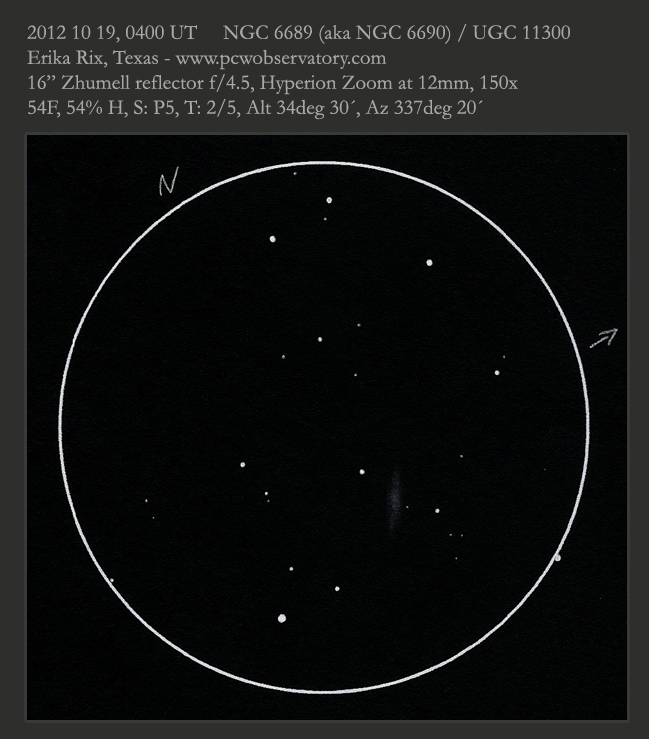
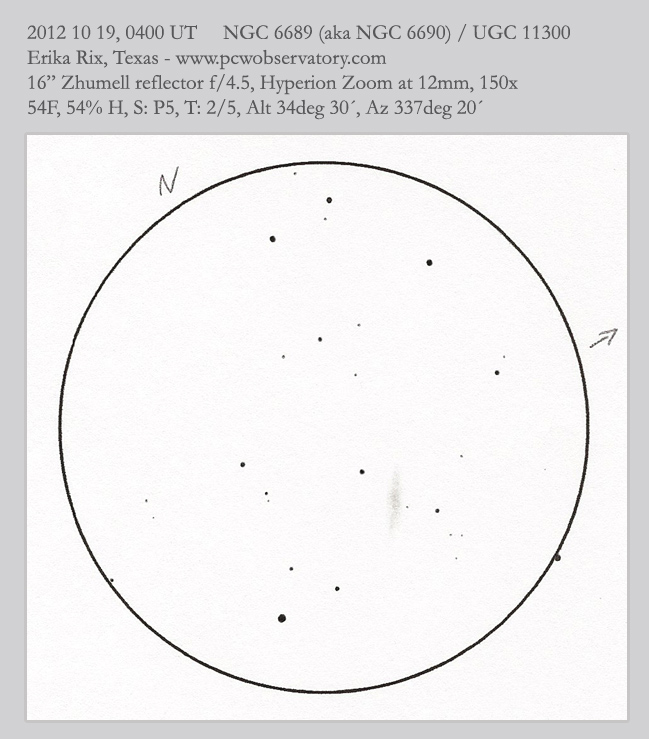
2012 10 19, 0400 UT NGC 6689 (aka NGC 6690) / UGC 11300
16” Zhumell reflector f/4.5, Hyperion Zoom at 12mm, 150x
54F, 54% H, S: P5, T: 2/5, Alt 34deg 30´, Az 337deg 20´

Edge-on barred spiral galaxy in Draco, 18h 34m 49.9s, +70º 31′ 27″, Type SBcd, 4.2´ x 1.5´, m12.3, SB 13.9

Discovered by Heinrich Louis d’Arrest in 1863 using an 11” refractor and also Lewis Swift in 1884 using a 16” refractor. Per Dr. Harold G. Corwin, Jr.(ref NGC/IC Project http://www.ngcicproject.org/ngcicdb.asp), both men observed this object twice but it was only d’Arrest that noticed both of his observations were of the same object. Swift’s positioning of the object from both his observations were off far enough that he didn’t recognize it as being one and the same. Dreyer caught Swift’s mistake but evidently didn’t spot d’Arrest’s entry as the same object, thus having two NGC numbers for the same galaxy.

Seeing was average, transparency was below average. This galaxy was dim using a 16” reflector at 150x. It is elongated NNW to SSE with a 14th magnitude star ~ 0.6´ to the west of its center. It rests between an 11th magnitude star NE and a 12th magnitude star SW, both to 1.75´ distance from its center.

Eyepiece sketch on white photocopy paper with black super-fine felt tipped pen for and #2 pencil, blending stump for the nebulosity. Template is from the Astronomical League.

Univerted Sketch