The James Webb Space Telescope

•March 21, 2013 • Leave a Comment

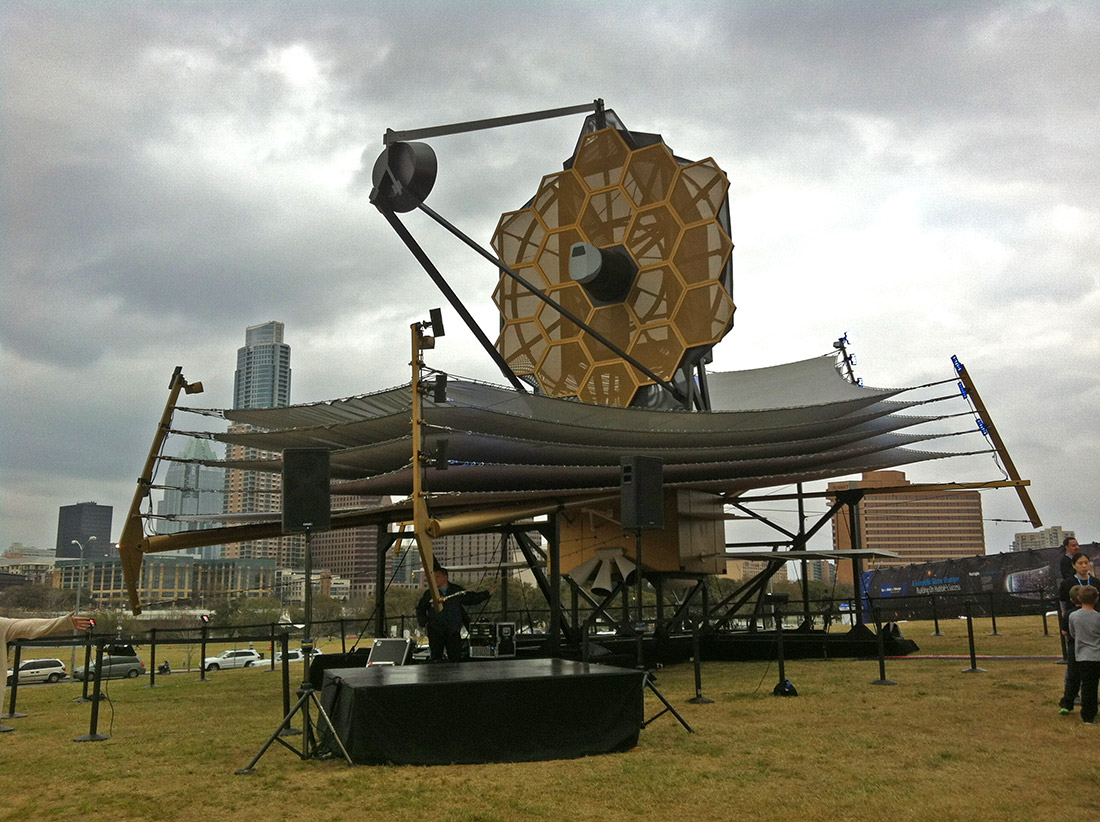
The James Webb Space Telescope full-scale model and crew came to the South by Southwest (SXSW) event in Austin, Texas over the weekend of March 8-10th, 2013. I had a full weekend lined up with other astro activities and obligations, but due to the weather, Paul and I were able to attend the event for a few hours on Saturday. This was a pretty exciting opportunity to learn more about the James Webb telescope design and its mission first hand from astronomers and engineers who are involved with its creation. The Webb Telescope will reach further into the Universe than Hubble, using infrared technology.

The James Webb Space Telescope – NASA

The James Webb Space Telescope (sometimes called JWST) is a large, infrared-optimized space telescope. The project is working to a 2018 launch date. Webb will find the first galaxies that formed in the early Universe, connecting the Big Bang to our own Milky Way Galaxy. Webb will peer through dusty clouds to see stars forming planetary systems, connecting the Milky Way to our own Solar System. Webb’s instruments will be designed to work primarily in the infrared range of the electromagnetic spectrum, with some capability in the visible range.

IMG_3053

Specs:

  • Primary mirror: 6.5-meter diameter aperture
  • Wavelength: 0.6 to 28.5 microns
  • Diffraction limit: 2.0 microns
  • One-year sky coverage: 100%
  • Orbit: L2, 1,500,000 km from Earth
  • Mission lifetime: 5 years (10-year goal)
  • Telescope operating temp. : ~45 K (-380F)
  • Mass: ~6500 kg

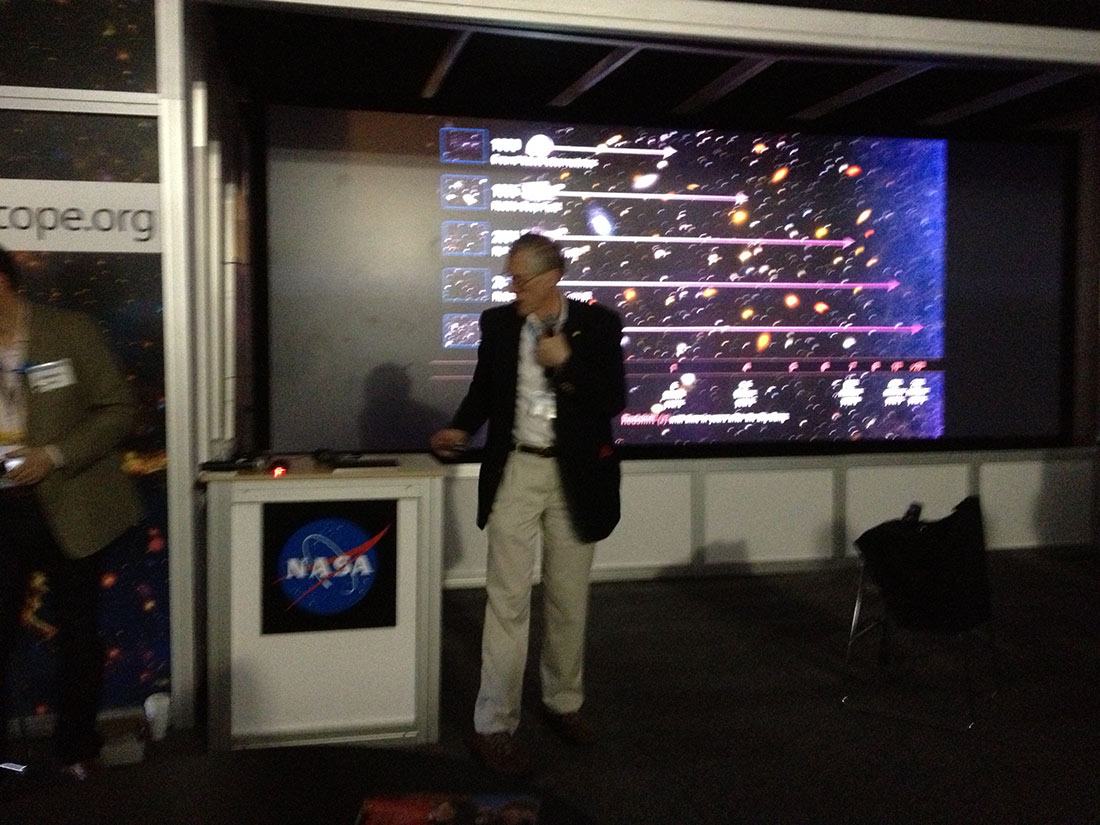
We listened to presentations from Dr. James Bullock and Scott Willoughby. One of the highlights was a talk by Dr. John Mather, Nobel Laureate in physics.

photo-3

Outside, several engineers and physicists were available for questions and answers. This lady explained about the importance of proper placement (Lagrange point L2) of the JWST beyond the Moon’s orbit for gravitational balance.  L2 is 940,000 miles from Earth, four times as far away from Earth as the Moon. The Sun is 93,000,000 miles from Earth.

IMG_3058

We made our way back inside the NASA Experience Tent to have a closer look at the displays, learn more about the design material and infrared technology, and to grab a few souvenirs.

SCAN0248

What a terrific opportunity NASA and SXSW gave the Austin community.

JWST set world record – Find out how the JWST set a world record on March 10th in Austin, Texas

This slideshow requires JavaScript.

Surprise from Barton Hills Elementary

•March 20, 2013 • Leave a Comment

In this day and age, I rarely receive hand-addressed envelopes in the postal service mail. When I do, it brightens my day with fond memories of receiving personal mail before the era of emails and the Internet. Today, I received such an envelope, and imagine my surprise when I opened it to find a beautiful handmade card from one of the students at Barton Hills Elementary School where I participated in an outreach event. Family Star Night – Barton Hills Elementary 2013

It really warms my heart when a child’s eyes light up while observing through my telescope. To receive this precious handmade thank you card, even more so. Thank you, Isabella!

thank-you1

Astronomy Now magazine: “Drawn to the Universe” March 2013 issue, M79

•March 19, 2013 • Leave a Comment

Astronomy Now magazine

“Drawn to the Universe”
March 2013 issue – Deep Sky
Target – M79 (NGC 1904)
Media – White paper, graphite, blending stump and tortillon

Untitled-3

Link to observation report: 2013 01 11 – NGC 1904 / M79

20130111 m79

Archive for the ‘Drawn to the Universe’ Category

2013 01 11 – NGC 1904 / M79

•March 19, 2013 • 1 Comment

2013 01 11, 0504 UT NGC 1904 / M79, constellation Lepus
Erika Rix, Texas http://www.pcwobservatory.com
102mm f/9.8, LXD75, 8mm TV Plossl, 2x Barlow, 250x (highest useful magnification estimated at 240x)

Globular cluster, Class V, constellation Lepus, 05h 24m 10.6s, -24º 31′ 27″, 7.7 vm, size 8.7´

20130111 m79

Eyepiece sketch on white photocopy paper with black super-fine felt tipped pen for and #2 pencil, 0.5mm mechanical pencil, blending stump for the nebulosity. General Observing Form template.

2012 12 19 – NGC 1904 / M79

•March 19, 2013 • Leave a Comment

2012 12 19, 0525 UT NGC 1904 / M79, constellation Lepus
Erika Rix, Texas http://www.pcwobservatory.com
AT6RC f/9 1370mm, LXD75, Hyperion 8-24mm Mark III @8mm, 171x
64F, 88% H, S: P4-5, T: 2/5-4/6, Alt 33deg 32´, Az 169deg 28´

Globular cluster, Class V, constellation Lepus, 05h 24m 10.6s, -24º 31′ 27″, 7.7 vm, size 8.7´

20121219 M79

Eyepiece sketch on white photocopy paper with black super-fine felt tipped pen for and #2 pencil, 0.5mm mechanical pencil, blending stump for the nebulosity. General Observing Form template.

2013 March 16/17th – AAS Messier Marathon

•March 18, 2013 • Leave a Comment

Terry's 20" in the foreground, my 16" to the right in the background

Terry’s 20″ in the foreground, my 16″ to the right in the background

The night of March 16-17th was our scheduled club event for the Messier Marathon for the Austin Astronomical Society. The weather was iffy but many of us made the trek to the Eagle Eye Observatory at Canyon of the Eagles (COE) with optimism that the weather would hold. That Saturday was also the COE’s public star gazing night, so it was fun to see the observatory opened up for outreach as well. This was to be my 2nd Messier Marathon of the week. The first was on March 13/14th from my property. 2013 March 13/14 Messier Sketching Marathon. I had observed 106 Messiers and sketched 103 during that session.

My primary mirror became severely out of alignment between dismantling/traveling/and reassembling the telescope again at COE that the collimator’s laser wouldn’t return to the focuser drawtube after bouncing off the primary. Thanks to the help of Mike Krzywonski and Terry Phillips, the three of us were finally able to collimate the scope with time to spare before the event. It was a warm evening and other than a few clouds along the horizon, it would be a great night.

I started off with a few bright targets, M42/43, naked eye of M45, and M103. Next came a successful spotting of M74! It appeared nearly stellar and then eventually a faint halo appeared around it. I called Terry over for a look and for verification. So happy to have caught M74, I moved on to M52 and M77 and then grabbed sketches of M31/32 and 110, which I missed sketching in the prior marathon! I steadily made my way through the sky, taking my time and enjoying the company of Kass Brown while sketching and hunting down targets. The wind was atrocious to the point that I had to scrunch up the shroud around the base of the struts to minimize wind resistance. Too many times the wind pushed the scope up or swung it around during while sketching in between views, forcing me to find the target yet again. It was still a great night and time was on my side. I knew I would have no problems finding and sketching all the Messier objects until the morning when the large hills to the SE would block out a handful of morning targets.

Close to midnight while working through Ursa Major, the weather took a turn for the worse. It completely blindsided me. I didn’t bother with fresh weather updates during the course of the evening and was very disappointed that the sky became 90% overcast. I grabbed two more targets, M106 and M97 before the last few sucker holes closed up completely. It was time to put the clipboard down and make my way over to the small group of observers still in that part of the field. Drinks, snacks and good company were in order before tearing down and heading home! What a great night regardless of having to turn the event into a “mini” marathon.

Somehow, I had miscounted how many pages of templates I had sketched through and believed that I had bagged 62 objects up to that point. Yes, I know, it seemed pretty high for just after midnight. It’s funny how your mind can get you to ignore reason at times like that. This morning, I finished unpacking the last of the gear that I had drudged into my office. I should say it wasn’t surprising when I reviewed my sketches and found that I had only bagged 42. Ha!

Below are the links to the results.

20130316 results – This pdf shows a comparison between both marathons during the week.
20130316 sketch results – pdf of the sketches

This slideshow requires JavaScript.

2013 March 13/14 Messier Sketching Marathon

•March 16, 2013 • 5 Comments

Wednesday evening through dawn on Thursday, I did my first run of the Messier Marathon, only I added the extra challenge of sketching it as well. Deranged? Perhaps. But if I am, then I’m in good company with a fellow sketcher, Jeremy Perez. In fact, if it weren’t for him, it probably wouldn’t have dawned on me to attempt it. He had a very successful run in 2009 by sketching 104 of the Messier objects (2009 All Arizona Messier Marathon). This was something I just had to try for myself. And try I did: 106 objects were observed, and 103 Messiers were sketched plus a handful of NGC/IC objects that were in the same fields of view. While observing M31, M32 and M110, I got sidetracked before sketching them. Much to my dismay, it was only after looking over my sketches the next day that I realized the omissions. Regardless, I was pleased with the run and am going to attempt it again this Saturday for our club’s rescheduled Marathon event.

If you’re interested in running the Messier Marathon or even sketching it, please have a look at last week’s blog on sketching the marathon. You’ll find links to Jeremy’s site plus a few others that are packed full of valuable information to help prepare you.

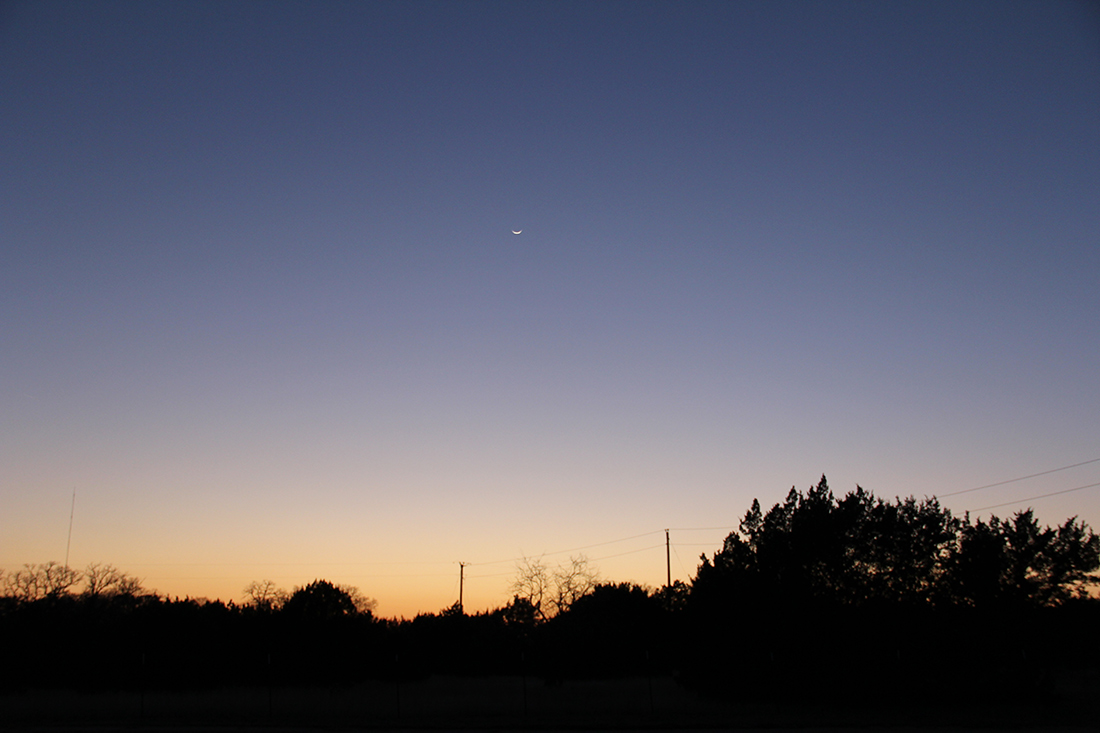
sunset

Now to the nitty gritty. I chose a location in our front field that would give me the lowest 360-degree horizon. As luck would have it, the only section of sky that sports a neighbor’s security light was in the north. We also have Austin’s light dome to the south. Neither affected locating the objects. I set up and had the 16” reflector collimated before 8pm. Comet PanSTARRS was in the western sky but I didn’t want to waste any time locating the Messiers so resisted the urge to sketch it. Having reviewed Jeremy’s run of the marathon, I tried to set up my observing table similar to his for time management during the night.

Observing locaton

Observing locaton

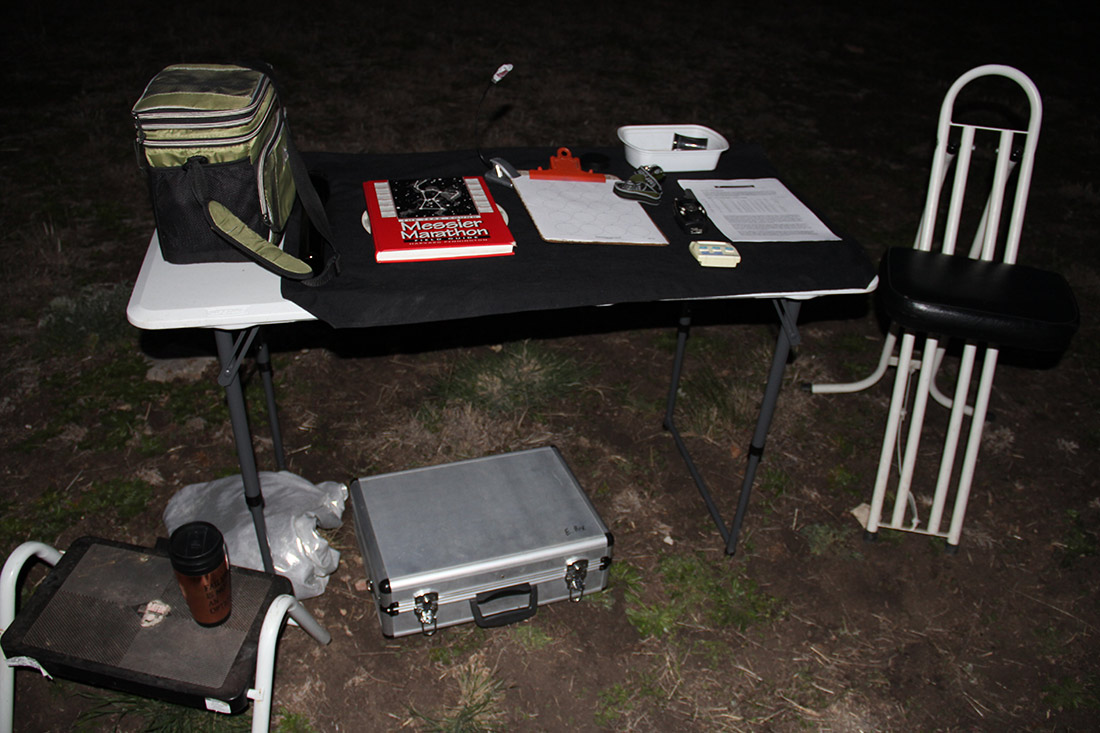
My table included:

  • A bright mag light for emergency lighting (you never know when you will need a LOT of light, like RIGHT now)
  • A couple red lights
  • Cooler with snacks and drinks
  • Travel mug with coffee
  • Walkie talkie to get hold of Paul in the house for more hot drinks or to give him updates on my well being
  • sketch kit containing pencils, eraser, and a blending stump that didn’t get used
  • Planisphere (that didn’t get used)
  • The Year-Round Messier Marathon Field Guide by Harvard Pennington (a God-send!)
  • Printout of Bill Feris’ sequence list and notes on running the marathon
  • Clipboard with marathon sketching templates designed by Jeremy (I chose the custom sequence templates)
  • A timer so that I could budget my time with each object (didn’t take long for me to toss that one to the side as I felt under pressure and nagged when using it)
  • Tylenol

I also brought out my observing chair that got used as the night and my weariness progressed, an observing stool to stand on for objects closer to zenith, eyepiece and accessory case, my solar cloths to keep dew off the table and chair, battery for anti-dew strips for my Telrad and eyepieces. And 3 clothes pins. Don’t laugh, they come in handy at the least expected times.
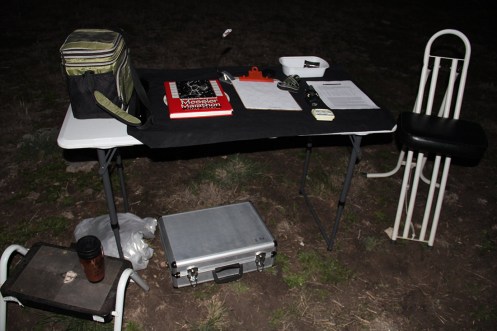
preparing

My plan was to use Bill’s observing sequence and then Pennington’s Messier guide as a back up. My first targets were M42/43 followed by a naked eye observation of M45 – I came back to that one with my telescope later on. Worried about time management, I worked myself into a sweat and had to get rid of my coat, neck warmer and hat. I also got rid of the timer and soon Bill’s list got tossed aside as well (sorry Bill!). The only reason I stopped using Bill’s list is because I found myself referring to the guidebook so much that I was worried I’d omit objects by using both, as was the case with Andromeda, M110 and M32. They were observed, but not sketched and that was around the same time that I switched to solely using the book.IMG_3030[1] This probably wouldn’t have been a problem had I filled in the planned Messier catalog numbers on the custom sketch templates prior to running the marathon. My thoughts were to cross off the objects on Bill’s list as I sketched them. Next time around, I’ll fill in the catalog numbers first to eliminate the possibility of missing any.

Something else that I hadn’t planned for was the need to switch back and forth quickly between the eyepiece view, my sketch, and the guidebook. I found that my normal red light that secures to my clipboard for sketching was just in the way and too dim. I needed more light and quick access to all three areas, so hung my red light headlamp to the eyepiece holder. By placing the book under my clipboard, I could quickly switch the sketch and book under one light. That saved time and effort. It wasn’t necessary for me to have a really dim light for this type of sketching. I was in it for quick dirty sketches, not delicate detailed ones.

I started off with an 8-24mm zoom eyepiece then switched to a 13mm Ethos for decent magnification with a very wide field of view for ease of locating the objects. There were  times that I even swapped out for a 34mm Titan, as in the case of viewing M24. The 13mm Ethos was used for the majority of the marathon.

M74 was a wash. I could barely make out nearby stars above the crescent Moon for star hopping to it and moved on to the next target for fear of wasting too much time. I did try once more after the Moon sank below the horizon but to no avail. From there on, everything seemed to run like clockwork until Virgo. Holy cow. I had to return to “home base” several times and refer back to my phone app, Starmap Pro, several times before I felt secure that the star fields and objects were correct. Breathing a sigh of relief to finally make my way past Virgo, it was smooth sailing again.

I never did get a break during the night for a quick nap; however, I managed to walk back to the house for something. What that something was, I’m not sure. My brain was on autopilot by that point. I remember seeing that the coffee pot was empty and becoming grumpy very quickly before high tailing it back outside. Imaging my relief when about 10 minutes later, Paul came out with a fresh travel mug full of hot mint tea for me. Bless his heart!

Sometime around 3-4 a.m. I became chilled and had to put my coat and hat back on. Dew was setting in and making my paper soggy. I hadn’t thought to use my Rite in the Rain paper for the templates. The result was soft, out of focus stars in my drawings. Well that’s my excuse, anyway. If my sketches lack detail or look soft and rushed, that’s because I spent only about a minute each to sketch them! I concentrated solely on the basic shapes and prominent field stars for identification purposes. I also found myself stumbling over the front wheel of my Scope Buggy. I chalk that up to exhaustion setting in. Next time, I’ll point the front wheel to the north so that it will be out of the way for the majority of the marathon.

At 5 a.m. I was thankful that I took Bill’s advice on his website by adding pain pills to my observing kit. Dehydration, fatigue and dampness set in giving me the start of a headache and achy neck. I was able to catch it in time before it became a whopper. My legs also began to get shaky and as most of the targets were by that time lower in the horizon and to the south, I took advantage of my observing chair or simply lowering myself to my knees as much as I could. Thankfully I didn’t gouge myself from young prickly pear. It would have been wise for me to lay a tarp on the ground in my observing area before setting up.

During the evening hours, the birds kept me company. As the night progressed, the only sounds I heard were those of owls, coyotes, neighboring dogs in the distance, a couple cat fights, donkeys braying, a few horse whinnies, and a rustling at the edge of the field near the tree line where I imagine the deer were watching me since I set up where they normally sleep at night. Music to my ears, though, other than the occasional walkie talkie chirps from Paul, was when I heard the first bird songs of the morning. That meant I was nearing the end of the marathon!

I glanced down to see what sketching template page I was on. It seemed like I still had so many to do! But then I reminded myself on how far I had already come and was determined to work hard to finish. At the end, I missed the last three, two of which were in Aquarius, M72 and M73 and then the final one in Capricornus, M30. It was sheer luck that I had a few stars to judge where M2 was and then only found it by scanning and then checking the Telrad once again after locating it.

What a relief to finally have the marathon completed! I was so revved from finishing the marathon that somehow I had the energy to tear down my gear and visit with Paul before grabbing a few hours of sleep. I’m only now just starting to really recover from the session, although my joints ache and I have a pretty hefty headache as a result of neck pain. I also had a touch of dehydration from not drinking enough during the night.
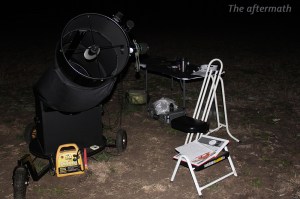
The Aftermath

Now, to prepare myself for the next marathon – tomorrow night. I may just have to act as part of the support crew for our club’s marathon event instead. As a recap of things I’ll do a little differently:

  • Add a tarp to set up on. This will especially be important at our club’s dark site at Canyon of the Eagles where the sticker plants are treacherous.
  • Point the front wheel of the Scope Buggy to the north.
  • Write the Messier numbers on my sketching templates in the planned order of observing them prior to the event.
  • Forgo using the zoom eyepiece and stick with the 13mm Ethos with the rare swap out of the Titan.
  • Drink more!

Sketching results can be viewed in this pdf, 20130313 MM sketching results, or by accessing individual pages from the gallery below. They are in observed sequence. I also have a pdf of the spreadsheet showing the list with times, both by Messier catalog order and by timed observed order. That list can be viewed by clicking this link: 20130313 results

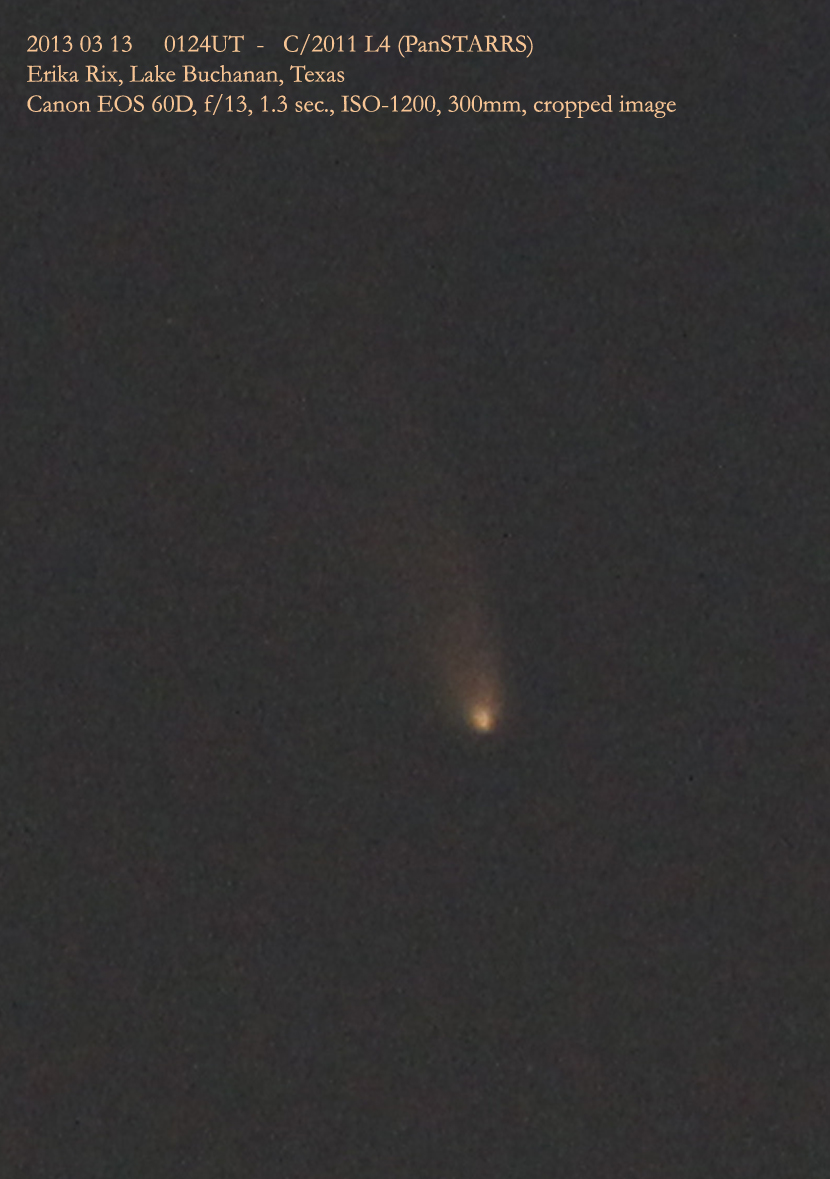
2013 03 13 C/2011 L4 (PanSTARRS) and 1.26-day Old Moon

•March 13, 2013 • 1 Comment

IMG_5773

One of the hot astronomy topics this month is the comet PanSTARRS (c/2011 L4). Just days ago, those of us in the northern hemisphere were finally able to view first hand what we’ve only before been able to read about from our southern neighbors. For more information about PanSTARRS, please visit Astronomy magazine’s webpage: Comet PANSTARRS – Astronomy magazine

March 10-11th, my husband, Paul, and I drove to a nearby county road to set up the tripod, camera and binoculars. The viewing location had a low, flat horizon to the west. Much to my disappointment, the comet eluded us both nights. By the third night, even though the comet would be higher in the sky, we decided to head to a better location with a higher altitude, Lake Buchanan in Burnet. The 1.26-day old Moon would be viewable after sunset and could be used as a reference for location PanSTARRS.

After sunset, Paul was first to locate the young Moon with the 10×50 binoculars. I located it next with the 15x70s, then panned the sky to the left and within minutes located the comet. After another 15 minutes passed, I was able to locate PanSTARRS with unaided eye, although the tail required the use of the binoculars.

Click on the image below for higher resolution. You’ll see PanSTARRS off to the left side of the photo.
IMG_5774

2013 03 12 – NGC 7006 (H 1.52/C42)

•March 12, 2013 • Leave a Comment

20130312-NGC7006-75x

Most globular clusters are located within the Galactic halo. NGC 7006, however, resides in the outskirts of the Milky Way, roughly 150k light-years away from the Galactic center. Although my observation was in the early morning hours of March, this stellar formation actually makes a terrific October target. It’s small and dim, which can make it difficult to locate. Look for neighboring star patterns and then increase your magnification to help locate it. You’ll see a dense core at all apertures with a faint halo evident in 8” scopes. My 16” f/4.5 reflector at 75x revealed a smooth, round 1.5′ disk with a brighter dense center. Increasing to 150x, it appeared slightly mottled with an absence of resolved stars. I attempted to increase magnification to 225x but the cluster became too dim to pull out more detail. My best view was at 150x with a 42-degree TFOV.

NGC 7006 (H 1.52/C42)
Class I (most star dense) globular cluster in the constellation Delphinus, 21h 01m 29.3s, +16º 11′ 16″, 2.8′, 10.6vm, 185k to 127k ly distance depending on source


Erika Rix – Liberty Hill, Texas
http://www.pcwobservatory.com
16” f/4.5 reflector on a non-driven Dobsonian mount, 8-24mm Baader Hyperion

Sketches were created with an observing template, #2 graphite pencil, loaded blending stump with charcoal and a super-fine Faber-Castell Pitt artist pen “S.

20130312-NGC7006

Sketching the Messier Marathon

•March 5, 2013 • 2 Comments

March and April provide us with an opportunity to test our observing skills by locating as many of the 110 Messier objects as possible from dusk to dawn near new Moon. This challenge is called a Messier Marathon.

Charles Messier (1730-1817) was a French astronomer and comet hunter. While observing in the constellation Taurus in 1754, he noted a comet-like nebula and decided to create a catalog to help other astronomers distinguish the difference between comets and other objects. The nebula in Taurus marked the first object in his list, M1 (the Crab Nebula, a supernova remnant). By 1771, he compiled a catalog of 45 objects presented to the French Academy of Sciences that was published in 1774. In subsequent years, Messier added additional objects to the list. The catalog is simply a compilation of targets, not necessarily objects that Messier himself discovered.

Today’s Messier list is actually four catalogs combined that, after errors were accounted for, consisted of 103 objects. Seven more deep sky objects observed by Messier (but not included in his original catalogs) were added in the 1900s, bringing the total to 110 Messier objects in the catalog. If you’re wondering why it’s said that the Messier catalog really has only 109 objects, it was discovered that  M102 is a duplicate of spiral galaxy M101 in the constellation Ursa Major. An elliptical galaxy in Draco, NGC 5866, was disputed to be M102 but cannot be verified due to plotting discrepancies. Because of this, NGC 5866 is sometimes used by amateur astronomers as a substitute for M102.

In the 1960s, according to The Year-Round Messier Marathon Field Guide by Harvard Pennington, a group of Spanish observers began working with the idea of a Messier marathon. By the mid-1970s, two American observers, Tom Reiland and Tom Hoffelder, started the marathon as we know it today – an informal competition for a single observer to locate as many Messier objects as possible from dusk to dawn. Around the same time, Don Machholz from California, conducted his own marathon, unaware of Reiland and Hoffelder’s efforts. Gerry Rattley is said to be the first to observe all 110 objects on March 23-24, 1985 in Arizona. The marathon really took off in the 1980s and continues to be a great way to hone your observing skills regardless of your experience. SEDS- The Messier Marathon is a tremendously valuable resource packed full of information to help you have a successful night as well as results from past marathons.

To take this challenge a step further, there are spinoffs for the Messier Marathon. For instance, some observers conduct the marathon using binoculars, others even try their hand at imaging each object. A few years ago, fellow sketcher and co-author, Jeremy Perez (Belt of Venus) challenged himself by sketching the marathon in 2009. He was able to sketch a whopping 104 of the 110 objects in one night! Make sure to check out his 2009 All Arizona Messier Marathon report. He’s been such an inspiration to me that this year, I’ve decided to attempt sketching the marathon as well.

There are a few tips that he shared with me:

  • time management is essential – allow only 5-10 minutes per object, if unable to locate and sketch the target, move on to the next one
  • use smaller sketch-circle templates – creating smaller sketches saves time
  • render only a few of the prominent field stars and then a rough sketch of the target itself – you can always revisit the objects on a later date for a more-detailed observation/sketch
  • organize your star charts, sketch kit, templates, snacks and drinks, and lists in such a way to optimize time management
  • run practice marathons prior to the actual event

If you’d like to sketch the Messier Marathon, Jeremy put together a page of useful information that you’ll want to take advantage of. It includes templates, marathon reports and drawings, and resource links – Sketching the Messier Marathon

For additional information, I hope you’ll check out the Astro Sketching column in the March 2013 Issue of Astronomy Magazine – The Messier Marathon. Please feel free to share your marathon experience here! I’d love to hear about it.