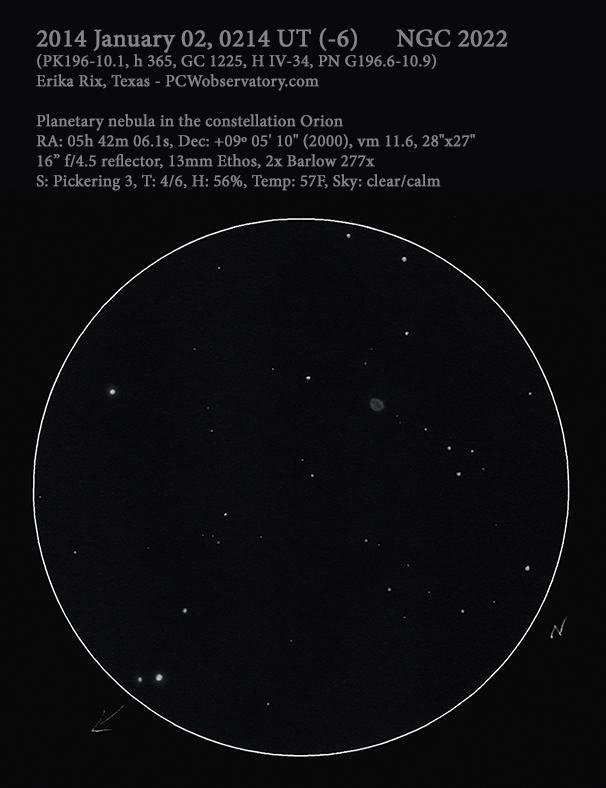
This small planetary nebula lies on an imaginary line between Lambda (λ) Orionis and Alpha Orionis (Betelgeuse) in the throat of Orion. Despite its size, it was an easy find unfiltered and resembled a bright fuzzy star at 138x through a 16-inch scope. At 277x, it appeared elliptical with a SSW-NNE elongation and bluish tint. The western and eastern edges were brighter and the center of the nebula was faint by comparison. Neither the outer shell nor the central star was detected. The use of an OIII filter added more definition in the rim.
2014 January 2 – NGC 2090
•January 2, 2014 • Leave a CommentNGC 2090 is a grand-design type galaxy with two spiral arms in the constellation Columba. The highest this galaxy reaches in my central Texas location is 25 degrees above the southern horizon. That, combined with Austin’s sky glow to the south, made it a challenging target. To locate it, I dropped down from the constellation Lepus to find magnitude 2.7 Alpha Columbae in the constellation Columba. NCG 2090 makes a very shallow obtuse triangle with Alpha Columbae and Wezn, a 3rd magnitude star in the throat of the dove.
It was necessary for me to star hop from Alpha Columbae to detect NGC 2090. I nudged the scope 40 arcminutes eastward to find a 6-arcminute wide trapezoid. From there, I continued east another 50 arcminutes until I recognized a 5-star curved chain of 9th- to 11th- magnitude stars concave to the northeast. NGC 2090 is 7 arcminutes west of the chain. A magnitude 7.7 star lies 17 arcminutes southeast of the spiral galaxy.
Through a 16-inch reflector at 138x, the galaxy appeared as a faint south-southwest to north-northeast oval with a slightly brighter 1.5-arcminute elongated core. The spiral arms were weak but detectable in that I could see hints of dark lanes with averted vision within the faint, diffuse outer lens. Three stars flickered in and out of view just north of its core. Their magnitudes are 12.4, 13.7, and 13.45.
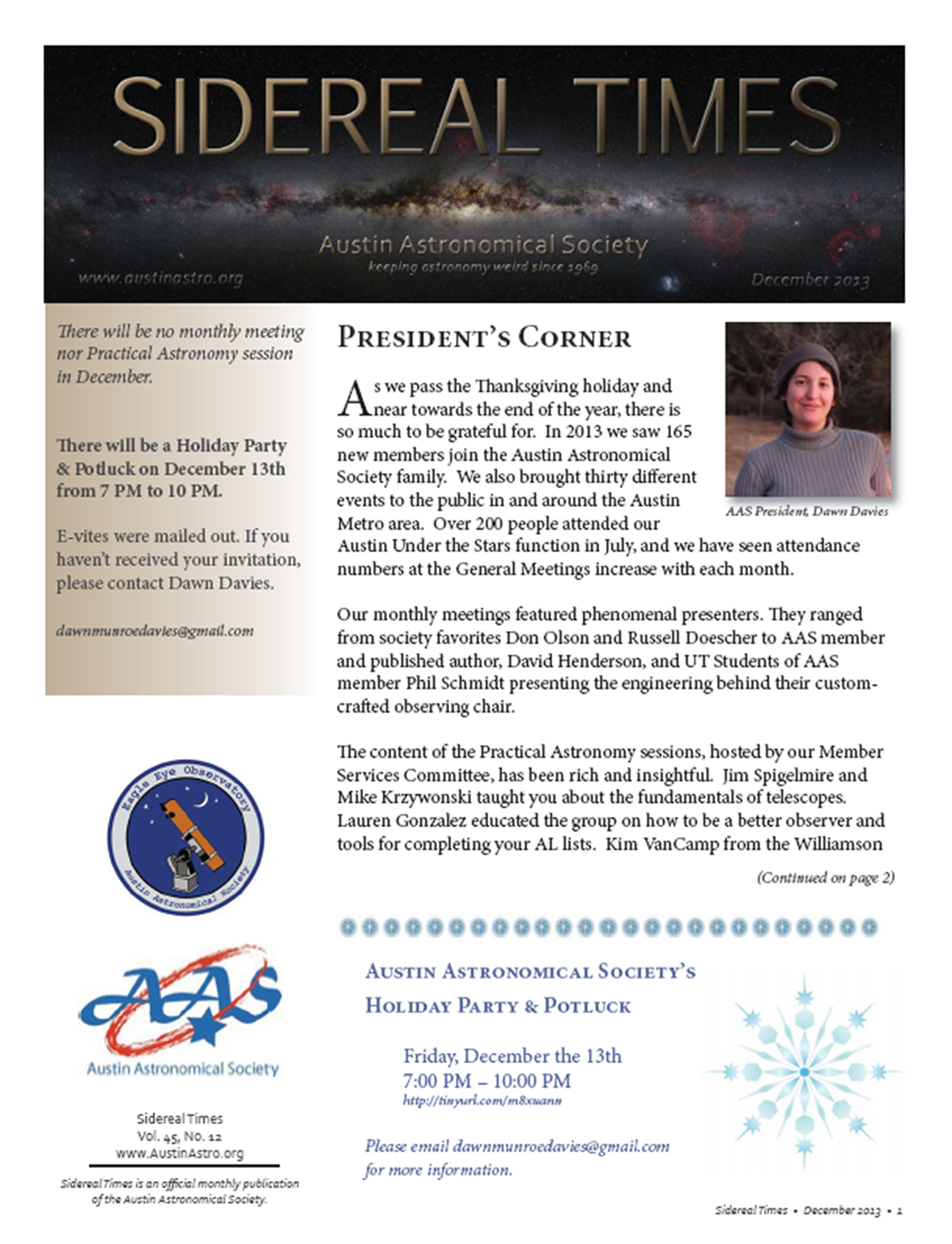
December 2013 Issue – Sidereal Times
•December 5, 2013 • Leave a CommentThe December 2013 issue of Sidereal Times for the Austin Astronomical Society is now available for download.

December 2013 issue of Sidereal Times pdf (1.13 MB)
Included in this issue are committee news, outreach events and reports, Image of the Month, December observing targets, NASA’s Space Place featuring volcanically active Io, Emily’s First Light report, Reaching for the Stars, Block House Creek Elementary Star Party, members’ gallery, “The Asteroids” transposed from Scientific American 1854 article, and Eldorado Star Party images.
Please contact me if you’re interested in joining the club or wish for more information! It’s a very active club and has a great outreach program.
August – November 2013 Sidereal Times
•November 15, 2013 • Leave a CommentBacklog issues of Sidereal Times, the Austin Astronomical Society’s monthly newsletter.
November 2013 Issue
October 2013 Issue
September 2013 Issue
August 2013 Issue
Please contact me if you’re interested in joining the club or wish for more information! It’s a very active club and has a great outreach program.
2013 09 – Double Cluster in Perseus (Caldwell 14)
•November 6, 2013 • Leave a CommentCaldwell 14 (NGCs 869 and 884) is a wonderful galactic cluster within the Perseus Spiral Arm. Viewable with unaided eye as a faint fuzzy patch between the lower left portion of the “W” in Cassiopeia and the sword arm of Perseus, it becomes magnificent through a low-power, wide-angle eyepiece and has become a favorite object of mine to share during outreach events.
NGC 869 (Cr 24, Mel 13, OCL 350, Lund 73, H 6.33, h 207, GC 512)
02h 19m 03.8s, +57º 08′ 06″ (2000)
200+ stars, 29′, m5.3v, Tr Type I 3 r
NGC 869 is the denser western cluster of the pair sporting a pair of bright magnitude 6.5 and 6.6 stars at its center. Several fainter stars surround the mag 6.5 star with the most obvious chain of 5 stars forming a curve toward its eastern side. The addition of two 8- to 9-magnitude stars to the north and south of the pair creates a N-S chain of stars extending 22 arcminutes. At 7200 ly away, NGC 869 is the younger of the two clusters (est. 6 million years old) with blue giants and supergiants as the brightest stars.
NGC 884 (Cr 25, Mel 14, OCL 353, Lund 76, H 6.34, h 212, GC 521)
02h 22m 32.1s, +57º 08′ 39″ (2000)
115+ stars, 29′, m6.1v, Tr Type II 2 p
NGC 884 is estimated to be 7500 ly away and the older of the two clusters (14 million years old) with white and red supergiants as the brightest stars. The brightest members form a large triangle to the NW with two smaller one further NE and SE. The overall impression is a broad, looser star cluster than NGC 869.
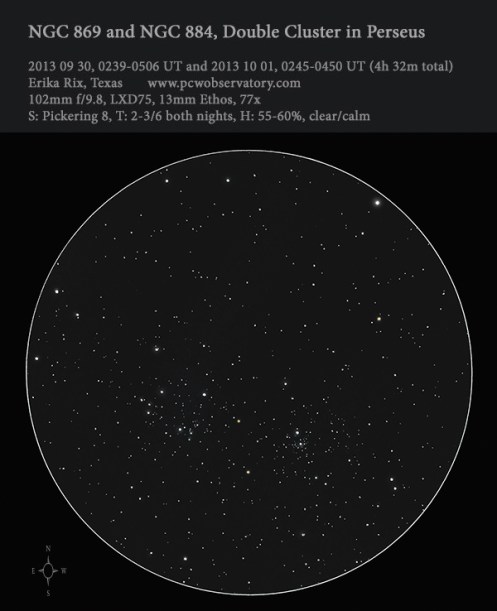
Eyepiece sketch took a total of 4 hours and 32 minutes to complete over two observing sessions. Rite in the Rain paper was use for its ability to hold integrity during humid conditions. Additional sketch media: super-fine black felt-tipped artist pen, #2 pencil, 0.5mm mechanical pencil, 6-inch circle template, blending stump to produce soft glow around brightest stars. Scanned and inverted in Photoshop. Stars were cleaned up (jagged edges removed if needed) and contrast added. Sketch was rotated so that north is up, west is to the right.
2013 11 01 – Cr 26 (Mel 15)
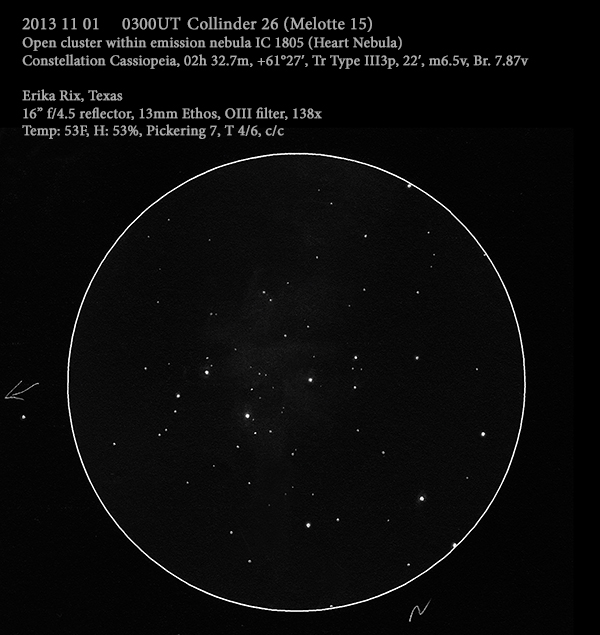
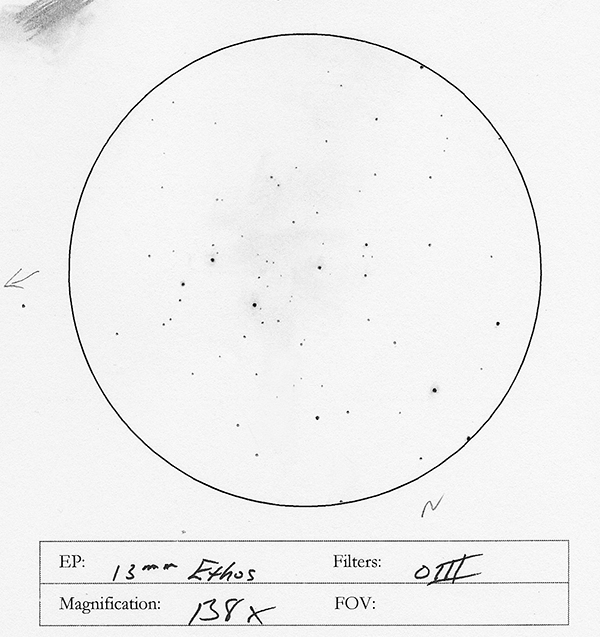
•November 5, 2013 • Leave a CommentWithin the center of IC 1805, the Heart Nebula (Sharpless 2-190), lies its open star cluster Melotte 15 (also known as Collinder 26). It’s a cluster measuring 22 arcminutes across and consists of 40+ stars with a Trumpler Classification of III 3 p.
Eyepiece sketch created with an observing template on white printer paper, a super-fine black felt-tipped artist pen, #2 pencil, 0.5mm mechanical pencil and a blending stump. The sketch was scanned in Photoshop, inverted and contrast adjusted to match eyepiece view.
Have a look at this fabulous image of the entire Sharpless 2-190 complex by Barry Schellenberg. Collinder 26 is seen in the center of the heart while open cluster Markarian 6 is nestled in its SW edge. The bright nebulosity at the bottom of the heart is emission nebula IC 1795 (NGC 896) with NGC 886 (Stock 6) consisting of a small grouping of 11th – 12th magnitude stars.
The nebula complex is just 5 degrees NE of the Double Cluster in Perseus, making it a fairly easy target to find. For a really nice tour, start at the Double Cluster and then hit Basel 10 to make out the small handful of stars in the small 2-arcminute open cluster. If you have a smaller telescope, skip Bas 10 and head NNW to Stock 2, a large open cluster measuring 60 arcminutes across. From there, you’ll see a small strand of 8-9th magnitude stars that form Mrk 6 before locating Cr26. You’ll have better luck viewing nebulosity within the emission complex with an OIII or UHC filter. I was able to see faint nebulosity with my OIII in Cr26 as well as the brighter sections of Sh 2-190 when panning the area.
2013 07 22 – Austin Planetarium’s Astro Camp
•July 23, 2013 • Leave a CommentThis is the second year I’ve had the pleasure to provide solar views during the Starry Sky Austin Astro Camp week at the All Saint’s Episcopal Church in Austin. My first experience was at the 2012 Astro Camp and this year was just as fun.
Lucia Brimer of the Austin Planetarium and Amy Jackson of Starry Sky Austin are the two astronomy educators of this program. They provide three tiers for the camp:
ASTRO CAMP I: PLANETS, STARS, AND TELESCOPES (ages 8-11)
ASTRO CAMP II: ASTRONAUTS, ROCKETS, AND ROVERS (ages 9-12)
ASTRO CAMP JUNIOR: PLANETS, STARS, AND TELESCOPES (ages 6-8)
During my solar outreach session, we had three educators and 20 children. With the help of two volunteers, Earth’s scale to the proper size in relation to the Sun was demonstrated using NASA’s Sun Pizza handouts. Topics also covered were the layers of the Sun, solar storms and how they can affect Earth, magnetic fields, solar features in various bandwidths and safe solar observing. We talked a little about the current active regions and the importance of studying the Sun. I also brought cool NASA handouts to introduce them to the Solar Dynamics Observatory and SOHO. With any luck, they’ll share what they’ve learned with their family and visit the websites printed on the handouts to learn more about the Sun!
One of the educators brought a telescope with a Sun funnel. I brought a dual mount with my double-stacked h-alpha 60mm Maxscope and a stopped down 102mm refractor, also equipped with a Sun funnel.
The Astro Camp is such a fun way to get kids interested in astronomy – thanks Starry Sky Austin and Austin Planetarium!
2013 July 6th Public Star Party at COE
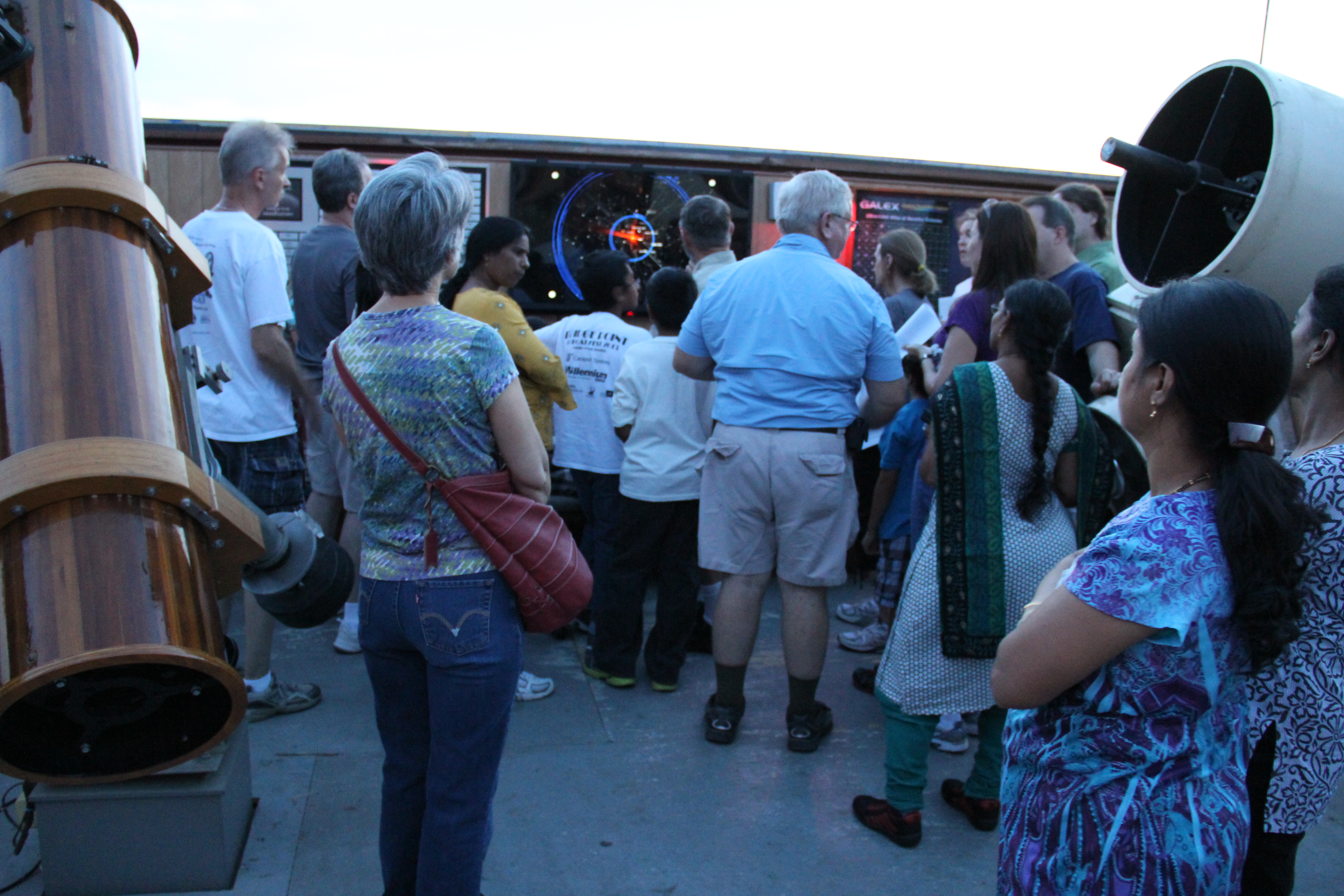
•July 7, 2013 • Leave a CommentOutreach events always ensure a great time for all involved. The forecast was partly cloudy for Saturday night, certainly doable to share the night sky with the public. I packed up the 16″ Dob and a cooler and set out to Canyon of the Eagles where our Austin Astronomical Society’s dark site it located – the Eagle Eye Observatory.
Our outreach chairperson for the AAS is Joyce Lynch (former AAS President) and she greeted the visitors while her husband, Jim, manned the observatory telescopes. The rest of us worked on observing lists, shared views with the visitors, and had imaging sessions. A quick guestbook count shows that around 130 visitors showed up despite the cloudy skies, including several children. They were all gathered in small groups, taking their turns at all the telescopes and binoculars that were sprawled across the observing field.
As for my part, I thoroughly enjoy teaching people how find objects in the sky by giving them quick instruction on how to use a planisphere, star atlas, and a Telrad, and then having them push the scope to the target. Along with that comes the opportunity to teach visitors how to use averted vision, awareness of light pollution and a bit about the objects they’re observing.
Soon the sky became nearly 90% overcast and the visitors slowly left the field to make their journeys home. As if on cue, the clouds dispersed again as we began packing up our telescopes. I contemplated staying longer until the realization hit me of how tired I was and knowing I that had a long journey ahead of me. Homeward bound it was.
July 2013 Issue – Sidereal Times
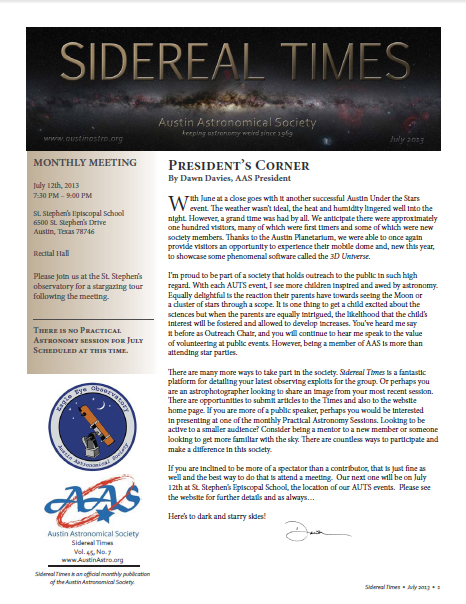
•July 2, 2013 • Leave a CommentThe July 2013 issue of Sidereal Times for the Austin Astronomical Society is now available for download.

July 2013 issue of Sidereal Times pdf (475 KB)
Included in this issue are committee news, outreach events and reports, July observing targets, Saturn Plus app review, image of the month plus the Reader’s Gallery, a letter to the Evening Star dated 1854 and much more!
Please contact me if you’re interested in joining the club or wish for more information! It’s a very active club and has a great outreach program.