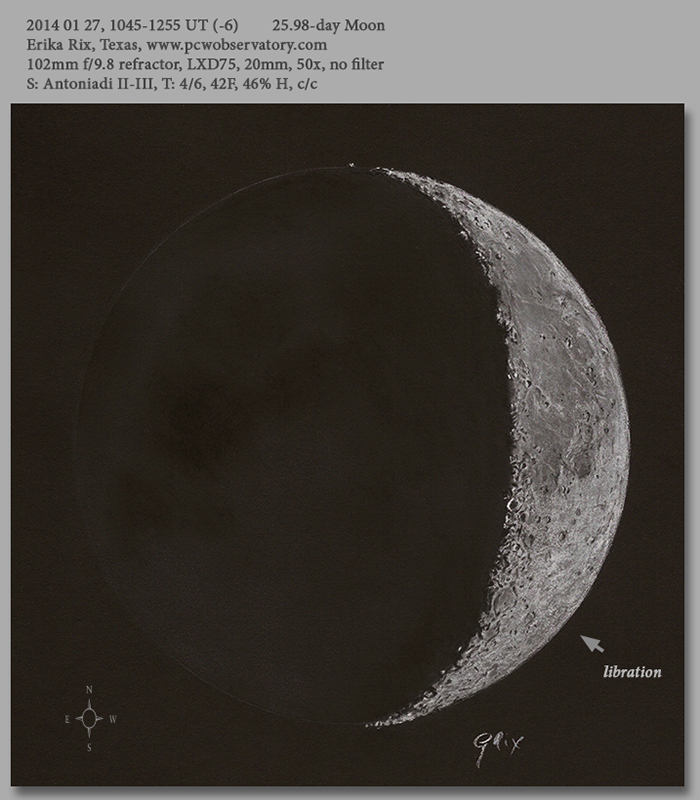
2014 01 27, 25.98-day Moon

•January 27, 2014 • Leave a Comment

Several days before and after New Moon, sunlight reflects off Earth’s surface and illuminates the lunar disk, especially the darker portion – the glow is known as Earthshine. Basic shapes of lunar features in the shadowed portion of the Moon can be seen, becoming more-defined the closer the lunation is to New Moon. Today, Mare Tranquillitatis is the most apparent of the shadowed features. With the unaided eye, the bright crescent appears to pop out of the Moon’s disk.

Erika Rix, Texas, http://www.pcwobservatory.com
102mm f/9.8 refractor, LXD75, 20mm, 50x, no filter
S: Antoniadi II-III, T: 4/6, 42F, 46% H, c/c
Colongitude: 227.5°
Phase: 228.4°
Lunation: 25.98 days
Illumination: 16.8%

20140127 25.98 day Moon

Eyepiece sketch on black Strathmore Artagain paper, white Conte crayon, white charcoal pencil, black Derwent charcoal pencil, black woodless oil pencil, blending stump.

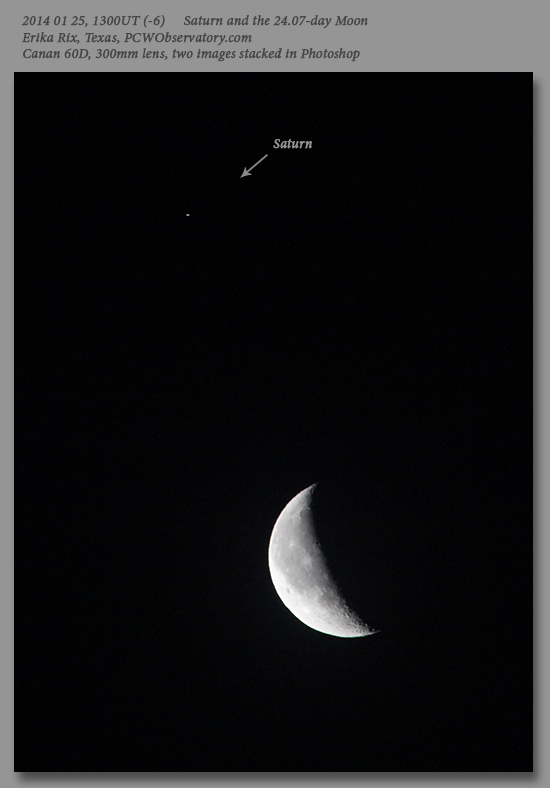
2014 01 25, 23.93-day Moon and Saturn

•January 26, 2014 • Leave a Comment

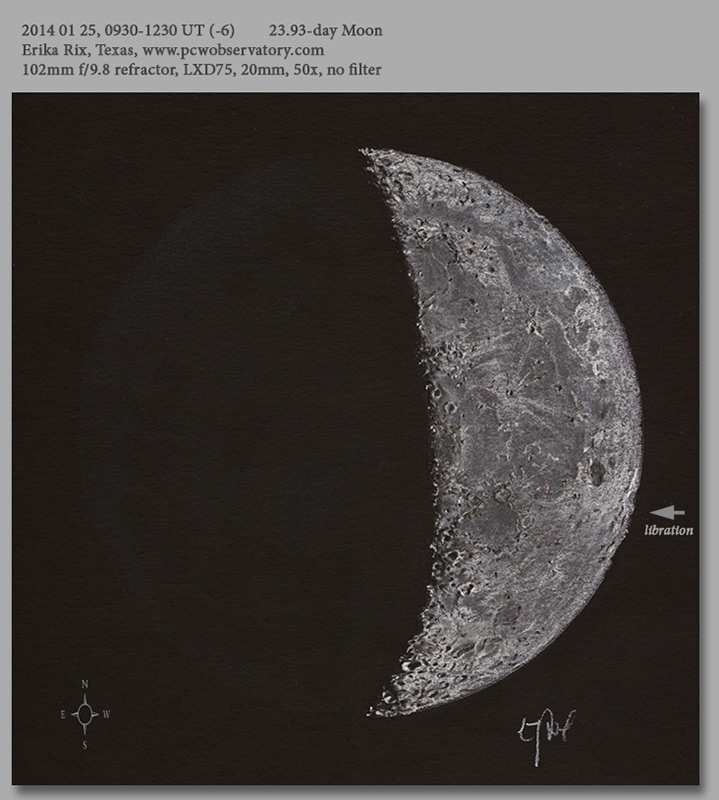
Libration favored a decent view of the eastern rim of Mare Orientale. The refractor telescope used flipped the view, so that in the sketch, the rim of Mare Orientale is to the right next to the libration pointer. I didn’t bother with a close-up sketch of the region, but you can see the darkened lines of Lacus Autumni and Lacus Veris. Montes Rook and Montes Cordillera are the highlighted lines. There was minimal indentation on limb.

2014 01 25, 0930-1230 UT (-6) 23.93-day Moon
Erika Rix, Texas
102mm f/9.8 refractor, LXD75, 20mm, 50x, no filter
S: Antoniadi II, T: 2/6 improving to 5/6, 26F, 39% H, c/c
Colongitude: 202.3°
Phase: 255.4°
Lunation: 23.93 days
Illumination: 37.4%

20140125 23.93day Moon

Eyepiece sketch on black Strathmore Artagain paper, white Conte crayon, white charcoal pencil, black Derwent charcoal pencil, black woodless oil pencil, blending stump.

20140125-Moon-and-Saturn

At 7am CST, Saturn could be seen just under 1 degree of angular separation from the Moon.

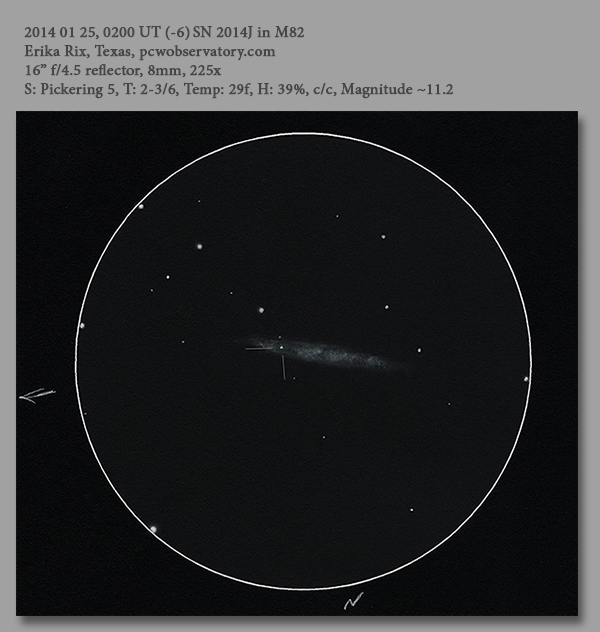
2014 01 25, SN 2014J in M82

•January 25, 2014 • 2 Comments

If the sky is clear, point your telescope to the constellation Ursa Major and have a look at the Cigar Galaxy, M82. A type Ia supernova was discovered within it on January 21, 2014, by Dr. Steve Fossey and astronomy students Ben Cooke, Tom Wright, Matthew Wilde and Guy Pollack from the University College London Observatory. M82 is 12 million light-years away, which in turn means that it’s taken that long for the light from the explosion to reach us.

This makes a fine target for large and small telescopes alike and should continue to brighten over the next couple weeks.

20140125 SN 2014J in M82
Eyepiece sketch created with white printer paper, #2 pencil, charcoal for nebulosity, and a 0.5mm mechanical pencil. The supernova is indicated in the sketch by two hash marks.

Related topics:
NASA Spacecraft Take Aim At Nearby Supernova
List of Recent Supernovae – IAU Central Bureau for Astronomical Telegrams
CBAT “Transient Object Followup Reports” – also from IAU Central Bureau for Astronomical Telegrams
Bright new supernova blows up in the Cigar galaxy (M82) by Astronomy magazine.
Bright Supernova in M82 – Astronomy Picture of the DAy

2014 01 22, 20.78-day Moon

•January 24, 2014 • 2 Comments

Lacus Autumni and Kopff are becoming more apparent on the southwestern lunar limb, as well as the northern edges of Montes Rook. Mare Orientale will be at its best on the 25th this lunation.

2014 01 22, 0630-0900 UT (-6) 20.78-day Moon
Erika Rix, Texas, http://www.pcwobservatory.com
102mm f/9.8 refractor, LXD75, 20mm, 50x, 13%T Moon filter
25F, 16% H, c/c, II, Transparency 5/6
Colongitude: 163.6°
Phase: 293.4°
Lunation: 20.78 days
Illumination: 69.9%

20140122 20.78d moon

Eyepiece sketch on black Strathmore Artagain paper, white Conte crayon, white charcoal pencil, black Derwent charcoal pencil, black woodless oil pencil, blending stump.

2014 01 21, 19.95-day Moon

•January 23, 2014 • Leave a Comment

2014 01 21, 1000-1242 UR (-6) 19.95-day Moon
Erika Rix, Texas, http://www.pcwobservatory.com
102mm f/9.8 refractor, LXD75, 20mm, 50x, 13%T Moon filter
38F, 28% H, c/c, Antoniadi III, Transparency 3/6
Colongitude: 153.5°
Phase: 302.9°
Lunation: 19.95 days
Illumination: 77.2%

20140121 19.95d moon

Eyepiece sketch on black Strathmore Artagain paper, white Conte crayon, white charcoal pencil, black Derwent charcoal pencil, black woodless oil pencil, blending stump.

2014 01 20, 18.77-day Moon

•January 21, 2014 • 2 Comments

Transparency made it difficult to grab sharp details for this sketch compared to the previous night.

2014 01 20, 0430-0700 UT (-6) 18.77-day Moon
Erika Rix, Texas, http://www.pcwobservatory.com
102mm f/9.8 refractor, LXD75, 20mm, 50x, 13%T Moon filter
37F, 32% H, thin clouds/c, Antoniadi II, Transparency 1/6
Colongitude: 139.1°
Phase: 316.1°
Lunation: 18.77 days
Illumination: 86.0%

20140120 18.77d moon

Eyepiece sketch on black Strathmore Artagain paper, white Conte crayon, white charcoal pencil, black Derwent charcoal pencil, black woodless oil pencil, blending stump.

2014 January 19, 17.84-day Moon

•January 20, 2014 • Leave a Comment

It’s fun to sketch lunar phases, especially when the weather allows you to record several nights during a lunation. There are a few tips I can offer that may be helpful if you’ve not yet tried your hand at it.

First of all, it can be easier to sketch highlights rather than shadows, especially when time is of the essence while sketching along the terminator. To do this, try using white pastel pencils on black paper. Concentrate on the brightest areas. The shadows will automatically form before your eyes. Next, it’s important to begin a full-phase lunar sketch along the terminator, as that’s where you’ll notice the most shadow change. During the first half of lunation (waxing phase), more lunar terrain becomes visible during the course of your observation as the light encroaches on the shadows. Shadows move inward, swallowing up visible terrain during the second half of a lunation, termed waning. To finish the sketch, add prominent lunar features to be used as anchors. They will aid in accurate placements and proportions for the remainder of the sketch.

I’ve indicated the favorable libration with an arrow toward the top of the sketch. Libration is the slow wobbling motion of the Moon as viewed from Earth. Over time, libration in longitude and latitude allows us to observe about 59% more of the Moon’s surface as it wobbles back and forth. The indicated libration on the sketch means that more lunar terrain is visible where the arrow is pointed. This also means that less lunar terrain is visible along the terminator on the opposite side of the sketch.

2014 01 19, 0430-0900 UT (-6) 17.84-day Moon
Erika Rix, Texas, http://www.pcwobservatory.com
102mm f/9.8 refractor, LXD75, 20mm, 50x, 13%T Moon filter
30F, 48% H, c/c, Antoniadi II, Transparency 4/6
Colongitude: 127.9°
Phase: 326.3°
Lunation: 17.84 days
Illumination: 91.6%

20140119 17.84d moon

Eyepiece sketch on black Strathmore Artagain paper, white Conte crayon, white charcoal pencil, black Derwent charcoal pencil, black woodless oil pencil, blending stump.

2014 January 7th – Solar Active Regions 1944 and 1946

•January 7, 2014 • Leave a Comment

Active region 1944 reached the middle of the solar disk today and produced an X1-class solar flare shortly after this eyepiece sketch was completed. For more info, please visit Spaceweather.com for the January 7, 2014 archive. This active region is so large that it could easily be seen with the use of solar glasses! Through a telescope, it burst into an amazing display of intricate details that was difficult to pull away from once the sketch was completed.

20140107 AR1944 and 1946

Sketched using white card stock, #2 pencil, and a 0.5mm mechanical pencil

January 2014 Issue – Sidereal Times

•January 6, 2014 • Leave a Comment

The January 2014 issue of Sidereal Times for the Austin Astronomical Society is now available for download.

ST201401cover
January 2014 issue (1.25 MB)

Here’s what you’ll find inside this month’s issue:

Are you searching for an extended-forecast astronomy weather app?

  • James Hall wrote a review for Scope Nights that may be just what you’re looking for.
  • Brian Cuthbertson’s January Observing Targets article provides information on three objects to shoot for this month, how to locate them, and what you can expect to see. Plus, Erika Rix included observation reports and sketches for two of those targets.
  • Alan Carruth shares a section of Scientific American about the Great Solar Eclipse of 1869.
  • Kieran Mulvaney, NASA’s Space Place, writes about The Big Picture: GOES-R and the Advanced Baseline Imager.
  • The Texas Star Party registration is now open. Are you on the fence whether or not to go? Check out one attendee’s Week to Remember to see just how much fun it is.
  • Plus catch up on AAS club news and events!

Please contact me if you’re interested in joining the club or wish for more information! It’s a very active club and has a great outreach program.

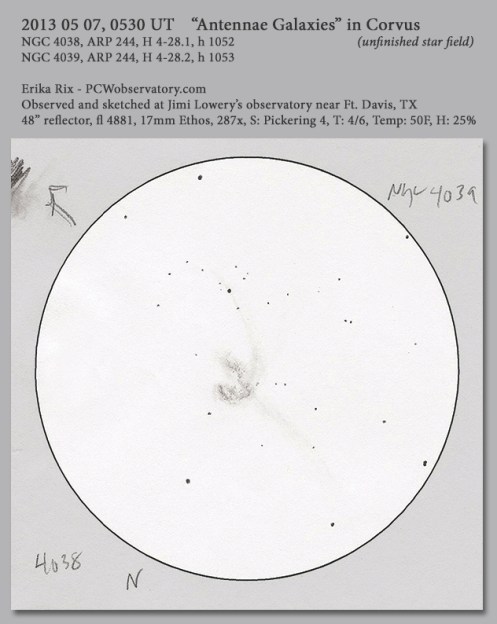
2013 May 07 – “The Antennae” NGC 4038 and NGC 4039

•January 4, 2014 • Leave a Comment

48-inch-Antennae-galaxies

As seen through a 16-inch telescope

As seen through a 16-inch telescope

Named for the two filamentary extensions uncurling from their nuclei, The Antennae (NGCs 4038 and 4039, also known as The Ringtail) are a pair of interacting galaxies in the constellation Corvus that began a collision course a few hundred million years ago. They will eventually combine to form a single elliptical galaxy, shedding light on what may occur when our own galaxy encounters the Andromeda four billion years from now.

NGC 4038, ARP 244, H 4-28.1, h 1052
RA: 12h 01m 53.0s, Dec: -18º 52′ 07″ (2000)
Sc Galaxy, vm 10.5, sb 13.3, size 5.2’x3.1′

NGC 4039, ARP 244, H 4-28.2, h 1053
RA: 12h 01m 53.6s, Dec: -18º 53′ 10″ (2000)
SBm Galaxy, vm 10.7, sb 12.2, size 3.1’x1.6′

Through a 16-inch telescope, the pair resembled a puffy V-shape opening to the WSW. NGC 4039 was long and slender compared to its companion. A bright nodular loop surrounded the dark central patch within NGC 4038. Using averted vision while observing through a friend’s 20” telescope, I was able to see hints of the filaments scarcely extending from the eastern base where they join.

Later, I had the opportunity to create a quick eyepiece sketch of the Antennae through Jimi Lowery’s 48-inch reflector. We were both able to confirm long extensions of the antennae at 287x. The filaments were thick near the galaxies’ base; the northern filament branched the furthest of the two. Bright nodular areas (very mottled and somewhat stellar) were observed looping through the northwestern lobe of NGC 4038, breaking apart as it extended south with a thick nodular patch in the middle of the southern edge. A faint notch could be seen at the SSE base where the pair joins. A bright, jagged line extended the full length of NGC 4039 and faint nebulosity outlined both galaxies.