2011 06 27 – NGC 5204/H 4.63/UGC 8490

•June 28, 2011 • Leave a Comment

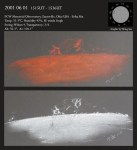
This is a type SA(s)m IV-V galaxy, 04.9′ x 3.1′, m11.3v, SB 14.1 found at 13h29.6m +58°25′ in Ursa Major. Distance is ~14.05 million light years. It had diffuse edges and a slightly concentrated core.

Part of the M101 group, NGC 5204 is a magellanic spiral. Magellanic spirals are galaxies with a classification type Sm (including SAm, SBm, and SABm). They are unbarred and have only one spiral arm.

  • NGC 5204: A Strongly Warped Magellanic Spiral. I. Light Distribution and HII Kinematics – by Sicotte, V.; Carignan, C.; Durand, D.
  • NGC 5204/H63-4 – by NGC IC Project
  • 2011 06 27 – M51/NGC 5194, NGC 5195/H 1.186, Supernova 2011dh

    •June 27, 2011 • 1 Comment

    Last night, I observed a supernova in the Whirlpool galaxy. A supernova is the explosion of a star. Simply put, at the end of its life, a large star collapses in on itself and its inert core exceeds its critical mass (1.44 solar masses). At that point, a shock wave is formed that causes a massive explosion.  A type II supernova marks the death of the star.  Depending on the star’s mass, either a neutron star or a black hole is formed as a result. So much energy is released in a supernova that it is possible to visually observe it even in a galaxy millions of light years away.

    The ejected matter (that is left over after a supernova) forms what is known as a supernova remnant, which is a rapidly expanding shell of hot gas. Probably the most famous supernova remnant is the Crab Nebula in the constellation Taurus. The Crab Nebula was formed when a star ~6500 light years away (in our own galaxy) went supernova. Chinese astronomers in the year 1054 A.D. recorded a “guest star” (supernova) that was so bright that it was visible during daylight hours for more than three weeks and they were able to observe it for ~2 years before the supernova faded away. This supernova formed the crab nebula, which is still expanding.  (2011 03 03, M1/NGC 1952 report)

    click on thumbnail for inverted view


    The supernova in M51 is a type II supernova. A star with a mass of 9-50 times that of our Sun is required for a type II supernova to occur. Also known as: Arp 85 and UGC 8493.

    So how do we determine solar mass of other suns (stars)? We compare it to our own Sun’s mass:

       (or 1:332,946 ratio of Sun:Earth)

    This is the second time in 6 years (first was in 2005) that a type II supernova occurred in M51. A third supernova occurred in 1994. You can see the supernova in my sketch from last night, marked to the left of the M51’s spiral arms. For comparison, I’ve included an image of M51 that Paul took prior to the explosion with the ED 80 and a DSI III Pro.

    Credit: Paul Rix, M51 taken with Orion ED 80, DSI III Pro

    For more information regarding the supernova 2011dh in M51 and supernovae in general, please visit the following links:

    ”The first hint of the eruption came on May 31st, when French amateur Amédée Riou noticed a previously absent 14th-magnitude star in CCD images of the galaxy. Riou recorded it again the following evening. Independently, it was identified on June 1st by Thomas Griga in Schwerte, Germany. The next night it got picked up by Tom Reiland in Glenshaw, Pennsylvania, and by French observer Stéphane Lamotte Bailey who noticed it on digital images taken through his 8-inch telescope.”

    The Whirlpool Galaxy (otherwise known as M51 and NGC 5194) is a face-on spiral and is just south of its companion galaxy NGC 5195. The stellar core of NGC 5195 was brighter than that of the M51, although M51’s core seemed larger. They are located in Canes Venatici. M51 is ~35 million light years distant from us, magnitude 8.4v, and is ~ 08.2’ x 6.9’ in size.

    2011 06 17 h-alpha, NOAAs 11236, 11234

    •June 17, 2011 • Leave a Comment

    Sketches created scope-side with black Strathmore Artagain paper, white Conte’ crayon and pencil, Derwent charcoal pencil, black oil pencil

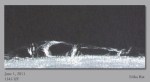
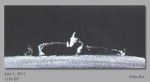
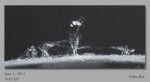
    There were two active regions listed today that I observed in h-alpha, 11236 and 11234. NOAA 11236 was spread out more compared to 11234, although 11234’s plage was more distinct. There was a very long slender filament reaching up and around 1236.

    A very large, beautiful, fast-moving prominence graced our presence on the SE limb. I had to check a few times once I came back into the house to make sure it wasn’t the western limb putting on a show on the SOHO website. But I was certain of the FOV drift when I turned off the mount and it is indeed a SE prom. It is particularly distinctive because of a very bright, flat plage area to the N inner limb of the prominence where the faintest arm of the prominence reaches away from the brighter main area of plasma.

    I took a break from drawing the prominence to sketch the full disk, only to find that it looked like a crescent hanging far above the limb by the time I came back. Pushing for more magnification, I could, of course, observe the faint areas connecting the whole area together.

    2011 06 05 – 4.12 day old Moon

    •June 7, 2011 • Leave a Comment

    2351 UT
    18% illumination
    Colongitude 325.3 deg
    Distance 374681 km

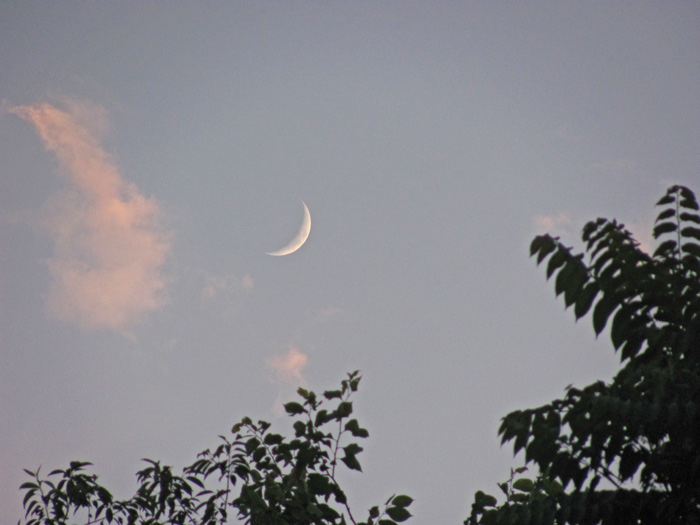
    I couldn’t resist taking this snap shot of the 4-day-old Moon on the 5th of June, 2011. It was well-hidden by the trees from the observatory, but it was a lovely sight in the evening hours while standing just outside the front porch.

    The clouds were also putting on a show, almost iridescent as the light and atmospheric conditions played off the water droplets that formed them. For more information on clouds, fog, and water droplets, please visit Les Cowley’s site Atmospheric Optics

    2011 06 06, Prominences and NOAAs 11231, 11228, 11227, 11226

    •June 6, 2011 • 3 Comments

    2011 06 06, 1300 UT – 1620 UT
    Solar h-alpha, Prominences and NOAAs 11231, 11228, 11227, 11226

    Sketches created scope-side with black Strathmore Artagain paper, white Conte’ crayon and pencil, Derwent charcoal pencil, black oil pencil

    I opened the observatory at 8:30 EST (1230 UT) but knew I’d have limited time to catch a quick sketch/observing session before taking Nigel to the vets for his appointment. Feeling slightly rushed, I was unable to complete the sketch of the SW prominence and struggled to keep up with the changes as it evolved during my session. Normally, I can complete a prom sketch in 5-15 minutes, but I found myself chasing the changes, making the sketch time drag out longer. It was time to just lay down the white pencil, sigh, and close up the roof, knowing I’d have another chance when we got back from the vets.

    When we returned, I started a new session and was able to complete a new SW prom sketch, although seeing had gotten slightly worse for the first part of the session. The prominence had changed quite a bit from two hours before but the main structure of it was still fairly intact.

    What caught my eye after completing that sketch was a very faint slanted arm of a prom to the SE limb. Using a solar observing cloth and not even putting pencil to paper for quite awhile, I was finally able to make out a loop instead of an arm. Then above that reaching to the north, I saw two very faint blotches of plasma that, on brief rock steady moments of seeing, showed that the two blotches were connected and actually reached down to the northern section of the looped prominence. The whole area was very diffuse because of the poor transparency, making it difficult to render a definite structure on paper. Later, I was relieved to see an image of it on SOHO, verifying that it was actually there and not just condensation on my eyepiece from the damp heat coming off my face.

    Credit: SOHO, NASA

    Active regions 11231, 11228, 11227, 11226 were still quite showy with plage, filaments and a couple obvious sunspots in h-alpha. Just inside the limb near the Eastern proms as well as the NW prom, the “surface” crackled with the lightened areas.

    I was pleased that Paul brought his laptop down to the observatory for an imaging session when I was done observing.


    Credit: Paul Rix, 1705 UT - taken with DSI III Pro, DS MS 60mm, LXD 75

    2011 06 05 – Prominences and NOAAs 11231, 11228, 11227, 11226

    •June 5, 2011 • Leave a Comment

    2011 06 05, 1600 UT – 1820 UT
    Solar h-alpha, Prominences and NOAA 11231, 11228, 11227, 11226

    Sketches created scope-side with black Strathmore Artagain paper, white Conte’ crayon and pencil, Derwent charcoal pencil, black oil pencil.


    Several fellow solar observers captured a large portion of the SE prominence lifting away from the limb earlier today. The following link from Mikael Joe of Denmark shows a beautiful image taken at 1206 UT.  Mikael Joe’s image

    For a closer look, Vince22 from Italy, captured this same prominence at 1016 UT.  Vince22’s image

    By the time I recorded this prominence, it was 1640 UT and there were no signs of the faint plasma reaching out of the very bright prominence. With the skies, especially to the South, being a milky white, the transparency was the worst I’ve observed in quite some time and it was very difficult for me to pick out faint details in the prominence sketches as well as plage and filaments on the solar disk.

    I did try my hand at another color full-disk sketch with the oil pastels, but gave up when it came time to put in the surface details as the filaments and plage were lost in the background. Shortly after, I grabbed my faithful Conte’ and began again, having to tease the details out of the view with the tuner and magnification, as well as waiting for clouds to pass by.

    Nigel kept me company on Riser’s old blanket on the floor of the observatory and Freckles popped in now and again to make sure we hadn’t left. It’s nice to have a dedicated observing buddy again since Riser’s passing…other than the carpenter bees that seem determined to burrow holes in the observatory roof and the allusive mouse chomping away behind me.


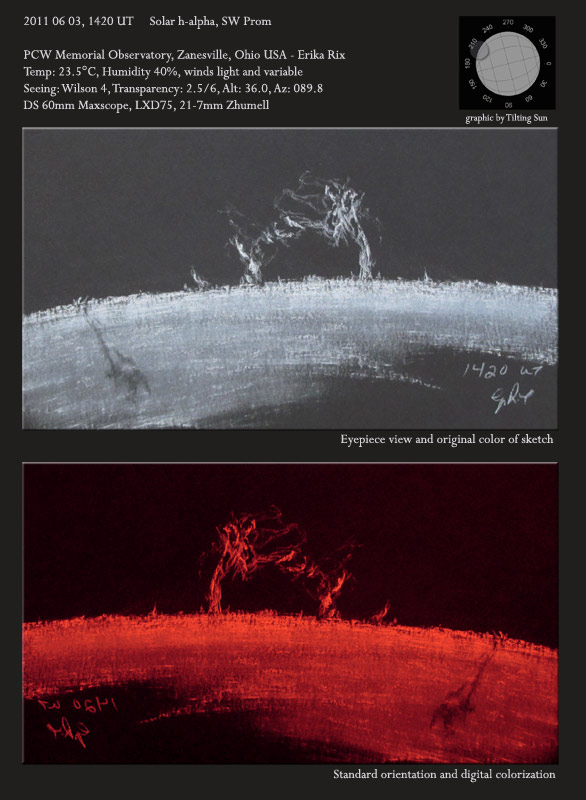
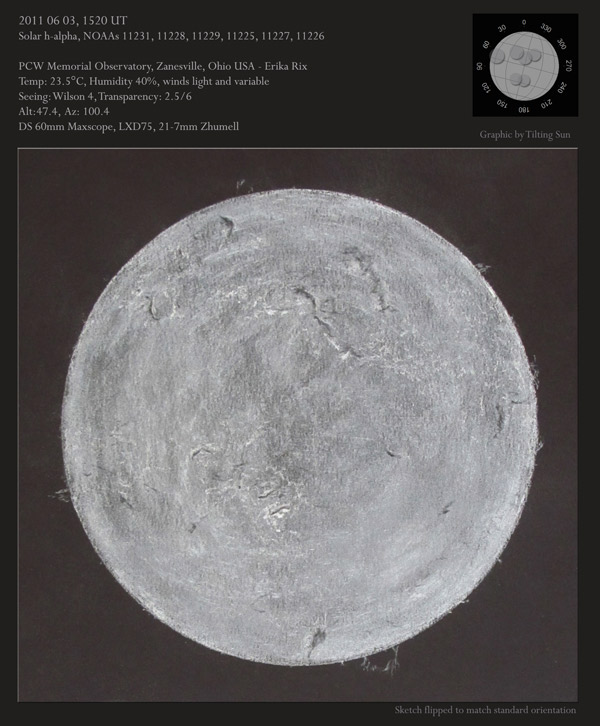
    2011 06 03, SW Prom and NOAA 11231, 11228, 11229, 11225, 11227, 11226

    •June 3, 2011 • Leave a Comment

    2011 06 03, 1400 UT – 1530 UT
    Solar h-alpha, SW Prom and NOAA 11231, 11228, 11229, 11225, 11227, 11226

    PCW Memorial Observatory, Zanesville, Ohio USA – Erika Rix
    Temp: 23.5°C, Humidity 40%, winds light and variable
    Seeing: Wilson 4, Transparency: 2.5/6

    DS 60mm Maxscope, LXD75, 21-7mm Zhumell

    Sketch created scope-side with black Strathmore Artagain paper, white Conte’ crayon and pencil, Derwent charcoal pencil, black oil pencil

    The LXD 75 had a little bit of a fit for tracking at the beginning of the session and because I had already made the first markings on my paper for the large SW prominence, I continued sketching, having to unlock the clutches and manually move the scope a few times during the short period it took to complete the sketch. After restarting the mount’s computer, it worked just fine and I was able to sit comfortably as it tracked perfectly for the full disk sketch.

    There was another large prominence to the south in the shape of an “A” as well as a NE prominence that had a very thin sliver connecting a larger blotch of plasma that at first seemed to be floating above the limb unattached. Several other smaller prominences scattered the limb and are shown roughly on the full disk sketch. It took a little effort and moments of clear, steady skies to show the finer, faint tendrils reaching above the large prom to the SW that I’ve sketched. Just for kicks, I digitally colorized it and flipped it to match a standard orientation.

    The active regions and filaments were a sight to see, especially the band of plage areas (even though very small areas of plage scattered about) that reached east to west in the northern hemisphere. The two active regions to the south were almost mid-line and had brighter plage compared to the northern ones.

    For comparison, Paul hooked up his camera to the Maxscope when I was finished with my observing session.

    Image by Paul Rix, DS Maxscope 60mm, LXD 75, DSI III Pro

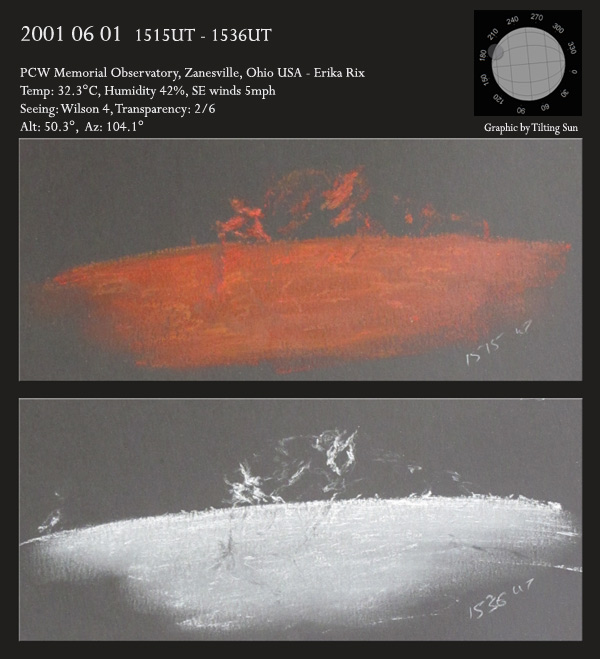
    2011 06 01 Solar Prominences, Possible CME

    •June 2, 2011 • Leave a Comment

    2011 06 01, 1500 UT – 1630 UT

    PCW Memorial Observatory, Zanesville, Ohio USA – Erika Rix
    Temp: 32.3°C, Humidity 42%, SE winds 5mph
    Seeing: Wilson 4, Transparency: 2/6
    DS 60mm Maxscope, LXD75, 21-7mm Zhumell

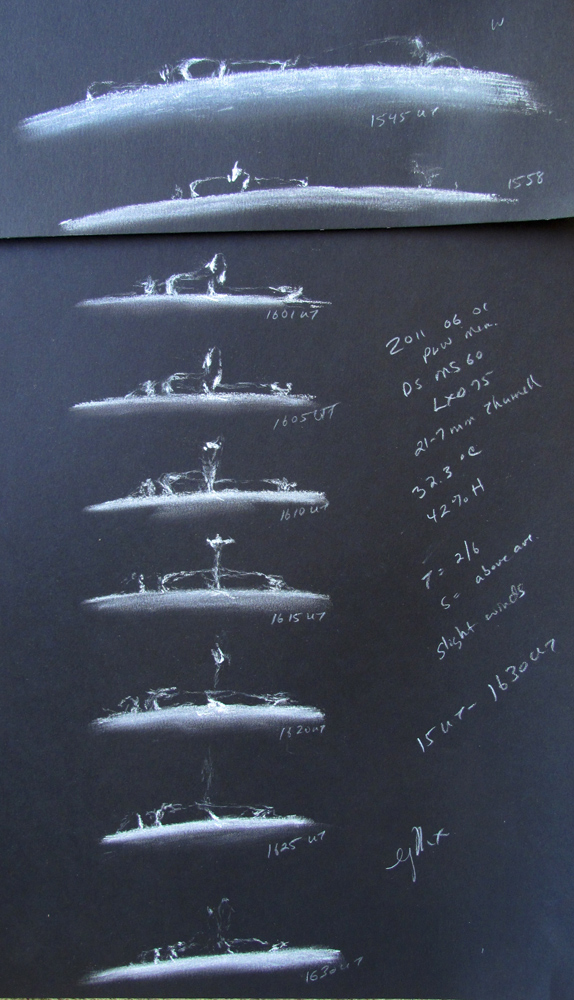
    There were six active regions on the Sun, but a western prominence region caught my eye as a possible CME that took place during my observation. If it was simply an erupting prominence, it was the brightest I’ve witnessed as such. I’ve created an animation of my sketch sequence that I recorded during the observation at 5-minute intervals.

    201106


    Sketches created scopeside with black Strathmore Artagain paper, white Conte’ crayon and pencil, Derwent charcoal pencil, black oil pencil, oil pastels

    This was my first attempt at creating a color solar sketch with oil pastels. It may have worked better if the pastels weren’t so blunt and the problem of the pastels turning soft from the heat (even though I kept the box from direct sunlight). Still, I was pleasantly surprised at the colors compared to other attempts at using colored pencils or colored pastels for sketching the Sun. With a bit more practice, or if I can find oil pastel pencils), I might actually enjoy using color over my preferred method of monochrome.


    2011 June 1, western solar limb

    •June 1, 2011 • Leave a Comment

    With six active regions, I had planned on tackling the solar disk, but the western limb caught my eye with an eruptive prominence, or what I suspect was actually a solar flare.

    With little time to spare because of having to get ready for work, I’ll have to look into it later.

    Here’s an unprocessed photograph of the sketch sequence.

    2011 05 09 – Solar NOAA 11203, 11204, ??, 11209, 11208

    •May 9, 2011 • Leave a Comment

    2011 05 09, 1429UT-1550UT

    PCW Memorial Observatory, Zanesville, Ohio USA – Erika Rix
    DS 60mm Maxscope, LXD75, 21-7mm Zhumell, ETX70 AT w/tilt plate and white light glass filter.


    All sketches done scopeside and flipped in Photoshop to match standard orientation. H-alpha sketch created with black Strathmore Artagain paper, white Conte’ crayon and pencil, Derwent charcoal pencil, black oil pencil. White light sketch created on photocopy paper with 0.5mm mechanical pencil and #2 pencil.

    Transparency made it nearly impossible to view prominences at the start of the session with the thin layer of cirrus creating a milky white sky. There were small breaks that allowed me to sketch in some of the detail on a western prominence, that later as the transparency improved, showed an abundance of thin whispy structure that wasn’t captured on paper. By that time, I was already working on a full disk sketch in h-alpha. Seeing was terrific until I started on the white light observation, but had I set up the ETX at the beginning of the session to let the scope adjust to the warmth, it would have been much better by the time I observed with it. As it was, I observed in the observatory for protection of the wind as I view with a shade attached to the objective and wanted to avoid vibration.

    There is a possible new active region between 1209 and 1208 that, while observing in white light, had several little spots forming an elliptical shape with pointed ends like a football. I noticed facula around 1208, but the seeing was so bad that I couldn’t make out a definite shape. The umbra of the preceding spot in that region was displaced, as was the preceding spot in 1203. I didn’t notice any sunspots in 1209 during my observation, but that may have been the result of the seeing.

    The band of active regions is still putting on a nice show in h-alpha with more-defined plage around them.