June 2013 Issue – Sidereal Times

•July 2, 2013 • Leave a Comment

The June 2013 issue of Sidereal Times for the Austin Astronomical Society is now available for download.
ST201306cover
 
June 2013 issue of Sidereal Times pdf (1.04MB)

Please contact me if you’re interested in joining the club or wish for more information! It’s a very active club and has a great outreach program.

Girlstart Puts the Sparkle in STEM

•July 1, 2013 • Leave a Comment

If you haven’t heard of Girlstart, let me introduce you to you a wonderful organization that increases interest and engagement in science, technology, engineering and math (STEM) to girls grades K-12. Founded in Austin, Texas in 1997, Girlstart has reached over 40,000 girls and 4,000 teachers to provide school-based programs, teacher professional development, summer camps, and community STEM that includes Star Lab, community booths, Saturday activities, STEM conferences and expos, science events and outreach programs. In 2012, over 96% of their services were provided free of charge thanks to the support of sponsors and donations.

What we do and why

“Through its comprehensive programming, Girlstart provides a year-round, intensive suite of STEM education programs for K-12 girls. Girlstart’s core programs foster STEM skills development, an understanding of the importance of STEM as a way to solve the world’s major problems, as well as an interest in STEM electives, majors, and careers”
~ Girlstart

Recently, I had the opportunity to speak at their STEM Society Luncheon and take a tour of the Girlstart facilities. My presentation was held in their newly constructed mini-planetarium and covered astronomical sketching past to present. The planetarium is such a terrific addition to their facility, and I’m really excited knowing that the girls (as well as the community) will have access to comprehensive astronomical activities. The planetarium will make its debut September 7th, 2013 during their back to school open house.

Girlstart’s summer camp was in full swing and it was fun to see all the young girls working on projects and having such a great time. We got to see apps that they programmed, 3D drawings made into real life foam objects, hand-painted goal bowls where each girl stated what they wanted to accomplish in life or what they wanted to be when they grew up, robotics, marine biology projects – everywhere I looked, there were fascinating projects going on. Sigh, to be a young girl again with the opportunity to join Girlstart.

Everyone I met was full of life and excited about what they were doing. It’s not difficult to see why. If you’d like to support Girlstart, please visit “their “how to support” page. .

Thank you, Julie and the rest of the Girlstart staff, for having me over and providing such a wonderful experience for all involved. I loved the Girlstart t-shirt, tote and card!
IMG_3696[1]

Astrozap Truss Dobsonian Shroud and Soft Cover

•June 15, 2013 • Leave a Comment

My 16″ Zhumell reflector required a specialized shroud. It has three struts rather than the typical 8-truss structure. The lack of trusses means that normal light shrouds would dip into the light path when the telescope is pointed at anything other than zenith. As Light Bridge reflectors are very similar to Zhumells, I ordered the Astrozap shroud for a 16″ Light Bridge telescope from Scopestuff.com. Scopestuff is nearby and have been reliable with fast service. I also threw in an order for a soft cover to fit over the secondary cage. The costs were $89 and $21 respectively.

Within a few days, both arrived via Priority Mail and were in individual plastic bags.
IMG_5871

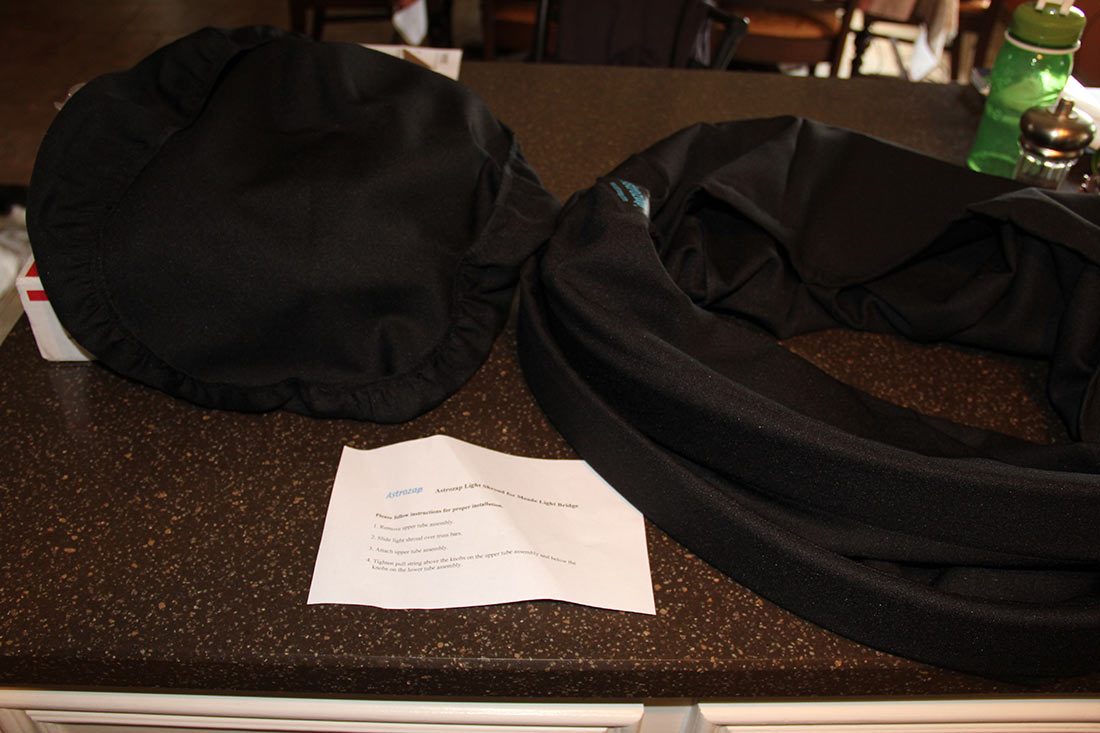
They were made of an opaque cotton and nylon blend black cloth. The dust cover had an elasticated edge to snugly fit over the secondary cage. The shroud had drawstrings at both ends to keep it in place as well as two stiffening bands to keep the shroud from sagging into the light path. Also included were instructions.
IMG_5874

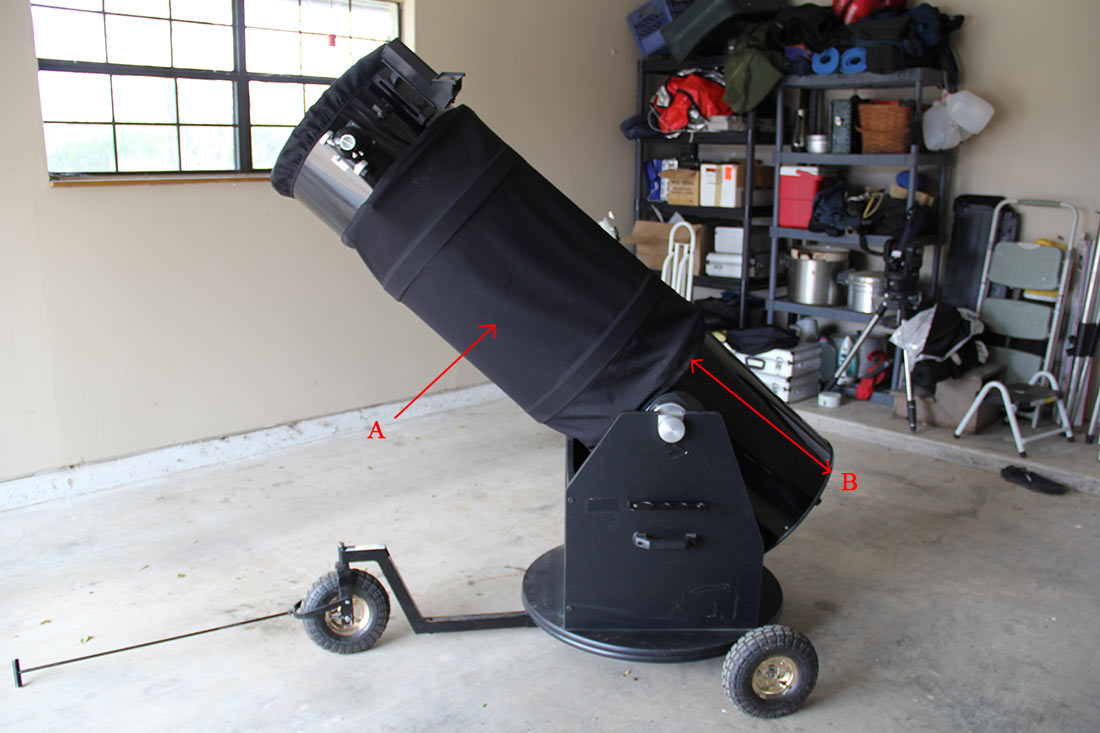
Shroud assembly couldn’t have been more straight forward. I removed the secondary cage and slipped the shroud over the three struts and then reassembled the scope.

I pulled the shroud up and over the strut bolts at both ends and tightened the drawstrings. The dust cover was secured in place.

After several uses, I’ve determined that the design could be improved by adding a third stiffening band in the center of the shroud (labelled “A”). Although the sagging was minimal, it could have been prevented with the extra band. If I were to attach two lightweight bungee straps (one on either outer side) to the bottom of the shroud and telescope, it would pull the shroud taut to eliminate the sagging (labelled “B”). During periods of wind while observing, the upper drawstring is loosened to slip the shroud to the base of the struts.

IMG_5880

Overall, I’m very pleased with my Astrozap shroud, and it works very well for the three-strut design. The only improvement I would like to see is the addition of a third stiffening band.

New PN? KN J1814-3955

•June 14, 2013 • Leave a Comment

I recently visited fellow observer/sketcher Jimi Lowrey for the weekend near Ft. Davis, TX. During my stay, we observed a possible new planetary nebula that came to his attention through contact with Matthias Kronber. Please see the link to his thread in the Deep Sky Forum: New PN? KN J1814-3955. This object is located in Corona Australis and was very obvious through Jimi’s 48″ f/4 reflector using an NPB filter. I haven’t attempted it yet with my 16″ reflector but plan to do so on the next clear, Moonless night.

The object appeared as a small circular fuzzy patch in a chain of three stars running NNW to SSE. I’m very much looking forward to hearing the results concerning its planetary nebula status in the upcoming months.

20130610-KNJ

Making Your Own Astro Sketching Light

•June 8, 2013 • 1 Comment

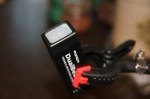
IMG_6820If your sketching light has an uneven glow, is too bright, cumbersome, or if you’ve had to hand hold it or hang it from your eyepiece holder, this easy-to-make sketching light might be useful. I pulled Jeremy Perez’ idea from our Astronomical Sketching, A Step-by-Step Introduction book and after a quick trip to Lowe’s, I made this light in less than 15 minutes.

I use a dual-beam flashlight. The white light works well for lunar and planetary sketches and the red light for all other nighttime observational sketches.

Materials used

  • 7/16 to 29/32-inch stainless steel clamp
  • Plastic spring clamp
  • Orion variable brightness, dual-beam LED flashlight
  • 3.58 x 21.9 x 38.7 cm lamp with movable neck and a clamp base
  • Flat head screwdriver
  • Phillips head screwdriver
  • Clear cellophane tape
  • Crescent wrenches
  • Utility knife

Remove the lamp’s light apparatus and wiring using a screwdriver and crescent wrench, leaving only the adjustable neck and clamp base.

Cut a groove out of the bottom of the spring clamp’s handle with the utility knife so that the neck end of the lamp fits snugly in the clamp’s handle. I used a plastic clamp instead of a metal one to keep the overall weight of my light to a minimum. The sharp end of the clamp was folded under to prevent me from cutting myself when using it at night.

Use the stainless steel clamp to secure the spring clamp the neck of the lamp.

Remove the lens from the variable brightness flashlight and place a piece of clear cellophane tape over it. This will even out the glow of the LED lights. Replace the lens and attach the flashlight to the lamp using the spring clamp.

The new sketching light securely clamps onto both my sketching board and my clipboard. If yours has excess movement where it clamps to your clipboard, an empty CD case between the clamp and the bottom of the clipboard, as Jeremy suggests, will eliminate that.

If you have suggestions for improvement, please feel free to share it here!

Cen-Tex Star Party Spring 2013

•April 10, 2013 • 1 Comment

IMG_5988

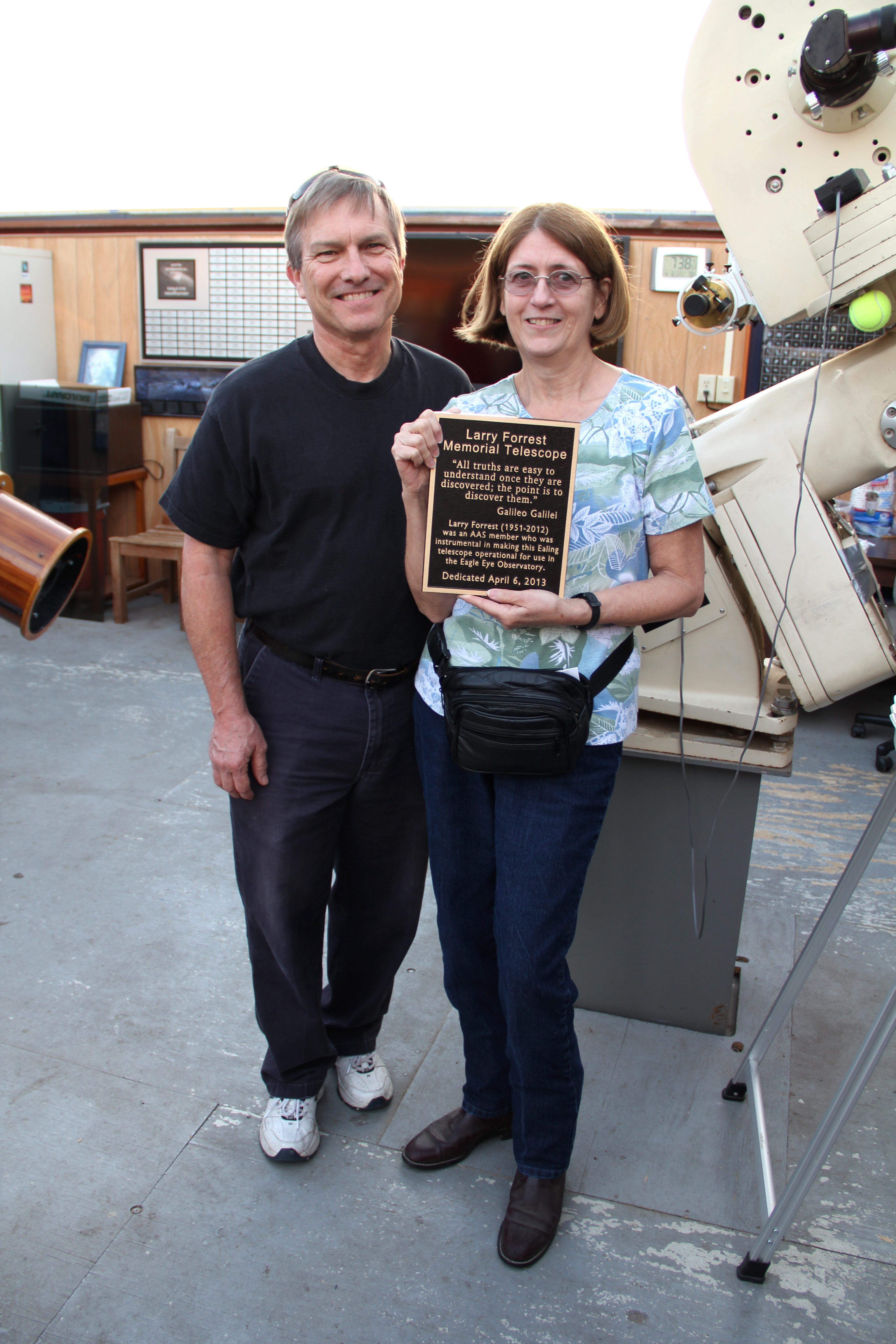
Sharleen Forrest with dedication plaque for

Sharleen Forrest with dedication plaque for the Ealing.

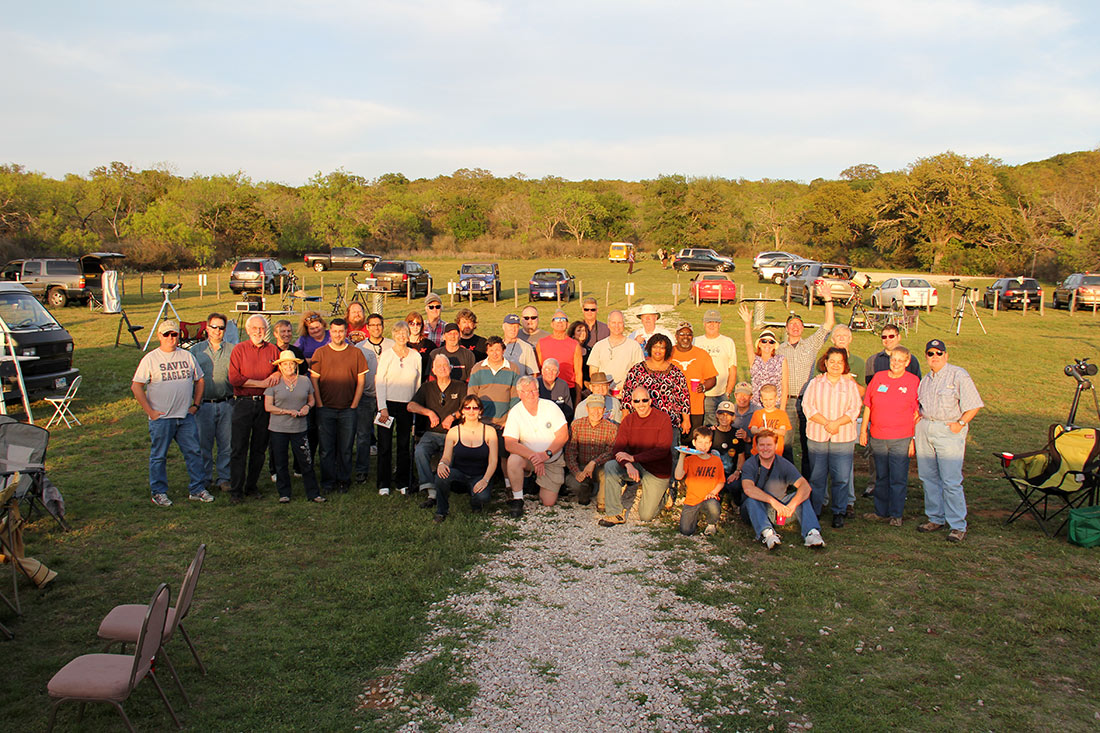
The spring Central Texas Star Party is a 2-day event for the members of the Austin Astronomical Society and their guests. It’s held at the Eagle Eye Observatory. This year, we had two special dedication ceremonies held on the second evening of the event. The first was in honor of the late Larry Forrest by rededicating the Ealing Educator Telescope in his name. Larry was instrumental in acquiring and restoring the 16″ CAT. I never had the pleasure of meeting Larry as he passed away just months after I moved to Texas and joined the AAS. I have been able to hear all the wonderful stories about him from the other AAS members and know he’s truly missed. His wife, Sharleen, attended the dedication ceremony and I was happy to have met her.

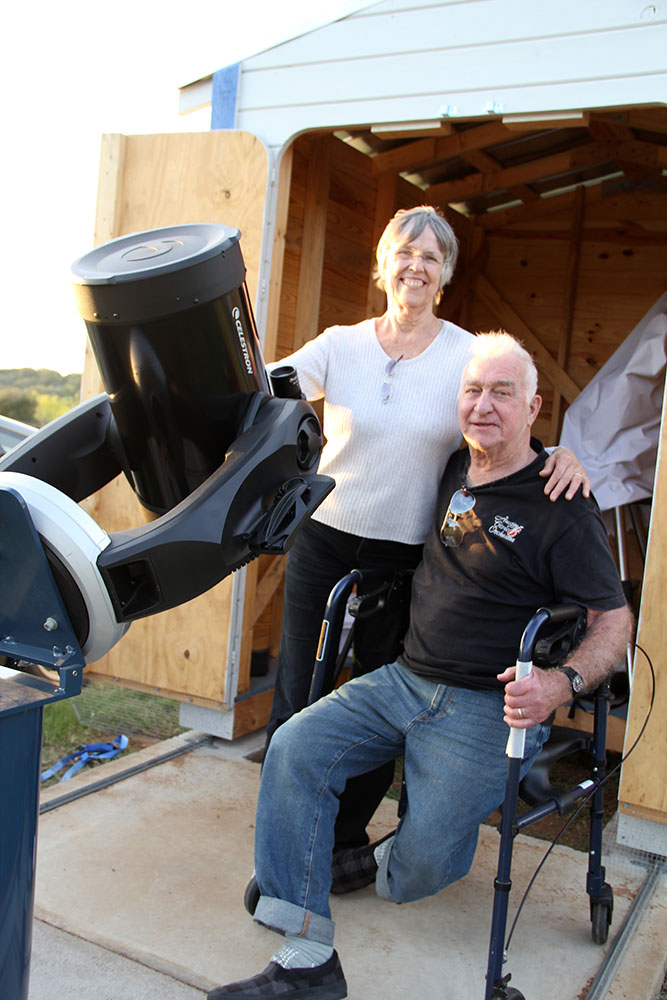
Fred and Melissa Ruof with their donated roll-off observatory and telescopes.

Fred and Melissa Ruof with their donated roll-off observatory and telescopes.


The second was in honor of AAS member Fred Ruof. Fred and his wife moved here from Pennsylvania and donated an observatory, an 11-inch CAT, a 4-inch refractor and a PST to the club. In Fred’s words:

“My offer is very simple. I’ll give AAS my three best instruments – TeleVue 101 refractor, 11-inch Celestron Schmidt-Cassegrain, H-alpha solar scope. This is a good thing for all of us. I expect the AAS will be around for at least several score of years. I may poop out in just a few.”

This was my first time meeting Fred and his wife, Melissa. What a fun couple. I also managed a hug and kiss from Fred, but only because he mistook me for someone else. Hey, I’ll grab a hug whenever I can regardless if it was intended for me or not!

Larry and Fred are wonderful examples of how dedicated and generous people can be, whether it be with their time or donations. We can carry on their efforts by using the equipment and being generous with our own time and support through public outreach and teaching others about the night (and daytime) skies.

The rest of the star party was filled with great company, great food, and particularly great cookies (thanks Kass Brown!).

April 2013 Issue – Sidereal Times

•April 8, 2013 • Leave a Comment

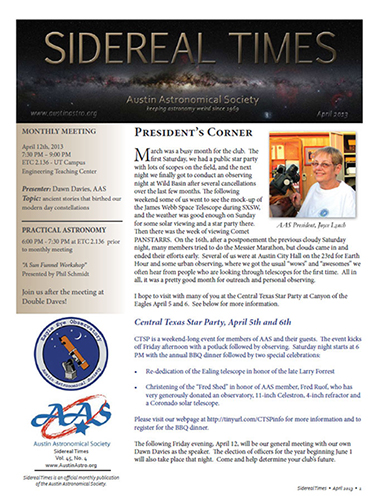
The April 2013 issue of Sidereal Times for the Austin Astronomical Society is now available for download.
ST-201304

 
April 2013 issue of Sidereal Times pdf (2.3MB)

Inside this issue, you’ll find meeting minutes, IDA news, Central Texas Star Party, Messier Marathon report, outreach events and reports, image of the month, report on Earth Hour, Observing Targets, App reviews, Guest Spotlight with Nick Howes, member photos and more!

Please contact me if you’re interested in joining the club or wish for more information! It’s a very active club and has a great outreach program.

2013 April 6 – Meridian Charter School Science Day

•April 7, 2013 • 1 Comment

IMG_5954

This weekend was Science Day at Meridian Charter School. I love these types of events because they provide hands-on learning experiences for a broad range of sciences rather than just astronomy. Marshmallows with toothpicks, empty soda bottles, plastic human skeletons and the likes were being ushered in by the armfuls in preparation of the event. My station was solar astronomy in the courtyard. I brought my dual mount solar rig consisting of a double-stacked Maxscope 60mm hydrogen alpha solar telescope and a 102mm refractor with a Thousand Oaks white light filter. I also brought handouts for the students and their families.

The volunteers and faculty staff at Meridian Charter were fantastic and very helpful. They provided food and refreshments and volunteers to assist me during the event as well as unloading and loading my equipment. They couldn’t have made me feel more welcomed if they tried.

I’m not sure how many people came through to take peeks at the Sun, but if I were to guess, it would be 300-400 during the 5 1/2 hours I was there – 1 hour for set up and tear down, the remainder for viewing. The ages ranged from toddlers to senior citizens. There were only a few breaks where I had a minute or two to step away from the scopes for a breather. Other than that, it was a steady stream of attendees with small lines. I explained the views of both scopes with each person that stepped up to the eyepiece. What fun it is to experience “first solar views” over and over again during the course of a day!

How often does a person get to hear a young student exclaim, “This is the BEST station yet!!”

Outreach is such a rewarding experience!

This slideshow requires JavaScript.

International Dark Sky Week 5 – 11 April, 2013

•April 5, 2013 • Leave a Comment

It’s International Dark Sky Week.

Celebrate the stars! Created in 2003 by high-school student Jennifer Barlow, IDSW has grown to become a worldwide event and a key component of Global Astronomy Month. The goals of IDSW are to appreciate the beauty of the night sky and to raise awareness of how poor-quality lighting creates light pollution.

Light pollution affects our night skies, disrupts ecosystems, and affects our health by breaking up a healthy sleep pattern. It’s never to late to address the problem and start making changes. There are several ways we can mitigate light pollution.

  • Join the International Dark-Sky Association  (IDA)
  • Assess lighting around your home
  • Spread the word
  • Outreach: throw a star party or present about light pollution in public locations such as schools, parks, sidewalk astronomy and libraries
  • Assess and photograph lighting in public areas to help out the IDA

To see how assessments are performed, please see IDA – Learning to Assess Lighting.

What do the skies look like in your area? Compare your skies with the image provided by The Universe on Facebook and learn more about the effects of light pollution and what we can do to help. Light Pollution Simulation

2013 Earth Hour – Austin City Hall

•March 24, 2013 • 2 Comments

IMG_5870

Earth Hour. Have you heard of it before reading this? If so, do you understand what it is?

The World Wide Fund for Nature (WWF) in Australia and the Leo Burnett Worldwide, in 2004, collaborated to bring global climate awareness to Australians. In March 2007, “The inaugural Earth Hour is held in Sydney Australia 7.30pm – 8.30pm, 2.2 million Sydneysiders and 2,100 businesses participate.” The idea was to reduce energy consumption by simply turning off all non-essential lighting for one hour at a proposed time and date. By doing this, it would bring people together as a community to show and act on a desire to protect our planet during (and continuing after) the Earth Hour event. October, that same year, San Fransisco ran their own version of Earth Hour after being inspired by the Sydney event. As word spread, so did the participation around the world.

“Uniting people to protect the planet

The world is using the equivalent of one and a half planets to support life on Earth. WWF’s Earth Hour was born out of a hope that this could change. At 8.30pm on 23 March hundreds of millions of people will turn off their lights for one hour, on the same night, all across the world in a huge, symbolic show of support.

It is a unique annual phenomenon that focuses the world’s attention on our amazing planet, and how we need to protect it.”

~ WWF 2013

I encourage you to read the message and watch the video from Andy Ridley, CEO & Co-Founder of Earth Hour, that can be found at this link:  Message from Andy – Earth Hour. Also, next time you see an envelope in the mail with a black and white panda logo on it, please take the time to open it. It’s an organization near and dear to my heart.

Outreach Chair Dawn Davies

Outreach Chair Dawn Davies

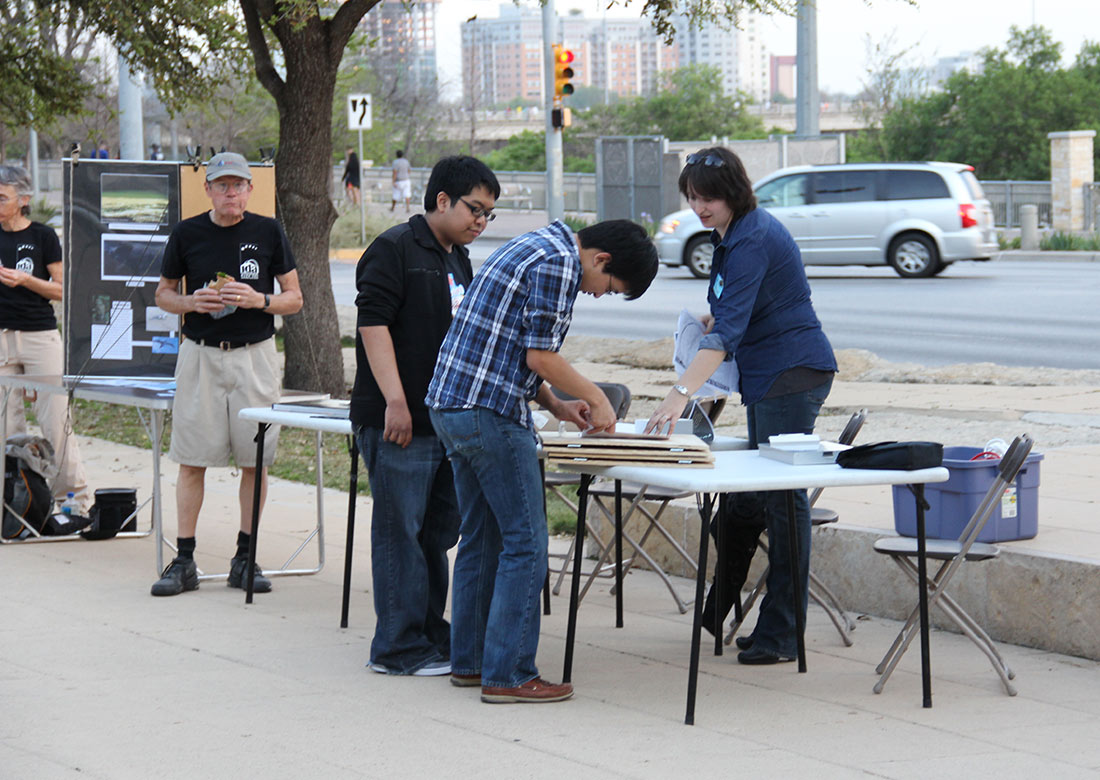
I’m very thankful to belong to an astronomy club that actively participates in and promotes events like this, light pollution, as well as public awareness and education concerning our important roll in preserving the night skies. We have a wonderful outreach chair, Dawn Davies, who spends countless hours organizing these events to provide avenues for us to reach out to the public. Last night, the Austin Planetarium and the University of Texas at Austin’s Astronomical Students Association collaborated with the Austin Astronomical Society in celebration of Earth Hour. Thanks to Dawn’s efforts, we were able to set up in front of Austin’s City Hall. What a wonderful opportunity and a thoroughly enjoyable evening! The Austin Planetarium Mobile Dome was there as well as Steve and Crystal Bosbach with the IDA. We also had 5 telescopes for both nighttime and solar viewing, binoculars, the “City Dark” documentary and lots of terrific company and discussions during the course of the evening.

This slideshow requires JavaScript.