2010 04 30 – H-alpha

•April 30, 2010 • Leave a Comment

A blast from the past in 2010

2010 April 30, 1430 – 1530 UT
Solar h-alpha – Erika Rix
PCW Memorial Observatory, Zanesville, Ohio USA
DS 60mm Maxscope, LXD75, 21-7mm Zhumell


H-alpha sketch created scopeside with black Canson paper, white Conte’ crayon and pencil, white Prang watercolor pencil, Derwent charcoal pencil, black oil pencil.

T: 21°C-24.6°C, H: 48%-45%
S: Wilson 3, T: 4/6
Clear with slight breeze
Alt: 44.7-54.8, Az: 111.1-127.4

Three main filament areas yesterday are making their way to the proceeding limb. The area to the SE appears shorter than yesterday, but when increasing magnification, I noticed that it was so narrow on either end that it only appeared broken up. There was another small filament forming to the following limb of that area.

The western filament hasn’t made its way clear to the limb yet, but the darker “shadowed” area around it is more pronounced today.

The bright circular plage from yesterday at the NE filamentary area still looks like an eyeball staring back at me, only instead of a pair, there’s only one with the center dark area. Today, I was able to make out that it’s a short filament directly in the middle of the plage reaching NW to SE.

The prominences were still many and very small and there were quite a few smaller filaments scattered across the disk.

2010 04 29 H-alpha

•April 29, 2010 • Leave a Comment

Blast from the past in 2010

2010 April 29, 1449 – 1551 UT
Solar h-alpha

PCW Memorial Observatory, Zanesville, Ohio USA – Erika Rix
DS 60mm Maxscope, LXD75, 21-7mm Zhumell

H-alpha sketch created scopeside with black Canson paper, white Conte’ crayon and pencil, white Prang watercolor pencil, Derwent charcoal pencil, black oil pencil.

Temp: 18.5°C-22.7°C, Humidity 40%-30%
Seeing: Wilson 4-3.5, Transparency: 4/6-1.5/6
Clear to 100% light overcast, Alt: 47.8-57.5, Az: 115.9-135

The skies looked terrific first thing this morning, but I spent too much of my morning off cleaning house. By the time I got out there, I could see some thin cirrus making its way across the southwestern skies.

The limb features were many, even if they were pretty small. The brightest were scattered along the western and northeastern limbs. The filaments put on a good show today and plage had to be teased out. The exception to that last remark was the area of a hooked filament with two circular plage areas just outside of it. Those two round, bright areas stood out like a pair of eyes blinking at me.

The shallow-curved filament to the western limb had very bright plage that ran along it’s edges, about doubled the filament’s width. Around that area, it looked like faint brush strokes of darker contrast reaching out from it. I can only assume those faint, darker wisps are extended portions of that crisp filament. If so, it should put on a decent show within the nest couple of days.

Finally, the skies became overcast and I had to stop the observation. Still, it was a great morning with my observing buddy, Riser.

2010 03 26 – AR 11057

•March 26, 2010 • Leave a Comment

Blast from the past in 2010

2010 March 26, 2033 UT
Solar h-alpha, AR11057

PCW Memorial Observatory, Zanesville, Ohio USA – Erika Rix


DS 60mm Maxscope, LXD75, 21-7mm Zhumell.
H-alpha sketch created scopeside with black Canson paper, white Conte’ crayon and pencil, white Prang watercolor pencil, Derwent charcoal pencil, black oil pencil.

SW prominence at first glance looked detached. Increasing mag and waiting for steady seeing, I could make out fainter portions of the prominence that reached the limb. There were a few brighter prominence regions scattered about, but nothing of great significance, especially after the magnificent NW prominence last week.

AR 11057 stood out immediately with two dark areas and bright plage. Panning the FOV brought out another bright plage area on the WNW area just 10 deg in from limb. This could possibly be a remnant of 11056. Toward the southern-middle of the disk, brighter little clusters of plage scattered the area, as well a plage to the NW about 40 deg in from the limb. There were a few filaments but the one that really caught my eye was a wide V-shaped one to the SE. I had to tweak the Etalons to bring out the full structure of what first appeared as a single line of filament.

2010 03 18 – Large Prominence, NOAAs 11054 & 11056

•March 18, 2010 • Leave a Comment

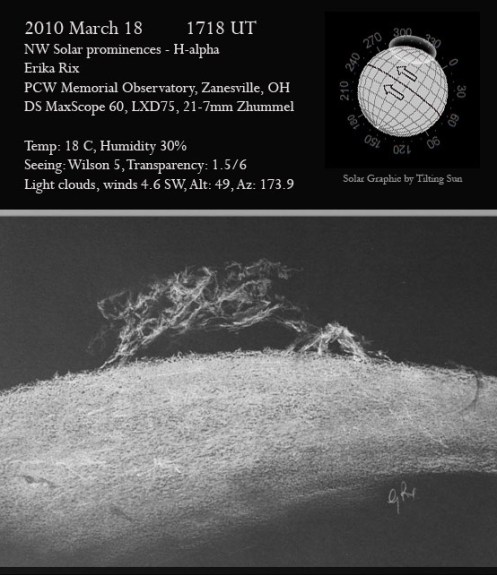
Every once in awhile someone will say to me with regard to solar observing, “I just don’t get the fascination.” If only they could look into a narrowband solar filter to witness a breath-taking prominence such as the one above, no words would be needed to explain why so many people invest the money in equipment to view just one star. And then when the desire to understand the Sun hits you…well, it opens Pandora’s Box and there’s no turning back.

Past report from March 2010.

2010 March 18
Solar h-alpha, Active regions 1054, 1056

PCW Memorial Observatory, Zanesville, Ohio USA – Erika Rix

DS 60mm Maxscope, LXD75, 21-7mm Zhumell
H-alpha sketch created scope-side with black Canson paper, white Conte’ crayon and pencil, white Prang watercolor pencil, Derwent charcoal pencil, black oil pencil.

Here’re the sketches from today. I spent the good part of four hours out there between h-alpha and white light observations. It sure felt terrific to kick off my shoes and just soak up the Sun. Paul, my husband who normally only images the night skies, even set up his imaging gear for a session on my Maxscope when I was finished with it.

The two active regions were pretty obvious with the plage in the NW and NE quadrants in h-alpha. In white light, I could only see evidence of facula and a spot (or two looking like they were merged together) in the NW region, which would have been AR 1054.

I didn’t blend the full disk sketch very well this time but by the time I realized it, I had already added features over the background and couldn’t fix it. Because of that, some of the features are lost a bit with all the “noise”.

That huge prom was an absolute beauty and I could have spent the entire day sketching it over and over for an animation. As it was, it nearly was so complex that a person could spend too much time on one sketch and end up chasing the changes and never actually complete the sketch.

The filaments were in abundance too.

Note that view for the full disk sketch is 180 degrees rotated from the prominence sketch. The large prominence at the bottom of the full disk sketch is the same prominence as the close-up prominence, sketched 2 hours later and viewed at a different angle from the eyepiece.

2010 03 04 – AR 1051, AR 1052, AR 1053

•March 4, 2010 • Leave a Comment

A blast from the past in 2010

2010 March 4
Solar h-alpha, Active regions 1051, 1052, 1053
PCW Memorial Observatory, Zanesville, Ohio USA – Erika Rix

(Click on the image for a larger view.)

DS 60mm Maxscope, LXD75, 21-7mm Zhumell
H-alpha sketch created scope-side with black Canson paper, white Conte’ crayon and pencil, white Prang watercolor pencil, Derwent charcoal pencil, black oil pencil.

Temp: -1°C, Humidity 75%
Seeing: Wilson 4, Transparency: 4.6/6
Light cirrus, calm, Alt: 35.1, Az: 140.0

2010 01 14 – AR1040

•January 14, 2010 • Leave a Comment

A blast from the past…

Click on the image for a larger view

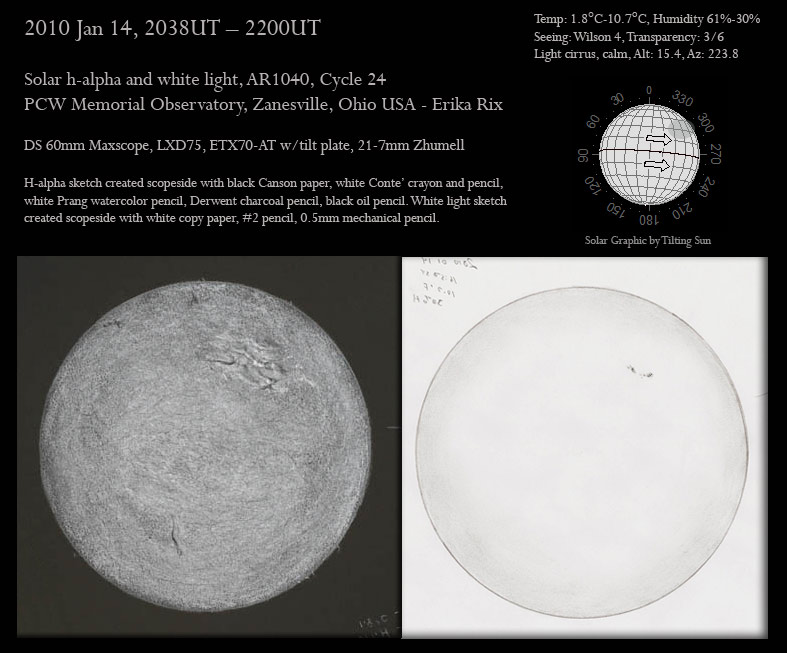
2010 Jan 14, 2038UT – 2200UT
Solar h-alpha and white light, AR1040, Cycle 24

PCW Memorial Observatory, Zanesville, Ohio USA – Erika Rix

DS 60mm Maxscope, LXD75, ETX70-AT w/tilt plate, 21-7mm Zhumell
H-alpha sketch created scopeside with black Canson paper, white Conte’ crayon and pencil, white Prang watercolor pencil, Derwent charcoal pencil, black oil pencil. White light sketch created scopeside with white copy paper, #2 pencil, 0.5mm mechanical pencil.

Sketches were rotated and flipped to match standard solar orientation. West is to the right and north is to the top.

Temp: 1.8°C-10.7°C, Humidity 61%-30%
Seeing: Wilson 4, Transparency: 3/6
Light cirrus, calm, Alt: 15.4, Az: 223.8

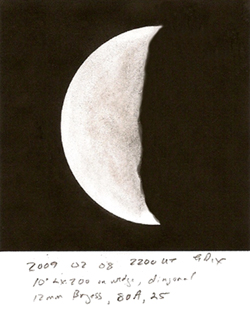
2009 07 08, 15.3-15.42 day Moon

•July 8, 2009 • Leave a Comment

2009 July 8, 0240UT – 0535UT
Lunar, Erika Rix
PCW Memorial Observatory, Zanesville, Ohio USA

Orion ED80 w/WO dielectric diagonal, LXD75, 21-7mm Zhumell, 13% T moon filter
Lunar phase 352.2°-350.9°, 15.3-15.42 days
Temp: 17.6°C-11.7°C, H: 59%-86%
Alt: 11°02’ to 27°10’    Az:  132°18’ to 170°38’
Libr. Lat: 01°32’ to 01°24’, Libr. Long: 00°00’ to -00°37’
Seeing: Antoniadi II, Transparency: 3/6
Light cirrus, calm

Sketch created scopeside with black Strathmore Artagain paper, white Conte’ crayon and pencil, white Prang watercolor pencil, black oil pencil, black charcoal pencil.

This was my latest attempt at a full disk sketch for a lunar phase. At 99.5% illumination, a filter was needed for not only bringing out details on the lunar surface, but for ease of viewing on the eyes.

Shortly after drawing an outline of the Moon, I always feel a bit overwhelmed. It doesn’t take long to remember just how difficult it can be to get the shapes, sizes, and placements correct for all the predominant features. Even the “borders” of maria become elusive when you try to set boundaries for it on paper.  Yet there always seems to be that magic point in a sketch where everything starts to come together…usually just after the sense of despair when it takes sheer willpower not to toss the sketch in the trash and start over again.

Northeast Astronomy Forum (NEAF) 2007

•April 30, 2007 • 1 Comment

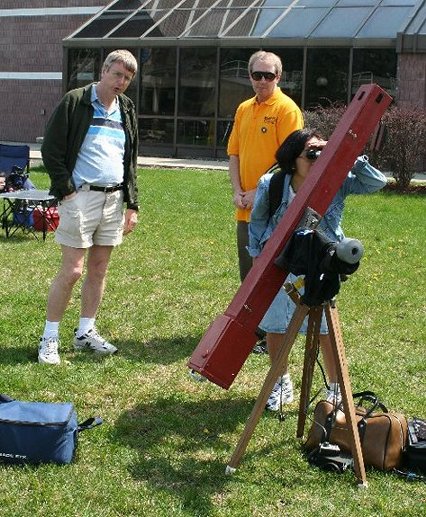
A few years ago, April 2007 to be exact, I attended my first NEAF event and helped out as part of the Solar Party staff. The trip to New York was made in my old Ford pick up truck with my favorite telescope and mount tucked securely in the back along with my sketching kit and small suitcase. It wasn’t an easy trip to make, not so much because of the journey itself, but because it meant leaving my grandmother behind at Hospice while I took a few days off for myself. I had made a promise to help out at NEAF and needed the break. My grandmother (her name was Pauline, friends called her Polly…but to me she was Nanny) was very supportive of my astronomy and I knew she wanted me to go. Still, it was one of the hardest decisions to leave even though my mother was still there with her.

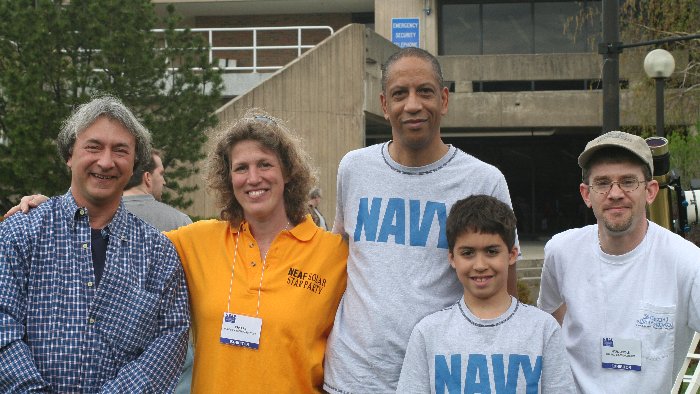
I picked up an astro friend, Jim Winters, in Philly on my way through and then was greeted by other great friends once we arrived at the Holiday Inn in Suffern. I met many people for the first time in person that I had only met through emails or through the Cloudy Nights Telescope Reviews forum. Of those people, it was wonderful to finally meet Sol Robbins in person, one of the co-authors of Astronomical Sketching. We had spent hour after hour on Skype together with the other authors and the moment I heard his voice in person, I knew it was him standing in front of me. Harry Bloom (Springer) was another.

Sol, Erika, Markus, Markus' son, Mark at NEAF 2007

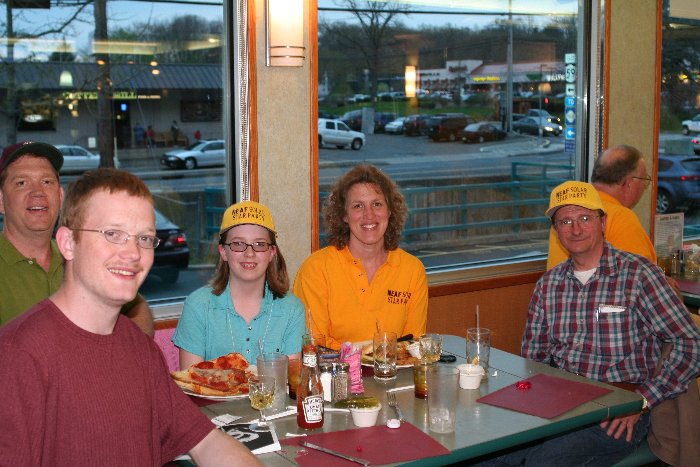
It was great fun to finally meet Greg Piepol and Gary Palmer, not to mention other solar observers such as Barlow Bob, Paul Hyndman, Alan Friedman, and Ralph M. to name only a few. After the first day of solar observing and sharing views, the solar staff were invited to the local diner for supper.

As if the solar equipment wasn’t enough to drool over, such as this homemade solar spectrum scope, the countless vendor booths inside made you feel like a child in a candy store.

Barlow Bob Scope

The whole weekend was a bit of a blur to be honest. I had forgotten to bring my battery packs to run my mount. Thankfully with several other solar observers there with their rigs, Paul Hyndman kindly lent me his. As with star parties and other astro events, it was heartwarming to have friends there such as Gary Gibbs. My treasured Maxscope 60mm that I brought to NEAF for sharing solar views was originally his and I’ve named it GG after him. These types of events are fun, but it’s really getting a chance to spend time with good friends, both old and new, that send you home with treasured memories.

Other highlights that stick vividly in my mind were helping to tear down the BYO stand with Tom Trusock helping to support the beams next to me and us chatting about this and that with our arms extended above us, Mark Nordle (my first time meeting him) making me laugh with his antics until tears were nearly streaming down my cheeks, spending time Gary Palmer discussing solar outreach, a few meals with a dear friend John Crilly, meeting Marcus for the first time in person and feeling like I’ve just fun into an old friend that I’ve known for ages….and then there was the long drive home Sunday evening.

I’m not sure what time of the morning I arrived at my doorstep, but I remember struggling to keep my eyes open after I dropped Jim back off in Philly. It was a relief to be back with Nanny and you could tell by the look in her eyes that she was relieved to have me back as well.

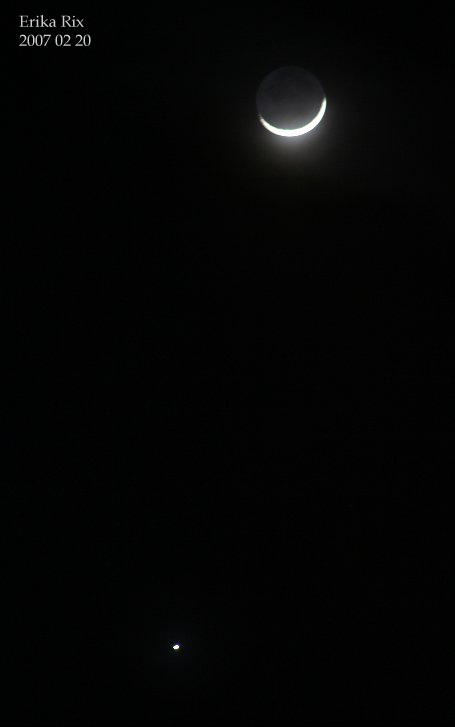
2007 02 20, Diana’s Bow and Venus

•February 20, 2007 • Leave a Comment

Date 2007 02 20, Time 0008 UT – Erika Rix
Location +39deg 12’, +82deg, -5 hours


Canon Rebel 350XT, Sigma 70-300mm with tripod
270mm, ISO100, 0.02sec, f/5.0

Venus:
Constellation Pisces
AZ 256 deg 10.561’
Alt 13 deg 25.959’
RA 23h 55.549m
Dec –1 deg 38.712’
Distance 1.4406au
Radius 6051km
Apparent Magnitude -3.95

Moon:

AZ 257 deg 19’
Alt 18 deg 14’
RA 0 deg 6m 3.1s
Dec 02 deg 01’46”
Distance 360034km
Apparent Diameter 33.19
Lunation 2.33d
Illumination 7.7%
Solar inclination –0.4deg

Artemis was an ancient Greek goddess of hunt, wilderness, and animals (to name a few), carrying bow and arrows. She was the daughter of Zeus and Leto. Overtime, other names associated with her were Selene (Titan Greek moon goddess) and Diana (Roman Goddess). The crescent of the 3-day moon is said to look like a bow, hence “Diana’s Bow”. It almost looks like a glowing sliver bursting out of the shadowed moon.

The Romans named the planet Venus after their goddess of love and beauty. In reality, it has an extremely hot, toxic atmosphere with volcanic activity.

Excerpt from NASA’s Solar System Exploration websites:

Venus is a dim world of intense heat and volcanic activity. Similar in structure and size to Earth, Venus’ thick, toxic atmosphere traps heat in a runaway ‘greenhouse effect.’ The scorched world has temperatures hot enough to melt lead. Glimpses below the clouds reveal volcanoes and deformed mountains. Venus spins slowly in the opposite direction of most planets.

The two sketches below were created during observations (two years after my photograph) showing subtle hints details on Venus.

2009 02 05 Venus Observation Sketch

2009 02 08 Venus Observation Sketch

2006 07 07 – Lansberg, Mons Gruithuisen Gamma & Delta

•July 7, 2006 • Leave a Comment

Work has been keeping me from viewing recently. Please excuse more “blasts from the past”…this observation was done over four years ago and was my first attempt at white on black lunar sketching. A sketching friend of mine, Rich Handy, introduced this style to me. Sometimes it’s easier to sketch the highlights rather than the shadows.

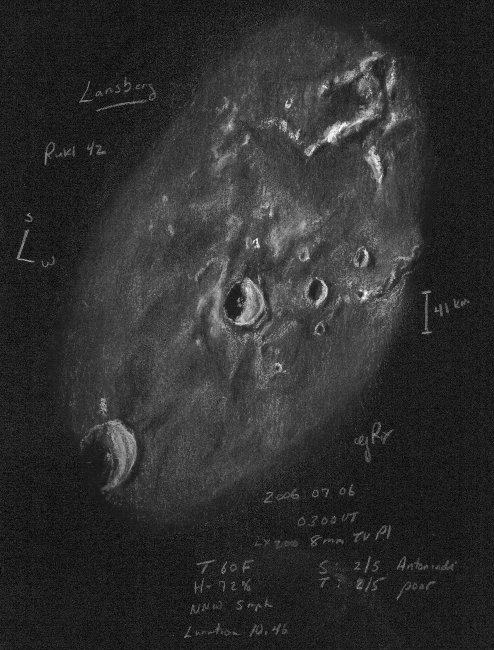
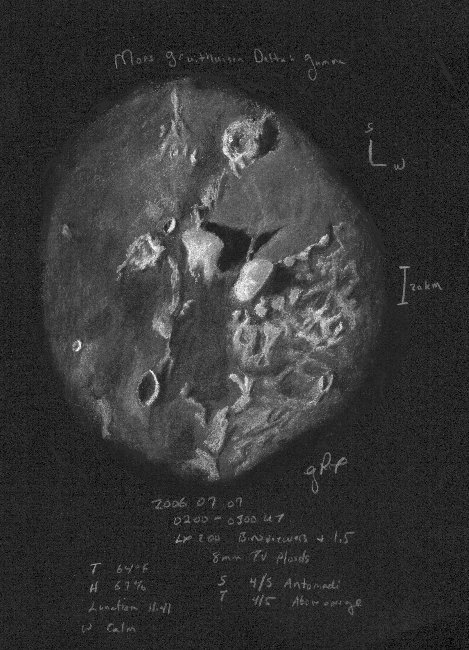
2006 07 07
Lansberg/Gamma and Delta

Wednesday night (Thursday for UT), was a practice session for imaging with my Rebel. I finally bought a t-ring adapter during a star party a few weeks ago and had some fun playing with the new toy. The guys in the DSLR forum are giving me some great pointers. Feels very strange entering that realm, but I have a feeling it will compliment the sketching well for my observations. Plus gives me yet another way to enjoy this hobby to the fullest!

It was then time to put the camera away and dig out my sketch kit. Paul, being the thoughtful husband that he is, bought Tom L’s binoviewers for me last month. Tom, if you’re reading this, I absolutely LOVE them! Wow! Thank you both so much!!! I’ve been having a lot of fun with black Strathmore paper and Conte’ crayons for my solar work, so with Rich in mind, I got up the nerve to try my first lunar sketch with this media. Lansberg and the surrounding craters were my main targets that night. I explored the terminator, tried to count craterlets in Plato, and admired Copernicus (and was tempted to try it again, as the last time I tried to sketch that beauty, my sketch was cut short and it was never completed).

Lansberg is from the Imbrian period and is about 41km. The central mountains stuck out like two eyeballs in a dark room and I was pleased to see some terracing. All the little craterlets around Lansberg belong to it with Kunowsky D being the exception to the NW. Reinhold is trying to slip into the scene to the NE, but got its toe stuck in the door. Montes Riphaeus was very dramatic, or at least compared to the rest of the scene in that area.

After a great day today, which included solar observing (boy, that sun feels great!), I set up with the binoviewers again tonight. Although seeing was poor, I went ahead and bumped up magnification with 8mm TV Plossls (love that EP so much, I had to get another one!). It was good enough to support the level of detail needed to observe domes. Had I wanted to jump into a few complex craters, I believe a 20mm would have been best. So, domes it was and why not a pair? Mons Gruithuisen Delta and Gamma were flagging me down and I just could not resist.

They are also from the Imbrian period and close to 20km each. Looking at VMA, Delta is classified as a mountain and Gamma is a dome. Rukl calls both of them a dome-like mountain massif. Hmm, let’s see what Chuck Wood has to say about them. Aha! He calls them domes, most likely formed of silicic volcanic rocks. For more reading on this, see The Modern Moon, page 37. I would love to be one of the geologists that Chuck suggests may someday bang on the domes with their rock hammers to see what they are made of.

It was a bit disappointing that I didn’t see the summit crater on Gamma, but there was an obvious darkened area on the western top portion of it. I loved buzzing around in the all the little dips and valleys to the north of it, though. The little raised line between Gamma and Gruithuisen K looked like a pea pod. Isn’t the lava covered floor beautiful in that region?

Sketches created scopeside with black Strathmore Artagain paper and white Conte’ crayons