2010 08 29 Rima Hyginus

•August 29, 2010 • Leave a Comment

2010 08 29, 0820 UT Rima Hyginus
PCW Memorial Observatory, OH, USA, Erika Rix
Zhumell 16”, 20mm TV, 5x Barlow, 450x mag, 13% T moon filter
Temp: 12.8C, >90% humidity, S: Antoniadi I
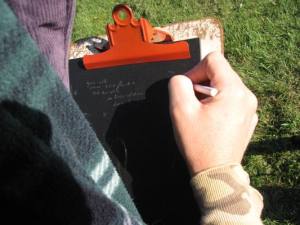
Sketch created scopeside with Rite in the Rain paper and charcoal.

Phase: 307.3°
Lunation: 19.38d
Illumination: 80.3%
Lib. Lat: -6°04’
Lib. Long: -6°03’
Az: 260°08’, Alt: 34°57’

Rima Hyginus: Linear Rille, 7° E, 7.5° N
Imbrian period (-3.8 billion yrs to –3.2 billion yrs)
Dimension: ~226 km, Height: unknown
Named after Caius Julius Hyginus, 2nd century BC Greek Astronomer

LPOD 2004-02-25, by Chuck Wood

“The key to understanding the origin of Hyginus is probably the small pit craters visible in the rille on the northwest (left) side of Hyginus. These pits almost certainly formed by collapse of the roof over a lava tube.”

A lot of the features were washed out surrounding the rille, but the flat floor of Hyginus was evident as well as its irregular shape. I could make out some of the pits to the northwest half of the rille and a couple hints of the craterlets (or pits) to the southeast half. The subtle variances in albedo were difficult to render, however, interesting to observe. If I remember correctly, the dark patch to the north of H consists of volcanic ash.

While searching for information on this rille, I came across yet another amazing image from Wes Higgins. The pits Chuck Wood wrote about in the article above are clearly shown. Rima Hyginus 2007-08-03, by Wes Higgins

Resources
Rukl plate 34
“The Modern Moon” by C. Wood pgs. 58-59
LPOD Thumbnails of Rima Hyginus
Virtual Moon Atlas

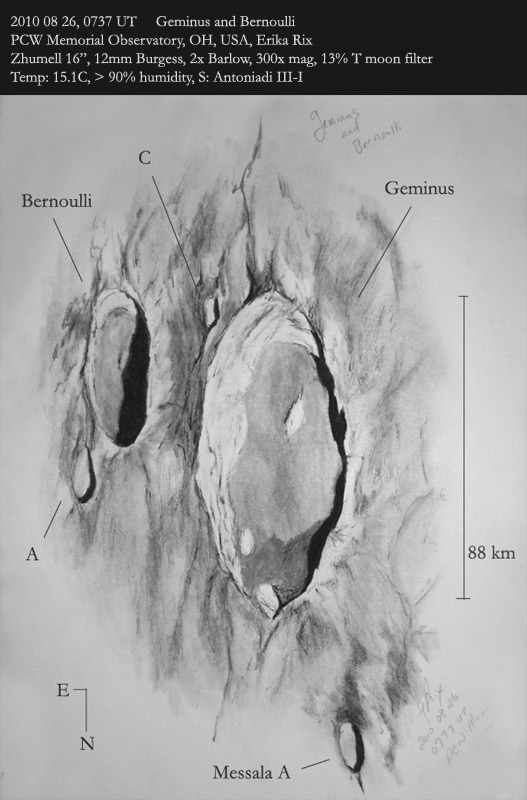
2010 08 26, Geminus and Bernoulli

•August 29, 2010 • Leave a Comment

Phase: 342.4°
Lunation: 16.19d
Illumination: 97.6%
Lib. Lat: -5°48’
Lib. Long: -2°06’
Az: 206°48’, Alt: 46°49’

Geminus: complex crater, 56.7° E, 34.5°N
Eratosthenian Period (-3.2 billion yrs to –1.1 billion yrs)
Dimension: ~88×52 km, Height: 5400 km
Named after Geminus of Rhodes. Depending on which reference you use, he was said to have lived in 70 BC or in 50 AD (or thereabouts) and was a mathematician and astronomer.

Although this is a circular formation, it appears oblong because of an effect called foreshortening caused by its position near the limb. Even the central ridge appears offset from the midpoint of the crater floor. The moon filter helped bring out more details not only in the terraced walls of the crater but also the extensive ejecta and formations surrounding Geminus. An area of interest is northern rim of the crater. In the sketch, there are two bright circular areas representing notches that I first believed were craters. The rim itself appeared well-defined and very sharp.

Geminus C (16×16 km) is located just southeast of Geminus and Messala A (26×26 km) is located a little further to the northwest.

Here is a good photograph by François Emond on the LPOD site to support the foreshortening effect that I observed. Geminus, Foreshortening Effect

This is an image that shows what Geminus looks like from above taken by the LO-IV-191H. Geminus, Above View

Bernoulli: crater, 60.7° E, 45° N
Upper Imbrian period (-3.8 billion yrs to –3.2 billion yrs)
Dimension: ~49×49 km,  Height: 4000 km
Named after Jacques Bernoulli, 17th century Swiss mathematician and physicist

The central mountain in this crater was visible just outside of the encroaching shadow. The terraced southern rim appears to spill into the outer surroundings and the northern edge seemed to plateau connecting like a bridge to Bernoulli A.

Resources
Rukl plate 16
“The Modern Moon” by C. Wood pgs. 98-99
Geminus Gallery from LPOD
Virtual Moon Atlas

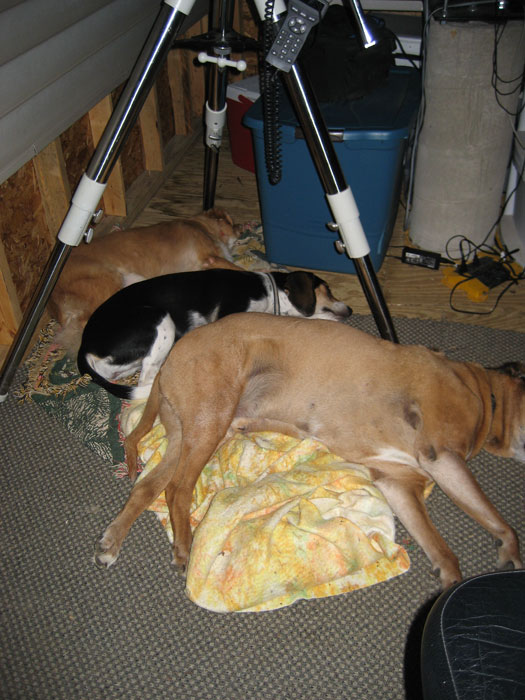
Paul was on a flight but the astro dogs kept me company. Even Nigel was wrapped around the base of my telescope mount next to my feet.

Buttercup, Freckles, and Riser

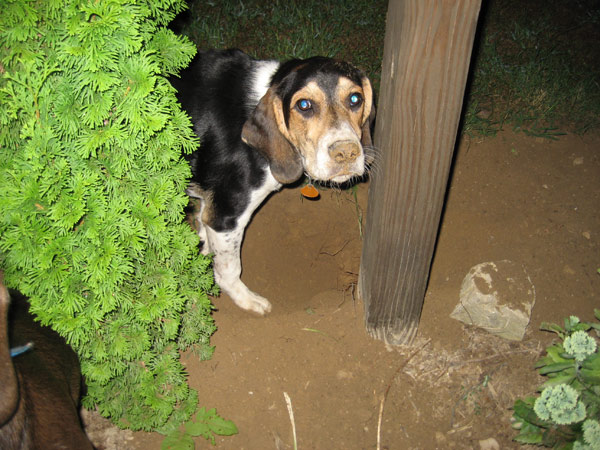
Freckles decided to do a little landscaping as I was putting equipment away and locking up the observatory.  She was certainly very pleased with herself.

Freckles caught in the act

Sketch completed scopeside on Rite in the Rain paper and charcoal.

2010 08 12 Perseid Study

•August 12, 2010 • 3 Comments

I’ve been reading a chapter out of “The Sky is Your Laboratory, Advanced Astronomy Projects for Amateurs” by Robert Buchheim (Springer) regarding meteor studies. I’ve never tried recording observations of meteor showers before and was very thankful to have an introduction explaining meteors and how to observe and record your observations. I’ve elected to do the “Project A” which is just a visual count of a major meteor shower. In this case, Perseids.

My first question was how does a person make the distinction between a Perseid and any other meteor? The author describes…

The “radiant” of a meteor stream is the point in the sky from which all of the meteors appear to have originated.

So in other words, Perseids radiate from Perseus.

But what if some of the meteors look like they radiate from Perseus but are actually from a different shower? The magnitudes and velocity and length are a few ways to tell if they belong to the same shower you’re recording.

As a rough rule of thumb, a meteor’s path will be roughly half as long as its distance from the radiant.

With that in mind, I decided to try sketching the meteors on a star chart, which really should have been gnominic charts. A fellow member of Cloudy Nights, GlennLeDrew, gave me the link to such charts: Charts designed just for meteor plotting.
Here’s what I came up with:

2010 August 10, 0600 UT - 0700 UT, 45 minutes observing time

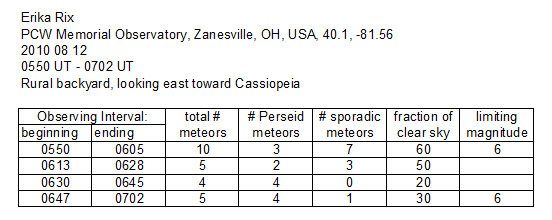
The next step for me, which I’ve done tonight, is an hour’s worth of actual recording, broken down into 15 minute intervals, as suggested for this project in the book.
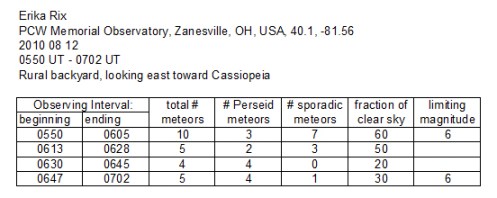
It would have been nice to continue on through the morning making several hours of observations. Not only was the weather not cooperating tonight, but I knew that I’d never be able to complete another hour of restful observation without falling asleep again while laying on my back in the comforts of my sleeping bag and all the night noises of nature. I believe the only thing that really kept me awake tonight was the smell of decomposing cabbage in the garden right night next to me from all the slugs having a late night supper each night.

Another CN member, Jane Houston Jones, posted very helpful insight on a similar project to mine. She’s taking it a few steps further with recording the magnitudes as well as identifying the sporadics and which showers (if any) they originate from. I will tackle that next. Thread on CN

Something else to take into consideration is how high the radiant is in the sky. When I started my observation tonight, Perseus’ tip was just starting to gain altitude from behind the trees. I could see the Double Cluster and then as far down as Mirtak. There were also trees to either side of my view, so that blocked out about 60% of my section of skies from Perseus. Add a few clouds and that might as well make it 70-80% blocked from any possible meteors radiating from Perseus.

For example: If Perseus was at zenith, the number of Perseids were 60 per hour, and there were no clouds in the sky and no obstructions with perfect conditions, you could ultimately view almost 100% of meteors from this shower (~ one Perseid meteor per minute) assuming you could catch them all. If Perseus is at the horizon, the number of Perseids you could potentially see under the same conditions drops to half that (~ one Perseid meteor every two minutes or 30 per hour). Add tree obstructions on either side blocking 25% of your sky makes it ~ 22.5 Perseids per hour. Add 30% cloud coverage and it drops the possible Perseids you might see to ~15.75 per hour. This amount decreases again for light pollution (take NELM into consideration), tiredness, interruptions, discomfort…..you get the drift.
As the radiant got higher, I started spotting a few meteors radiating outward to the SW. Unfortunately, the cloud coverage was becoming worse as Perseus gained altitude, which reflects in the record from tonight’s observation.

For more information on meteors and recording them, please visit The American Meteor Society and International Meteor Organization. It would make a fantastic project for you, your friends, and children.

20100809 Perseids

•August 9, 2010 • 4 Comments

The optimal viewing dates for the Perseids meteor shower are quickly approaching. Perseids 2010: visual data quicklook from the International Meteor Organization

…..expect the “normal” peak of ~100 meteors per hour to occur in the night of August 12-13 between 18h and 7h Universal Time.

Interested in recording your observations with IMO? Familiarize yourself with their Standard Procedure and then record your observations using their Visual Observation Report Form

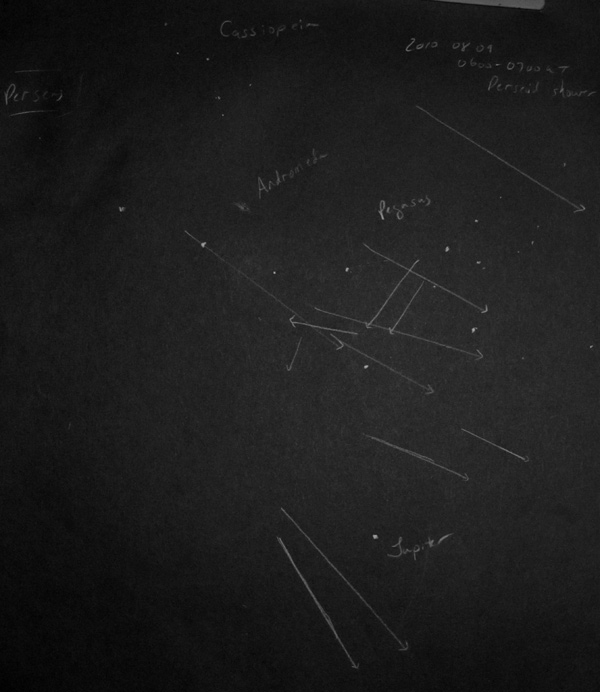
I’ve been planning on several observing sessions this week and tonight was a perfect night to get out there under the stars. Had I been a little more prepared, I would have reviewed guidelines for proper observation recording so that I could contribute my observation from tonight. It was a spur of the moment decision to grab my sketch pad, headlamp, and pencil to draw the meteors and their directions. I got home from work and changed into my pj’s, grabbed my sleeping bag and headed down to the hillside in front of the observatory with the dogs on my heels. Laying on my back with Freckles keeping my neck warm and Riser at my feet, Pegasus was directly overhead and Andromeda was a wide smudge in the sky en route to Cassiopeia. Jupiter was on the other side of Pegasus looking every bit the part of the giant planet that it is.

The highlight of the session (other than watching the show of course) was getting smacked in the forehead by what I believe was a bat. They were swooping down overhead to catch insects. I recorded 13 meteors in the sketch over the course of an hour. Prior to sketching, I observed 4 more. This was a dry run. I believe next time I’ll print off a sky map and draw them directly on that instead of quickly putting in a few constellations on my paper.

2010 Aug 09, 0600 UT - 0700 UT Perseids

2010 08 08, Solar

•August 8, 2010 • Leave a Comment

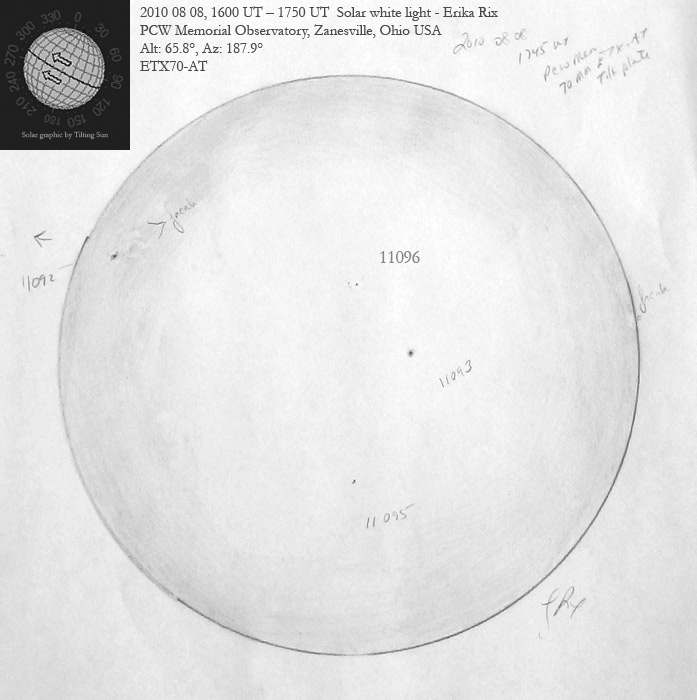
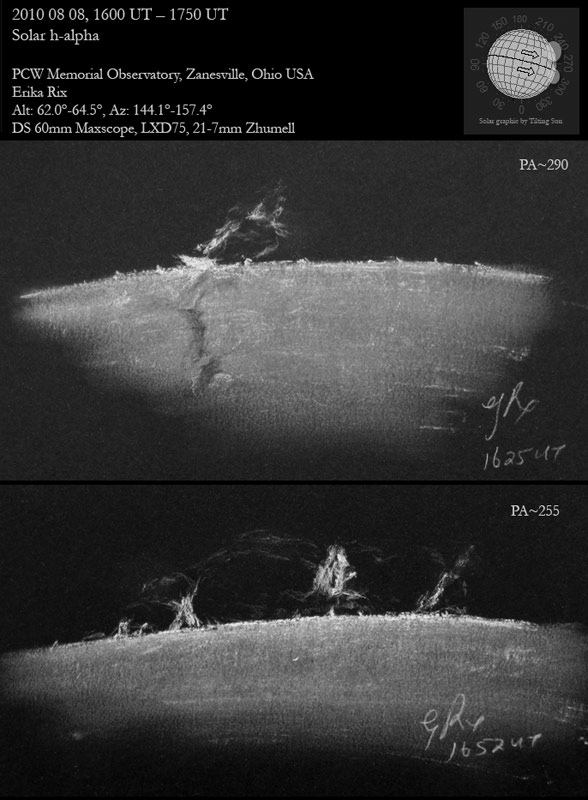
2010 08 08, 1600 UT – 1750 UT
Solar h-alpha

PCW Memorial Observatory, Zanesville, Ohio USA – Erika Rix

Alt: 62.0°-65.8°, Az: 144.1°-187.9°
DS 60mm Maxscope, LXD75, 21-7mm Zhumell, ETXA70-AT w/tilt plate, glass white light filter
H-alpha sketch created scopeside with black Strathmore Artagain paper, white Conte’ crayon and pencil, Derwent charcoal pencil, black oil pencil. White light filter sketched with a #2 pencil and white photocopy paper.

(Click on the images to enlarge)

I’m afraid the notes are missing from this report as I was rushed for time after observing on the 8th. My shift at work was about to start and I had only given myself 10 minutes to get ready for work before rushing out the door. I do remember that I noticed two small spots, perhaps pores, just NW of AR 11093 while working on my white light observation. The following day, NOAA designated it as 11096. Faculae were notice on both the western and northeastern limbs and a hint of it around the new active region 11096.


The prominence at pa 290° reached over the surface of the limb for form a hazy filament. The base of the prominence was very bright and dense. The prominence at pa 255° was networked together by very faint thin strands that were very difficult see.

2010 08 07, Solar NOAAs 11093, 11092, 11095

•August 7, 2010 • Leave a Comment

2010 August 7, 16:15 UT – 1920 UT     Solar NOAAs 11093, 11092, 11095
PCW Memorial Observatory, Zanesville, Ohio USA – Erika Rix

ETX70-AT w/tilt plate, DS Maxscope 60mm w/LXD 75, 21-7mm Zhumell

H-alpha sketch created scopeside with black Strathmore Artagain paper, white Conte’ crayon and pencil, Derwent charcoal pencil, black oil pencil. White light sketch created scopeside with copypaper and #2 pencil.

It was every easy to see three active regions in h-alpha with the disturbed looking sections of the solar disk including plage and filaments. 11093 and 11093 both had a very obvious sunspot within them. By the time I set up for white light observing, the sky had become so overcast that I was only able to observe those two sunspots long enough for placement on my paper. I’ve always enjoyed the sharp details in sunspots with a white light filter, so it was disappointing that the clouds came in and would have been nice to see if there were more little sunspots or faculae to be seen.

The large prominence on the NE limb gave me fits to render at the beginning of the session. Transparency made it nearly impossible to pull out details. It was so soft looking that I decided to pull out a larger sheet of black paper and work on the solar disk in h-alpha instead. Seems it was the right decision because an hour or so later, the prominence was very sharp and the sketch went quickly. Very faint areas of it extended out to the north and south, reaching far beyond the first views. I was unable to see these areas until I covered my head with the solar cloth to block out excess light. Even with the black paper, those areas were so faint that my eyes had to adjust after each marking was added to the sketch.

A tutorial for sketching prominences can be found here: Prominence Sketching

For more information and images from other solar observers around the world, please have a look at today’s Spaceweather page. Spaceweather

Excerpt from Spaceweather page…

M-FLARE: At 1825 UT on August 7th, Earth-orbiting satellites detected a long-duration M1-class solar flare. The source of the blast was sunspot 1093. Several amateur astronomers caught the active region in mid-flare. First-look data confirm that the blast produced a CME, but the cloud is not heading directly toward Earth. A glancing blow to our magnetic field on August 9th or 10th might produce auroras, but this does not appear to herald a major space weather event at Earth. Stay tuned for updates.

Astro Sketching??

•August 1, 2010 • Leave a Comment

by Erika Rix

PCW Memorial Observatory, Ohio, USA

Every so often someone will ask why in this day and age people still sketch at the eyepiece.  It’s true, there are some magnificent images, gathering light far beyond what a human eye can, enabling us to see much deeper via cameras.  Frankly, I’m happy that we can have the best of both worlds.  I wouldn’t want to compromise one for the sake of the other, and in fact I share this hobby with my husband, who is an imager.

So, why indeed sketch?

There’re many reasons and I certainly can only speak for myself when answering this question.  I suppose, truth be told, one of the main reasons I sketch is for the connection I get with the target while studying it, looking for the smallest nooks and crannies, contrasts, its essence.  The experience is very intimate and humbling. Who can think of astronomical sketching without having Galileo come to mind?  To know that we can look under the same skies as him, using modest equipment, going back to the basics with sketching and yet achieve so much while doing so, is quite fulfilling.

Next, and just as important, is for recording what I can see visually at that moment.  I write reports for my records and having a visual reference to go with them helps me to remember and study that session’s target.  The Sun, for example, is in constant change and even though I try my best to put the views into words, it simply cannot compare to a visual record.  With the Sun, you’ve already got all the light you need, so you have to depend on moments of very clear transparency as well as steady skies to see the faintest, most intricate details.  Brief moments like that is a luxury we have as visual observers.

Among the many other reasons for sketching, I’d have to say on the top of the list is to help yourself become a better visual observer.  When you sketch, you are forced to really study the target. Instead of spending a few minutes on one object, you can spend a few hours on it, depending on what your target is or what you are trying to achieve with your session.  I’ve spent anywhere to just a few minutes with the Sun to the entire day on and off, or following active regions over the few weeks that it takes for them to cross from the eastern limb to the western, if they hold out that long.   Sketching, simply put, increases your visual sensitivity, allowing you to see more subtle details with each session.

As always, I am looking for better ways to render and record my observations.  I’m a firm believer that there’s no such thing as a bad sketch since each sketch helps you increase your observing skills and leaves you with a record of your observation.  But along with trying to improve my observation reports, I want to strive to make my markings as true to life as I can.

How do you take the first steps towards sketching?

Got a piece of paper and a pencil?  That’s all you need…well that and a comfortable observing chair and clear skies.  The key to long observing/sketching sessions is comfort. Without that, you lose your concentration, rush through a session, and end up with a sore neck or back afterward.  I know I’ve hit the comfort zone when I lose track of my surroundings and feel like I’m hovering above the object instead of stuck on the ground at the backend of a telescope.

Of course, good optics are always a plus!

Good Optics are a Bonus!

2010 07 29 – NOAA 11092

•July 29, 2010 • Leave a Comment

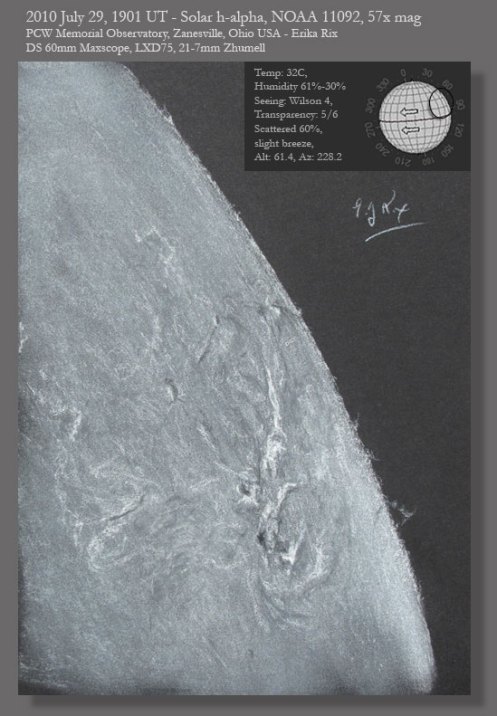
2010 July 29, 1901 UT
Solar h-alpha, NOAA 11092, 57x mag

PCW Memorial Observatory, Zanesville, Ohio USA – Erika Rix

Temp: 32C, Humidity 61%-30%
Seeing: Wilson 4, Transparency: 5/6
Scattered 60%, slight breeze, Alt: 61.4, Az: 228.2

DS 60mm Maxscope, LXD75, 21-7mm Zhumell
H-alpha sketch created scopeside with black Strathmore Artagain paper, white Conte’ crayon and pencil, Derwent charcoal pencil, black oil pencil.

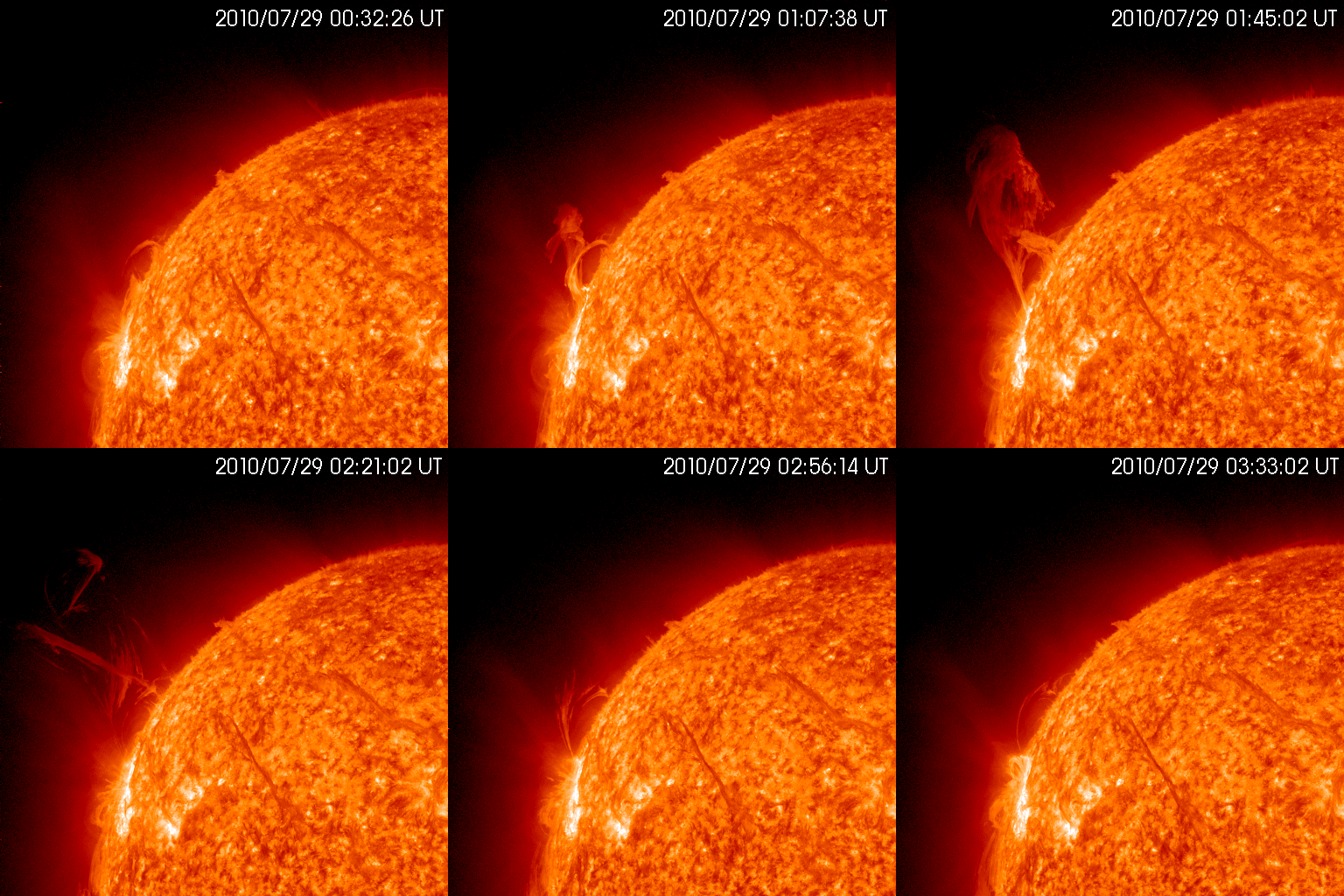
One day after that magnificent eruption on the southeastern limb (http://www.spaceweather.com/archive.php?view=1&day=29&month=07&year=2010), we’re left with no significant prominences, but the surface features are abundant!  I wanted to zoom in on a feature instead of doing a full disk sketch, so chose active region 11092 as my target. The bright line of plage had caught my eye, and together with the prominent sunspot near the end of it, it created quite a scene.

This new active region poses a threat for C-class flares according to Spaceweather. In fact there was another eruption around 01:00 UT this morning!  Click here to see amazing footage of it from the Solar Dynamic Observatory:  http://www.spaceweather.com/swpod2010/29jul10/eruption29jul10.gif?PHPSESSID=eaoh9nq80nb718gq45s69lpvp2

Active region 11089 was very prominent as well on the western edge of the Sun. There were two very large filaments stretching across the northern hemisphere and several smaller ones scattered across the entire disk.

Seeing was nearly perfect today, although I had to wait long periods in between the scattered clouds.  I kept the magnification at 57x. I used a smaller sheet of Strathmore, but made up for it by filling in the entire piece with this active region, allowing me to add more details to the sketch.

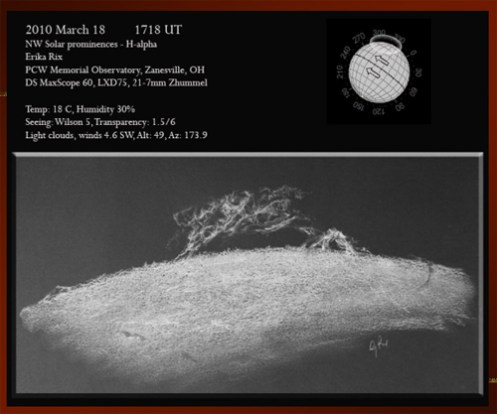
Prominence Sketching

•July 24, 2010 • 1 Comment

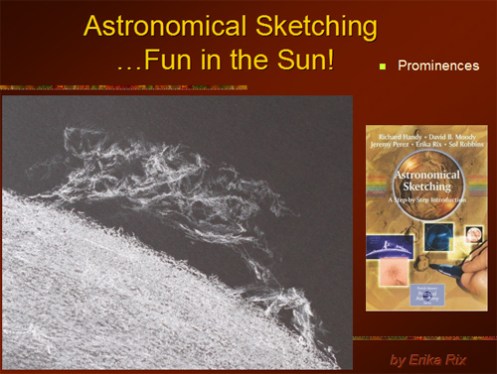
Solar prominences are constantly changing; sometimes dramatically, other times slow enough that you don’t really notice the changes unless you’ve taken the time to a sequence of sketches over a period of a few hours.  It’s taken a lot of trial and error as well input from other astronomical sketchers to help me along through the years come up with the technique I use today for sketching prominences. Having said that, I imagine my technique and media will most likely continue changing as the years go by since I never seem to be truly happy with my sketches and how they represent such a powerful, magnificent target.  Hopefully this tutorial will give others a good starting point for developing their own style and technique.

Prominence Sketching

Tips:

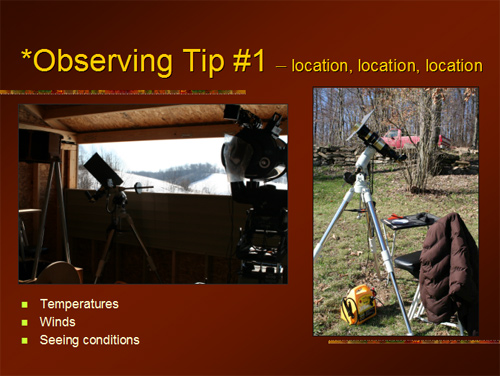
  • Remember that solar observing is affected by the same conditions that night-time observing is: the Sun beating down on pavement or wood decks creating quivering views, winds, eyepieces fogging up from your breath in the colder months/sweat from your eyebrows in the hotter months, even dark adaption (yes…having your eyes adjust to the darker views of hydrogen alpha so that you can see the faintest of details in prominence structure). Pick your location wisely to give you the best views for that day’s weather conditions.

¨

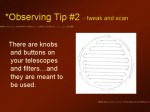
  • Your eyes can detect movement sometimes easier than they can the fainter details. Some filters don’t have a flat bandwidth nor a flat field of view. Different solar features have slightly different optimal bandwidths. So…have a play with those knobs to get the most out of your session. Scan back and forth slowly, move the FOV around, notice the features popping in and out of bandwidth.

¨

  • The types of paper and pencils you use can hinder or help you. Things to consider: sunlight glare on your paper will temporarily give you blind spots when you try to observe again after adding a marking (worse with white paper – think dark adaption when you put your eyes back to the eyepieces), texture, smudges or holds the pencil markings, colors…

¨

  • Outside light around the eyepiece cups will prevent you from seeing the fainter details. Eyecups, towels, proper solar cloths, or even a cardboard solar shield, will help.

¨

Tutorial:

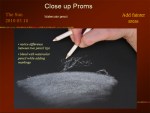
  • I normally use black Strathmore Artagain paper, but had run out at the time I did this observation sketch. Canson paper is comparable. A clipboard is handy to keep the paper stiff and in place. Using the flat edge of white Conte’ crayon to draw the arc freehand, I make sure not to create an over-curved arc.

¨

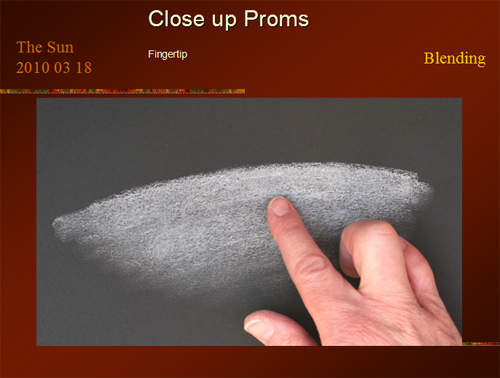
  • Using my fingertip, I blend the surface of the disk fairly smoothly. I’ve tried different chamois and blending stumps, but they all remove too much of the pastel, so even though my fingertip leaves oil residue, my fingertip so far has given me the best control over my blending.

¨

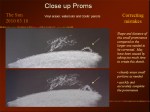
  • Sometimes I add fainter markings for the anchor points, other times, the brighter markings. In this case, I used a watercolor pencil to lightly add the anchors of the prominence since this prominence was very extensive.

¨

  • Working quickly, as most of my prominence sketches are done in 5-10 minutes, and very rarely in 15-20 minutes, I use the Conte’ pencil for adding in the brighter markings. I use an exacto knife for creating a sharp edge on my pencil. I try not to pay attention to the fainter strands of the prominence through the telescope. The bright areas make a great foundation for the rest of the sketch.

¨

  • Switching to the watercolor pencil, I add the fainter markings. By adding the markings over portions of the Conte’ markings, you can achieve some blending at the same time.  A zoom eyepiece really helps so that you can zoom in or out depending on seeing and transparency conditions. Also, a dark cloth over your head is a huge asset for pulling out those faint details that are barely detectable otherwise.

¨

  • A white vinyl eraser erases cleanly if needed. I sharpen mine into a wedge shaped for better control. Be careful blowing/wiping the erasure debris so that you don’t smear the sketch. Prominences are in constant motion. If you spend too long of a time sketching one, you’ll find yourself reaching for that eraser constantly chasing the changes. That’s why it’s important to build up your speed to 5-10 minutes per prominence.

¨

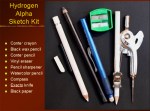
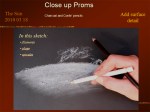
  • Adding surface detail is made easy with charcoal, the brilliantly white Conte’ pencil, and a black oil/wax pencil. The charcoal creates a softer, fainter filament and is great for shading contrast in active regions or around plage. Black oil pencils leave a very crisp, sharp dark gray/black marking for the more pronounced sections of filaments/fibrils, and sunspots. White Conte’ is perfect for plage or for creating more texture for mottling.

¨

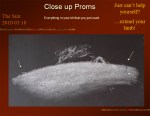
  • Sometimes, a person just can’t resist the urge to continue along the limb or into the disk to grab more features. I do it often, myself. Don’t be hesitant about grabbing all the kit you’ve just used and add to your sketch. Sometimes, that’s when I can nab sketches of a flare or a prominence erupting right before my eyes.  What starts off as a small spicule could lead to an eruption that you’ll be glad you caught on paper.

¨

  • To finish it off, I scan my sketch or take a photograph of it, adjust the brightness/contrast to match the true appearance of my sketch, and then I insert a graphic from the Tilting Sun program that shows the orientation for my scope and mount (dependent on how my diagonal is turned and where I am sat behind the eyepiece) and any useful information concerning my observation.

TrES1 Transit – 2010 July 15, by Paul Rix

•July 23, 2010 • Leave a Comment

One of the benefits of being married to another amateur astronomer is sharing the love of astronomy through various aspects, which in turn, expands our overall enjoyment. Through sharing his images and what he’s researched, it opens up whole new areas of the hobby that I might not have experienced.  Such is the case in his report below. What a fascinating endeavor and quite an accomplishment! ~ E. Rix

TrES1 Transit – 2010 July 15, by Paul Rix

For many years Astronomers theorized that stars other than our own Sun should have their own solar systems (after all, there is nothing particularly unusual about our own star). It wasn’t until the mid 1990’s that advances in technology finally allowed this to be confirmed. Since then over 450 extrasolar planets have been discovered, with more being added to the long list almost on a weekly basis.

One method of detecting an extrasolar planet is to measure the luminosity of a star before, during and after a ‘transit’. This is where the planet crosses the face of the star (when seen from here on Earth). The planet will block out a small amount of the star’s light, causing it to slightly dim. This dip in brightness can be measured. For this to work the planet’s orbit around its star has to be almost exactly edge on to us. As you can imagine, the chances of that happening are rather slim. Despite the odds, over 80 transiting extrasolar planets have been discovered so far.

Over the past few years, the equipment available to Amateur Astronomers has advanced incredibly, especially in the field of astro-photography. Affordable, purpose built CCD camera’s are now standard equipment for many amateurs. These cameras are sensitive enough to detect the slight reduction in brightness of a star as an extrasolar planet crosses in front of it.

A few months ago I set myself the goal of detecting an extrasolar planet by the end of this year. On 14th /15th July (Wednesday night /Thursday morning) I managed to detect a transit of the planet named TrES-1 that orbits a star in the constellation Lyra. TrES-1 is a gas giant similar in size to Jupiter. Unlike Jupiter, TrES-1’s orbit is very close to its star (closer than Mercury orbits the Sun). The planet completes an orbit every 3.03 days.

To find out the timings for known transits, I looked at the Exoplanet Transit Database website. This site is a great resource that gives you all the information you need to know : Timing, Right Ascension and Declination co-ordinates, how much the star is anticipated to dim and even a photo of the star field showing the target star. Once I had everything set up, I let the camera run from 90 minutes before the predicted transit until about 45 minutes after it was due to be complete (I had to cut the session a little shorter than planned).

The hard work came the next day when it was time to process and plot the data as a graph, which is known as a Light Curve. I used a freeware program called Iris to measure the intensity of the target star in each of the 367 frames and compared the values with those of two nearby ‘comparison’ stars. As I worked through the images, it slowly became apparent that the target star had dimmed ever so slightly at the predicted time and then picked back up again. That was exciting to see but the best moment came after transferring the brightness values into a graphing program and seeing my first Light Curve with a noticeable dip in the middle.

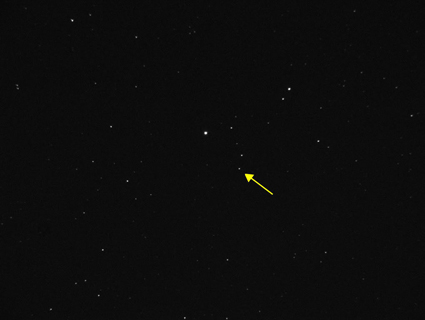
TrES1 transit 20100715

Image showing the star involved with the transit.

The equipment I used to detect this transit was a Meade 10inch LX200 Classic SCT, F3.3 Focal Reducer, Meade DSI III Pro CCD camera and a Photometric ‘R’ band filter. For processing I used a program called IRIS (http://www.astrosurf.com/buil/us/iris/iris.htm), the Open Office spreadsheet (http://www.openoffice.org) and Graph (http://www.padowan.dk/graph/).

In future I will use a program that will automate the processing which will save a lot of time and work.

This has been a fascinating project for me, which marks my first steps in Photometry and doing science with a telescope. There is much for me to learn and I am looking forward to improving my skills and knowledge with this side of amateur astronomy.