Sky Conditions and Scales

•February 7, 2011 • Leave a Comment

Protect our night skies:
The International Dark-Sky Association – Non-profit organization fighting to preserve the night, protecting wildlife, cutting energy waste and stopping light pollution

Estimating Limiting Magnitude – by Nine Planets

Antoniadi Seeing Scale – Seeing scale used for planetary and lunar observing.

Clear Sky Chart – Find out what your sky conditions are in your area.

Mt. Wilson Solar Seeing Scale – Seeing conditions for solar observing.

Pickering Scale – Pickering scale of rating atmospheric turbulence, hosted by Damian Peach’s site.

Lunar

•February 7, 2011 • Leave a Comment

Inconstant Moon – “Explore the Moon… discover its dramatic features and phenomena – often beautiful, sometimes bizarre, always changing. Inconstant Moon will take you on a new tour each night, with maps, photos, explanations, animations, selected links and even music! “

LPOD – Lunar Photo of the Day – Daily lunar images, information, and discussions – by Chuck Wood

Rukl-Based Index to the Moon – Love your Rukl atlas? Jim Mosher created a clickable online map using Rukl’s indexing.

The Moon – LPI – Includes lunar images and mapping

Virtual Moon Atlas – Superb freeware for lunar observation and survey – written by Patrict Chevalley and Christian Legrand

Virtual Moon Atlas – Beginner’s Tutorial – Article to assist beginners in locating features on the moon and using the VMA program – by Erika Rix

General Astronomy

•February 7, 2011 • 1 Comment

APOD – Astronmomy Picture of the Day – Daily image of our universe with brief explanation of the object

Astronomical League – One of the largest amateur astronomical organizations in the world, promoting incentives for observing and research, communications with other clubs, and education

Cloudy Night Telescope Reviews – Likely the most valuable astro resource out there…forums, reviews, articles, huge membership of fellow observers sharing information, classifieds. In other words, you name it, CN has it.

COSMOS – The SAO Encyclopedia of Astronomy – “Cosmos is a unique astronomy reference written by research astronomers. Our encyclopedia entries are for a general audience who wish to know detailed information on a wide range of astronomical topics.”

Heavens Above – Real-time satellite, ISS, and Space Shuttle orbital pass information, maps, and star charts by Chris Peat

IAU: Central Bureau for Astronomical Telegrams – “The CBAT is responsible for the dissemination of information on transient astronomical events and various IAU news including the announcement of designations and names of various celestial objects.”

LVAS Observer’s Challenge – Monthly observing challenge to encourage visual observing, by Roger Ivester, Rob Lambert, and Fred Rayworth

NASA – NASA’s home page

Space.com – Space and NASA News

The Calendar-Sky – Personalized astro-calendar

Deep Sky

•February 7, 2011 • 2 Comments

Catalogs

Common Catalogs

Arp

Caldwell

Collinder (C)

Herschel (H)

Index Catalog (IC)

  • NGC/IC Project – collaborative effort between professional and amateur astronomers to correctly identify all of the original NGC and IC objects

Lund

Lynds (LDN)

Messier (M)

Minkowski

  • Minkowski 1 through 4 – on DeepSkyPedia site, observations completed by observers Ante Perković (AP), Vedran Vrhovac (VV), and astro-photographer André Hartmann.

New General Catalog (NGC)

  • NGC/IC Project – collaborative effort between professional and amateur astronomers to correctly identify all of the original NGC and IC objects

Perek-Kohoutek (PK)

Sharpless (Sh)

Uppsala General Catalog (UGC)

Open Clusters

Double Stars

  • The Washington Double Star Catalog – maintained by the United States Naval Observatory is the world’s principal database of astrometric double and multiple star information, by Brian D. Mason, Gary L. Wycoff, and William I. Hartkopf

Galaxies

Logbooks

Planetary Nebulae

Supernovae

Comets/Meteors/and Artificial Satellites

•February 7, 2011 • Leave a Comment

American Meteor Society – “The AMS is a group of meteor enthusiasts who wish to share their knowledge with fellow observers and the general public alike.”

Astronomical and Comet Definitions – useful listing of common astronomical and comet terms with their definitions

CalSky – tool to create orbit calculations for satellites in your location

Comet and Meteor Terminology – by Utah Skies

IAU: Central Bureau for Astronomical Telegrams – “The CBAT is responsible for the dissemination of information on transient astronomical events and various IAU news including the announcement of designations and names of various celestial objects.”

The ICQ Comet Information Website – “This is a key place to begin looking for useful and accurate information regarding news, observations, orbital data, designations and names, and good links regarding comets and related topics [sponsored by the International Comet Quarterly (ICQ)].”

International Meteor Organization – “The collection of meteor observations by several methods from all around the world ensures the comprehensive study of meteor showers and their relation to comets and interplanetary dust. “

2011 01 24 Glory

•January 25, 2011 • Leave a Comment

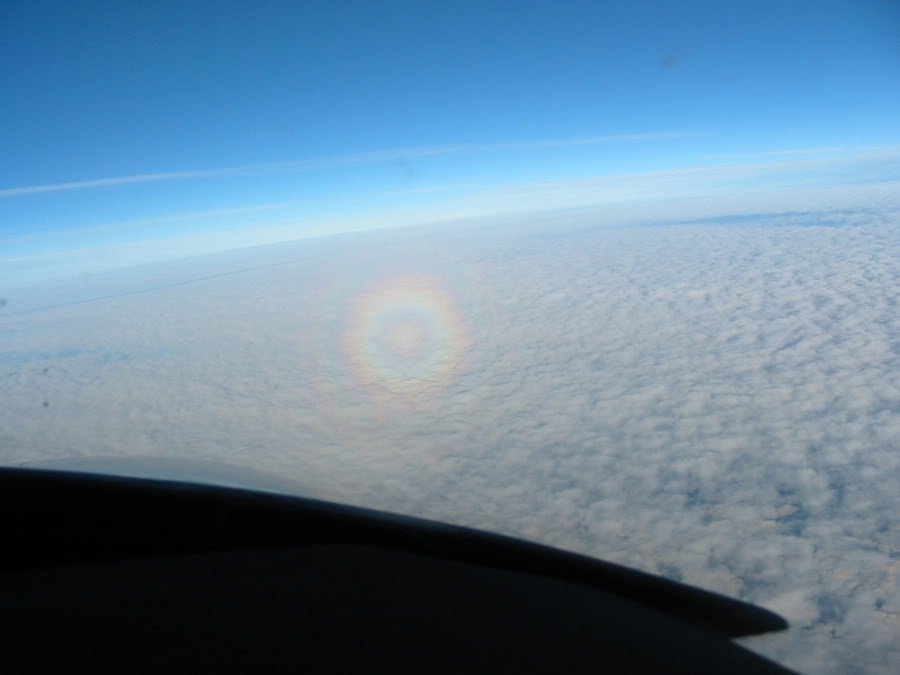
Photo taken by Paul Rix, 2011 01 24

On the site Atmospheric Optics, Les Cowley describes clouds, fog and water droplets to help us understand how light plays on them to produce phenomena such as glories and sun dogs.

Clouds appear substantial and opaque because the total number of droplets is immense. Light rays are scattered after travelling just a few metres and most emerging rays will have been scattered several times. Sunlit clouds appear white because, overall, their droplets scatter the different wavelengths of visible light equally and absorb little light in the process. Colourful coronae, glories and ghostly fogbows show up when the cloud or fog has similar sized droplets and when the cloud is thin and lighting conditions are such that light rays are only scattered once.

When sunlight interacts with clouds or mist, the water droplets in the clouds are small enough to diffract and scatter its waves in all directions, creating beautiful spectrums of color such as ringed glories. Glories are opposite the Sun (anti-solar point), and can only be seen when the observer is directly between the sun and cloud that is diffracting the sunlight. In the photo above, the airplane would be in the Sun’s light path. Droplet size distribution determines how many rings the glory will have. Droplet diameter determines the size of the glory.

Looking at the photo that Paul took on the January 24th, the clouds were far enough away from the airplane that its shadow was not visible in the middle of the glory. It also looks like there is ~20% variance in water drop size distribution by looking at the lack of rings. I’m unable to estimate the size of the glory, but the angular size of the glory is only determined on the diameter the droplets (as stated above), not how far away the plane is from the clouds.

Here is another photo of a glory taken by Paul a few years ago in November 19, 2004.

Photo taken by Paul Rix, 2004 11 19

Other useful links:
Glory Formation, by Atmospheric Optics
Glory (optical phenomenon), by Wikipedia

If you’d like a little fun creating your own glory simulations, check out Les’ IRIS software.

2010 12 20 Lunar Aureole Sketch

•December 20, 2010 • Leave a Comment

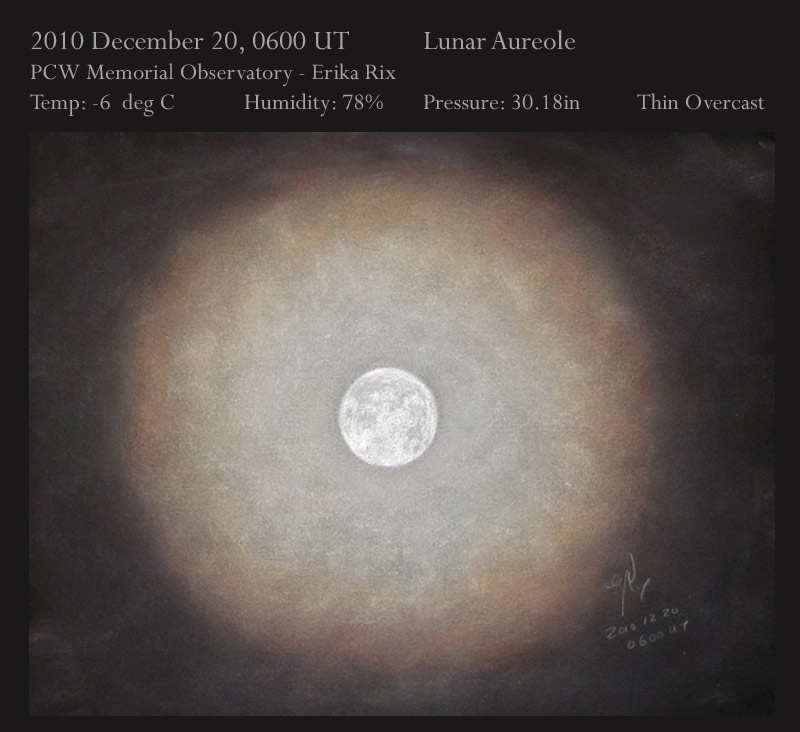
Sketch created sitting on the steps under the skylight window of our house roof. Media: Black Strathmore Artagain paper and Conte’ pastel crayons.

Links to Aureole Archives from PCW.

Excerpt from a previous post:

Light is diffracted by tiny droplets of water in the atmosphere creating these beautiful scenes. The droplet size, shape, and light wavelength all determine the outcome of the corona. The smaller the water droplets in the atmosphere, the larger the diameter of the ring around the Moon or the Sun.

Talking about the upcoming lunar eclipse yesterday evening with my husband, Paul, I thought the date at that time was the 20th. There was a thin layer of overcast, which meant no telescope viewing but certainly good enough to watch the lunar eclipse…if only yesterday were indeed the 20th! I had gone to bed and read for awhile before I convinced myself that I could get through a day of work with only a few hours’ sleep. After putting on my slippers and heating up the tea kettle, I walked down to the observatory to retrieve my sketching gear. When I got back to the house, I was pleased to see that I had a perfect view of the Moon, clouds and all, through the skylight on our house roof. If my luck held out, I could do a naked eye observation of the Moon in the warmth of the house.

I wanted to sketch the eclipse so thought I could do a quick practice run on the lunar aureole that put on a display through the clouds. It was only after I completed the sketch and checked the date on my computer that I realized I was a day early!

Maybe tomorrow night the clouds will be kind for viewing the actual eclipse. In the mean time, I’ll just have to settle for a “golden crown of light.”

Observation Forms/Templates

•December 19, 2010 • 7 Comments

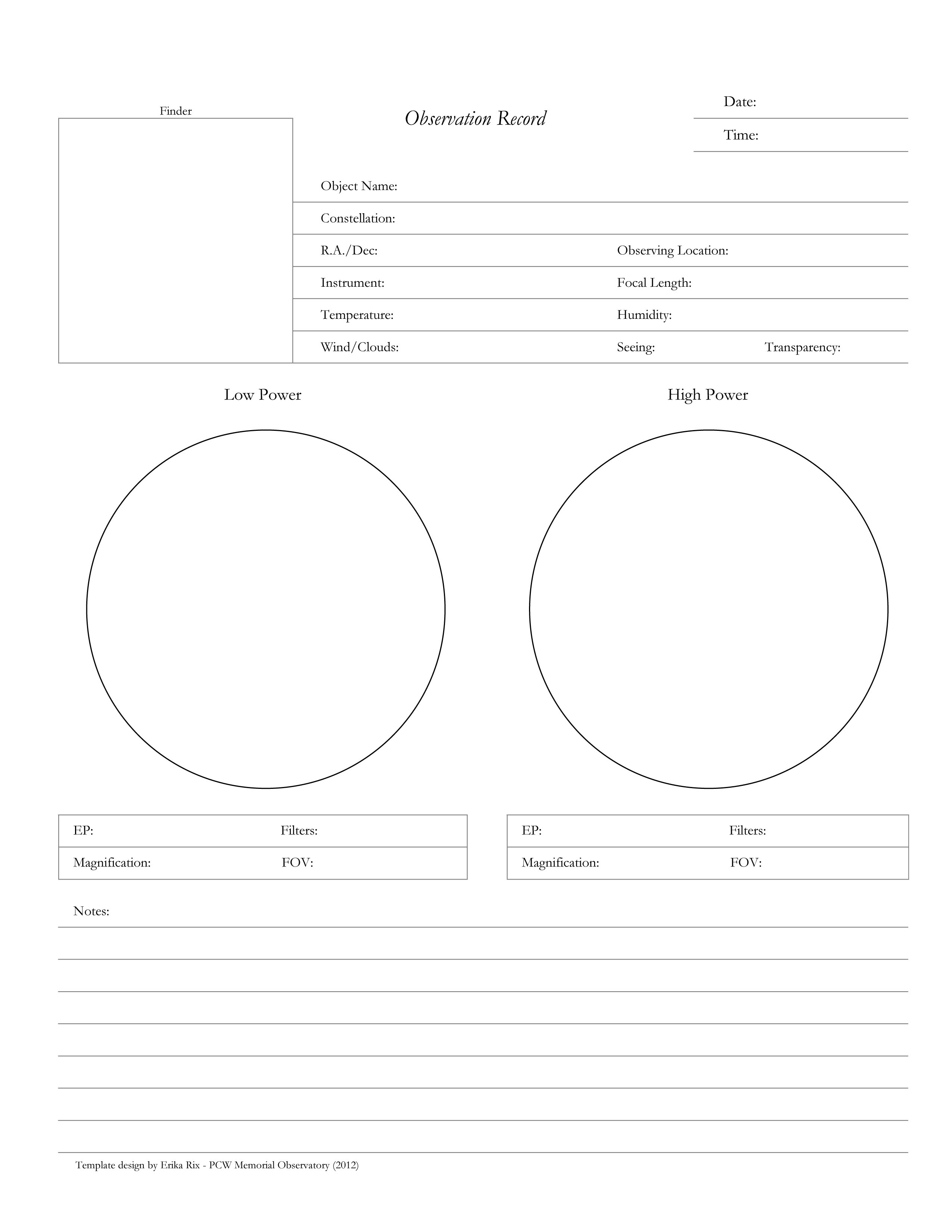
Please feel free to print, download, or share copies of the following forms for personal or club non-profit use.

General Observing Form

Click here for a pdf version of the form.

Lunar Observing Forms/Templates

Meteor Observing Forms

Planetary Observing Forms/Templates

Jupiter Templates

Courtesy of Sol Robbins

Mars Templates

Courtesy of Sol Robbins

Saturn Templates

Courtesy of Sol Robbins

Venus Templates

Courtesy of Sol Robbins

Transit Observing Forms/Templates

Full Solar Disk

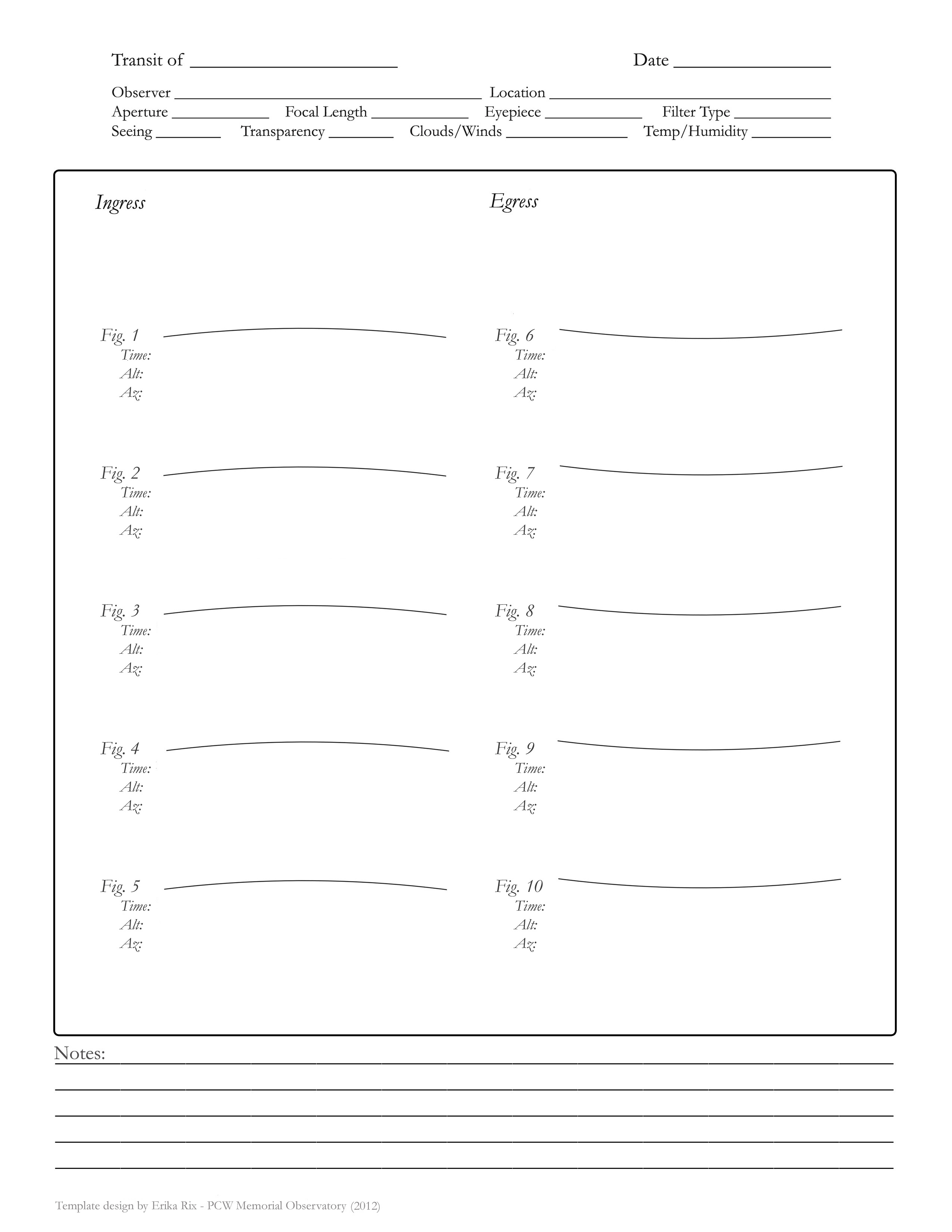
Ingress and Egress – 10 stages

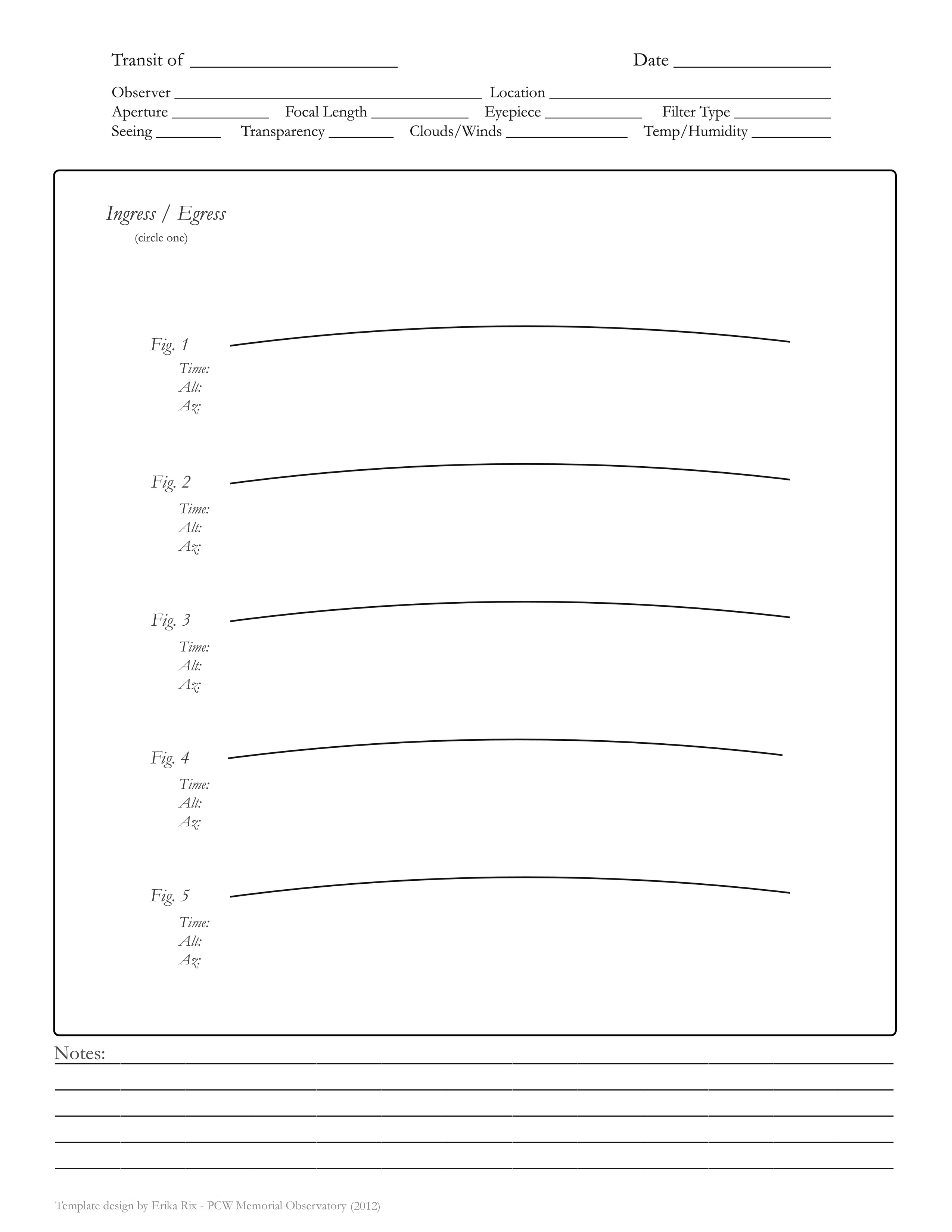
Ingress or Egress – 5 stages

Useful Websites with Observing Forms and Templates

NOAA Active Region Designations

•December 15, 2010 • Leave a Comment

If you’ve noticed that NOAA 11135 from 2010 December 14 lacked sunspots, you may be wondering why it was designated an active region number by the NOAA.

Per the NOAA Glossary, the NOAA defines an active region as:

A localized, transient volume of the solar atmosphere in which plages, sunspots, faculae, flares, etc., may be observed. Active regions are the result of enhanced magnetic fields; they are bipolar and may be complex if the region contains two or more bipolar groups.

A region number is defined as:

A number assigned by NOAA to a plage region or sunspot group if one of the following conditions exists: (1) the region is a group of at least sunspot classification C; (2) two or more separate optical reports confirm the presence of smaller spots; (3) the region produces a solar flare; (4) the region is clearly evident in H-alpha and exceeds 5 heliographic degrees in either latitude or longitude. (See also active region.)

In the case of NOAA 11135, it flared a few days ago. That in itself was enough to warrant designating a number for that region. Solar observer Thomas Ashcraft caught it superbly in his thread Flare at northeast limb now 1849 ut Dec 12, 2010

There were a few eruptions on the 12th. For another look at the activity on the 12th: Triple CME gif from SOHO

2010 12 14 – NOAAs 11131, 11133, 11135

•December 14, 2010 • Leave a Comment

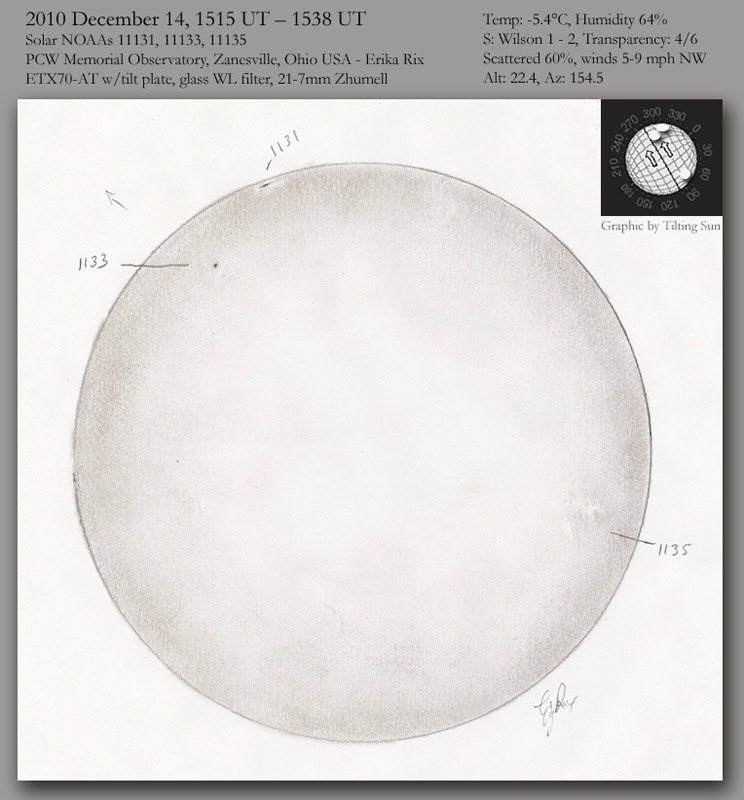
2010 December 14, 1515 UT – 1538 UT Solar NOAAs 11131, 11133, 11135
PCW Memorial Observatory, Zanesville, Ohio USA – Erika Rix
ETX70-AT w/tilt plate, glass WL filter, 21-7mm Zhumell

White light sketch created scopeside with copypaper, charcoal, and #2 pencil.

Temp: -5.4°C, Humidity 64%
Seeing: Wilson 1 with moments of 2, Transparency: 4/6
Scattered 60%, winds 5-9 mph NW, Alt: 22.4, Az: 154.5

Initially, I had planned on doing both H-alpha and white light solar observing this morning. After the rains and the snow, a break in the clouds was very welcomed and just in time for the peak of the Geminids. Unfortunately, I didn’t take advantage of the clear skies during the night, but did get dressed in my coveralls for a solar session today. Just as I was getting ready to set up, more clouds rolled in. It would have made a very discouraging h-alpha session, but very doable for white light. Since the observatory roof was covered in snow (the thought of drifts of snow landing on the lens my Maxscope was enough to make me cringe) and difficult to roll off from the ice, I opted to only drag out the ETX70 for a white light observation. Thanks to my husband, Paul, for his willingness to clean the roof off and attempting to roll it back for me.

I warmed up my disfigured eyepiece cup with my hand so that I could manipulate it back to its original form after packing it away quickly from my last session. The view was like a saw blade, but I had a few moments of steady “enough” skies to make out both the umbrae and penumbrae of the sunspots in 1131 and 1133, as well as the facula around 1131, with a hint of facula around 1133. AR1135 was only visible to me by its facula. AR1134 was elusive and I saw no hints of that active region. AR1131 was appeared flattened as we often see when the sunspots are so close to the limb.

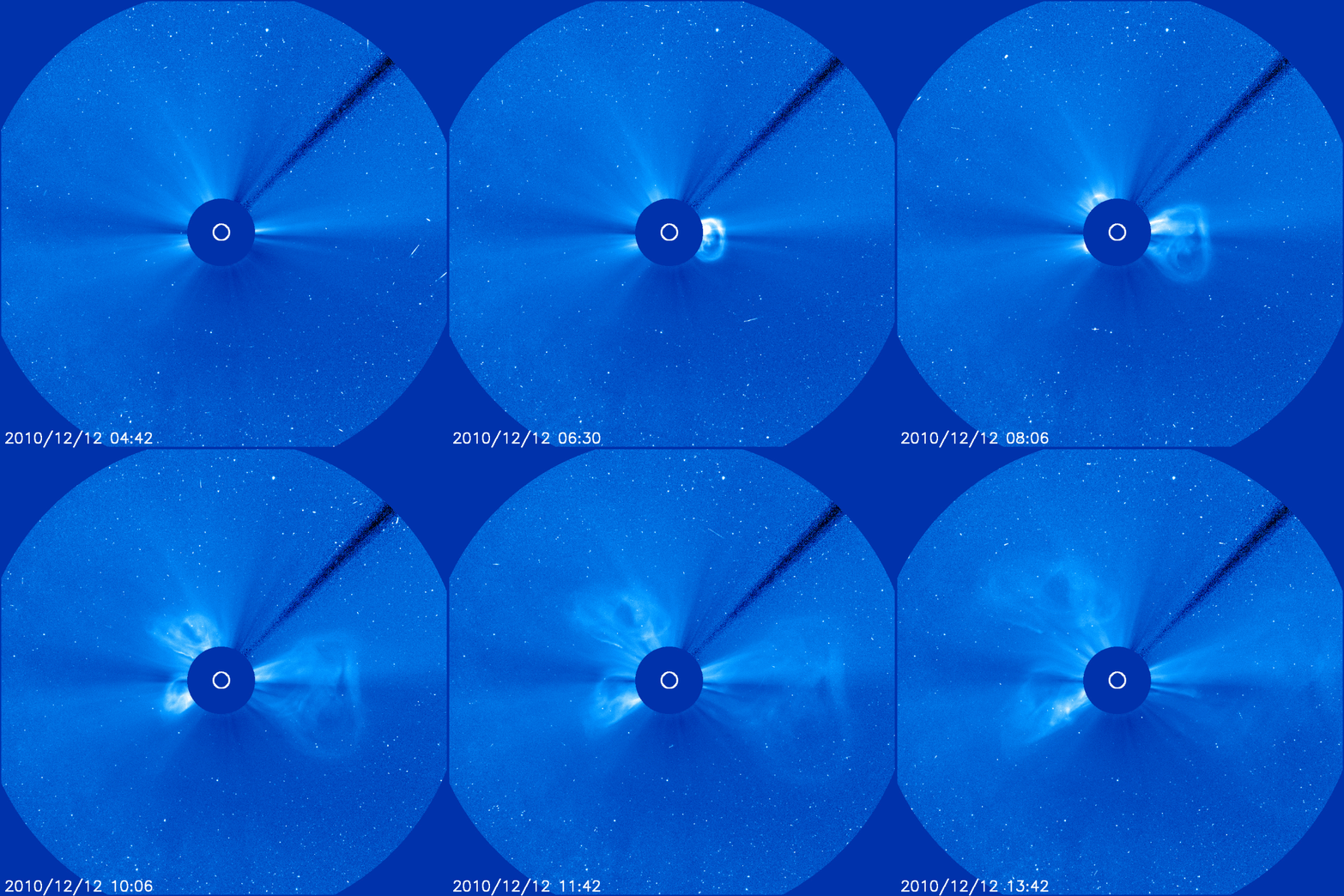
Two days ago, there were three eruptions within a matter of hours. Dec. 13, 2010 Spaceweather.com

TRIPLE ERUPTION: Solar activity surged on Sunday, Dec. 12th, when the sun erupted three times in quick succession, hurling a trio of bright coronal mass ejections (CMEs) into space. Coronagraphs onboard the Solar and Heliospheric Observatory recorded the action:

Link to the video (9MB gif): SOHO Coronograph Movie 12/12/10

Many might remember the large eruptions from August 1, 2010. In an article from NASA Science News, authored by Dr. Tony Phillips:

“To predict eruptions we can no longer focus on the magnetic fields of isolated active regions,” says Title, “we have to know the surface magnetic field of practically the entire sun.”

“The whole-sun approach could lead to breakthroughs in predicting solar activity,” commented Rodney Viereck of NOAA’s Space Weather Prediction Center in Boulder, CO. “This in turn would provide improved forecasts to our customers such as electric power grid operators and commercial airlines, who could take action to protect their systems and ensure the safety of passengers and crew.”

“We’re still sorting out cause and effect,” says Schrijver. “Was the event one big chain reaction, in which one eruption triggered another–bang, bang, bang–in sequence? Or did everything go off together as a consequence of some greater change in the sun’s global magnetic field?”

So much to learn and thankful to have the new information at our fingertips…