2011 05 05 Solar NOAAs 11203, 11204, 11205, 11207 and prominences

•May 6, 2011 • Leave a Comment

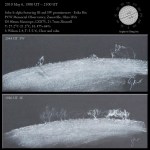
2011 05 05, 1230 UT – 1515 UT
Solar h-alpha, NOAAs 11203, 11204, 11205, 11207 and prominences

PCW Memorial Observatory, Zanesville, Ohio USA – Erika Rix
Temp: 22.5°C, Humidity 38%
Seeing: Wilson 4, Transparency: 3/6

DS 60mm Maxscope, LXD75, 21-7mm Zhumell, ETX70 AT w/tilt plate and white light glass filter.
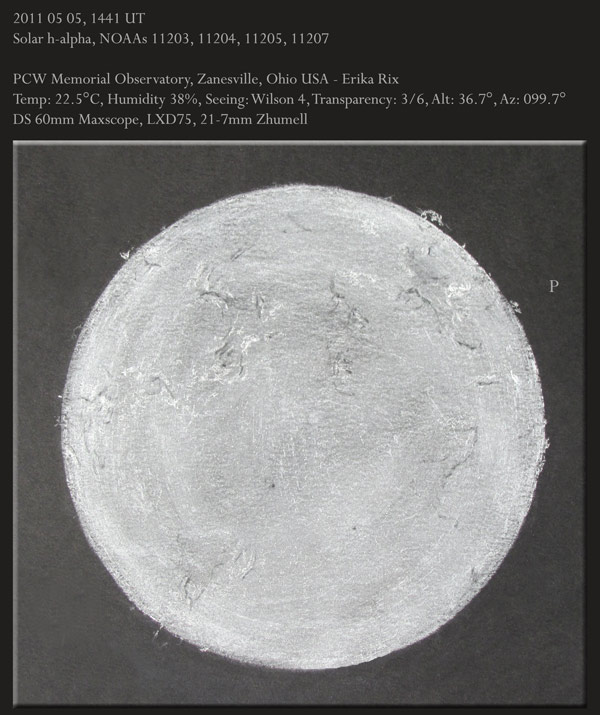
H-alpha sketch created scopeside with black Strathmore Artagain paper, white Conte’ crayon and pencil, Derwent charcoal pencil, black oil pencil. White light sketch created on photocopy paper with 0.5mm mechanical pencil and #2 pencil.

The Sun was a little too low in the observatory for me to stay inside at the beginning of the session, so I pulled all my gear onto the grass. It was probably the best move anyway, since it warmed up quite a bit during the session.

I started off with the Maxscope for an overall view. The prominence at the western limb caught my eye initially, but it was the prominence on the eastern limb that really put on a show. It was nearly three times taller than the other and had the faintest wisps of filament reaching out connecting the brightest three areas of that prominence section.

The h-alpha full disk was filled with filaments and plage within the band of active regions. I’ve flipped the views of both the white light and h-alpha full disk sketches to match the standard view (at least a little more so as I didn’t rotate it completely) for comparisons with SOHO views. In white light, there were three distinct areas of faculae, one each on the western and eastern limbs and one around AR 11207. I couldn’t detect 1205 in white light and although the Sun had rotated slightly, I’m fairly sure 1207 is indeed that designation in my sketch and not 1205. Prenumbrae were noted around the preceding spots in 1204 and around the entirety of 1203.

Four Years Ago Today…

•May 3, 2011 • Leave a Comment

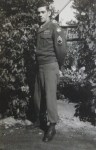
Four years ago today, I said goodbye to my grandmother for the last time.

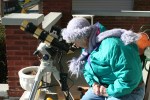
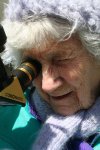
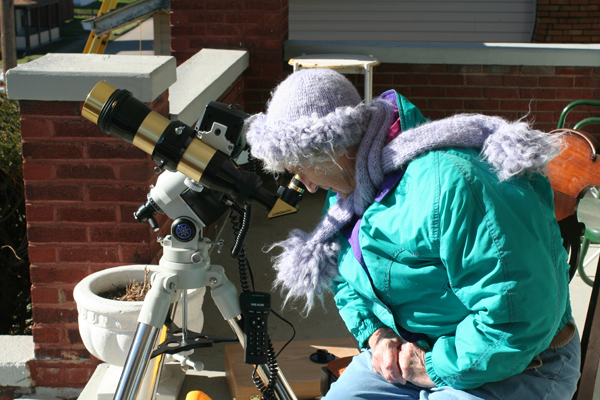
Pauline Withers (Nanny) first solar view

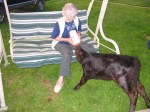
She wasn’t just any grandmother, she was mine and I called her Nanny. She was someone I looked up to, who loved and took care of me and I took care of her the best I could in return. She passed away in her room at Hospice where she spent the last few weeks of her life with the family keeping vigil at her bedside, along with her little dog, Daisy, and my dog, Riser.

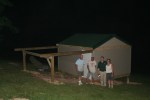
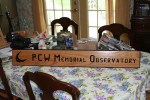
Paul and I named our observatory in honor of my late grandparents, Pauline (Nanny) and Charles (Bampy) Withers. I can’t say they showed a great affection for astronomy, but what they did show affection for was their family. My grandparents were the stronghold of the family and taught us sense of adventure, wonders of nature, desire to travel and enjoy new experiences, having the guts to jump in with both feet to accomplish any task you set for yourself. The list could go on and on as I remember my grandfather teaching me about photography or how to clean my own fish after a fishing trip. Nanny with her amazing pie baking and letting me tag along for mushroom hunting or berry picking. The endless camping trips and ghost stories, late nights huddled together watching Double Chiller Theater sharing a big bowl of popcorn. Their love and compassion for animals. The ability to work out how to take things apart and fix it. How to play a mean game of gin rummy!

But above all else, they believed in me. They supported me in every endeavor with pride (and an abundance of love) in their eyes. I wish Bampy could have met Paul before he passed away. Thankfully, Nanny was alive for almost a decade after Paul and I were married.

When Paul and I eventually bought our first telescopes, Nanny never failed to ask me to tell her all about what we observed each night or day when she’d see us outside viewing. Her eyes would light up and she’d gently shake her head side to side with a smile on her face. You can imagine her delight when I brought over my Maxscope for her to have her first (and sadly only) view of our Sun.

Today was bittersweet as I left the cemetery to put lilac flowers on their grave and then drive by the old tannery where they first met. But it also is a celebration of their lives and my great fortune and thankfulness to have had them in my life.

2011 03 19 “Super Moon”

•March 20, 2011 • Leave a Comment

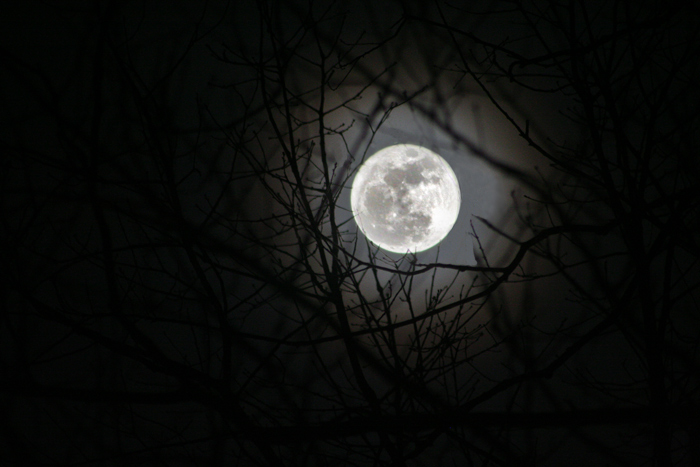
2011 03 19/2011 03 20 Full Moon 1 hour from Perigee, a.k.a. Super Moon

2011/03/19 Super Moon - by Paul Rix, DSI Pro III, ED 80

Diagram of Moon's orbit to Earth - NASA

The Moon has an elliptical orbit around Earth. The term “perigee” means that it has reached its shortest distance to earth. Likewise, “apogee” means that the Moon has reached the furthest distance in its orbit around Earth. Add a full Moon into the equation, and you could be in for a treat. Although a full Moon near perigee happens a little more often, the March 19th 2011 full Moon was only an hour away from perigee, making it a little more special. This event only happens approximately every 18 years, making near-perfect conditions for a Super Moon. The Moon’s apparent size will change ~14% from apogee to perigee.

2011/03/19 by Erika Rix

At any given night, the Moon often looks larger in the sky near the horizon as seen at sunrise or sunset. This illusion appears more pronounced when “near” trees or buildings; however, you can hold your thumb in the air to cover the Moon at various times of the night and see that its size hasn’t changed during the course of that night.

At any given month or year, the moon may appear larger or smaller because of how far away from Earth during the course of its orbit. For instance, at my location, it reached full Moon at 20:51 UT on March 19, 2011. At that moment, the Moon was 359,573 km away from Earth.. One year ago on Mar 19th, it was 384,138 km away. Five years ago, 397,291 km away. Coloring of the Moon near the horizon may have lovely shades of orange, tan, or yellows. This is mainly due to our atmospheric conditions such as haze or air pollution filtering out light’s wavelengths.

2011/03/19 with Lunar aureole by Erika Rix

Paul and I (along with Nigel who chose to be my astro-dog companion of the night) were treated with beautiful views of an aureole throughout the night. It was an added bonus to the perigee. For more views of aureoles, please visit the archive for Lunar Atmospheric Phenomena.

Additional Resources concerning the Super Moon 2011:

Amateur Astronomy Websites/Blogs

•March 14, 2011 • 2 Comments

Here is a listing of superb websites and blogs from other amateur astronomers. If you have any recommendations of other amateur sites, including your own, please contact me so I can add them to the list.

0-100

A

B

C

D

E

F

G

H

I

J

L

O

P

R

S

U

V

W

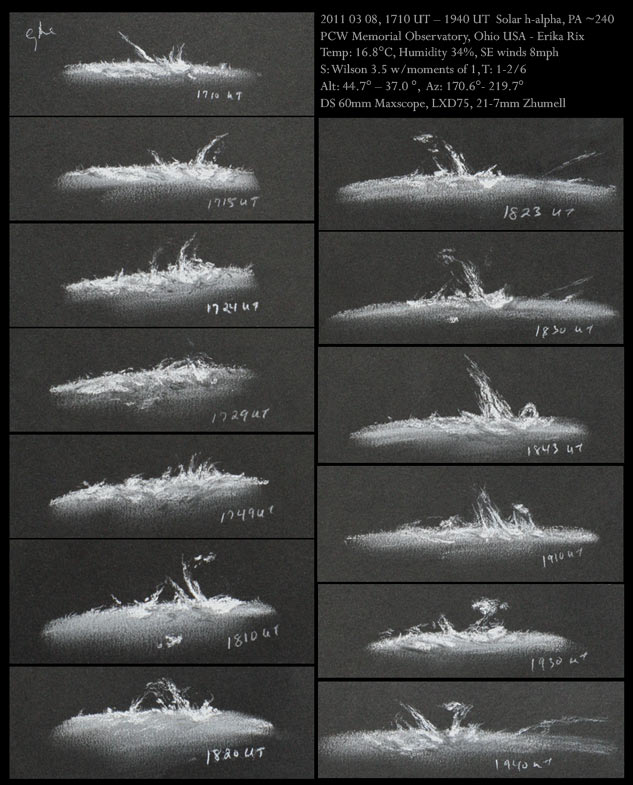
2011 03 08 Solar H-alpha

•March 8, 2011 • Leave a Comment

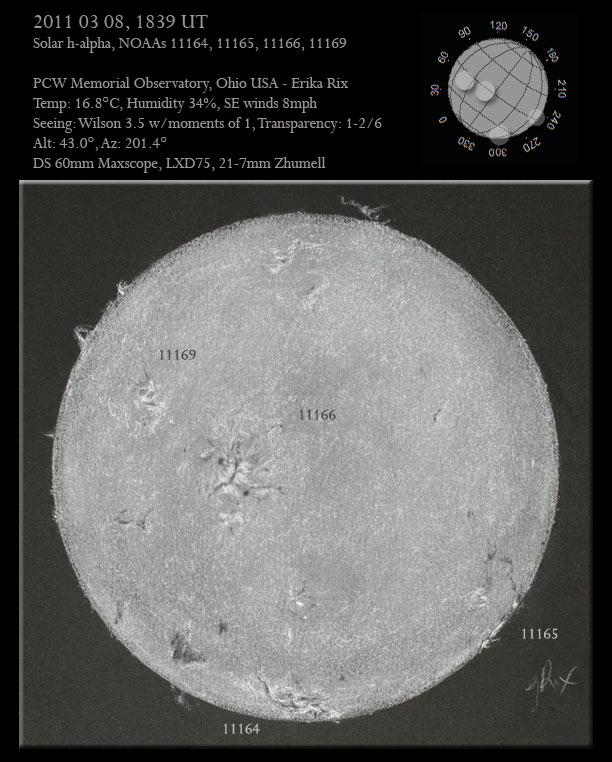
2011 03 08, 1703 UT – 1945 UT

Solar h-alpha, NOAAs 11164, 11165, 11166, 11169, prominence sequence 240 pa

PCW Memorial Observatory, Zanesville, Ohio USA – Erika Rix
Temp: 16.8°C, Humidity 34%, SE winds 8mph
Seeing: Wilson 3.5 w/moments of 1, Transparency: 1-2/6
Alt: 44.5°- 36.4°, Az: 168.1°- 221.1°

DS 60mm Maxscope, LXD75, 21-7mm Zhumell

H-alpha sketch created scopeside with black Strathmore Artagain paper, white Conte’ crayon and pencil, Derwent charcoal pencil, black oil pencil.

It was a nice surprise to see the Sun out and the thin clouds scattered enough for a solar session, especially with 4 active regions present. I didn’t pull out a white light filter. It certainly would have made a great comparison to the h-alpha views with all the sunspots scattered about. The fibrils in NOAA 11166 were outstanding and plentiful, reaching out through plage in wide arcs. 11164 looked etched near the limb with stark contrast between the filaments and plage.

It was 11165 that kept most of my attention today with its area of prominence changing so rapidly that I’m fairly certain portions of it erupted and then collapsed on itself. Two times sections had broken free and floated off. During those times, a sketch was completed every 5-10 minutes.

On the Spaceweather website today, it reported:

FAST CORONAL MASS EJECTION: A coronal mass ejection (CME) exploded from the vicinity of sunspot 1164 during the late hours of March 7th. It lept away from the sun traveling some 2200 km/s, making it the fastest CME since Sept. 2005. A movie of the cloud prepared by Karl Battams of the Naval Research Lab seems to show a small but non-negligible Earth-directed component. This CME and at least one other could brush against Earth’s magnetic field on March 9th or 10th. High-latitude sky watchers should be alert for auroras.

I would have liked to have stayed out for at least a few more hours, but the transparency became too horrendous to pull detail out of the prominences and full overcast skies was soon to follow.

3011 03 08 Halo and Sundogs

•March 8, 2011 • Leave a Comment

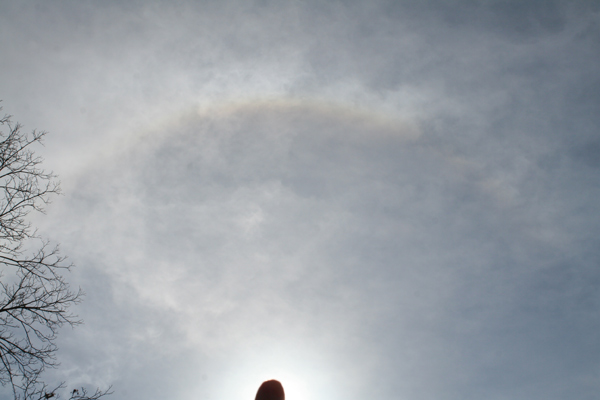
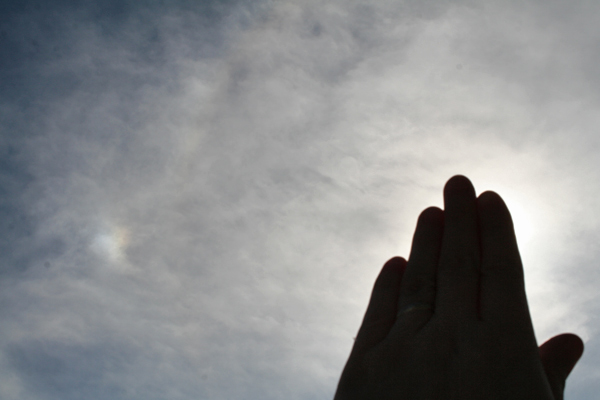
To my surprise, the skies cleared up enough for me to have a few hours under the Sun with my telescope. It wasn’t meant to be that clear. Even so, the transparency was fairly obnoxious but seeing wasn’t too bad with only a few moments of boiling.

I took a little break from the eyepiece to grab a drink. Thin clouds were making their way across the sky and halos and sundogs were popping in and out of view.

Water droplets in the air and clouds form these beautiful displays when light hits them. Les Cowley of Atmospheric Optics describes them best.
Water Droplets , 22° halo, sundogs

20110308 22 degree halo

20110308, 22 degree halo

20110308 partial halo and hint of a sundog

20110308 sundog to the left of the Sun

More atmospheric phenomena observations

2011 03 03, M1/NGC 1952

•March 7, 2011 • 2 Comments

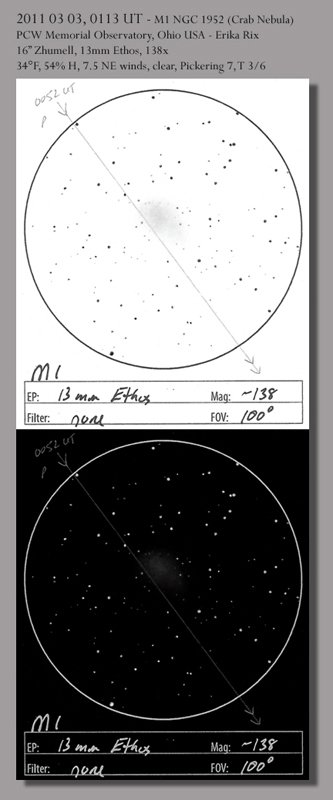
2011 March 03, 0113UT

M1, NGC 1952 (Crab Nebula)
Nebula (SN 1054 Supernova remnant) in the constellation Taurus, 5h 34.5m, +22°01`, m8v, 6`x4`, distance 6300 light years, diameter >7 light years, formed in 1054 A.D

PCW Memorial Observatory, Ohio, USA – Erika Rix
16” Zhumell, 13mm Ethos
34°F, 54% H, 7.5 NE winds, clear, Pickering 7, T 3/6, 138x

Sketch created scopeside with white photocopy paper, #2 pencil, ultra-fine black marker, 0.5mm mechanical pencil. Template from http://www.perezmedia.com.

Messier created the Messier Catalogue when he first observed this object while observing a bright comet in 1758. John Bevis recorded it 1731. It was originally recorded in July 1054 A.D. after the progenitor explosion took place (most likely in April or May). The Earl of Rosse dubbed it the Crab Nebula in the 1840’s when he observed it at Birr Castle, Ireland.

While reading my copy of The Night Sky Observer’s Guide, Vol. 1, by GR Kepple and GW Sanner, pulsar NP0532 (Crab Pulsar) was detected in the center of M1 in 1968. This pulsar is said to be the collapsed core of the progenitor star and is a 16th magnitude rotating neutron star. It pulses radiation every 0.033 seconds. Depending on the source, this supernova remnant gas is expanding 600-1000 miles per second. Per an article from P Haensel and M Bejger regarding the rate of expansion, “dependence of the acceleration is connected to the evolution of pulsar luminosity.” (Bejger, M.; Haensel, P. (2003). “Accelerated expansion of the Crab Nebula and evaluation of its neutron-star parameters”. Astronomy and Astrophysics 405: 747–751.)

Comparison Image of M1 by Paul Rix, 2010, taken with DSI Pro II

Visually, an OIII filter brought out a little more definition in hints of structure, but my best view overall was without it. There were so many stars that I ended the sketching session without adding them all. The telescope was at such an angle that I either had to bend my knees slightly on the higher step next to my scope or stand on the tips of my toes on the lower step. Neither was very comfortable for a prolonged session of star placements. With such an abundance of stars, it was very difficult for me to find my place again to locate new stars after each addition to the sketch.

The SE end of the nebula was faint compared to the NW area. Although there were brighter areas within the NW region, I couldn’t make out filamentary structure. The edges around the entire nebula were diffuse and it was difficult to tell exactly where the edges began. There was a hint of a notch to the SSE with averted vision.

A satellite crossed just below this region at the beginning of the session, and then at 0052 UT, a meteor zoomed across the field of view just grazing the apparent SW edge of M1.

Solar

•February 7, 2011 • Leave a Comment

Groups

ALPO Solar Section Yahoo Group – Yahoo Group dedicated to the study of the Sun


Click to join Solar-ALPO
    (Click to join Solar-ALPO)

Charlie Bates Solar Astronomy Project – King of Solar Outreach, Stephen Ramsden

Equipment

Build a Sun Funnel – By Rick Fienberg

Solar Projection Box – By Bob Oseman, Mid-Kent Astronomical Society

Solargraph Instructions and Pinhole Photography – By Justin Quinnell

Track the Sun with a Solargraph pin-hole camera – CEastronomy.org

Observing: Definitions and How To’s

Observing the Sun in H-alpha – Written by David Knicely

Planning/Orientation Tools

Solar Noon Calendar – Table showing exact noon for your location.

TiltingSun Software – Created by Les Cowley – “freeware which shows the Sun’s orientation, poles, equator, rotation direction, prominence position angles and drift direction for any date, time and location.”

Websites/Blogs

ALPO Solarblog – Current solar news reported and gathered by the Association of Lunar and Planetary Observers

British Astronomical Association Solar Section – Reports, photos, observing forms, newsletters and much more

Global Oscillation Network Group – National Solar Observatory

MEES Solar Observatory – Institute for Astronomy, University of Hawaii

Solar Influences Data Analysis Center (SIDC) – Solar data research department of the Royal Observatory of Belgium, “includes the World Data Center for the sunspot index and the ISES Regional Warning Center Brussels for space weather forecasting”

Solar Dynamics Observatory – Close up look at our Sun.

Solar Dynamics Observatory – Close up look at our Sun.

Spaceweather – Daily news and info about our Sun-Earth environment.

Sungazer – by Greg Piepol

The Sun in Motion – by Gary Palmer

Sketching

•February 7, 2011 • Leave a Comment

Astronomical Sketching: A Step-by-Step Introduction – Comprehensive Astro Sketching book – available on Kindle now too

Astronomy Sketch of the Day – Daily astro sketches from around the world, sharing techniques and media.

Astrosketch – Yahoo group that discusses techniques of sketching astronomical objects

Belt of Venus – Fantastic resource by Jeremy Perez – full of resources, templates, tutorials, sketches, reports

Cloudy Nights Telescope Review sketching forum – friendly forum for the discussion of sketching stellar objects, and displaying user drawings.

Dick Blick Art Supply Store – Comprehensive art supply store where just about any media can be obtained.

Introduction to Astronomical Sketching – Astro sketching video by Jeremy Perez

LCD Monitor Test Images -Extensive monitor calibration tests by Han-Kwang Nienhuys

PCW Sketching Notes/Tutorials – Collection of notes and tutorials by Erika Rix

Rite in the Rain (water resistant paper) – Love this product and the staff are terrific!

Sketching the Messier Marathon

Sketching the Moon: An Astronomical Artist’s Guide

Planetary

•February 7, 2011 • 1 Comment

A Jupiter Observing Guide – by John W. McAnally, S&T article

The Institut de Mécanique Céléste et de Calcul des Ephémérides – national ephemeris, research in astrometry and planetology

Mars A.L.P.O. Albedo Map – by Carlos E. Hernandez and Daniel M. Troiani

Mars Map CatalogLPI – Map Series by the Lunar and Planetary Institute

Mars Previewer II – Freeware Mars Mapping by Leandro Rios from Sky and Telescope

Observing the Planet Mars – by Jeffrey D. Beish

WinJUPOS 9.1.8 – Database for Object Positions on Planets and the Sun by Grischa Hahn