2012 05 03 – Solar h-alpha, Prominences and NOAAs 1469, 1471, 1472, 1473, 1474

•May 4, 2012 • 1 Comment

With five active regions, the Sun made quite an appearance today in spite of the limb. There were a few decent prominences, especially to the eastern hemisphere. My favorite view, though, were magnetic fields surrounding 1471 made apparent by the very thin active region filaments (ARFs). They reached down like fingers from the sunspots in that region. Plage was very intricate and meshed into what I believe was AR 1472.

The quiet region filaments (QRFs) were in abundance in the southern northern hemisphere with a few speckled to the south. AR 1474 seemed a bit washed out with plage and faint darkened areas. There was only slight plage definition and no sunspots observed in h-alpha. I didn’t set up a white light filter today for comparison.

1473 and 1469 were blended together by the plage and many lines of ARFs, including filaments reaching out over the edge for short, bright prominences. Plage was very bright, forming the shape of a tuning fork in 1469. These were impressive sets of active regions when paired up.

This was my first solar observing session since moving to Texas about two and a half weeks ago. With all that took place in preparing the old house for sale and the move to Texas, I’ve been deprived of any observing other than naked eye. It was a relief to be behind an eyepiece once again.

Sketches created scope-side with black Strathmore Artagain paper, white Conte’ crayon and pencil, Derwent charcoal pencil, black oil pencil.

2012 01 07 – Mars

•January 21, 2012 • 1 Comment

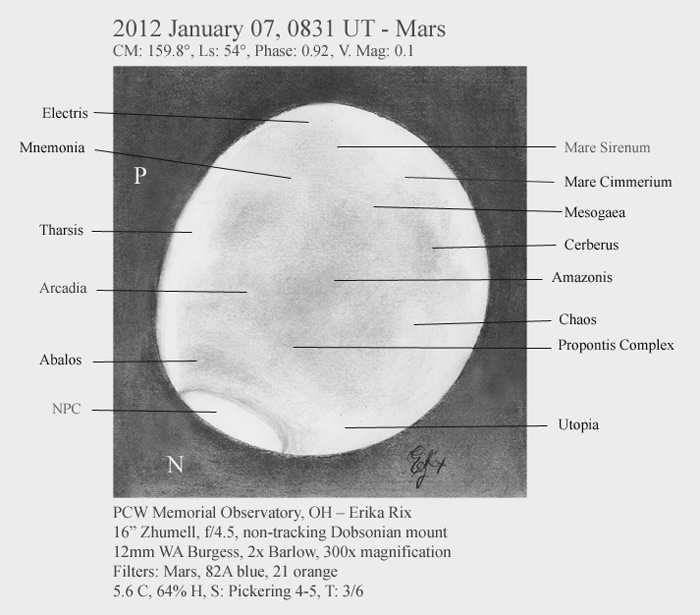
This was my most recent Mars observation from a few weeks ago. With only one or two clear nights recently, the timing was such that it prevented me from being able to crack open the observatory since then.

The early morning of the 7th, I had ample time to let the mirrors cool down on the telescope and collimated before dark. It was a little windy but had calmed down by 3am. Still, seeing wasn’t the best. I cold make out the NPC straight away and it appeared tucked in on the western and eastern edges more so than my observation the week prior. There was a definite dark streak above the NPC in my view and a few more darkened patches scattered around the disk. Very slight limb brightening on both the preceding (just prior to the terminator toward either pole) and following limbs.

I had to nudge the scope time and time again to let Mars slowly drift through my FOV before slight variances in albedo became apparent. It was nearly impossible for me to match them up with labeling programs such as Mars Previewer II or my Mars Globe app on my iPad because the two views on those programs were a little off from each other even though I checked the date, time and location several times. In the end, I went with Mars Previewer II since I’ve been using that program the longest. Helpful resources for Mars

I’m very much looking forward to more opportunities with Mars as it reaches opposition. If only my primary mirror was clean…sigh.

2012 01 07 – Mars
PCW Memorial Observatory, OH – Erika Rix
http://www.pcwobservatory.com
16” Zhumell, f/4.5, non-tracking Dobsonian mount
12mm WA Burgess, 2x Barlow, 300x magnification
Filters: Mars, 82A blue, 21 orange
5.6 C, 64% H, S: Pickering 4-5, T: 3/6
CM: 159.8°, Ls: 54°, Phase: 0.92, V. Mag: 0.1
RA: 11h 32m, Dec: 6° 18′ 51″

The sketch was created using charcoal on card stock, charcoal pencils, willow charcoal, vinyl eraser pencil and kneaded rubber eraser.

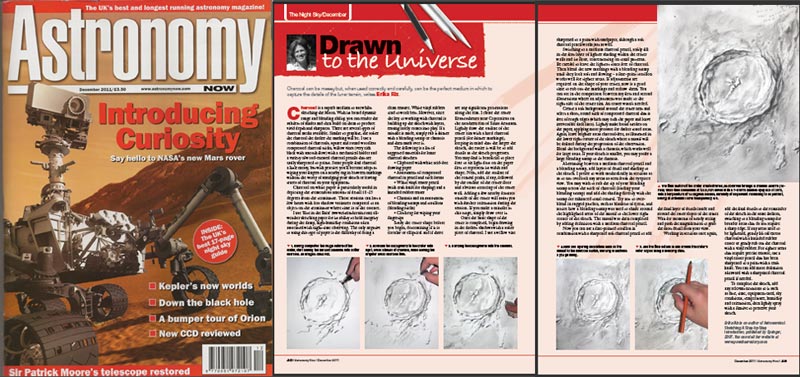
Astronomy Now magazine: “Drawn to the Universe” December 2011 issue, Eratosthenes

•January 15, 2012 • Leave a Comment

Astronomy Now  (UK magazine)

Drawn to the Universe
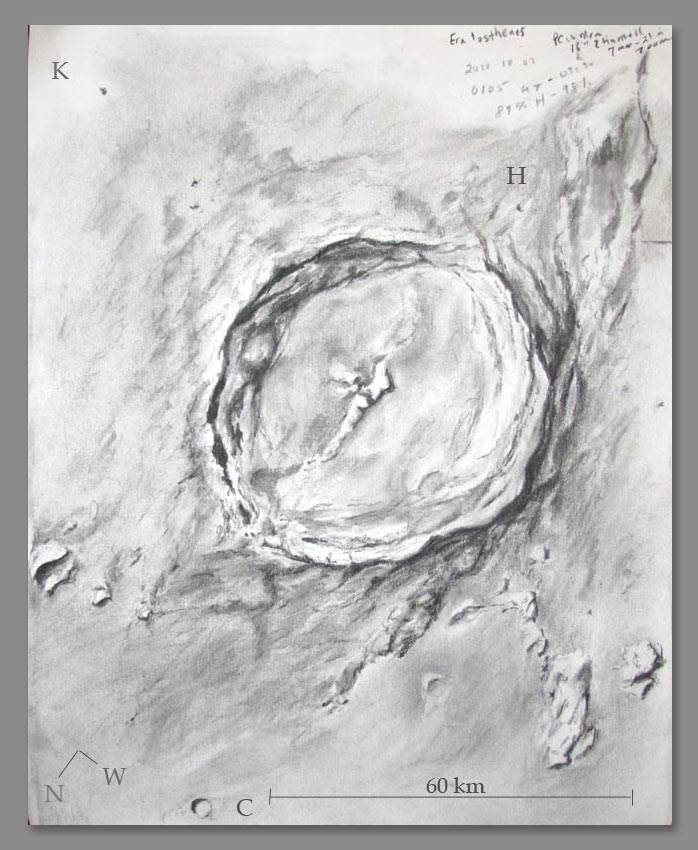
December 2011 issue – Eratosthenes
Target – lunar complex crater
Media – charcoal on Rite in the Rain paper

Link to observation report: 2011 10 07 – Eratosthenes

Please visit Drawn to the Universe – Belt of Venus to read the history of Astronomy Now‘s Drawn to the Universe column. Jeremy Perez, fellow co-author of Astronomical Sketching: A Step-by-Step Introduction,  began writing and illustrating this article for UK magazine Astronomy Now in April 2009. His fantastic writing style and amazing illustrations are not only inspiring, but are easy to follow, full of variuos techniques for recording observations through sketching, and training your eyes to really study the objects being viewed. In his words below:

Drawn to the Universe is a column devoted to astronomical sketching that I write and illustrate for Astronomy Now in the UK. The column features a step-by-step guide to sketching a different astronomical object each month. My goal is to inspire visual observers to get out and sketch. I want to provide newcomers with the tools and techniques they can use to get started. For more seasoned sketchers, I’m also trying to introduce a variety of different methods that I hope will encourage experimentation. For those that don’t relish the idea of drawing anything at the telescope, I hope it still provides an enjoyable insight into the process.

Recently, Peter Grego and I were invited to join as writers and illustrators for Drawn to the Universe, alternating months with Jeremy. I’ve always admired Jeremy and Peter’s outstanding sketches and look forward to working with them, creating easy-to-follow guides for astronomical sketchers!

If you’d like to try out Astronomy Now magazine, look for the link to the right side of the page that says “Download a free PDF version of the January 2011 issue of Astronomy Now. (20 MB file)” Astronomy Now

2011 12 26 – Mars

•January 8, 2012 • Leave a Comment

We’ve been fortunate to have a few clear nights for observing lately. Mars season is upon us and it feels great to have a chance to try out my new filter set: Mars, 82A blue and 21 orange.

This sketch is a composite of all three filters. I started off with the Mars filter for an overall view. Syrtis Major was the first area I noticed. Next were the north polar cap and the darkened area around it. Faint structure started to appear but became even more apparent when I switched to the orange filter. Lastly was the blue filter that made the NPC and Hellas pop out dramatically. The following limb was brightened. Seeing was above average with slightly poor transparency. The session had to end because of clouds, but I felt the session was pretty much completed by that time anyway.

The sketch was created using charcoal on card stock, charcoal pencils, willow charcoal, vinyl eraser pencil and kneaded rubber eraser.

2012 01 07 Hevelius, Lohrmann, Cavalerius

•January 7, 2012 • 2 Comments

2012 01 07, 0200UT – 0340UT Hevelius, Lohrmann, Cavalerius
PCW Memorial Observatory, OH, USA, Erika Rix
Hevelius: Walled plain with steep slopes and a small central mountain, from Nectarian geological period (-3.92 billions of years to –3.85 billions of years)
Lat: 2.2 deg N, Long: 47.4 deg W

16” Zhumell f/4.5 on a non-tracking Dobsonian mount, 24-8mm Baader Planetarium Mark III Hyperion, 225x, Moon filter
Temp6.5 C, 58% humidity, S: Antoniadi I-II, T: 4/6
Eyepiece sketch black Strathmore Artagain paper, Conte crayon and pastel pencil, charcoal pencil
Phase: 25.8 deg, Lunation: 13.35 d, Illumination: 95.0%
Lib. Lat: +01:33, Lib. Long: -04:22
Az: +206:07, Alt: +30:18

The trio of Hevelius, Lohrmann, and Cavalerius were the first to catch my eye along the terminator tonight. After a quick tour near the terminator, I settled on the trio and their surrounding area for a closer study. Grimaldi’s western rim was etched south of Lohrmann and had begun to fill with sunlight creeping over the waxing edge. The small central mountain of Hevelius and crater Hevelius A were spotted easily and the only hint of Hevelius rimae was a softened dark line reaching north to south just east of the central mountain. I didn’t realize it was even there until I came inside after my session and compared my sketch with an atlas of the area. The tormented outer slopes of the crater chain were very clear and sharp, making them very enjoyable to study and even more so to draw (in my feeble attempt to capture all the detail as accurately as I could). Cavalerius was completely filled in with shadow.

The fantastic find of the night was the Hevelius D 1 (dome) along the wrinkle ridge between Reiner and Hevelius. Reiner and Reiner Gamma were added as the sketch progressed as they were too tempting to leave out.

Lunar Orbiter Photographic Atlas

Photo Credit: Lunar Orbiter

2011 11 26 Venus-Moon Conjunction

•November 26, 2011 • 1 Comment

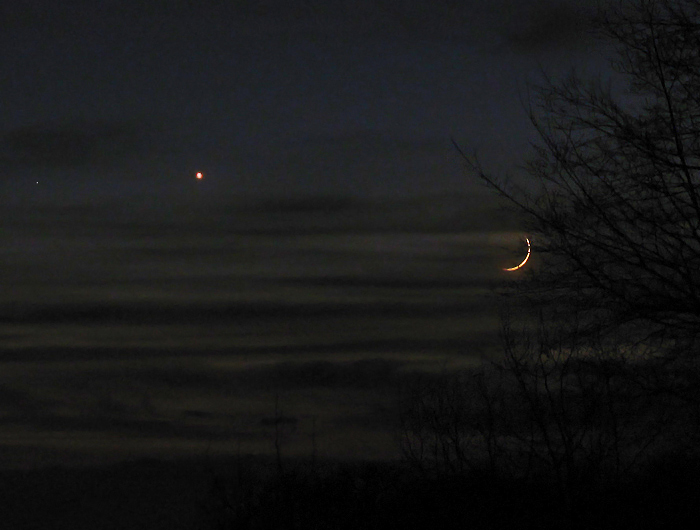
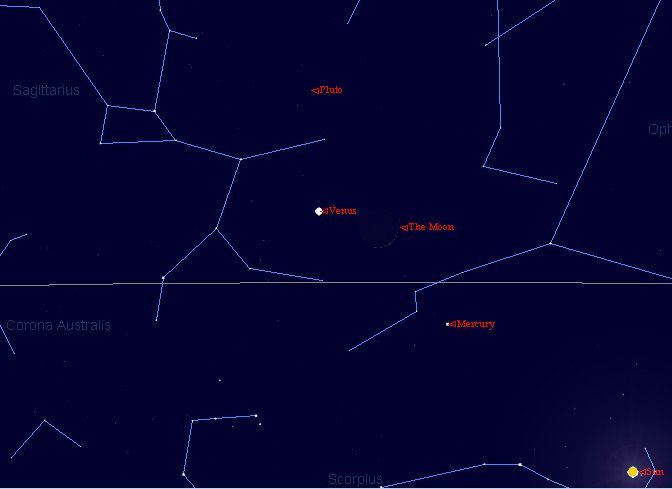
It was quite a treat just after sunset to view not only the Moon at just 1.71 days old (only 4% illumination) but also to have it only 3° apart from Venus. Mercury was just below the horizon and under the Moon by 1808 EST/2308 UT at the time I took this photo from my front yard looking to the west/southwest.

You can just make out the orange-tinted earthshine on the Moon and Venus is shining brilliantly.

Screenshot from Starry Nights

2011 11 26 – Mars Rover Curiosity to Launch

•November 26, 2011 • Leave a Comment

At 10:02 a.m. EST this morning, Mars rover Curiosity (and rocket Atlas V) is set to be launched at Cape Canaveral, Florida. It is due to reach Mars in August 2012 to begin its two-year mission to determine where there may have been life on the planet.

NASA Set to Launch Mars Rover

To watch a live stream video of the launch:   Mars Rover Launch Live

For those of you that have slower connection, here’s an alternate link: NASA Mobile

Exciting times ahead for the space program.

2011 11 08 – 2005 YU55

•November 8, 2011 • Leave a Comment

The excitement of catching a glimpse of 2005 YU55 is in the air tonight. My skies are currently overcast, but according to my CSC, it will clear later (even though I’ll have to fight the moonlight for a view). For those of you that don’t have a telescope or skies tonight for viewing 2005 YU55, you can watch a live webcast of the asteroid making its pass via Clay Center Observatory at Live webcast from Clay Center Observatory

For assistance in locating it from your site, Sky & Telescope has a good article with links to a finder map. Sky and Telescope article by Kelly Beatty

Here’s hoping many of you will get an opportunity tonight to see it firsthand!

2011 11 07 – Aristarchus, Herodotus, Vallis Schroteri

•November 8, 2011 • Leave a Comment

2011 11 07, 2315UT – 2011 11 08, 0115UT Aristarchus, Herodotus, Vallis Schroteri
PCW Memorial Observatory, OH, USA, Erika Rix
Aristarchus: Very bright complex crater with steep walls and a small central mountain from Copernician geological period (from –1.1 billion years to present)
Lat: 23.7 deg N, Long: 47.4 deg W
Herodotus: crater with flooded floor, steep slopes to the South and East, from upper Imbrian geological period (from –3.8 billion years to –3.2 billion years)
Lat: 23.2 deg N, Long: 49.7 deg W
Vallis Schroteri: rille from upper Imbrian geological period (from –3.8 billion years to –3.2 billion years)
Lat: 26.0 deg N, Long: 51.0 deg W

Celestron 102mm (1000 fl), 24-8mm Baader Planetarium Mark III Hyperion, 125x, no filter
Temp12.9C, 64% humidity, S: Antoniadi III increasing to I at 125x, T: 5/6
Eyepiece sketch using black Strathmore Artagain paper, Conte crayon and pastel pencil, charcoal pencil
Phase: 31.2 deg, Lunation: 12.14, Illumination: 92.8%
Lib. Lat: -05:06, Lib. Long: +01:36
Az: +163:55, Alt: +17:58

Vallis Schroteri is always a treat to view and the phase was prime tonight. Vallis Schroteri is the largest sinus valley on the moon, 160km long and 1000m maximum depths. The volcanic crater known as the “Cobra” head is near 10km and the body narrows to 500m. It was most likely the source of the sinuous rille Vallis Schroteri that was believed to be formed by rapidly flowing lava.

Aristarchus was very bright and had faint terraces to the western slope. Rays from this crater and Copernicus (and I believe Kepler), as well as scattered craterlets and dorsa, broke up the vast maria surrounding this area. As if the rille isn’t interesting enough, the ray system, domes, mons, Aristarchus plateau, and Montes Agricola add so much more to the view that any one feature deserves an in-depth study on its own. Tonight, however, I was more interested in the overall view, especially with the terminator spilling into the northeastern maria between Ramen and Montes Agricola, making the maria appear as an elongated crater that has opened up on the NW rim, filled up with lava. I also wanted to concentrate on the ray system with the peppering of craters between them.

Looking at past sessions, I stumbled across a sketch I did of this area in April 2005 using the 10” LX200 classic and an 8mm TV Plossl. It’s amazing what experience can offer to the table over the equipment used if you compare tonight’s observation sketch using modest equipment over that in 2005.

2005 observation sketch of Aristarchus

For more reading, please refer to Chuck Wood’s The Modern Moon: a Personal View, pages 165-169. Also, Rukl map 18 and pg 199 (Fifty Views of the Moon).

NEAF 2010

•October 29, 2011 • Leave a Comment

Photo courtesy of Pollux Chung

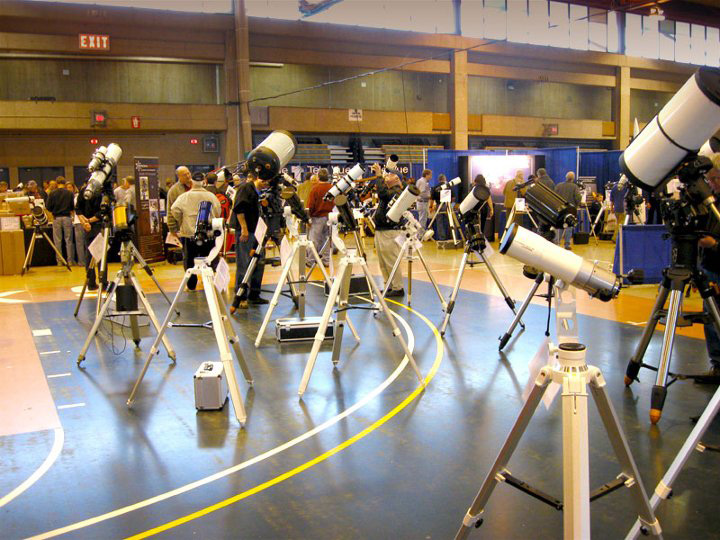
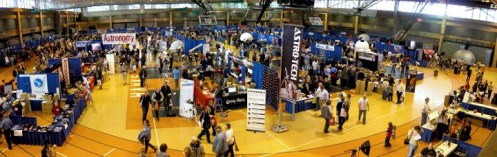
One of the biggest astronomy events of the year is Northeast Astronomy Forum & Telescope Show held at the Rockland Community College in Suffern, NY.

In 2007, I made the journey with my solar rig to join in on the solar party activities. Link to NEAF 2007. In 2010, I was privileged to be a speaker for a solar sketching workshop as well as help out with children’s activities by introducing them to astronomical sketching. The workshop was made very enjoyable by the active participation of those that attended. (Solar Sketching Tutorials)  We were meant to do live sketching after the Power Point presentation with the use of 25 Lunt h-alpha scopes and 5 Coronado Solarmax 60mm’s from Meade. The weather was overcast, however, so we made use of solar images and webcam video that Alan Friedman and Greg Piepol had generously supplied me with as a back-up plan.

Photo courtesy of B. Sims

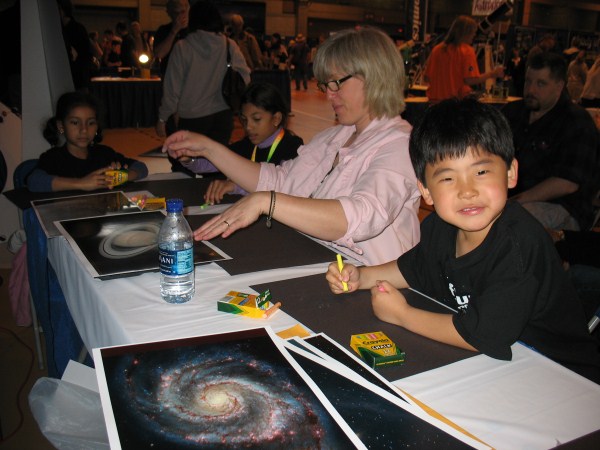
Both Saturday and Sunday, I had a ball sketching with the children as part of the children’s activities. My plan was to do an organized tutorial, teaching them how to sketch. That plan quickly flew out the window as the children couldn’t wait to do their own drawings using the images Caroline Moore gathered for the activity as inspiration. One child, sitting next to me, created a very accurate drawing of the solar system by memory. I need to add that not only did create the Sun, Moon and planets proportionately correct, he had them in the correct order! He couldn’t have been more than 5-6 yrs old.

There was a raptor show for the children and all the kids jumped up and headed toward that area. One boy stayed behind. When I asked him if he’d like to see the raptors, he explained that he wanted to learn to sketch the Sun, but had missed the solar sketching workshop earlier that morning. I told him he was in luck and dug out my laptop with my personal sketching kit. Together, we sketched the Sun based on one of the images Greg supplied as a practice example for the workshop. I gave him one of the sketching packets that were handed out during the workshop as well as the actual field sketch I made for one of the tutorials. I have to say, that hands down, that was my fondest memory of the whole weekend.
Photo courtesy of Pollux Chung

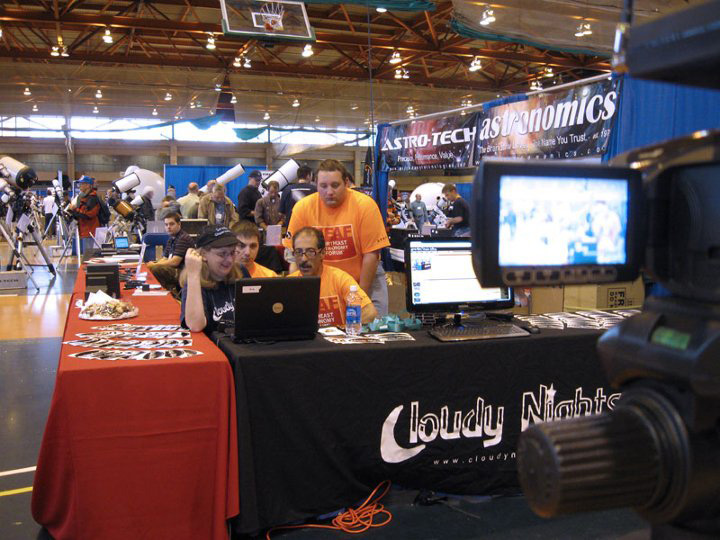
Other than meeting up with old friends (and a lot of people for the first that I only knew of from astronomy forums and sites), it always feels like home visiting the Astronomics booth. Astronomics owns the Cloudy Nights Telescope Reviews site and provides it free of charge to over 50k members worldwide. In this photo, you can see the man that runs the NEAF event, Alan Traino, and my buddy Steph Hansen answering questions for CN members via the Internet. Alan and the volunteers do an amazing job putting this show together! He needs a pair of roller skates with rockets on them, as much as he gets around during the event.

Photo courtesy of Marcus Thompson

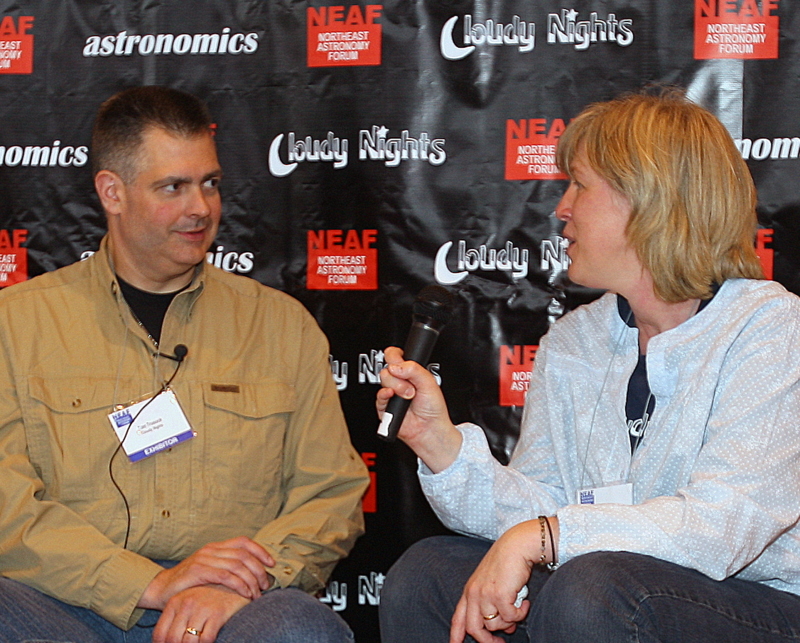
Speaking of Cloudy Nights, good friend, Tom Trusock, and I sat down for an interview where CN members could ask questions through Steph concerning sketching, past and upcoming astronomy projects that I’m working on or just any generalized question such as the equipment I use. Normally I would stammer in these situations, but having Tom as the interviewer put me completely at ease. He’s such a great guy. Interview with Tom Trusock

Photo courtesy of Pollux Chung

There is so much to see that it’ll leave you drooling and your credit cards burning holes in your wallets, not to mention the great line up of speakers that Alan brings in for us to enjoy. And if you’re lucky, you’ll run into this guy, Stephen Ramsden, who is touching the lives of countless children (and adults) with his solar outreach programs.
The solar man himself, Stephen Ramsden

I’ll end with this beauty from Meade, 20-inch SCT on a MAX mount. Wonder if I can strap it to the top of my CRV.
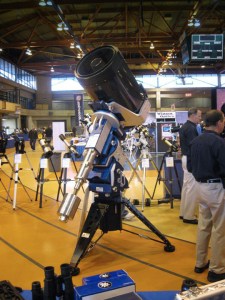
Photo courtesy of Pollux Chung