2012 05 20 Partial Annular Solar Eclipse

•May 22, 2012 • Leave a Comment

Knowing that we fell within a good band to view a partial portion of the annular eclipse, Paul and I scoped out the local county roads earlier in the day for optimal horizons. The partial eclipse for our location was due to start at 1932 ST (0032 UT) which would only give about 50 minutes of eclipse viewing before sunset. The skies cleared up and we were fortunate to have perfect viewing conditions that evening.
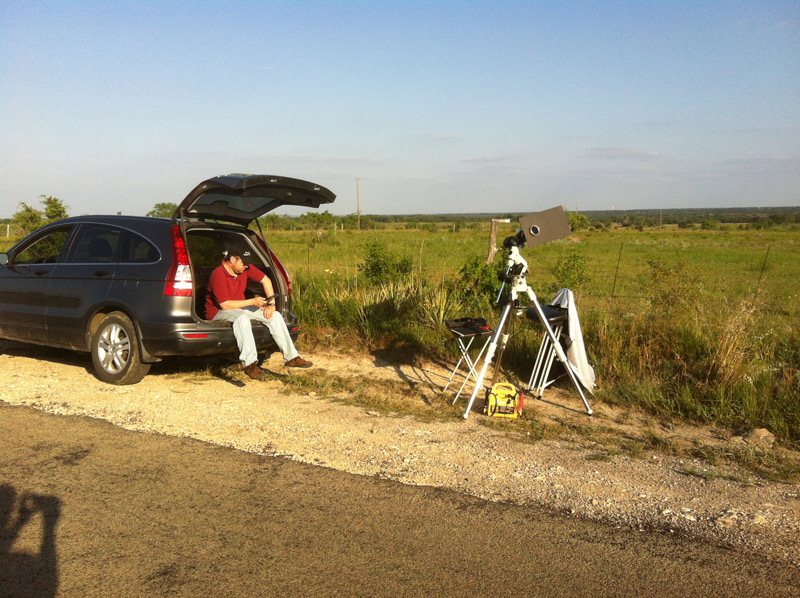
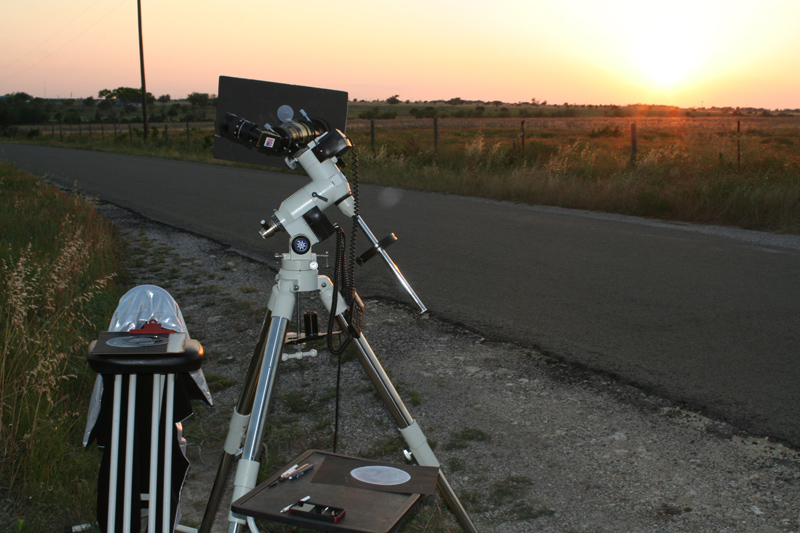


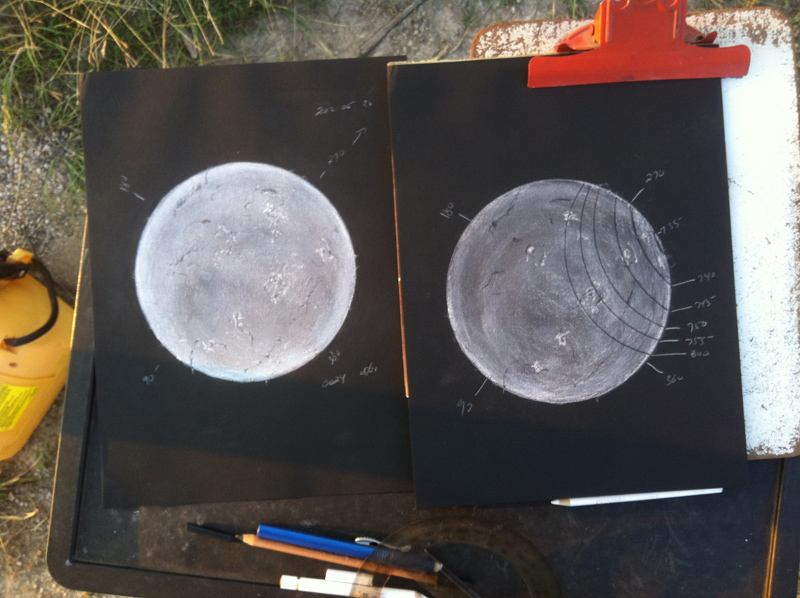
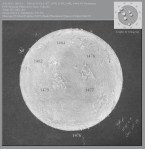
I started off drawing the full solar disk in h-alpha. Four active regions lined up east to west with two more to the south (depicted to the top of the first sketch in the animation). I then made a quick second sketch to use for recording the times and placements of the Moon as it passed between Earth and the Sun.

Quick second solar disk sketch used to record the Moon’s passing and times.

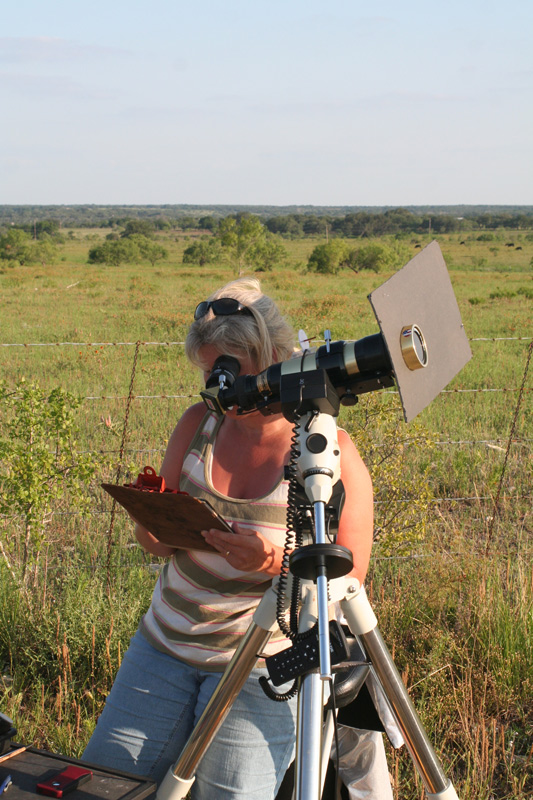
First contact was at 0032 UT. The first marking was at 0035 UT. I set my iPhone’s timer to go off every five minutes until sunset, marking the Moon’s progress each increment with my oil pencil along with the times. In between, Paul and I would alternate using a pair of solar glasses from solarastronomy.org and the views from my double-stacked Coronado Maxscope 60mm h-alpha telescope.

The first image of the animation shows the original sketch in its entirety. Later, I used the second solar disk sketch as a reference to recreate the eclipse on the original sketch with a cut out circular piece of black Strathmore paper. This animation is the result.
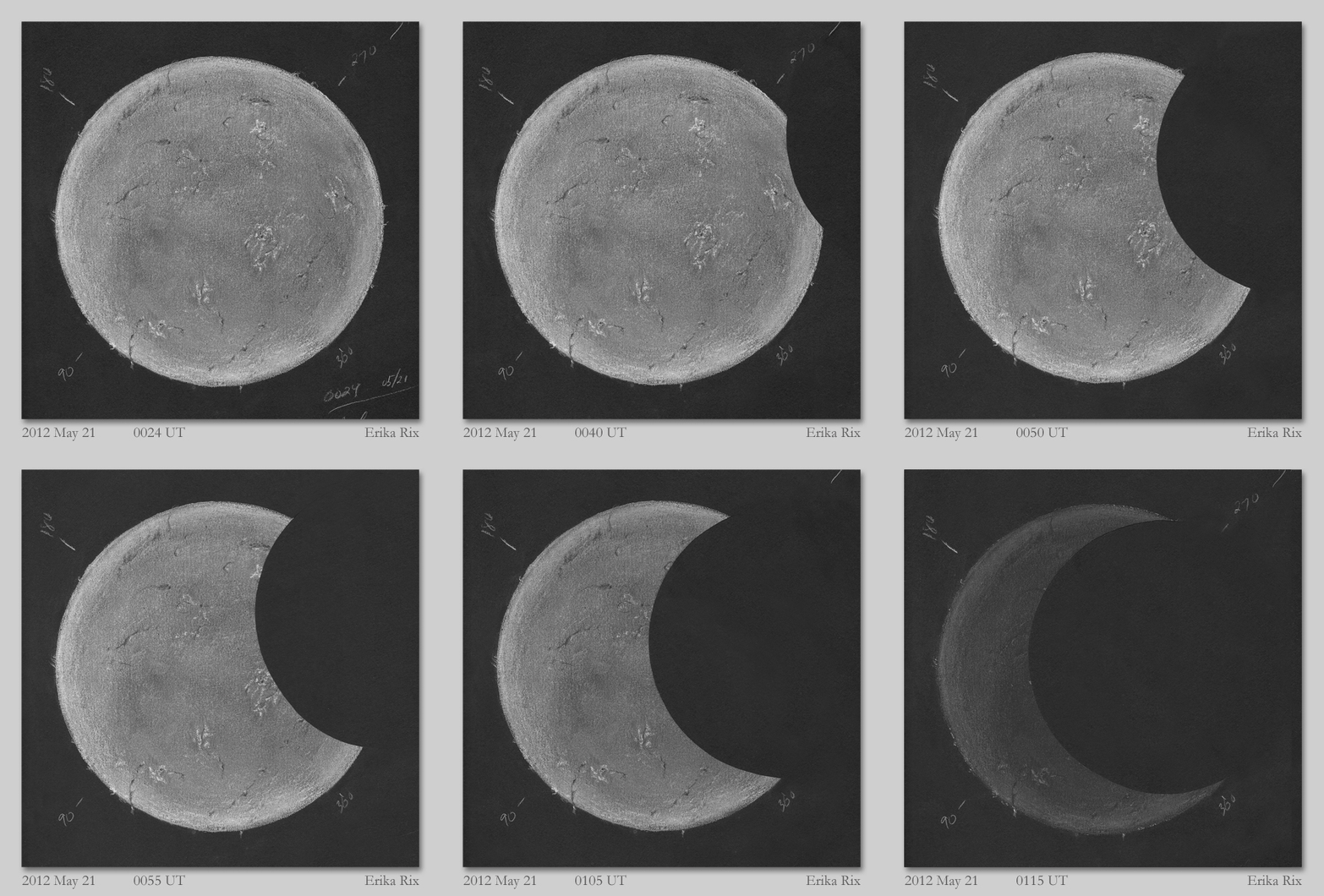
And the montage of the scanned sketch with the circular cutout representing the Moon…

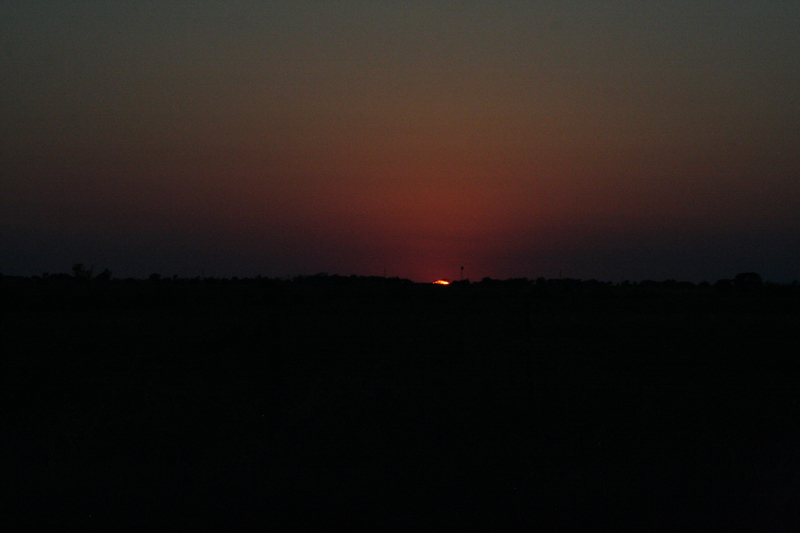
As the solar disk became too dim to view (represented in the last couple frames of the animation), I was forced to leave the eyepiece and enjoy the last several minutes with the solar glasses and my camera.

2012 05 20 – Annular/partial Solar Eclipse

•May 20, 2012 • Leave a Comment

Annular solar eclipse
Photo: NASA Goodard Space Flight Center

It’s time to make the last minute preparations for the annular eclipse tonight/early morning (depending on your location). My location should allow me to see a partial eclipse just before sunset. Traveling 6 hours further west, I would have had a chance to view the annular eclipse, which would certainly be a site to see! Here’s hoping my friends in the path of the annular eclipse has clear skies and the opportunity to witness it first hand. As for me, I’ll settle this time on a partial solar eclipse with my h-alpha solar telescope and a pair of solar glasses.

I plan on doing a set of full disk h-alpha sketches prior to the eclipse and then use them as a template to shade in the Moon as it passes between Earth and the Sun. Of course, this will only work if the clouds stay at bay and I can find a low horizon to view from.

An annular eclipse occurs when the Moon passes in front of the Sun near apogee, the furthest distance in its orbit around Earth. Because of its distance, it is smaller compared to the apparent size of the solar disk and only covers ~88% of the Sun instead of totality. The outer 12% of the Sun creates what looks like a ring of fire surrounding the dark lunar disk. This year, the Moon will pass in front of the Sun only one day after apogee and full annular eclipse will last a few minutes in the USA before it breaks through the ring. The path starts in southeast Asia in the early morning hours and travels 4000 miles to central USA. Partial eclipse will be visible through the more eastern states, but not the states along the Atlantic coastline. The last annular eclipse seen in the USA was in 1994.

Warning:  Please remember that you must view this event with either proper solar filters or special solar glasses, by projection, or grade 14 welder’s masks. Permanent eye damage or blindness can result otherwise.

Helpful links:

2012 05 17 – NOAAs 11476, 11477, 11478, 11479, 11482, 11484, NE Prominence

•May 17, 2012 • 1 Comment

1245 UT – 1845 UT
Temp: 20-30C, calm – S 5mph, clear.
Seeing: Wilson 4.8-1.2, Transparency: 5/6-4/6, 50x.
Maxscope DS 60mm H-alpha, LXD75, Baader Planetarium Hyperion 8-24mm Mark III.

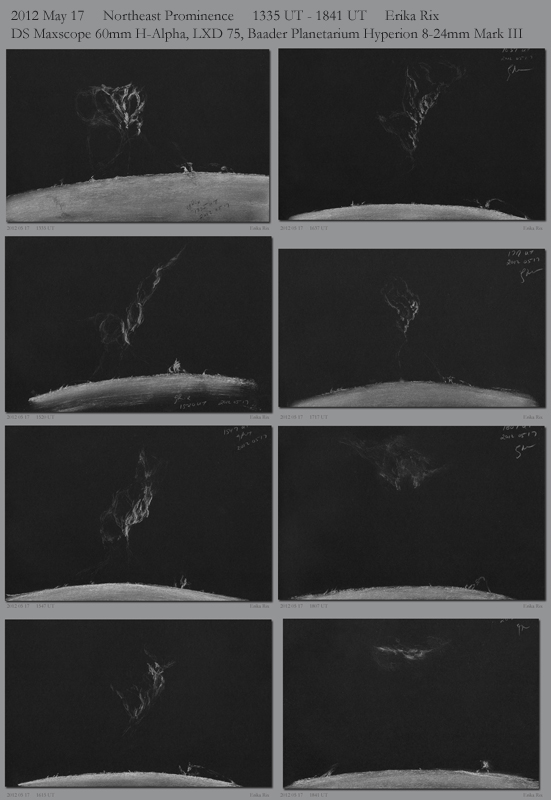
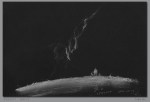
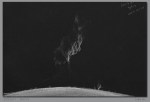
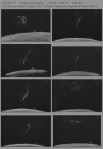
During the time I observed, a very large prominence off the northeast limb was enlarging and in the process of ejecting as it broke free from the magnetic fields supporting it. I’ve never visually witnessed that large of a prominence breaking away from the Sun before. What really stunned me was how bright it remained over several hours that far off the limb. I grabbed an 8-sketch sequence spanning over 6 hours of the event, not including the full disk rendering I recorded earlier in the day. The last 35 minutes of my session, the prominence became very faint and diffuse. I stopped seeing any connection from the limb after 1717 UT. Of course, that doesn’t necessarily mean there wasn’t, but was perhaps too faint for my tired eyes to see. Please click in the gallery at the bottom of this post to view the entire sequence individually.

Sketches created at the eyepiece with black Strathmore Artagain paper, white Conte’ crayon and pencil, white Prang color pencil, Derwent charcoal pencil, black oil pencil.

There was an coronal mass ejection (CME) recorded between the hours 0137 UT – 0648 UT by SOHO that began with an M5 class flare and reached S2 at its peak, hurling solar protons into space at speeds faster than 1500 km/s (per Spaceweather.com) 1476, in all its glory, has finally reached the western limb and is about to disappear from our view. It went out with a bang. Very condensed, short and slender prominences were in that area and the plage was very bright.

Video credit: SOHO

2012 05 16 – NOAAs 11476, 11477, 11478, 11479, 11481, 11482, 11484, 11485

•May 16, 2012 • Leave a Comment

1300 – 1600 UT
PCW Memorial Observatory, Texas – Erika Rix
Temp: 17.2°-27.8C, calm – N 5mph, clear
Seeing: Wilson 4.8-4.6, Transparency: 5/6, 50x
Maxscope DS 60mm H-alpha, LXD75, Baader Planetarium Hyperion 8-24mm Mark III

As of this morning, there were 8 active regions on the Sun. Plage and filaments scattered over three quarters of the solar disk with sunspots popping in and out of view crisply as it moved in and out of the scope’s sweet spot. A large diffuse quiet region filament, similar to the one observed on May 6, 2012, was to the SE quadrant reaching out over the limb. Two large bright prominences were located at PA 70 and 115 with several smaller ones scattered around the limb. The prom at 70 degrees had very faint wisps of structure reaching between the three brightest regions.

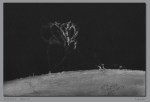
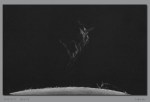
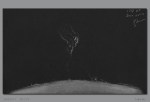
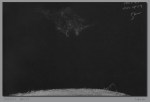
I had started to draw the full solar disk when a faint pair of prominences to the NW caught my eye. I had accidentally kicked the adaptor that was plugged into my power pack and the mount turned off, allowing the disk to drift across my field of view. When this happened, a huge billow of plasma floated above the limb. It was attached by very slender lines of plasma to the thick fainter prom at the 315 degrees position angle. It had the appearance of a large balloon being blown to the south while tethered to the ground. Tossing my larger sketchpad to the side, I grabbed the smaller pad and quickly sketched this prom. As the course this morning’s observation went on, the billowed top of the prominence changed quite dramatically. I almost expected it to either break free or collapse on itself before my session ended but by the time I completed the full disk sketch, it was still there.

The prominences near 1476 were dense and compact. The plage was very brightly formed as several slender lines within that active region. The main sunspot in 1476 was very easy to spot in h-alpha although the ARFs were very thin and few.

1479 is reminiscent of 1476 several days ago, although the preceding spot standing alone is on the opposite end. Of course, another difference that the sunspots in 1479 are smaller. They may develop more as the days go on. Here’s hoping for beautiful weather so we can keep an eye on it.

Sketches created at the eyepiece with black Strathmore Artagain paper, white Conte’ crayon and pencil, white Prang color pencil, Derwent charcoal pencil, black oil pencil.

Rainbows

•May 14, 2012 • Leave a Comment

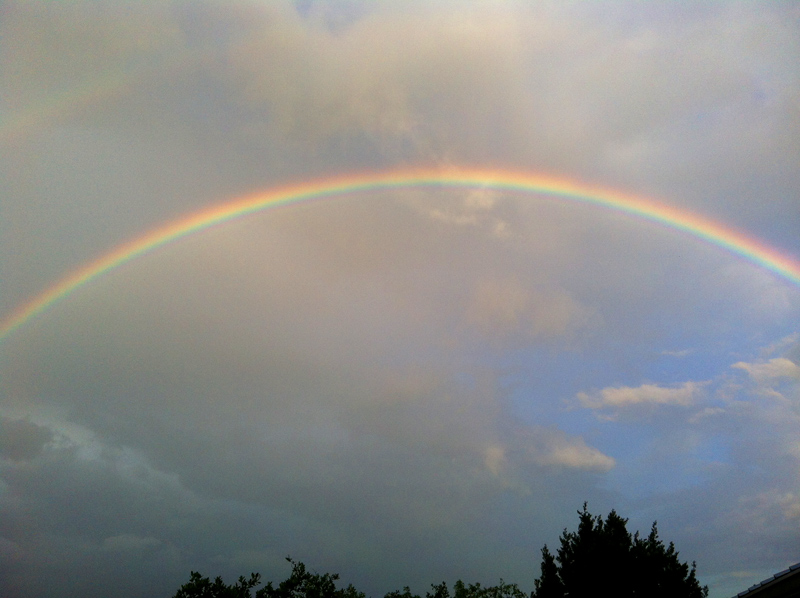
The other day at my first Austin Astronomical Society meeting since moving to Texas last month, I witnessed (along with the others in the group) a double rainbow. Rainbows themselves are always a treat to see along with sundogs, halos and the like. Make it a double and it becomes an exceptionally beautiful sight to see.

Rainbows are formed by sunlight diffraction within large droplets of water. The larger the droplet, the smaller the diffraction effect that produces a rainbow instead of similar cloud phenomena such as fog bows or glories. The main colors we typically see, starting from the outer to inner bands of the rainbow, are red, orange, yellow, green,blue, indigo and violet with a minute hue of colors in between.

Secondary rainbows are the result of sun rays escaping raindrops after the light has been reflected more than twice inside them. The color order of the secondary rainbow is always reversed from the primary as if mirrored and is more diffuse and widened. Rainbows are always opposite the Sun in the sky. The lower the Sun on the horizon, the taller the rainbow will be.

Les Cowely has a wonderful site for learning more about atmospheric phenomena. Here are a few links within that site to further explain rainbows.

Primary Rainbows, by Atmospheric Optics

Secondary Rainbows, by Atmospheric Optics

Please click PCW Archive for Atmospheric Phenomena for more observations.

2012 May 12th and 13th – NOAAs 11476, 11477, 11478, 11479

•May 13, 2012 • Leave a Comment

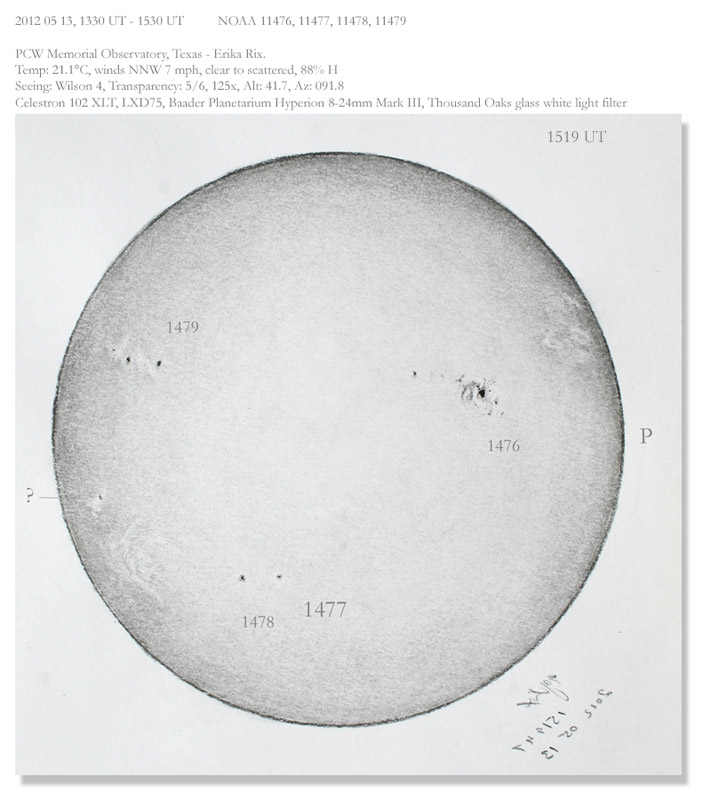
Equipment used: Celestron 102 XLT, LXD75, Baader Planetarium Hyperion 8-24mm Mark III, Thousand Oaks glass white light filter

2012 05 12, 1315 UT – 1440 UT
Temp: 18.8°C, winds N 10 mph, scattered to 75% overcast, 78% H
Seeing: Wilson 4, Transparency: 5/6, 125x, Alt: 22.3, Az: 081.2

2012 05 13, 1330 UT – 1530 UT
Temp: 21.1°C, winds NNW 7 mph, clear to scattered, 88% H
Seeing: Wilson 4, Transparency: 5/6, 125x, Alt: 41.7, Az: 091.8

Sketches created at the eyepiece with WH Smith white cartridge paper (135 gsm), felt-tipped black artist pen, charcoal pencil, black oil-based pencil and then flipped and rotated to match standard orientation.

1476 continues to put on a show each day. Seeing appeared to be fairly good but when I increased magnification for a close up view of that active region on both days, I struggled to get clear enough definition within it to do a close up sketch (although I made several starts which ended up crumpled to the ground next to my observing chair.) The intricate patchwork of penumbrae was a blast to sketch, not to mention observing the numerous speckles of umbrae within that region. My hat is off to all solar sketchers that were able to capture the scene so well as a close up. It certainly is not an easy region to render, but so worth the effort for an in-depth study. I could easily get lost in that region for hours! The few sunspots that lead to the east out of that region look as if they are trying to grasp at the very last following sunspot to reel it begrudgingly back in.

Seeing was perfect for full disk sketching and lowering magnification to 50-70x really brought out the contrast for plage. Three spots were seen both days in active region 1479. On the 12th, it was easily noticeable how they appeared closer together when nearer to the edge of the limb along with a foreshortening called Wilson’s effect. Penumbrae were observed in the two preceding sunspots with perhaps slight penumbra in the third following spot in that grouping. Faculae surrounded the two following spots and there were lines of facula on either side of the preceding larger spot. On the 13th, the following sunspot was little softer indicating a very faint line of penumbra while the two preceding sunspots showed very definite penumbra, although still a little flattened by foreshortening. The middle sunspot in that group appeared to have a separated umbra, verified later today by the SDO’s continuum image.

There was only one sunspot both days within each active region 1477 and 1478 with umbra and penumbra. They appeared slightly larger than the spots in 1479.

There were quite a bit of faculae on the eastern limb with a small sunspot observed both days. The sunspot had both umbra and penumbra with extreme foreshortening. There is no designation yet that I’ve found for that region.

A wide patch of facula was on the western limb as well, more abundant on the 13th. I believe my placement was off for this patch of facula on one or both of the sketches.

2012 05 07 – NOAA 11476, 11474, 11475, 11471

•May 7, 2012 • Leave a Comment

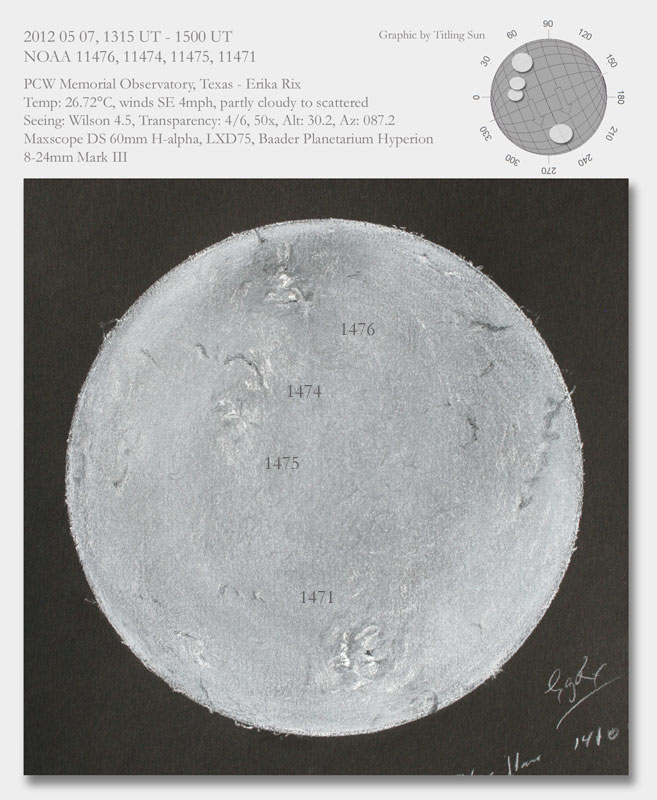
I’ve really been enjoying the current set of active regions the past few days. It would be nice to sketch each individual active region as a close up view, but to do that would take several hours. As it was today, I struggled with a group of thick clouds for the first hour of my session. The sky was crystal clear when I set up and I chose to ignore the weather channel for my area stating that we could have thunderstorms at 8 a.m. Thankfully the storms never came…the clouds did. I was able to catch glimpses of the Sun in between the clouds and by 8:45 a.m., the sky was nearly unobstructed.

The first features added to the sketch after the prominences were plage from 1476 and 1471. Next came the sunspots themselves and filamentary structure. By 9:10 a.m. (1410 UT), very bright plage appeared just north of the sunspots in 1471. I haven’t been able to confirm yet if it was a solar flare, having expected possible flare activity in 1476 instead. But it lasted nearly an hour before it dulled somewhat. Near the end of my session, 1471’s plage brightened quite a bit to the eastern side of the major sunspot in that region as well as about five more degrees further east again.

(edit: Andy Devey caught what he believed was an M class flare in 1741 around the same time I witness the plage brightening. Here is a link to his animation of the flare. “7 May 2012 here is a look at AR1471 where an M1-class solar flare breaks across it sequence between 14-24 and 15-02UT in seeing grade 3 to grade 2 through thin clouds.” The Solar Explorer website.)

John Stetson also captured the flare. His image was at 1519 UT: http://solarchat.natca.net/index.php/en/this-is-solar-chat/6-this-is-solarchat-/20715-m-class-solar-flare-ar-1471-1519-ut

1474 and 1475 paled in comparison to the two major active regions. There were nice filaments and thin plage that made them easy to find.

The large chain of filament reaching to the southern limb was still there, although thinner. Prominences scattered around the limb were insignificant.

Sketches created scope-side with black Strathmore Artagain paper, white Conte’ crayon and pencil, Derwent charcoal pencil, black oil pencil.

2012 05 06 – Prominences and Filaments

•May 6, 2012 • Leave a Comment

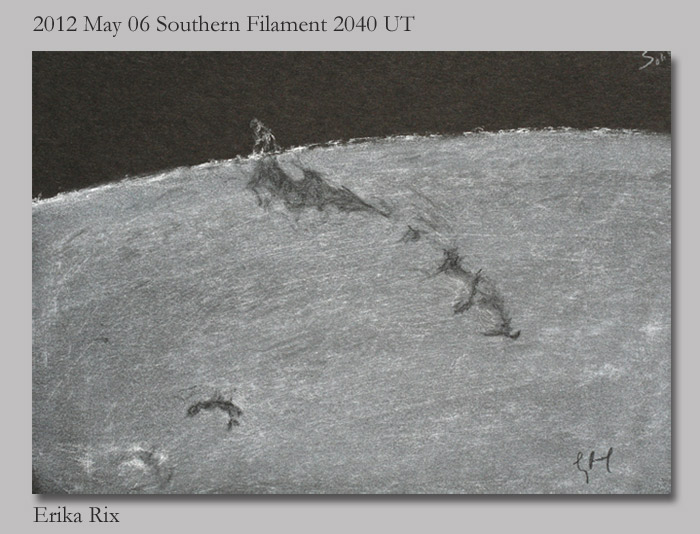
2012 05 06, 1930 UT – 2100 UT
Prominences and filaments

PCW Memorial Observatory, Texas – Erika Rix
Temp: 32°C, winds SSW 9 mph, lightly scattered
Seeing: Wilson 4, Transparency: 3/6, 50-100x
Maxscope DS 60mm H-alpha, LXD75, Baader Planetarium Hyperion 8-24mm Mark III, 2x Barlow

After a scan of the full solar disk, I noticed brightened, condensed prominences to both the western and eastern limb. These sometimes indicate an erupting prominence or if you’re very lucky, a solar flare. The western prominence seemed to be making faster changes. By the time I gathered my sketching gear, I was only able to catch three quick sketches before it fizzled out.


A huge chain of filament to the southern hemisphere was too tempting to pass up for a sketch, which I failed miserably in my attempt to do it justice. Still, my primary reason for sketching at the eyepiece is to study the object in depth, which I feel I succeeded at despite the poor rendering. What first appears as a chunky, cloudy layer of plasma shows quite an intricate network of filament with patience and increased magnification. I also had my shade cloth over my head at 100x magnification. The etalons were tuned to bring out the most contrast for that type of feature.

NOAA 11471 was very crisp and a filament wrapped around it, comma-shaped, similar to the paired active regions of 10940 and 10941 in Feb 2007. (shown below)

2007 Feb 04 – ARs 941 and 940

NOAA 11476 also put on quite the show with plage scattered abundantly and the sunspots centered in the middle. The brightened prominence that I noticed at the beginning of the session had morphed into a beautiful display reaching to the south. It changed quickly and my hastened sketch of it took place over 3-5 minutes, ending at 2050 UT. As tempted as I was to do grab a couple more quick sketches of it, it had become much fainter and I was in need of a break from the heat.

Sketches created scope-side with black Strathmore Artagain paper, white Conte’ crayon and pencil, Derwent charcoal pencil, black oil pencil.

2012 05 04 – NOAA 11471 in White Light

•May 4, 2012 • Leave a Comment

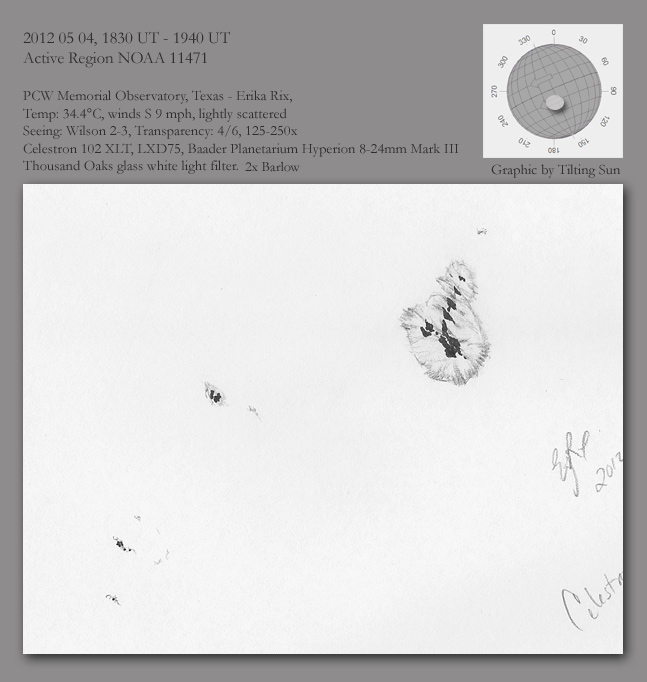
Faculae were present in several areas around the limb, particularly around ARs 1473, 1469, 1474, 1475 and north of 1473 ~45 degrees. Sunspots were observed in all five active regions with 1474 ad 1475 only showing one per region. Seeing was poor and it was windy. I had to wait several moments to catch sharp views so may have missed out on pores in those areas. There were a few sunspots in the two active regions near the western limb, 1473 and 1469.

Active region 1471 was the area I concentrated for today’s sketch. The larger sunspot grouping was in the eastern region of that AR with very defined edges to the penumbrae and radial structure reaching to the umbrae. It was painstaking to wait for the winds to drop and seeing to settle to grab as much detail as I could. I dropped magnification and then increased when sky conditions permitted. That group appeared to have a chain of smaller sunspots, all sporting both umbrae and penumbrae leading east from the larger cluster of sunspots. A very faint speckled area was a further few degrees beyond the chain. I couldn’t make out if they were pores or simply penumbral blotches.

Moving to the western area of the AR ~10-20 degrees showed three more small groupings in that active region. The middle two of the AR had both umbra and penumbra and faint areas that looked penumbral to the south of them. The furthest grouping to the west was too soft and faint to be sure of its structure.

Sketch created scope-side with white card stock, felt-tipped black artist pen, #2 graphite pencil.

Astronomy Now magazine: “Drawn to the Universe” March 2012 issue, Mars

•May 4, 2012 • Leave a Comment

Astronomy Now magazine

“Drawn to the Universe”
March 2012 issue – Mars
Target – Mars approaching opposition
Media – charcoal on white card stock

Link to observation report: 2011 12 26 Mars

If you’d like to try out Astronomy Now magazine, look for the link to the right side of the page that says “Download a free PDF version of the January 2011 issue of Astronomy Now. (20 MB file)” Astronomy Now

Archive for the ‘Drawn to the Universe’ Category