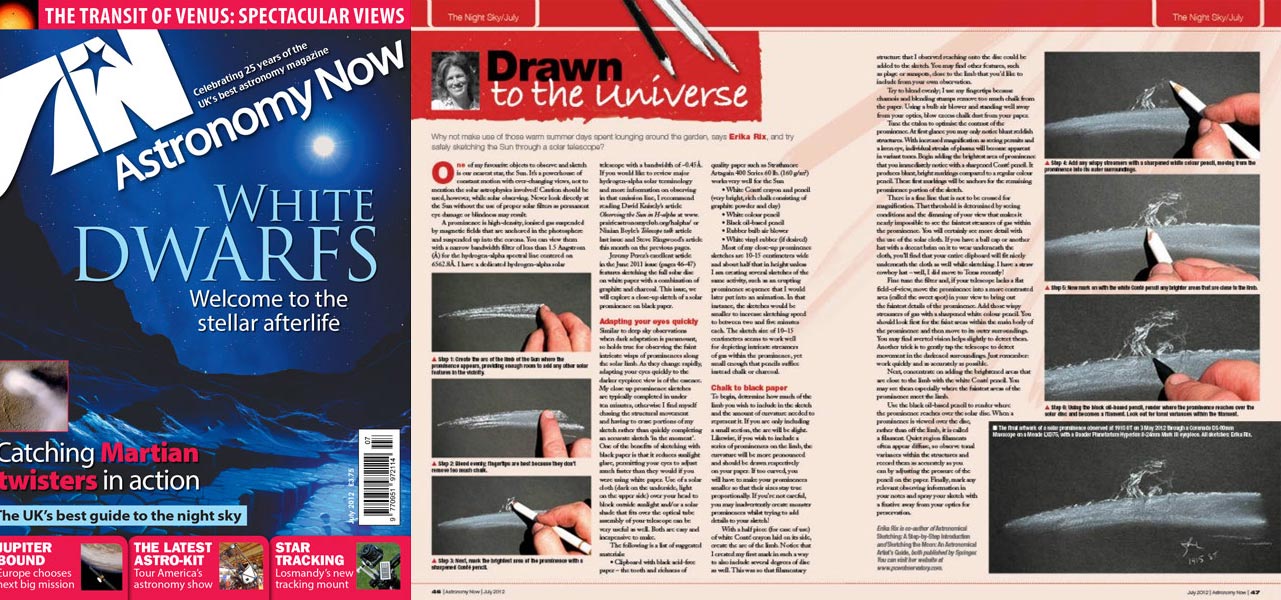
Astronomy Now magazine: “Drawn to the Universe” July 2012 issue, Solar Prominences

•June 22, 2012 • 1 Comment

Astronomy Now magazine

“Drawn to the Universe”
July 2012 issue – Solar Prominences
Target – Sun
Media – white pastel on black paper

Jeremy Perez’s excellent article in the June 2011 issue (pages 46-47) features sketching the full solar disk on white paper with a combination of graphite and charcoal. This issue, I’ve featured a close-up sketch of a solar prominence on black paper. Drawn to the Universe – Belt of Venus

Link to observation report: 2012 05 03 – Solar h-alpha, Prominences and NOAAs 1469, 1471, 1472, 1473, 1474

If you’d like to try out Astronomy Now magazine, look for the link to the right side of the page that says “Download a free PDF version of the January 2011 issue of Astronomy Now. (20 MB file)” Astronomy Now

Archive for the ‘Drawn to the Universe’ Category

2012 June 05/6 Venus Transit

•June 7, 2012 • 3 Comments


The Clear Sky Chart that Attilla Danko graciously created for PCW looked more promising when I woke up Tuesday morning than it did the previous day. You can imagine how excited I was because the CSC is almost always spot on, which meant Paul and I would have the opportunity to view the Venus transit later that day. I knew that I would have an hour or so of cloudy weather just before the transit so I didn’t sweat it when the clouds rolled in.


I set up my dual mounting rig for both white light and h-alpha and Paul set up his LX200 with a white light filter as well. We picked a spot in the front field to optimize the horizon for sunset. I had already utilized my sky planning tools so that I knew when and where first contact would be for my scopes and had templates on two different clipboards to record my observations, one for white light and one for h-alpha. Paul had my Canon EOS DSLR Rebel hooked up to the LX200 for his imaging session. In the mean time, temperatures had gone up to 101.3 F.

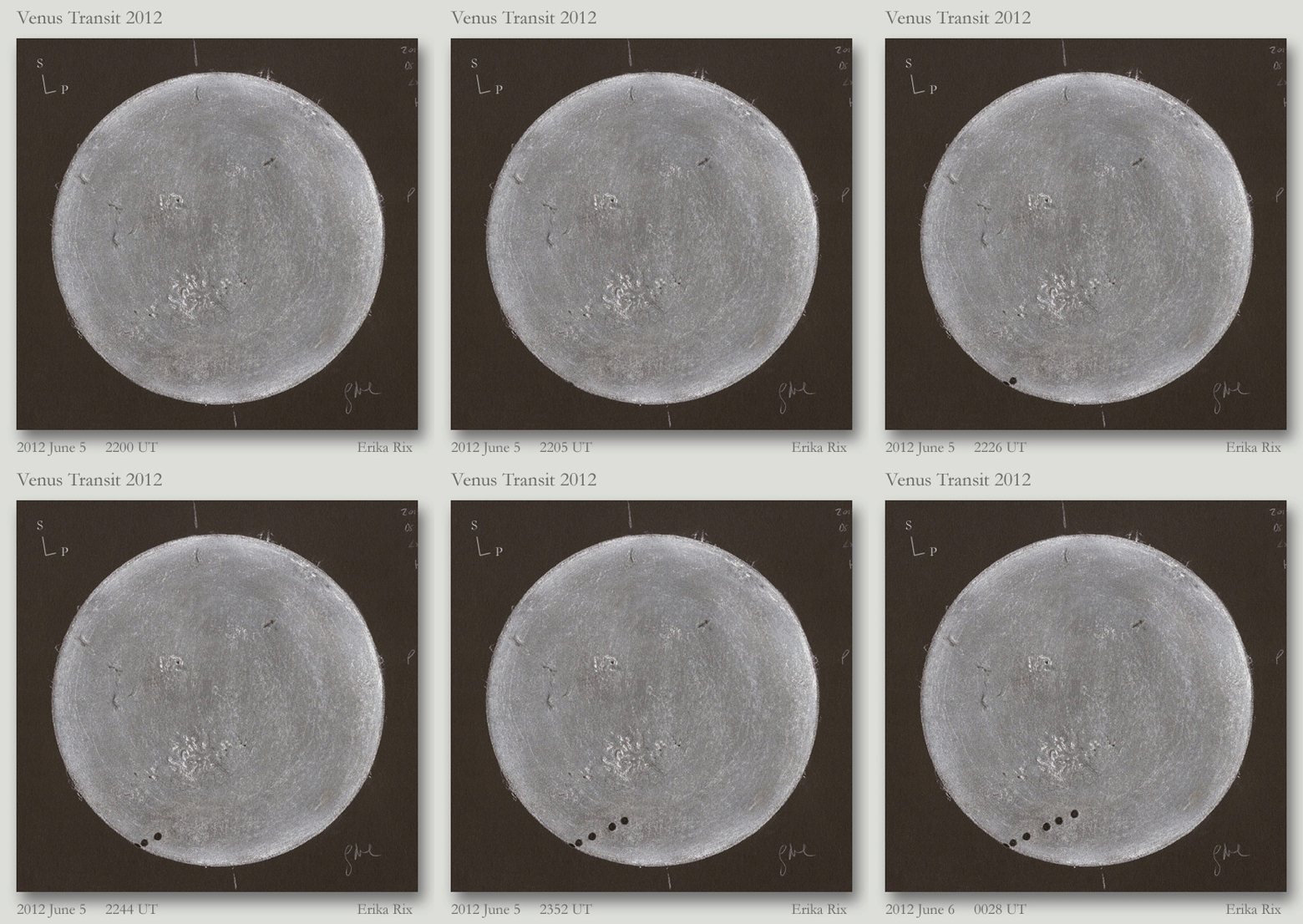
The countdown began and at 2205 UT (1705 CDT) first contact was made on the NE solar limb. Just as it bit a little more into the disk, the first cloud rolled across my view preventing me from witnessing the progression into (and including) second contact. It was disappointing as I wanted to recreate Capt. Cook’s and Charles Green’s observation/sketches from 1769. I did not observe the “black drop effect”. My first instinct was to view first contact through h-alpha in an attempt to view more of Venus’ disk prior to transiting in front of the limb, but the transparency was bad and seeing was moderate so thought I would stick with white light for a crisp “entry”. Due to the dual mounting system, I could easily switch between the two filter systems in the first few minutes of contact.

White light recording of my observation.

Hydrogen alpha recording of my observation.

The observation session ended at 0030 UT on June 6th, 2012 when a large cloud obscured our view and would be there well after Sunset. I was very grateful for the opportunity to witness this transit and the memories of it will last a lifetime.

This slideshow requires JavaScript.

Transit Observing/Sketching Templates

•June 4, 2012 • Leave a Comment

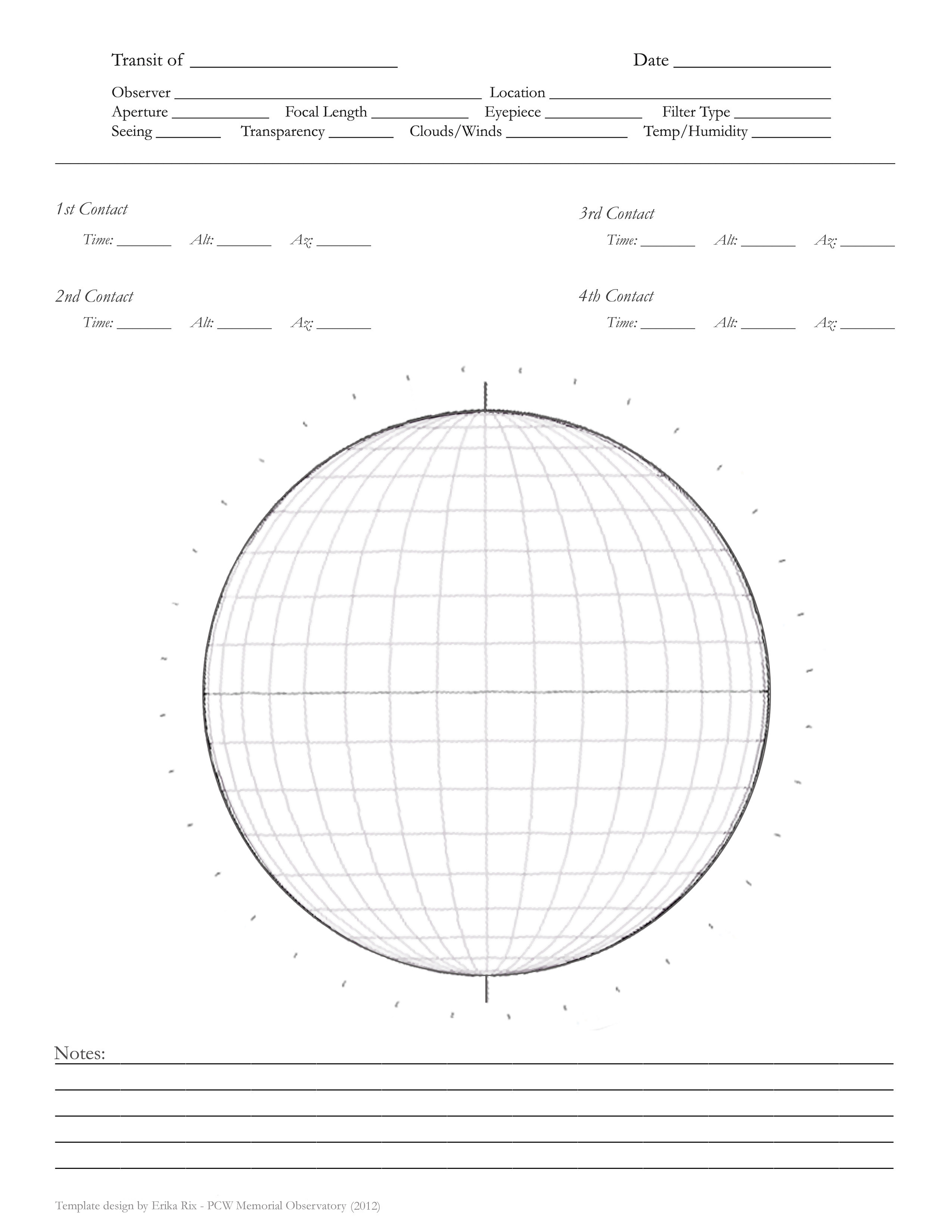
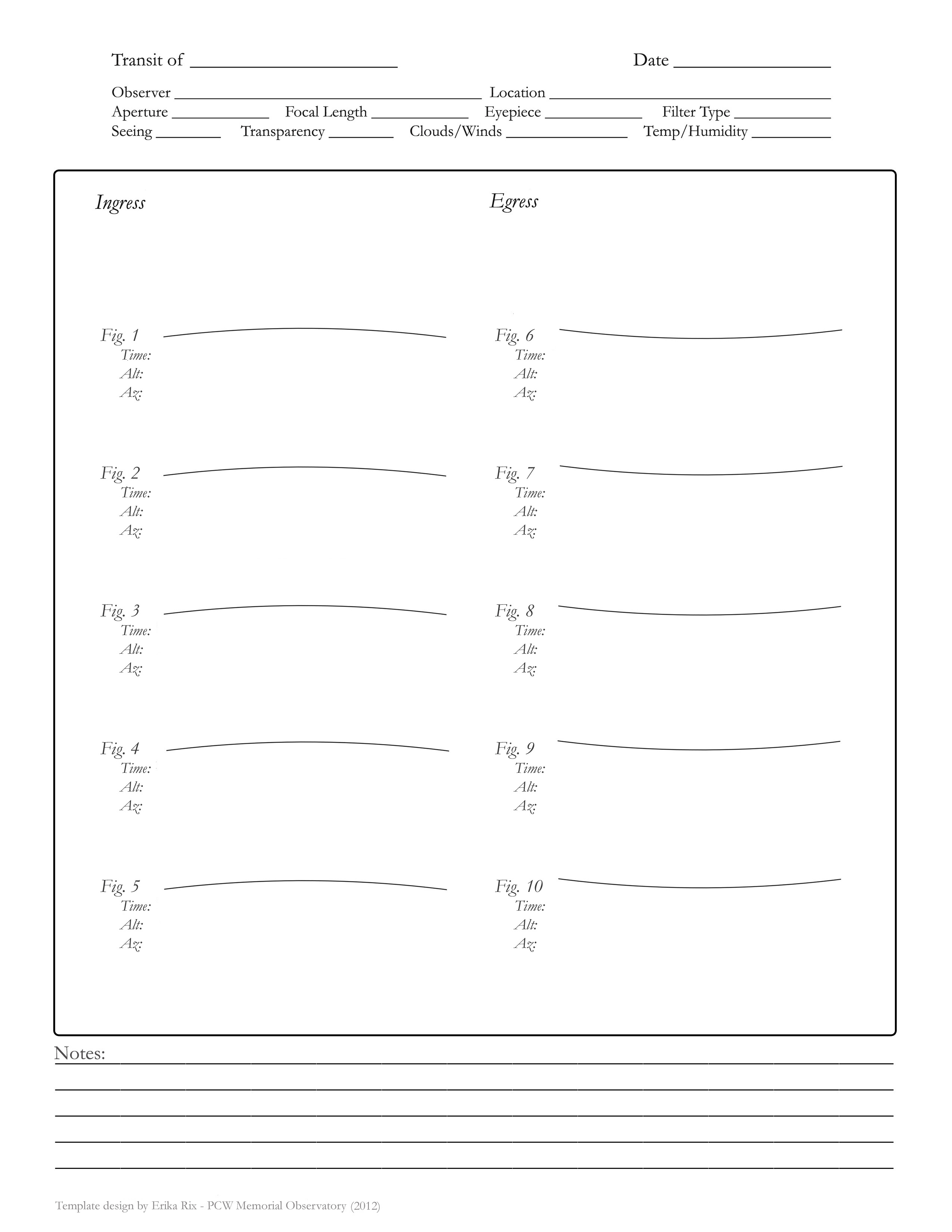
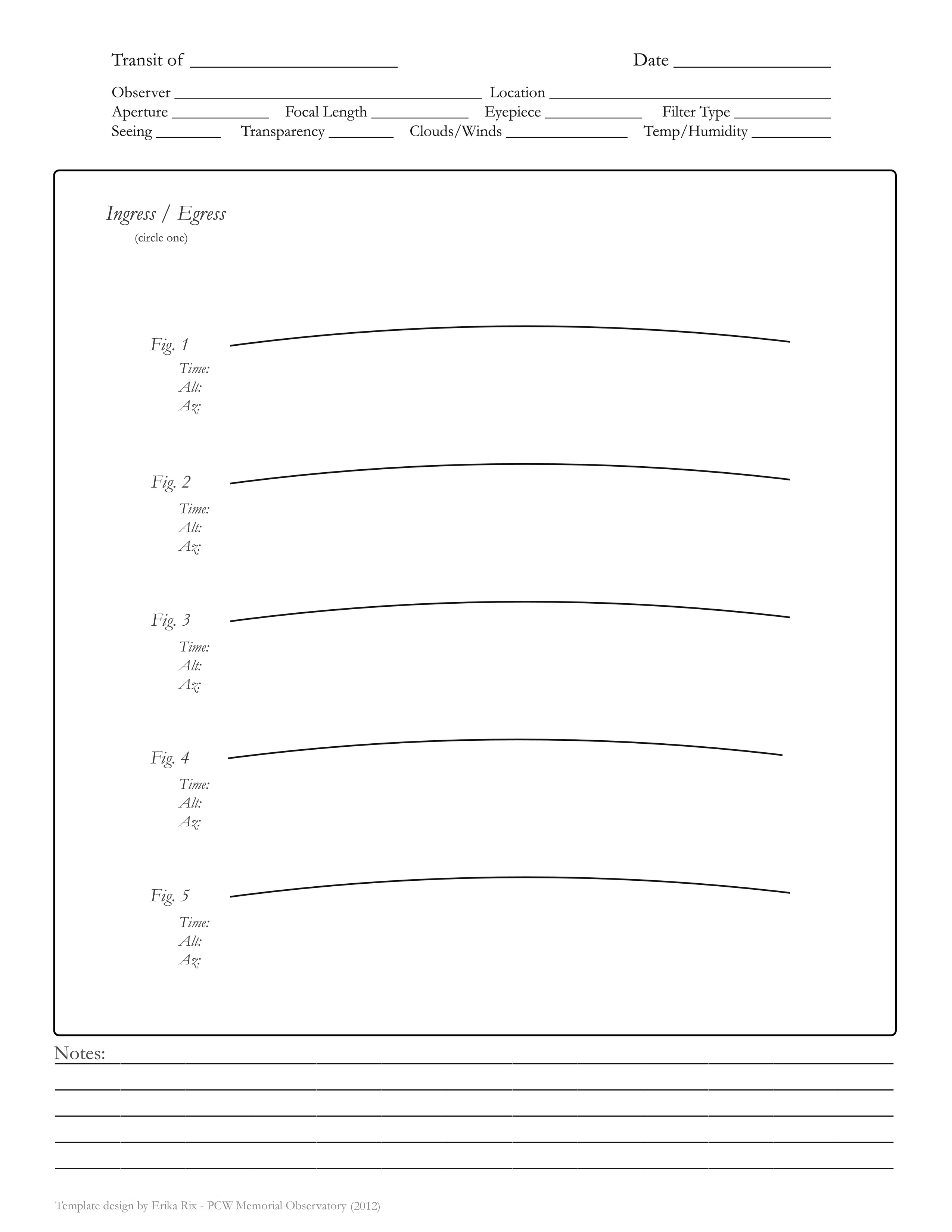
In preparation of the upcoming June 5/6 2012 Venus Transit, I’ve created a few observing forms for recording the transit. Please feel free to print, download, or share copies of the following forms for personal or club non-profit use.

Transit Full Solar Globe

Ingress and Egress – 10 stages

Ingress or Egress – 5 stages

For more templates, please see Observation Forms/Templates.

2012 06 02 – Babbage and South

•June 3, 2012 • 1 Comment

The eastern walls of impact crater Babbage formed dramatic streaks of thick shadow across its lava-filled floor. The highlighted areas of Pythagoras and Oenopides to either side of Babbage created slender chunks of light depicting the highest peaks of their rims. I was very tempted to sketch the entirety of the trio and would have most likely done so had I been using charcoal or chalk for media instead of a stippling technique.

Stippling is a very old and disciplined method of rendering the Moon, not to mention tedious. Done correctly, the results can be very accurate with magnificent observation records. I have a book of the late selenographer Harold Hill’s observations filled with his wonderful sketches, quite a few of them stippled or created with ink wash. “A Portfolio of Lunar Drawings (Practical Astronomy Handbooks)” by Harold Hill” He carefully drew line sketches and used a tonal scale legend to depict density of shadows. Later, away from the scope, he would create a “finished” sketch with ink using his outlined eyepiece sketch as a guide. He stated (on page xvi):

“One advantage of this system is that, provided the original drawing is conscientiously done, it is possible to prepare a satisfactory “finished” representation of what was seen two days, two weeks or even two years on without having to rely on that notoriously uncertain faculty – memory.”

By making a line drawing, it is possible to very quickly capture shadows, freezing the sketch in that moment. For this reason, I often find charcoal on white paper best to use 30 degrees or so from the terminator as it takes me longer to draw in the shadows with that medium. There are other options for capturing fast moving shadows. My friend, Rich Handy, introduced me to white chalk on black paper. Sketching the highlights can save quite a bit of time in a fast moving scene, such as shadows moving across the lunar surface as the terminator progresses. If you opt for black on white instead, you can still “freeze” the scene by concentrating on all the shadowed areas first and then work on the less pressing features.

It’s not the full proof, but what is really? An argument against redrawing the sketch away from the eyepiece is that there is only so much detail you can fit in a schematic line drawing. To recreate the drawing on a later date runs the risk of inadvertently adding more detail to the sketch than what you actually saw or simply remembering the details inaccurately because the notes and schematic sketch perhaps didn’t supply enough information.

On the flip side, how could a person draw a detailed sketch close to the terminator quickly enough to capture an accurate rendering because the fast shadow movement constantly altering the scene? I believe there’s no method that is without faults…yet both have great merits and will certainly make you a more conscientious visual observer as a result. Either way, it’s imperative that if you’re striving for accuracy, you must make a dedicated and fastidious effort to sketch exactly what you see rather than enhancing the sketch to make it more pleasing to the eye.

I tend to struggle remembering details well enough from the time my eye leaves the eyepiece to the time it takes to looks down at the paper to sketch. I have more difficulty trying to recreate the scene that same night after packing up my gear, let alone the next day or days after the observation. My schematic sketches leave more to be desired as far as details are concerned, although I’m sure that like anything else, practice makes perfect as the saying goes. I have been playing around with stippling at the eyepiece using felt-tipped pens. The results don’t hold a candle to the likes of experienced sketchers such as Harold Hill who use that technique but I’m improving and am enjoying the experience.

I outline the brightest areas beyond the terminator first and then fill in the blackness. The lunar features almost create themselves as a result. The black shadows within craters on the lunar disk are next and then the darker tones on the surface, both shadows and darker albedo tones. The brightest areas on the surface appear by default and can be sparingly stippled as needed.

The most difficult part of the process for me is eyestrain, especially as I’m far sighted. All those dots tend to run together after awhile. (So far, I’ve rarely had the need to use my reading glasses while sketching at the eyepiece. I hope that time doesn’t come.) I also tend to be heavy handed with the pressure I use on the pens, which result in a busy sketch where the features are difficult to digest. My dots aren’t uniformed and I feel the sketch would have been much improved had I given more time for proper spacing. The sketch lacks the very fine, delicate stippled effect of the masters for that technique, but I feel fairly confident that the scene was captured as accurately as my skills and stippling experience allowed.

Walled plain South was very difficult for more me as it mainly consisted of tonal ranges instead of defined boundaries. Looking at my sketch now, I could have done a better job at not filling in as many dots for the lighter, higher areas that haven’t been completely covered with lava.

Click here for more studies on stippling.
Babbage eyepiece sketch on white acid-free card stock, black felt-tipped artists pens

Atlas:
“Atlas of the Moon: Revised, Updated Edition” by Antonin Rukl, plate 2

Photo Credit: Lunar Orbiter

2012 06 01 – Gassendi

•June 2, 2012 • Leave a Comment

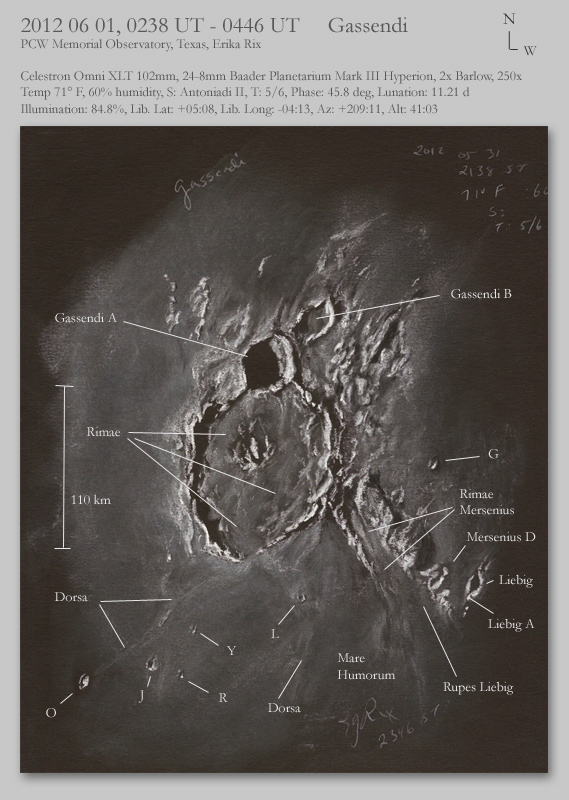
Labelled version of Gassendi sketch

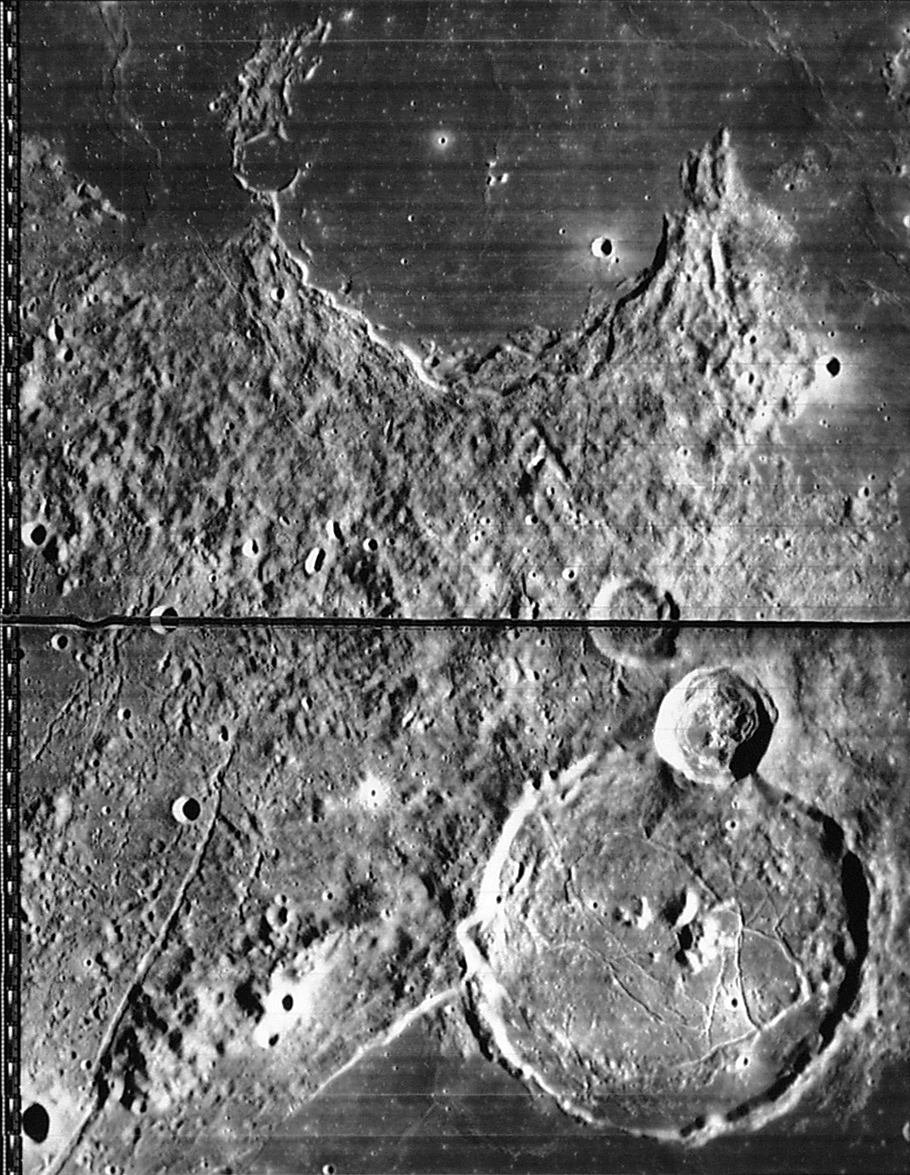
Photo credit: Lunar Orbiter

Located on the northern border of Mare Humorum, crater Gassendi is an impact crater formed during the Nectarian period (-3.92 to 3.85 billion years ago) that later was modified after volcanic activity, becoming a fractured-floor crater. Gassendi is believed to have been filled with lava from the inside, raising its floor, creating stress fractures in the process. This would explain it being considered a walled plain with a shallow depth of 2.8 km. The central peaks (~1200 m high) remain and several rilles (called Rimae Gassendi) were formed on the lava-filled floor during the Imbrian geological period -3.85 to –3.2 billion years ago.

Crater Gassendi A was formed during the Copernician period (–1.1 billion years ago to the present day) and overlaps Gassendi’s northern rim. The pairing of Gassendi and Gassendi A resembles a diamond ring and makes a very striking feature to observe 3 days after first quarter or two days after last quarter of lunation. My observation was nearly three days after first quarter.

Gassendi’s southern rim was swallowed by the lava of Mare Humorum leaving only a thin crest line to support its circular shape. Dorsa ran from the southern rim to Gassendi O (11 km wide). The sharp ridge that defines the border of Mare Humorum to the SW of Gassendi adds to the crater’s unmistakable identification.

At the beginning of my session, Spica and Saturn lined up with the Moon. Spica was 2.08 degrees north of the Moon and Saturn was 6.9 degrees north of the Moon. Extending further north, Arcturus was nearly in line as well at 31.8 degrees north of the Moon.

Suggested reading:
LPOD entry October 1st, 2010 “GIANT TURTLE-BACK CRATER”
“The Modern Moon: A Personal View” by Charles Wood, pgs 153-159
“Atlas of the Moon: Revised, Updated Edition” by Antonin Rukl, plate 52

Eyepiece sketch of Gassendi was rendered with black Strathmore Artagain paper, Conte crayon and pastel pencil, charcoal pencil.

2012 06 01 – NOAA 11493 and NE Prominence

•June 1, 2012 • Leave a Comment

Two spots were obvious in 1493 with slender filamentary lines reaching to the north of the preceding spot. Although there were a couple other small darker areas within the plage close to the limb, I couldn’t confirm that they were sunspots in h-alpha. The prominences off the eastern limb were short and dense with very faint lines of plasma stretching out in three different areas next to them. Transparency was decreasing and it became very difficult to differentiate the orange glow surrounding the disk from the faint lines of prominence reaching high above the limb.

Sketch created at the eyepiece with black Strathmore Artagain paper, white Conte’ crayon and pencil, white Prang color pencil, Derwent charcoal pencil, black oil pencil.

Active regions 1490, 1492, 1495 and 1494 formed a line across the solar disk and 1486 was set apart from them on the preceding limb. I should have taken the time to do a full disk sketch to record the long dark filaments observed, set dramatically against the lightened background of the chromosphere.

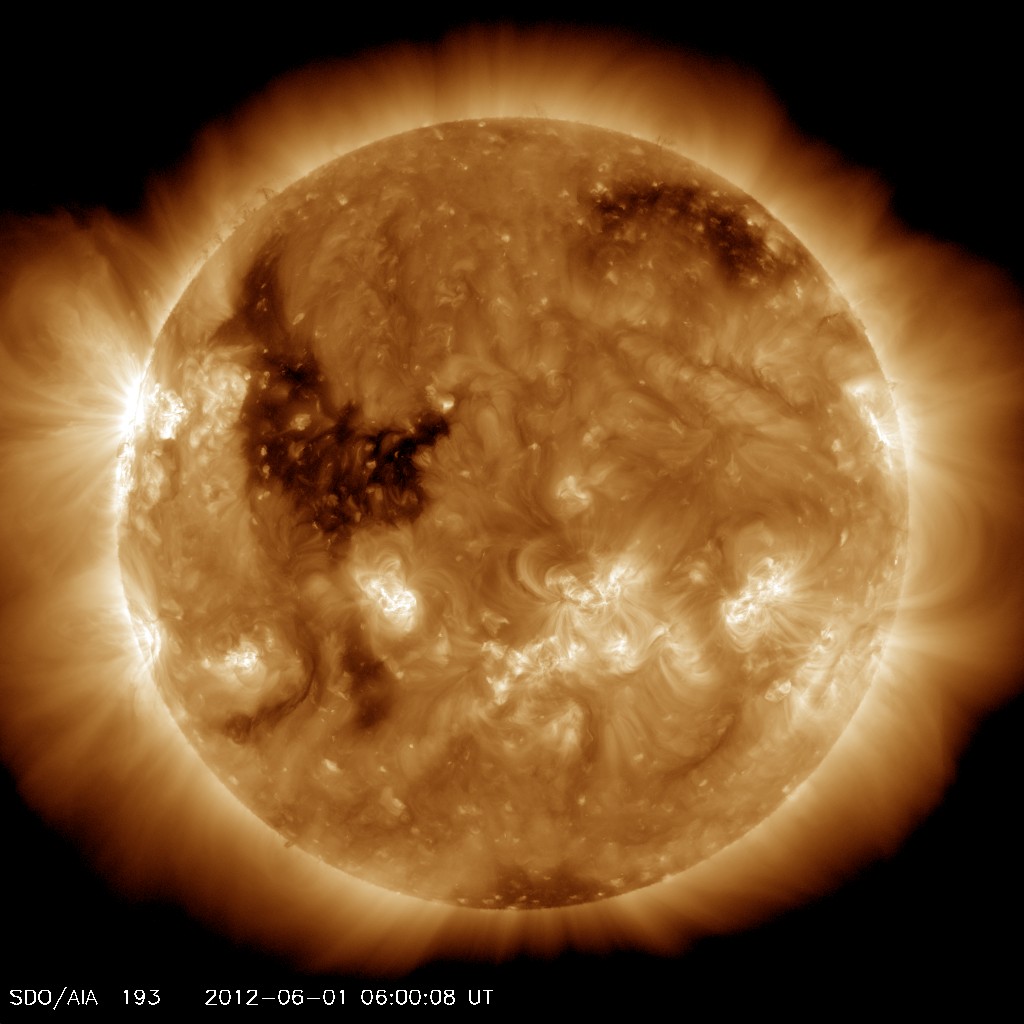
Earlier today, a coronal hole opened up on the Sun to the NE quadrant (the dark area to the left side of the image). The solar wind released from the Sun’s magnetic fields should reach Earth June 5-7th. SDO captured an image of it at 0600UT. The image also shows the hotter regions of 1493 that will show as plage in my sketch. I never tire of looking at views from SOHO or SDO. There is so much information packed into the images, not to mention the sheer beauty of them.

Photo Credit: NASA’s Solar Dynamics Observatory Coronal Hole

2012 June 5/6th Upcoming Venus Transit

•May 31, 2012 • 1 Comment

Image credit: NASA/LMSAL
“…image shows Venus on the eastern limb of the Sun. The faint ring around the planet comes from the scattering of its atmosphere, which allows some sunlight to show around the edge of the otherwise dark planetary disk. The faint glow on the disk is an effect of the TRACE telescope.”

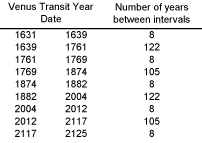
To recap an earlier post, a transit is when a smaller astronomical body passes in front of another. We have a rare transit coming up next week, Venus transiting in front of the Sun. There are only two planetary transits from Earth’s viewpoint, Venus and Mercury. Because Mercury orbits the Sun at a faster rate than Venus, we can expect 12-13 transits per century. Venus, on the other hand, transits in pairs 8 years apart in intervals of ~105.5 or 121.5 years (see chart). The last solar transit of Venus was June 8th, 2004. The next one in the pair is June 5/6, 2012. The previous transits were December 1874 and December 1882. After the upcoming transit, the next pairing is slated for December 2117 and December 2125.

Kepler had predicted a transit for 1631 but didn’t predict another for 1639. Jeremiah Horrocks reviewed Kepler’s calculations and determined the possibility of a second transit, which he observed by means of solar projection in November 24, 1639.

In the 1700s, Edmond Halley used the Venus transits as a means of measuring distances in the solar system using Kepler’s third law that states the orbital period squared is proportional to the distance cubed. Halley organized observations at several global observing sites for the 1761 and 1769 Venus transits, realizing that each observer’s line of site would have a slightly different placement on the Sun. By timing how long it would take Venus to transit, he could determine how far away the Sun was from Earth. What’s mind boggling is that the resulting astronomical unit (AU) from that experiment was between 149.67-156.11 million kilometers and we now have a more accurate AU of 149.60 million kilometers.

To help with understanding all this, here are a few definitions/figures that are useful to know:

  • A meter (m) is “the length of the path traveled by light in vacuum during a time interval of 1 ⁄ 299,792,458 of a second.” (Bureau International des Poids et Mesures)
  • Light travels 299,792,458 m per second (186,282 miles/second) and is known as “speed of light” or simply “lightspeed”.
  • Distance from the Earth to the Sun is called an astronomical unit (AU), which = 149.60 million kilometers (92.956 million miles). The speed of light from Sun to Earth (1 AU) = 8.3 min.

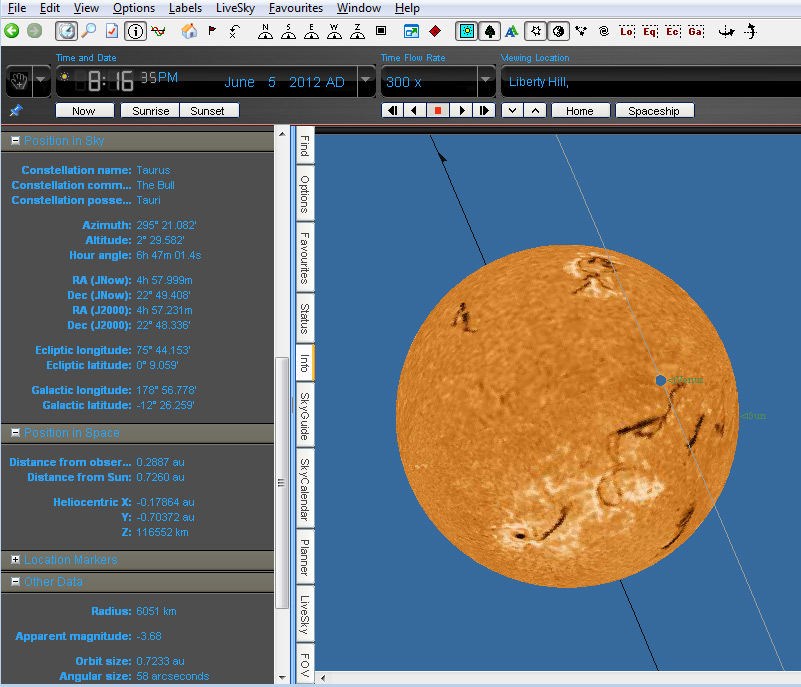
Using the ephemeris from my Starry Night program, the AU of Venus from my observing location during the transit from 1706 UT – 2032 UT (sunset) will be 0.2887 AU and from the Sun will be 0.7260 AU.

Screenshot from Starry Night

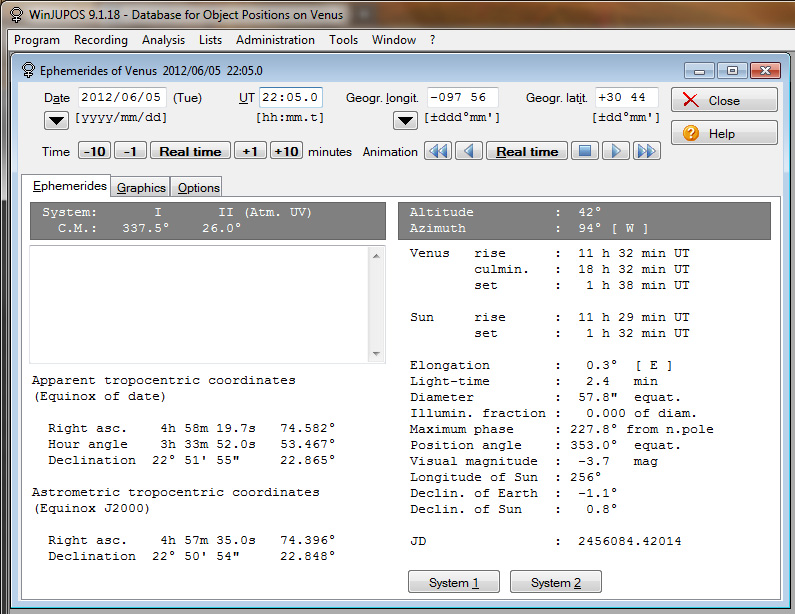
Another handy tool is a freeware program called WinJUPOS 9.1.8 – Database for Object Positions on Planets and the Sun by Grischa Hahn.

Screenshot from WinJUPOS 9.1.18 – Database for Object Positions on Venus

Here’s an excellent link taken from NASA’s site for the 2012 Transit of Venus that will be published in Observer’s Handbook 2012, Royal Astronomical Society of Canada. The link provides valuable information on how and when to observe the upcoming transit and from which locations. It also provides the history of the Venus transits and calculator tools for geographic positions. Also see Transit of Venus 2004 as taken from NASA’s site as Published in Observer’s Handbook 2004, Royal Astronomical Society of Canada.

From ALPO: ALPO Astronomy – “Local Circumstances for the Transit of Venus , June 5-6 2012”

Arvind Paranjpye wrote a helpful tutorial on Sketching the transit of Venus 8th June 2004. Peter Grego will also have an article in Astronomy Now magazine June 2012 issue for sketching the transit.

Good luck with your upcoming Venus Transit observations! REMEMBER SOLAR SAFETY: never look at the Sun directly without the use of a proper solar filter. Here are “Six Ways to See the Transit” by Chuck Bueter.

2012 05 25 – Successful Berthing of SpaceX’s Dragon to the ISS

•May 25, 2012 • Leave a Comment

SpaceX is a commercial space transport company, founded in 2002 by Elon Much (founder of PayPal and Zip2 Corportation). They build launch vehicles in for both private and commercial space transport.

In 2008, SpaceX was hired by NASA to use the DragonLab spacecraft and the Falcon 9 launch vehicle to resupply the ISS after the space Shuttle was to retire. June 2012, SpaceX’s first Falcon 9 successfully orbited Earth. In December 2010, it was the first commercial company to successfully re-enter (and retrieve) a spacecraft from orbit.

Photo credit: SpaceX

After a failed launch may 19, 2012 due to the detection of higher engine chamber pressure readings, the new launch was scheduled for May 22, 2012. Its mission was to demonstrate cargo delivery to the ISS by a privately built spacecraft. Among its cargo, the Dragon is carrying supplies, food and clothing, and lab experiments all weighing ~1200 pounds. As this launch was a test flight, its designed load capability of 7300 pounds was reduced.

Successful lift off was at 07:44 UT at Cape Canaveral as the ISS was crossing the north Atlantic. Dragon performed a series of tests before arriving at the ISS May 25th, 2012, and then was captured by astronaut Don Pettit using a robotic arm to berth it to the Harmony module at 16:02 UT. This marks a historic day being the first privately (commercially) owned spacecraft to dock to the ISS and will certainly pave the way for future transports.

On May 31, 212, the Dragon is scheduled to undock from the ISS and re-orbit Earth, using parachutes to land in the Pacific Ocean off of California’s coast.

2012 05 22 – Moon Occultation of Zeta Tauri, Moon/Venus/Elnath Alignment

•May 23, 2012 • Leave a Comment

Moon Occultation of Zeta Tauri

Occultation occurs when a larger body passes in front of a smaller body. In this case, the moon began its passage in front of variable star HIP26451 (Zeta Tauri) last night at 0233 UT (2012 05 23) in the constellation Taurus. I caught this image by accident while imaging the alignment of Venus, the Moon and multiple star Elnath HIP25428. Had I continued photographing the scene for the next several minutes, Zeta Tauri would have disappeared completely behind the Moon and then reappear at 0318 UT (2012 05 23), long after the Moon fell below my horizon.

Alignment of Moon,Venus, and Elnath

Venus had a phase of 7% disk illumination with an angular size of 53 arcseconds. The Moon was on lunation 2.11 days with a colongitude of 297.4 degrees.

Labelled Version

Photo details:

Alignment photo: Canon EOS DIGITAL REBEL XT, F/4, 2.5 seconds, ISO – 1600, 92mm
Occultation photo: Canon EOS DIGITAL REBEL XT, F/5.6, 1.6 seconds, ISO – 1600, 300mm

2012 05 22 – Crepuscular Rays and Cloud Shadows

•May 22, 2012 • Leave a Comment

Crepuscular rays are rays of sunlight that appear to radiate from the Sun, forming parallel columns of light that are separated by shadows of clouds or other objects. These rays are made visible by light diffracting and reflecting from particles in the air such as dust or moisture droplets. They are especially beautiful seen through stratocumulus clouds where the cloud shadows appear much darker by comparison and the sky around them is enhanced with beautiful colors of blues and pinks.

The Latin word crepuscular means twilight and the term “crepuscular rays” originates from their occurrences during the dawn and dusk hours.

For more information on crepuscular rays and cloud shadows, please visit Atmospheric Optics .

This picture was taken in my front yard during the evening hours just before sunset last night. Texas, USA.