2012 July – Austin Under the Stars

•July 29, 2012 • 2 Comments

This was my first year at Austin Under the Stars (AUTS) held at St. Stephen’s Episcopal School.

ASTRONOMY FOR THE PUBLIC — Austin Under The Stars is a special event, free to the public, offering a full experience of astronomical observation, including safe solar viewing. Hosted by the Austin Astronomical Society and St. Stephen’s Episcopal School, the public is invited to join local astronomers who will be viewing our closest stellar neighbor, the Sun, in daytime skies, using special protective filters on several telescopes. After the Sun slips under the horizon, we’ll turn our attention to the celestial wonders in the night skies.

Frank Mikan, Science Department Chair and Observatory Director at St. Stephens, was very welcoming and great fun to be around. He really made me feel at home and explained where everything was and where to set up when I first arrived. It sure helps a first timer when they’re greeted with such genuine kindness.

I brought my 16″ Zhumell reflector f/4.5 and DS Maxscope 60mm h-alpha rig. NASA Night Sky Network had just sent me a package full of goodies to hand out that introduces the Solar Dynamics Observatory and also more Sun “pizzas” that introduces heliophysics. So those along with the solar safe viewing glasses from the Charlie Bates Solar Astronomy Outreach Club that I’m associated with, there was plenty of handouts for people to take home to perk their interest in the Sun.

We had a “Sky Tour” for the kids and they were handed a “passport” after arriving. On the passport, they had targets to seek out through our telescopes: the Moon, a constellation, double star, galaxy (Believe me, with a 10-day waxing gibbous Moon, it was a strain to share any galaxy with the kids. In the end, M51 provided just enough of a view for most people to see it), nebula, star cluster and Saturn. Once they viewed it, the member that showed them the target would mark it off their passport, which would then be in a drawing to have the Austin Planetarium bring the mobile dome to that child’s school for a presentation.

We had a media tent set up for astronomical related presentations. I did a Power Point presentation on astronomical sketching, Jeff Phillips’ was Death by Black Hole, and Michelle Harvey’s was Anatomy of a Star. I would have liked to have seen both of the others’ presentations (I did manage a short bit of Jeff’s before having to leave to take photos for the newsletter before it got too dark). Our club members from the International Dark-Sky Association (IDA) were set up inside the gymnasium evidently to promote dark sky awareness. The mobile planetarium and the film “The City Dark” was also inside. In other words, there were lots of good stuff for the visitors to see and do. It was great to see a few familiar faces from previous public star party events that the club held at Eagle Eye Observatory. It’s funny how time flies by so quickly at these events. I wish there more time to spend with everyone.

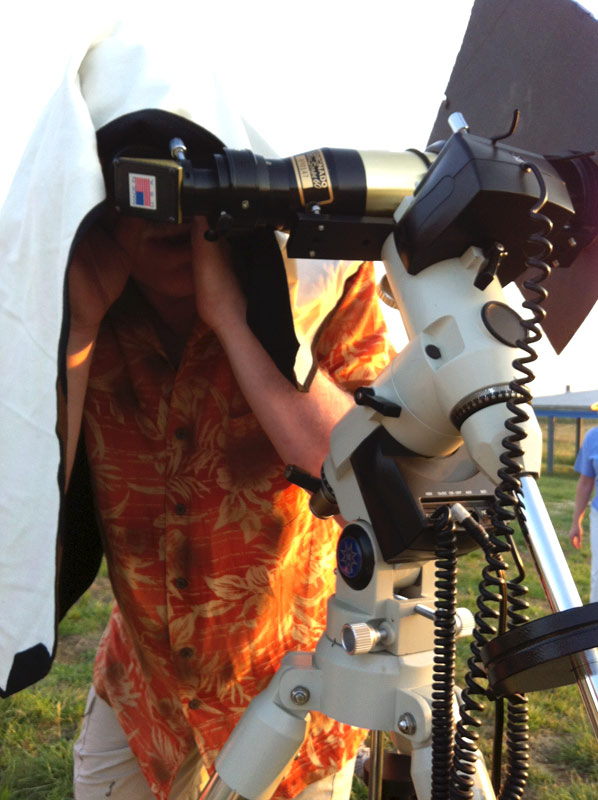
Terry Phillips, one of the club members, did a fantastic job (and much appreciated) of taking over my Maxscope to share views and discuss the Sun with visitors while I was giving my presentation. The Sun was putting on amazing views yesterday! There were several other solar filters there, but I didn’t manage to steal views from any bar one white light set up of David Ault’s. By the way, I generally bring two batteries for my LXD and wouldn’t you know the time I brought only one (yep, last night), the battery fell in the red during alignment. {sigh} It was green when I packed it. David was very kind to lend me a spare battery that he had on hand.

At one point of the night, there were two guys looking at various objects through my scope and became interested in how to actually find targets in the sky. I explained the type of scope I had and how a Telrad works. I then got out my planisphere and showed them how to use it along with my Pocket Sky Atlas. I had one of the guys try to find the Dumbbell nebula (M27). He got very close and had it not been for the Moon’s brightness drowning out stars, I am positive he would have. Using my Starmap Pro app on my iPhone, I also showed them how to use that sort of aid to find targets. The visitors that came to my scope really seemed to enjoy not only the views through the eyepiece, but also having me point out in the sky with my laser pointer where the targets are and then showing them what the object looks like from Hubble.

It was said before we left the field that there were about 250 guests. I’m not sure anyone counted the members, scopes and binos on the field. I always forget to. It was a terrific night. I got home sometime after 1 am and unloaded the CRV before breakfast this morning. What a great event!

This slideshow requires JavaScript.

2012 07 21 – AAS Outreach at Eagle Eye Observatory

•July 22, 2012 • Leave a Comment

This was my second outreach event at the Eagle Eye Observatory located near Buchanan Lake at the Canyon of the Eagles Lodge and Nature Preserve with the Austin Astronomical Society (AAS). I set up the double-stacked Maxscope 60mm h-alpha scope on the LXD75 mount and also managed to set up the Zhumell 16″ reflector (f/4.5) on a Dobsonian mount (carried it by myself and maybe even more unbelievable, I lifted it in sections into my CRV as well!).

If any of my insecurities at explaining the nighttime views to the public prohibited me from branching out before, I think it’s safe to say that I overcame them last night. It probably helped that I had my dob instead of the Celestron 102mm as I can move more freely hugging that light bucket, finding targets quicker, and well let’s face it, the views are more awesome! Remembering advice kindly given to me for outreach by other AAS members from the last event, and also advice and guidance from my husband, Paul, I felt much more equipped for this event.

The first quests, a very nice woman with her two adorable grandchildren, showed up shortly after 7pm just in time to enjoy solar viewing prior to the nighttime event. The kids were able to identify plage, filaments, and prominences in h-alpha and were able to tell me why the Sun is so important to us. I gave the three of them solar glasses from the Charlie Bates Solar Astronomy Outreach Club that I’m a member of as well as flyer with information about the Sun. The next guests to arrive were two gentlemen that were father and son, who also were able to view Sun.

At dusk, I collimated the dob and packed up the solar rig to prepare for nighttime viewing. A three-generation family came to my area to view the crescent Moon. It was fantastic to see a large family making the journey together to enjoy the night skies at this type of event. There were actually a few families, all with younger children and it really warmed my heart. Soon, more people came to my scope to view the Moon. At 8.6% illumination and a 2.8-day lunation, Mare Crisium put on quite the show just in full view off the terminator. I explained maria to the children and how it was formed, what the terminator was, and how craters are formed.

Next up was a very small Mars viewing followed by Saturn, both in the constellation Virgo. The pair of them along with Spica formed a very bright trio just after dusk. Viewers were able to see hues of yellow/beige in Mars and several of them had their first view of Saturn, which always causes exclamations of excitement! The main targets I shared that night with the public were M57 (Ring Nebula); M51 (Whirlpool Galaxy); M71, M56, M22, M28 (all globular clusters). One little girl told me the Ring nebula looked like a…well, a ring! I asked her little brother if it looked like a Cheerio and he very “matter of factly” told me that no, it looked like a doughnut. It was great fun explaining what nebulae and clusters were, how stars are formed, how to read planispheres, and the differences between types of telescopes. Using the laser pointer, I showed the viewers where the objects were in the sky that they had just looked at through the telescope and also showed them the the constellations in those areas.

When the observing field started to become more sparse and shared views through my telescope were less frequent, a few of us from the club that were set up next to each other started sharing the views between ourselves. What fun! It reminded me so much of observing with my friends back home in Ohio, the joking around, calling out targets and drooling over each others’ gear. I played around quite a bit hunting down faint galaxies in Ursa Major as that area of the sky was obscured by trees the majority of the time at our old observatory site in Ohio. The night passed by so quickly that I hated to see it end. I packed up my gear and headed out by half past midnight to begin my journey home, just in time too since a thin layer of clouds was creating murky skies. By the time I got home, they were much worse. Thankfully they held back during the event!

I can hardly wait for our next outreach event, Austin Under the Stars held at St. Stephen’s Episcopal School in Austin. I will be giving a short presentation on Astronomical Sketching as one of the presenters, followed by solar viewing and then our nighttime viewing.

Link to other outreach events and star parties.

This slideshow requires JavaScript.

2012 07 16 – Austin Planetarium’s Astro Camp

•July 16, 2012 • 1 Comment

Austin Planetarium and Starry Sky Austin is holding the Austin Planetarium’s Astro Camp at the All Saints Episcopal Church in Austin July 16-20th. Part of the astro camp includes learning about the Sun. They needed someone with a hydrogen alpha solar telescope (or filter set) to share the chromospheric views with the kids. One of the educators brought an Orion refractor with a homemade solar funnel for the white light views and I was very happy to volunteer for the h-alpha views as part of my solar outreach with the Charlie Bates Solar Astronomy Project Outreach Club and the NASA Night Sky Network.

The age group was 8-11 years old and there were 14 kids and two educators in the group. The kids and I had a short discussion about the Sun: what the Sun is, why the Sun is so important to us, solar facts and a little about what the Sun is made of, as well as solar features in both white light and h-alpha. We talked about how to safely view the Sun and of how to handle the telescopes, then I handed out the solar glasses so that all the kids could enjoy the solar views while waiting for their turn at the scopes.

While each child was seated at the eyepiece of my solar scope, they were able to see filaments, mottling effect in the chromospheric network, active regions including plage and sunspots, and prominences. I explained what each of the features were and told them how the active region (AR 1520 that they were looking at today through the eyepiece) produced a solar flare the other day (X1.4-class on July 12th). That flare caused plasma and other matter to be hurled from the Sun, called a coronal mass ejection (CME), which then produced auroras the past couple of nights. One boy said “This is the best astro camp ever!!”…then admitted that it was actually the first one that he ever attended.

They all agreed on one thing, and that was that the Sun is awesome! To which my response was, “I KNOW, right?!! Very cool!”

This slideshow requires JavaScript.

2012 07 15 – Moon, Venus, Jupiter, Aldebaran Conjunction

•July 15, 2012 • Leave a Comment

Sunday just before dawn, we were treated with a beautiful conjunction of the Moon, Venus, Jupiter, and giant red star Aldebaran to the East in the constellation Taurus. The Pleiades, M45, was an added bonus set above the scene. My buddy, Steph Hansen, came over for the weekend and we set our alarm clocks so that we wouldn’t miss out. I set up the tripod and camera and then began taking photos with minor adjustments to focus and settings, trying to dodge the thin layer of clouds moving across the sky. I have a couple photos of M45 but couldn’t fit both that and the other four in the same frame.

In the photo, Jupiter is at the top, Aldebaran to the right, Venus at the bottom and the waning crescent Moon at the left.

Steph (left) and me (right) visiting the Longhorn Cavern state park Saturday before the conjunction.

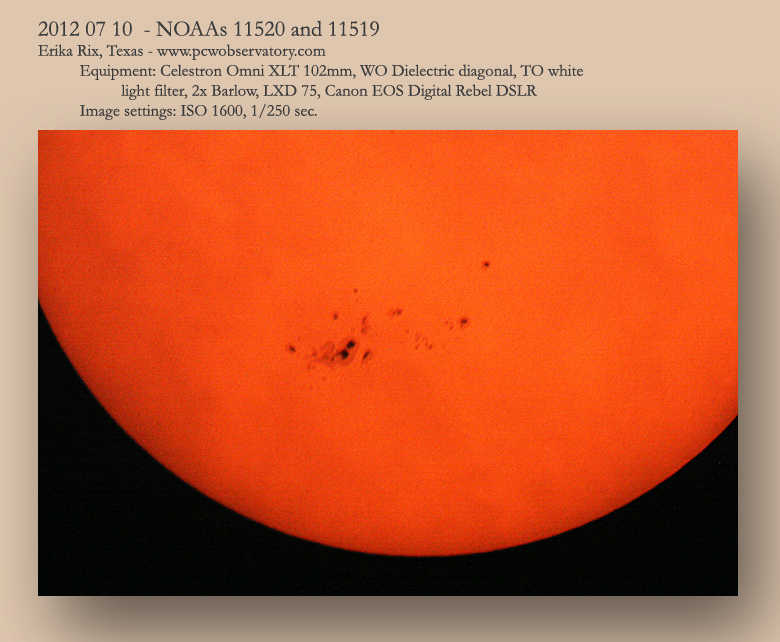
2012 07 10 – NOAAs 11520 and 11519

•July 10, 2012 • Leave a Comment


Temp: 89F, winds calm, 80% overcast

It was clear first thing this morning after a night of much needed drizzling rain. I had intended on sketching the large active region 1520 but after getting the morning chores done and then setting up my equipment, the clouds had rolled in once again. I decided to image the Sun instead. There weren’t enough gaps to allow time for sketching and I didn’t want to miss the opportunity to grab at least some sort of recording of this sunspot group.

According to NOAA forecasters (as read on Spaceweather.com), this active region’s magnetic field may produce an 80% chance of M-class flares and a 25% chance of X-class flares within the next 24 hours. It’s definitely the region to watch today. If it clears up again, I’ll try to grab an observation in h-alpha as well, although my CSC shows that may be a slim chance! I’m thankful for the rain…if only I could have the best of both worlds!

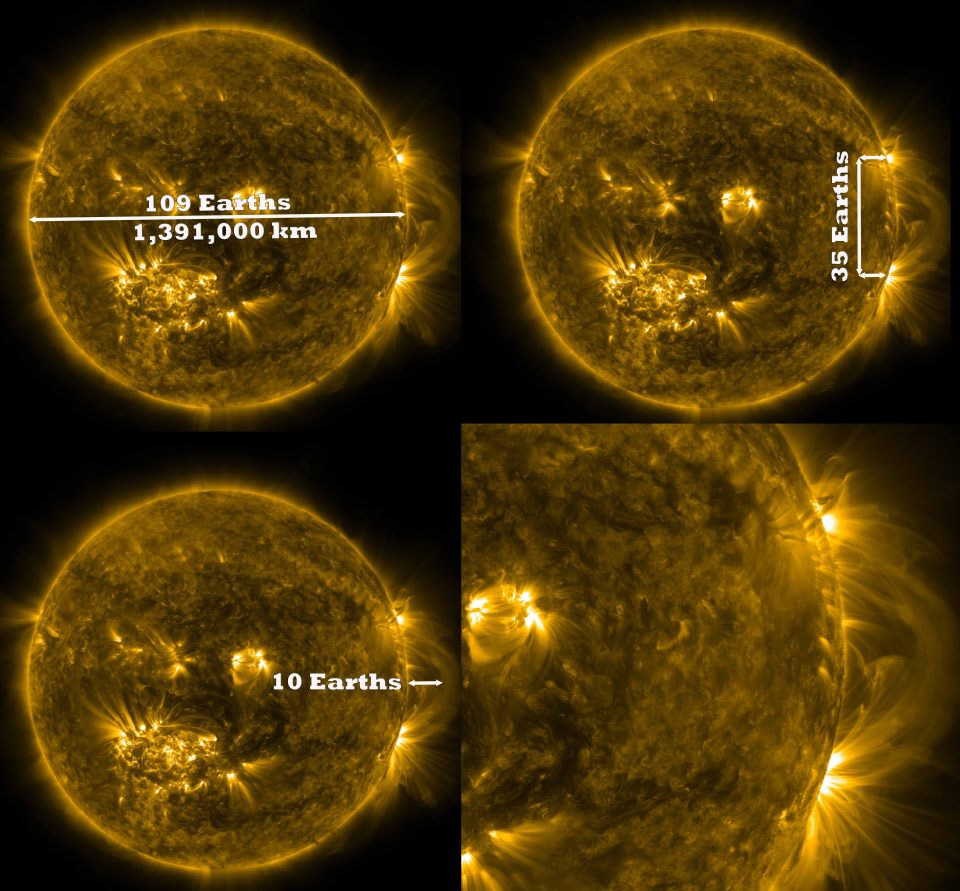
I didn’t have enough time for a close look at 1515 on the western limb. The Solar Dynamic’s Observatory (SDO) put up a wonderful picture today to demonstrate the approximate size of the coronal loop on the western limb today.

Photo credit: NASA SDO

Link to Facebook post from SDO from 2012 July 10th

In SDO’s words regarding the photo compilation:

For many Coronal Loops are the favorite feature on the Sun. And there are some amazing loops on today’s Sun. So I decided to illustrate the size of today’s loops over the western limb of the Sun.

These are approx. sizes only to give some idea of how big the Sun and these coronal loops are.

The corona is made up of loops of hot gas that arch high above the Sun’s surface. These highly structured and elegant loops are a direct consequence of the twisted solar magnetic flux within the solar body and plasma travels along these magnetic field lines.

Thank you SDO for providing amazing images and solar education!

July 2012 Issue – Sidereal Times

•July 7, 2012 • Leave a Comment

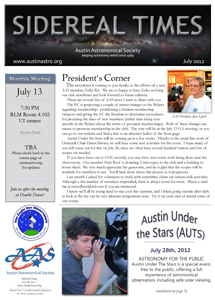
Recently, I became the newsletter editor of Sidereal Times for the Austin Astronomical Society. July’s issue is now available for download.


Click the following link for the PDF version: July 2012 issue (11.6 MB)

This issue is the first that I’ve done for the club. Inside, you’ll see photos and reports from the Transit of Venus, Annular Eclipse, star parties, classifieds, galleries, updates on club news, Show and Tell for new gear, and many other goodies! Before the next issue, I’ll need to pick up new publishing software which will allow for smaller file sizes and clickable links.

Please contact me if you’re interested in joining the club or wish for more information! It’s a very active club and has a great outreach program.

2012 06 23 – AAS Outreach at Eagle Eye Observatory

•July 5, 2012 • Leave a Comment

Earlier that Saturday, I had a solar outreach event with the Webelos Scouts. I had time for a quick break at home before heading back out to the Canyon of the Eagles Lodge and Nature Preserve, in particular, the Eagle Eye Observatory for another quick solar outreach followed by nighttime outreach with the public through the Austin Astronomical Society (AAS).

This was my first star party with the AAS and I brought both my DS Maxscope 60mm h-alpha scope and my 102 Celestron refractor with LXD75 mount. The views through the solar scope were very dim because of the Sun being so low on the horizon. It’s a pity the star parties don’t begin a little sooner because of that, but I suppose when most people think of astronomy, they think of night time viewing instead of our day star. There are exceptions to that, of course. I would like to see a dedicated solar star party closer to where I live…maybe someday.

Would you believe there were no sunspots at all that day to show off the white light filter views, especially as we are in the midst of a solar maximum? The chromospheric views were terrific in h-alpha, though, so not all was lost. I handed out a few more solar glasses and the recipients were incredibly thankful for them. I never tire of talking about the Sun and tried my best to educate the viewers of what they were seeing and how to observe. (Thinking of my buddy, Gary Gibbs, who used to own that wonderful Maxscope and thankful that he graciously sold it to me several years ago.)

After the Sun went down, I got out my trusty planisphere and Pocket Sky Atlas. Although I have GOTO on my mount, I struggle remembering to use it as I’m so used to star hopping and actually prefer to star hop. I use my mount mainly for its tracking. At the next public star party event, I will certainly take advantage of the GOTO feature as it would be a lot faster than hunting down targets to share. I also found that I need a lot more practice speaking out to crowds to invite them over to my scope. Perhaps I spend too much time on my own with just the dogs around me when I observe. It was obvious that I was a bit of a wallflower nestled securely behind my scope, completely unsure of how to share night skies with the general public. The other members of AAS were terrific and I look forward to gaining experience through them.

There were about 15 member scopes including the two observatory scopes and approximately 112 visitors, although there very well could have been more that didn’t sign in. A handful of astro imagers were off to the other side of the observing field and produced some exceptionally beautiful images from that night. The event ended at midnight, but by the time I packed up my scopes and headed home, it was nearly 2am. Had I not had the dogs to consider, I would have happily spent the entire night out there sketching and observing targets that I wasn’t able to see very well from our old location in Ohio.

This slideshow requires JavaScript.

2012 06 23 – Solar Outreach with Webelos Scouts

•July 4, 2012 • 4 Comments

This late spring, I joined the The Charlie Bates Solar Astronomy Project Internet Outreach Club to become more involved with solar outreach. This club was founded by Stephen Ramsden and is listed with NASA’s Night Sky Network. The club is represented in 17 countries at this time and growing. To give you an idea of the how many children and adults this program reaches, Stephen started the The Charlie Bates Solar Astronomy Project in 2008 as a small local solar outreach program. By 2009, he reached over 50,000 teens and adults in Atlanta! “2010 was a record breaking pace with appearances at Dragon*Con and national vendor shows lecturing all across the country” and he has received several awards for his outstanding outreach efforts.

In Stephen’s words:

CHARLIE BATES SOLAR ASTRONOMY PROJECT INTERNET OUTREACH CLUB

“The Charlie Bates Solar Astronomy Project Internet Outreach Club (CBSAPOC) is a global coalition of like-minded individuals whose primary interest is sharing solar astronomy with students and the general public. The world’s first internet based astronomy club is hard at work distributing solar related supplies, solar glasses, equipment, support and motivation to its members around the world. There are no fees or charges for anything in the club if you abide by the general principles stated in the membership application. The club is the first of its kind and is recognized by the NASA Night Sky Network as an official astronomy club for event reporting.”

Although I’ve been involved with outreach events in the past, I’ve been itching to branch out and become more involved. What better way than through Charlie Bates Solar Astronomy with the support of Stephen and the others in the group…especially when it involves my favorite object in the sky, our Sun.

To start off, I log my upcoming events with NASA’s Night Sky Network. After the event, I log the completion and details of the events and also share the photos and stories with whoever will listen! What’s in the middle is sheer fun, with adults and children alike. It makes my day to have someone look through the eyepiece for the very first time, let out a gasp and say “WOW!” The telescopes aren’t the only stars of the show. The solar glasses supplied from the club could just as easily be $100 dollar bills if you could see the excitement on the kids’ faces when you hand them out and tell them they’re theirs to keep!

The Webelos scouts were no exception. They were camping at Camp Mabry that weekend and I asked if I could share the Sun with them. I created a solar poster for visual aid and explained a little about how the Sun and the solar system came to be. They were already pretty knowledgeable with the importance of the Sun to Earth and our existence. I told them some fun facts about the Sun such as it only takes about 8 minutes for the Sun’s light to reach us, you could fit about 1 million Earths in the Sun if the Sun was a hollow ball. Likewise, if it was flat, you could fit about 100 earths across the solar diameter. I explained plasma and how hydrogen fuses together to create helium in the Sun’s core and that’s what creates energy which equals heat. Using rubber bands, they learned how plasma is held  structurally by magnetic field lines, producing filaments and prominences. But then (such a newbee is prone to I guess), I went into too much detail and could see their eyes glazing over similar to what I imagine mine looks like when Paul tries to explain his imaging techniques to me (recording an observation is so much similar with a piece of charcoal and paper!)

At that time, the solar glasses were passed out and we made our way to the telescopes! There were about 20-23 people in total with the scouts and adults together. I had a brief moment of embarrassment when after packing up the equipment, I headed out the wrong way on a one way road. Nevertheless, it was a great time and I think the scouts will remember their solar views for a long time to come.

This slideshow requires JavaScript.

2012 06 25 – When All Else Fails, Get Out the Camera

•June 27, 2012 • 2 Comments

Pulling out the Celestron 102mm refractor and setting it up on my LXD75, I was looking forward to a long session with the Moon. Several things had gone wrong that day and I had it in my mind that a peaceful observing session was just what I needed. It turns out that I just couldn’t relax and frustration kicked in.

I’m sure you all can relate: couldn’t get comfortable; neck was hurting; even though I had sprayed myself with bug spray, mosquitoes were nibbling at my ankles; sweating into the eyepiece and the dogs were barking at seemingly nothing, putting my nerves on edge and forcing me to shut them in the house.

Nevertheless, I tried to pull myself out of that funk. Manilius caught my eye straight away, as did Rima Ariadaeus and Rima Hygius. I got out the sketch kit and while drawing terminator shadows, it quickly became obvious that I wasn’t in the right mindset to sketch. I moved further into the lighted area of the 6-day Moon and thought perhaps if I concentrated on an object with minimal shadows things would improve since I wouldn’t feel so rushed. I targeted Plinius. Soon after, I found myself swearing at the diminishing seeing conditions at increased magnification and the target was small enough that removing the Barlow meant loss of details anyway.

Resigned to the fact that I simply wouldn’t be able to enjoy myself sketching the Moon, I soaked in the views instead. For some reason, I couldn’t even bring myself to jot down notes or dictate the observation on my iPhone voice recording app. The view was so beautiful and I was failing to record it in either of my usual methods. That’s when I remembered my camera.

When I first became active in astronomy, I had purchased a Digi-T adapter for my camera at the time. I enjoyed photography and thought I would equally enjoy dabbling in astrophotography. What I discovered instead was that the adapter was too fiddly and it was taking away from my viewing session, not to mention the number of times my camera and/or the Digi-T adapter fell off the scope. And the little wrench was nearly impossible to use in the dark to tighten the adapter. That’s when I turned to sketching at the eyepiece.

Don’t get me wrong, I do like playing with gear and electronics, but when I’m under the stars, I much prefer the quietness of a Dobsonian and sketch pad. Would you believe that instead of using the GoTo features of my LXD that I unlock the clutches after alignment and star hop with my Telrad the majority of the time. When I find my target, I lock the clutches and use is mainly for tracking. But anyway, I digress.

I picked up a bower for Canon (AF) either at the Apollo Rendezvous or from an astro friend of ours, John Crilly, several years ago and it never got used until Paul borrowed my camera for the Venus transit. There’s nothing fiddly about it at all. You just take the lens off your camera and put the bower on it in its place, then slip it into the eyepiece holder and tighten with the set screw. Swapping my sketch pad for the camera and adapter was my last hope to record that night’s session. I took about 10 photos with slight adjustments to focus, ISO and shutter speed before finally settling on two images that were suitable for a mosaic. I needed to add a 2x Barlow because of in-focus issues, which then meant that I couldn’t fit the entire Moon phase in one photo. I wasn’t about to attempt a focal reducer, assuming one could have been used with this set up. That’s Paul’s area of expertise, certainly not this sketcher’s.

This is my first successful image astro image through a telescope and although it could be a lot better, I’m pleased with it and am tempted to dabble in astro photography once again. (Did I just hear other sketchers gasping??)

2012 6 25 – New active region and NW Prominence

•June 25, 2012 • Leave a Comment

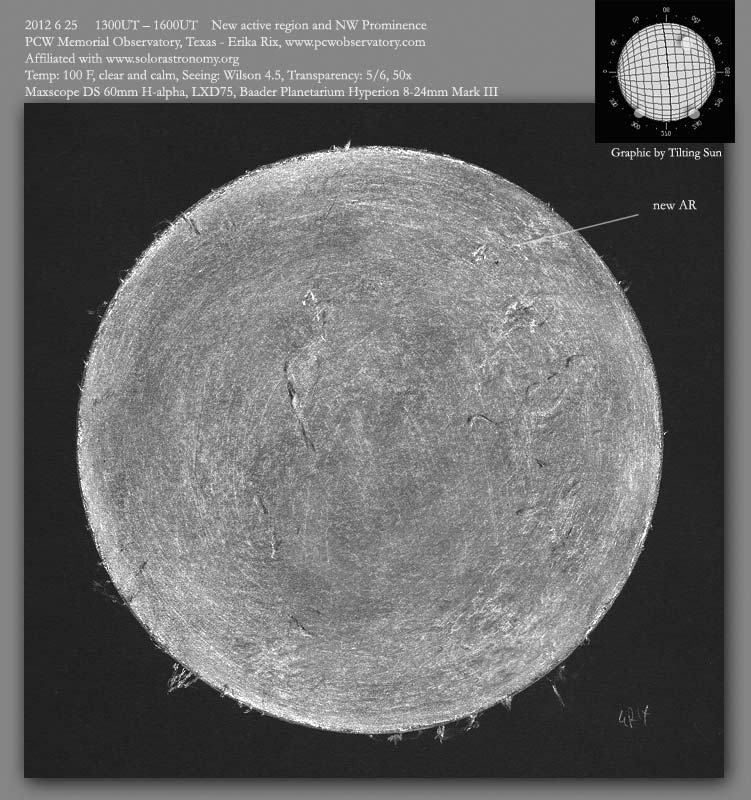
There is a new active region about 30 degrees off the eastern limb. There were two groups of sunspots in that region with several smaller patches in between them. In hydrogen alpha, plage supported the northern group of sunspots. Seeing was crisp during my h-alpha session. I attempted white light after 1600 UT but the seeing had deteriorated quite a bit and I was unable to get a sharp enough view for a close up active region sketch in white light. I did see faculae just inside the limb near the new active region. Two days ago, I observed facula in white light just inside the eastern limb. I imagine this is now the active region seen today with the sunspots.

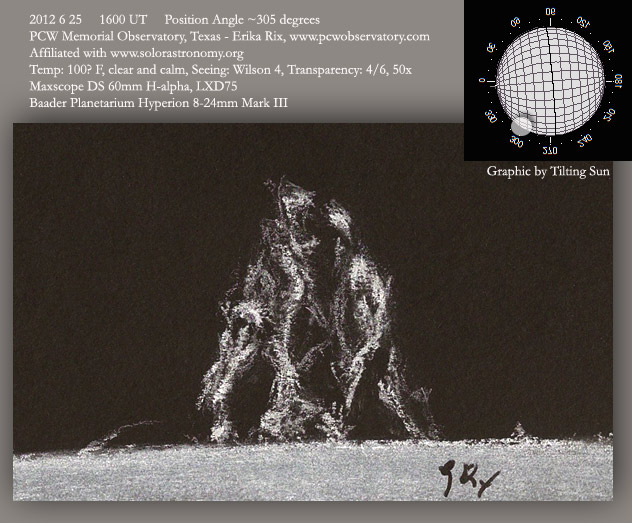
There were large patches of plage in the southern hemisphere of the h-alpha view. Several smaller filaments were scattered throughout them. A larger thin filament reached about 30-40 degrees east to west in the northern hemisphere. There was a thick line of prominences on the western hemisphere. Two of the prominences were particularly tall. One was an “A” shape with two openings at the base of it. It was very bright in appearance and thick. At the opposite side, a very slender tall prominence stood about 15 degrees out from the limb, connected by two faint lines of plasma directly beneath and then a thicker bundle of prominence to the eastern edge of it.

Sketches created at the eyepiece with black Strathmore Artagain paper, white Conte’ crayon and pencil, white Prang color pencil, Derwent charcoal pencil, black oil pencil.