Sketch from the crypt:
Constellation: Andromeda
Object type: open cluster
01h 57m 55s, +37° 51′ 57″
Distance: 1300 ly
Apparent magnitude: 5.7
Apparent dimension: 75′


Sketch from the crypt:
Constellation: Andromeda
Object type: open cluster
01h 57m 55s, +37° 51′ 57″
Distance: 1300 ly
Apparent magnitude: 5.7
Apparent dimension: 75′
2012 08 20, 1017 UT – NGC1907/H 7.39 and M38/NGC1912
Erika Rix – Liberty Hill, Texas
AT6RC f/9 1370mm, LXD75, 13mm Ethos, 105x
70F, 71% H, calm/clear, Pickering 6, T 2/6
NGC1907
Open cluster in the constellation Auriga containing 30+ stars, 05h 28.0m, +35deg19´, 0.6´, m8.2v, distance 4500 lyM38/NGC1912
Open cluster in the constellation Auriga containing 100+ stars, 05h 28.7m, +35deg50´, 20´, m6.4v, distance 4200 ly, calculated diameter 21 ly.
M38 is located within 2.3 degrees of M36 and was discovered by Giovanni Batista Hodierna before 1654 then independently discovered by Le Gentil in 1749. Messier later catalogued it in 1764. It’s a beautiful open cluster of approximately 100 member stars that forms almost an obtuse isosceles triangle with Elnath and Theta Aurigae. It was only after sketching this beauty that I noticed an “X” asterism within it. Turning my sketch upside down, the “cross” was very evident with a pair of stars in each arm of the cross.
I opted to use my 100 degree apparent field of view 13mm Ethos for this observation specifically so that I could include NGC1907 in the same field of view as its northern companion, M38. At 105x magnification, this small compact open cluster resembles a stellar lenticular galaxy set in the middle and slightly south of stars HIP25476 (giant at 6.5m) and HIP25733 (variable multiple star at 6.75m). There are close to 30 9th to 12th magnitude stars within it, but I could only plot around 10 within the hazy backdrop of this cluster at 105x magnification using the 6-inch RC. With more aperture and a small increase in magnification, an observer will be able to pick out close to 30 stars and star chains within this object.
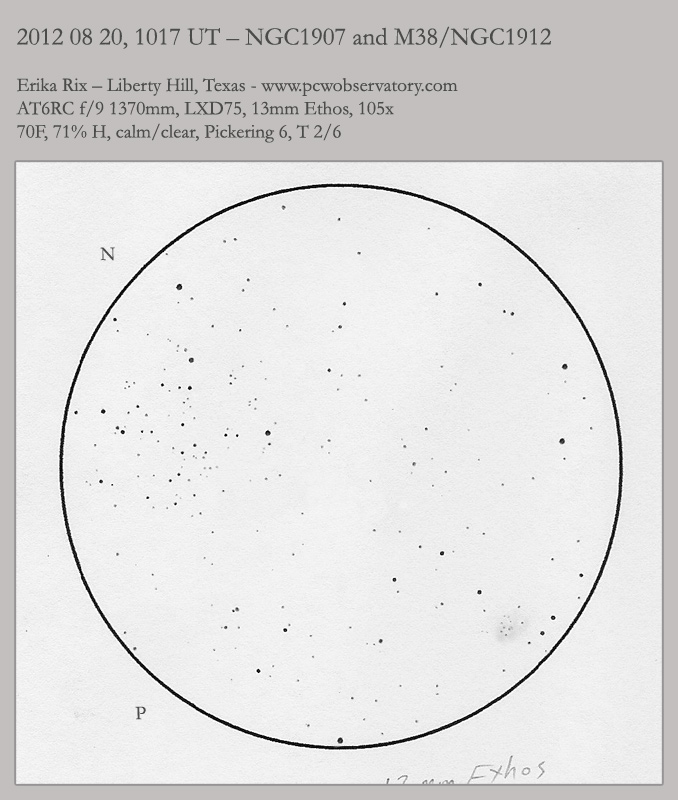
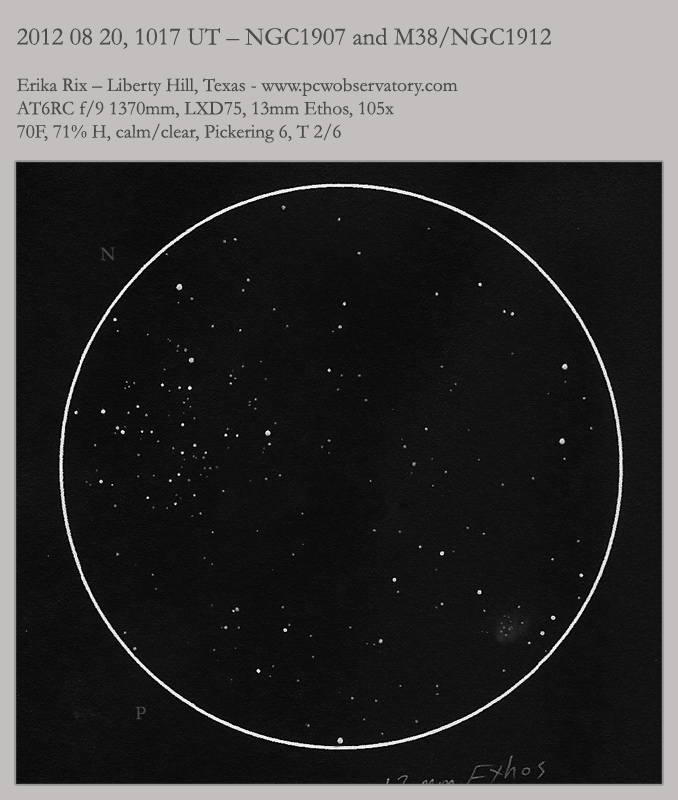
Sketches created with AL template, #2 graphite pencil, loaded blending stump with charcoal, super-fine Faber-Castell Pitt artist pen “S”, 0.5mm mechanical pencil.
The Astro-Tech 6″ f/9 is actually my husband’s telescope that had yet to see first light. He was holding on to it until he could pick up another mount that would be suitable to use with it. I do feel slightly guilty that after all this time, it was me who had first light with this gem instead of Paul. It fit really nice on top of my LXD75 and even though transparency was poor, I enjoyed several hours with it during the night and wee hours of this morning! With any luck, tonight’s sky conditions will be slightly better for a better “test” of it’s visual use.

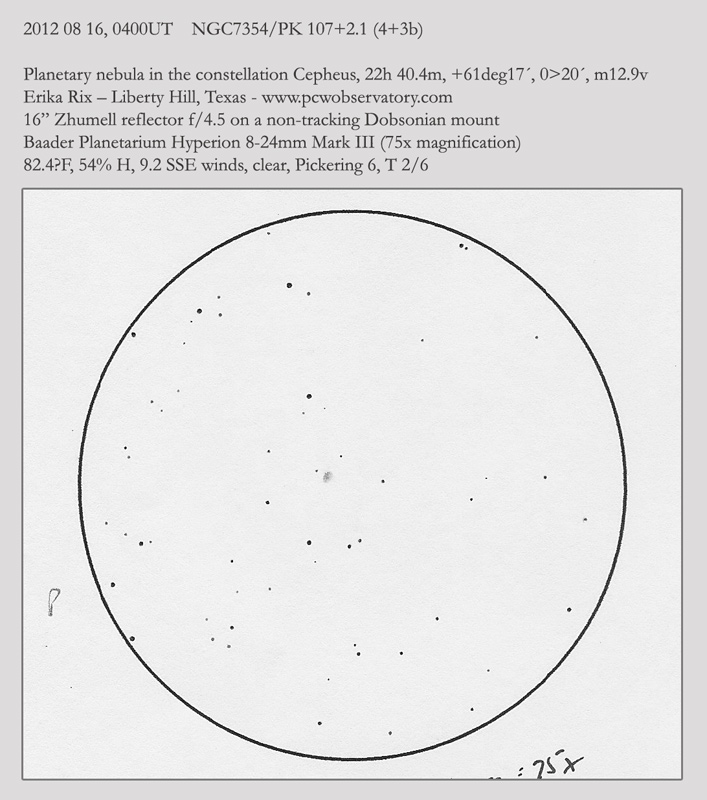
NGC7354/PK 107+2.1/H II-705 (4+3b)
Planetary nebula in the constellation Cepheus, 22h 40.4m, +61deg17´, 0>20´, m12.9v
NGC7354 is a small, slightly faint planetary nebula in Cepheus. Through the telescope, it is located the middle of a star pattern that resembles Sagitta where Delta Sagittae would have been. The star pattern consists of TYC4265-877-1 (m11.7) and USNO J2240137+612011 (m13.2) to the north with TYC4265-347-1 (m10.68) to the south. A strand of three other stars to the west, along with the pattern of stars that resembled Sagitta and NGC7354, resembled the shape of an ear or an ammonite fossil.
75x magnification: Small, soft circular disk, with a hint of slight elongation. O-III adds contrast and there was a hint of brightness in the center of it. A 14.75 magnitude star to the southwest and a 15.3 magnitude star to the southeast of NGC7354 were observed at this magnification just outside of the disk.

225x magnification: A third star with a magnitude of 14.9 was observed just outside of the disk to the west. Using an O-III, the NE and SW edges of the disk were fainter and I could see a brightened edge to the nebula around the rest of the disk with a fainter center. I detected a faint, diffuse haze outside of the brighter borders and there may have been a hint of the central star as it looked slightly grainy in the center of the disk.
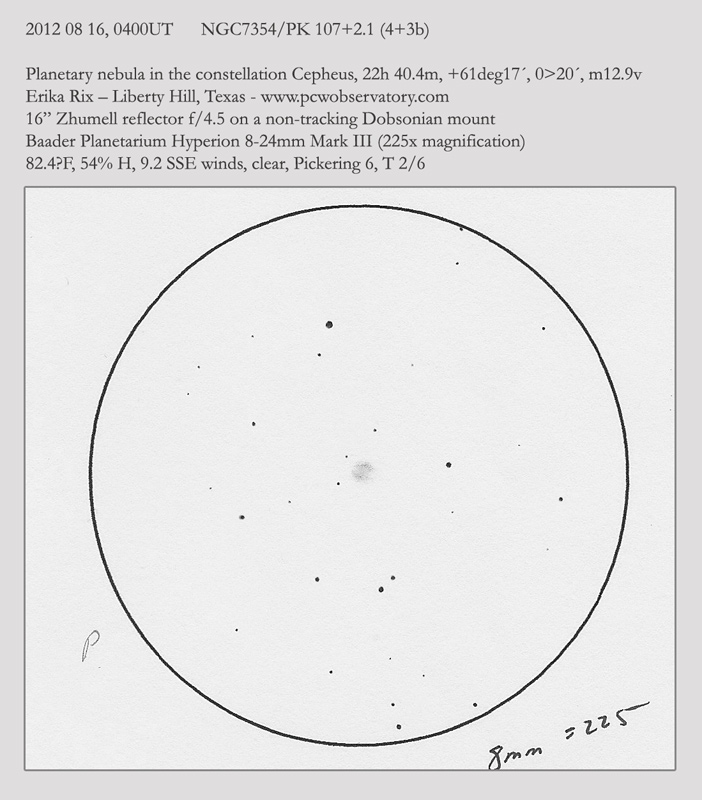

Sketches created with AL template, #2 graphite pencil, loaded blending stump with charcoal, super-fine Faber-Castell Pitt artist pen “S”, 0.5mm mechanical pencil.
NGC7635/Sharpless 162/Caldwell 11/Bubble Nebula/H 4.52
Emission nebula in the constellation Cassiopeia, 23h 20.7m, +61 deg 12´, 15´x8´
Distance: ~11 kly, apparent magnitude: ~10
Discovered in 1787 by William Herschel, this emission nebula lies SW of open cluster M52 and west of open cluster Czernik 43. It lies at heart of 8th magnitude star TYC4279-1582-1 where two imaginary lines form a cross-shaped star pattern with 7th magnitude HIP115198 at the top (southwest), TYC4279-930-1 (northeast), TYC4279-381-1 (southeast), and TYC4279-1203-1 (northwest).
75x magnification: At first glance, the 7th magnitude star to the SW drowned out any nebulosity of NGC7635. My only certainty that I was in the right area was by knowing the star pattern and where NGC7635 was located within it. The use of an OIII filter brought out a faint, clear circular glow around the 8th magnitude star.


225x magnification: Without the OIII, there was a faint circular glow with no definitive structure. With the OIII and adverted vision, the nebula was elongated north to south and extended more to the NW with some darkened areas within it. The edges were diffuse.
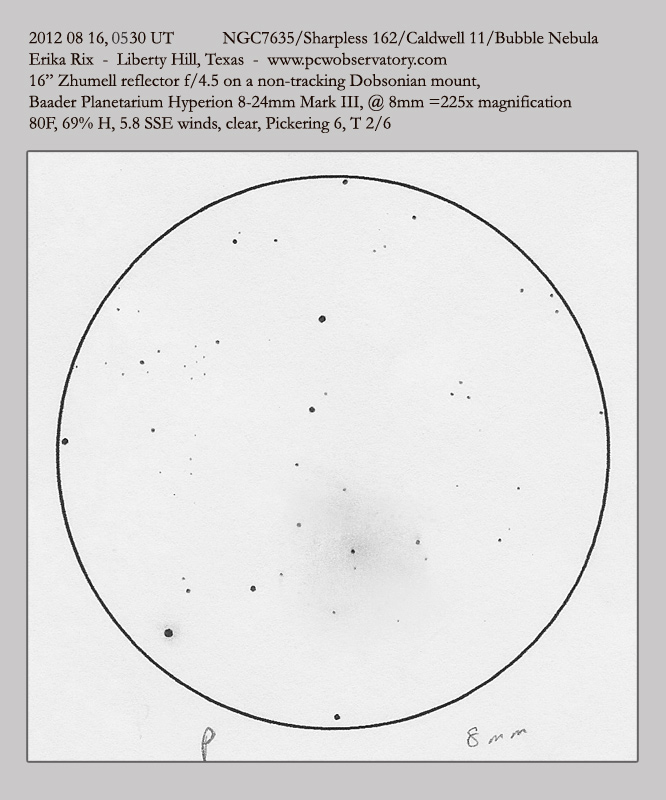

Sketches created with AL template, #2 graphite pencil, loaded blending stump with charcoal, super-fine Faber-Castell Pitt artist pen “S”, 0.5mm mechanical pencil.
For a good comparison, my husband, Paul, took this image using an hydrogen alpha filter in 2007. The magnification would be similar to the 225x sketch. You’ll need to rotate it ~10 degrees clockwise to match the orientation.
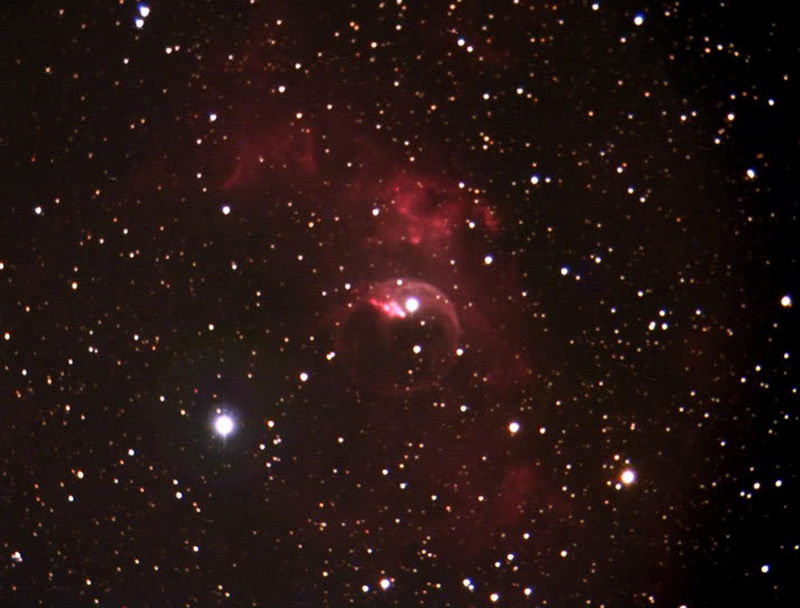
Photo credit: Paul Rix – NGC7635 taken in 2007 in Zanesville, OH
NOAA 11543 had very bright plage. The sunspots within it weren’t quite as pronounced as the other day. There was a very large filament going east to west in the SE quadrant of the solar disk. More plage located to the SW and the E-NE quadrants.
The brightest, largest prominence that I spotted was located on the NW limb and resembled two dancers joined by their outreached hands with their other hands stretched out behind them. More prominences were scattered about the limb, but to the SW, a very short, bright set of prominences were apparent.

Sketch created at the eyepiece with black Strathmore Artagain paper, white Conte’ pencil and crayon, white color pencil.
For a comparison, the image below was taken by SOHO. The prominence sketched was the one around 2-3 o’clock and my sketch orientation is flipped left to right and rotated (as drawn at the eyepiece) from the SOHO image.

Photo Credit: NASA SOHO
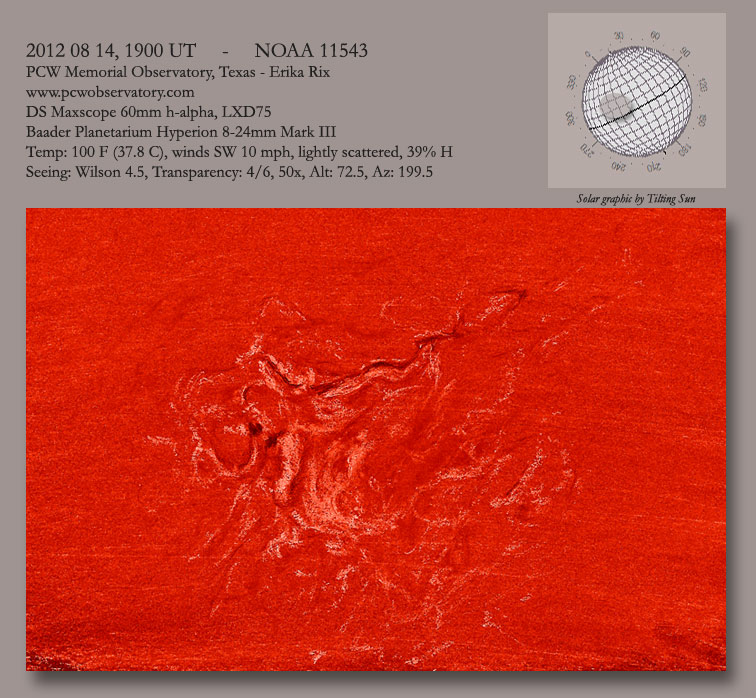
NOAAs 11543 and 11542 are said to have beta-gamma magnetic fields which have a small chance of producing M-class flares today.
AR 1543 had two obvious sunspots on the leading edge of that region with a long filament trailing behind. Lots of bright plage within the AR and fainter patches further away from the sunspots and filament. There was also a bit of fine filamentary structure swirling around the sunspots and reaching out to the SW, resembling a crackling in the chromosphere.
AR 1542 had plage and a filament, but I didn’t see sunspots in that region. With the heat at 100F and winds, I have to admit I didn’t stray for long from AR 1543 so may have missed any great detail in 1542. There were several bright prominences on the western limb and fainter ones scattered about the entire disk as well as more plage to the eastern hemisphere.
Sketch created at the eyepiece with black Strathmore Artagain paper, white Conte’ pencil and crayon, charcoal pencil and black oil pencil, then hue/saturation added for h-alpha color in Photoshop CS2.
Began watching meteor shower at Eagle Eye Observatory site, Canyon of the Eagles, for a public star party. The Moon hadn’t risen at that time and the meteors were very bright. As I was showing members of the public deep sky objects through the telescope, I wasn’t able to keep count of the meteors but I did witness a few bolides along with the meteors I did see.
Came home to Liberty Hill at 0730 UT (0230 CDT) and the 24-day old Moon had risen in Taurus just under Perseus at 26% illumination, drowning out the stars and lowering limiting magnitude to 6.1. Began my count at that time holding a clipboard in front of the Moon, Venus and Jupiter to keep my eyes better adapted to the dark. Will have missed any meteors in that area of the sky that I blocked out plus any really faint meteors in the rest of the sky for that quadrant because of the excess sky glow from the Moon. Was planning on a two-hour counting session at 15-minute intervals, but struggled to keep awake during the 5th interval and am sure I missed several meteors. Ended the observation at that time. During the first 4 intervals, I witnessed 41 Perseids within a 60-minute observing window.
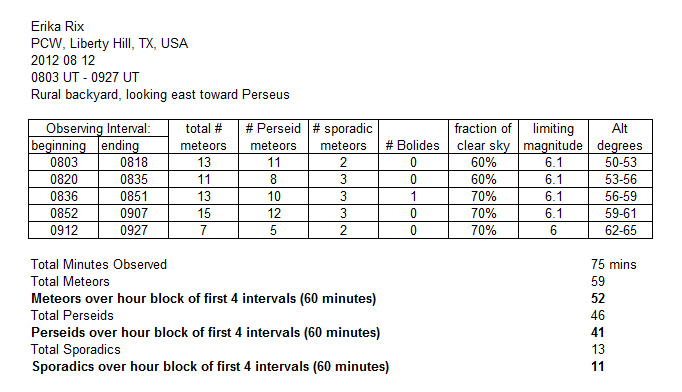
The 2012 Perseid meteor shower peaks tomorrow early in the morning hours. For anyone wishing to record their Perseid meteor shower count for the International Meteor Organization, please see the IMO site. I’m going to do a similar study to the one I did in 2010: 2010 Aug 12th Perseid Study from an activity in the book “The Sky is Your Laboratory” by Robert Buchheim. I may also attempt mounting my Rebel on the LXD75 to capture a few of them using the bulb setting, but it’ll depend on how organized I’ll be. There’s a public star party at Eagle Eye Observatory that I’m volunteering at for outreach and will be setting up for the meteor shower once I return home. Going to be a fun night all around!
Good luck with your observations during the night! You are welcome to use my form for a simple counting of the Perseids. Meteor Observing log Template
Specifics:
Cost in US dollars:
My husband and I moved this spring and had to leave our observatory behind. Not knowing when we’ll be able to have a new one built, it left me with little opportunity to use my 16” reflector because of its weight and my husband’s work schedule. Although I can dismantle the scope and carry each piece individually by myself, the primary mirror is so heavy I can only carry it a short distance. It was obvious that I would require a cart to haul the scope around longer distances and also to keep from having to dismantle the scope every time I wished to observe. I had read reviews for the ScopeBuggy and made a decision to purchase one to use both at home and for outreach events.
The purchase was made online at http://www.scopebuggy.com via PayPal. Their website was easy to navigate and to ensure you choose the correct type, they ask for the size and make of your telescope as well as the mount used. I ordered a standard-sized one on May 3, 2012. The confirmation received said to allow 4 weeks for delivery; however, the reviews I read stated to expect 6 weeks. I emailed Larry from ScopeBuggy on June 15th to inquire on the shipment date, as a tracking number was not given at time of order. Larry responded via email the same day to say shipment would be there on June 18th and gave me his phone number in case I had questions.
Arrival of the ScopeBuggy:
The package arrived on the 18th and was delivered in good condition.
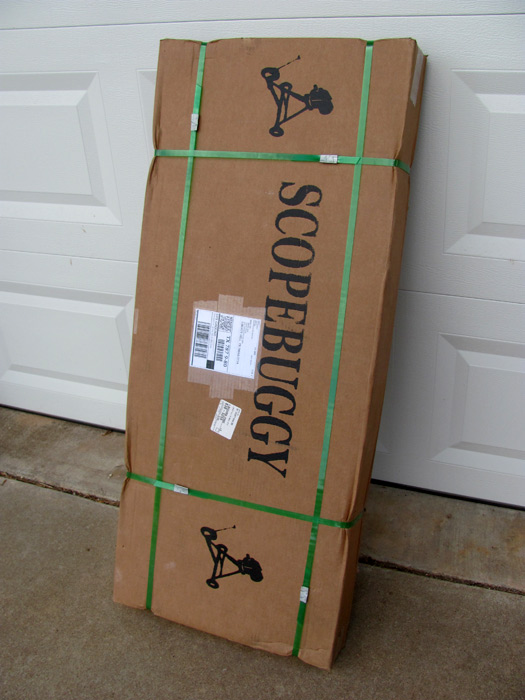
All pieces of the buggy were wrapped well and there were no scratches or dents.
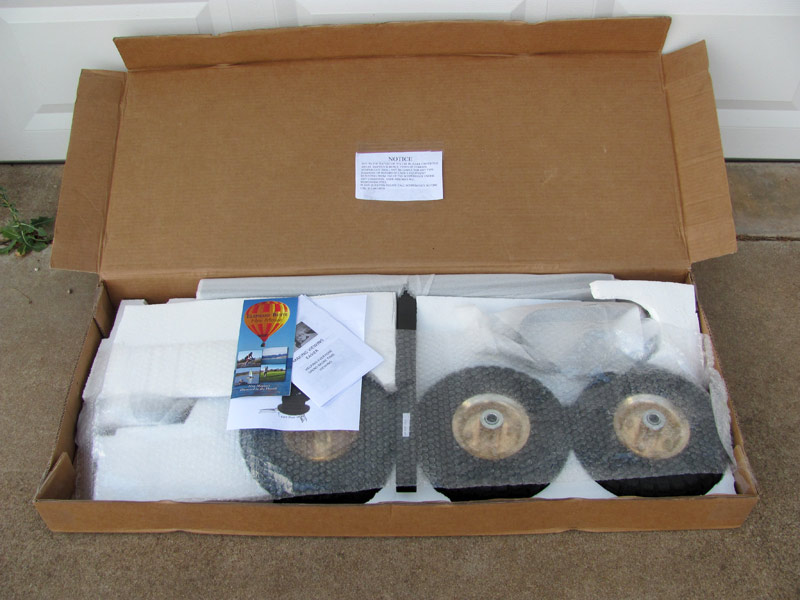
Included were instructions on how to assemble the ScopeBuggy, contact info, tourist information on Elephant Butte, NM and information on how to mount Dobsonians to the ScopeBuggy.

There is no list of parts for the ScopeBuggy, but a quick scan through the assembly instructions confirmed that nothing was missing. Clockwise starting at lower left corner: front steering yoke, hardware, three 3/8” bolts to keep the buggy from moving, three foot pads (the smaller ones are shown in this photo), three 10″ pneumatic wheels, gooseneck bar, t-bar, two rear axles, push/pull handle. The tape measure is mine and did not come with the buggy.

Tools that I needed for assembly were two wrenches for the bolts and a pair of pliers for the cotter pins. Hardware included: five cotter pins, one clip pin, wheel bushing and front wheel axle, two bolts and nuts used to hold the gooseneck in place on the t-bar.

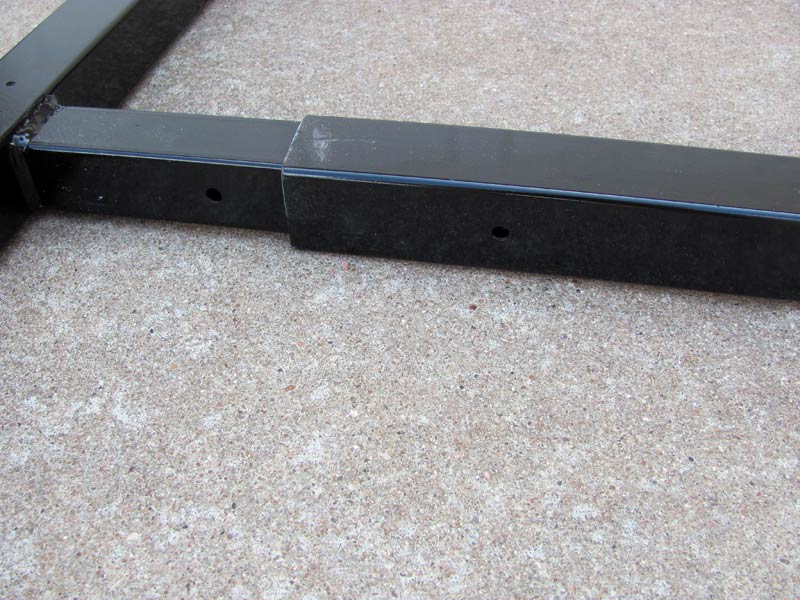
One of the footpads’ bases is larger than the other two and is used to slip on to the gooseneck. The two smaller ones are for the rear axles and are small enough not to slip over the rear section of the t-bar.
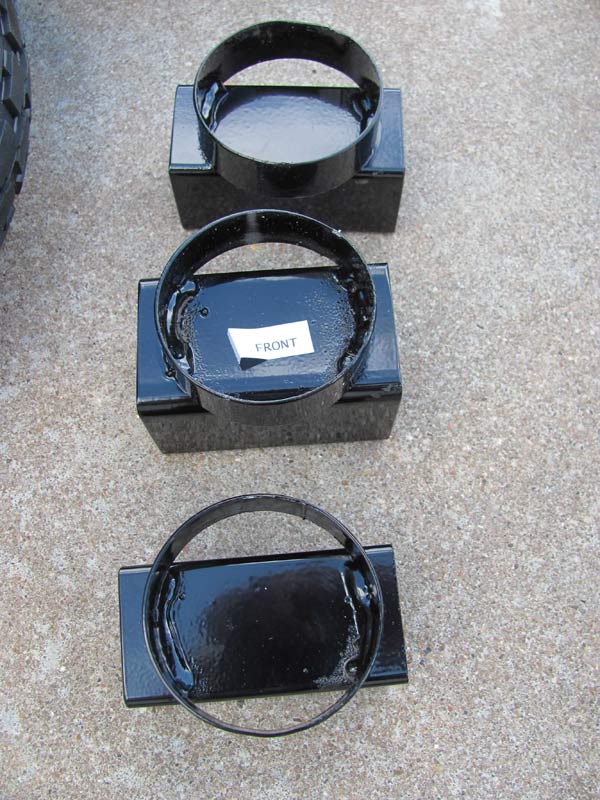
Assembly:
The picture below shows the larger footpad in place on the gooseneck.
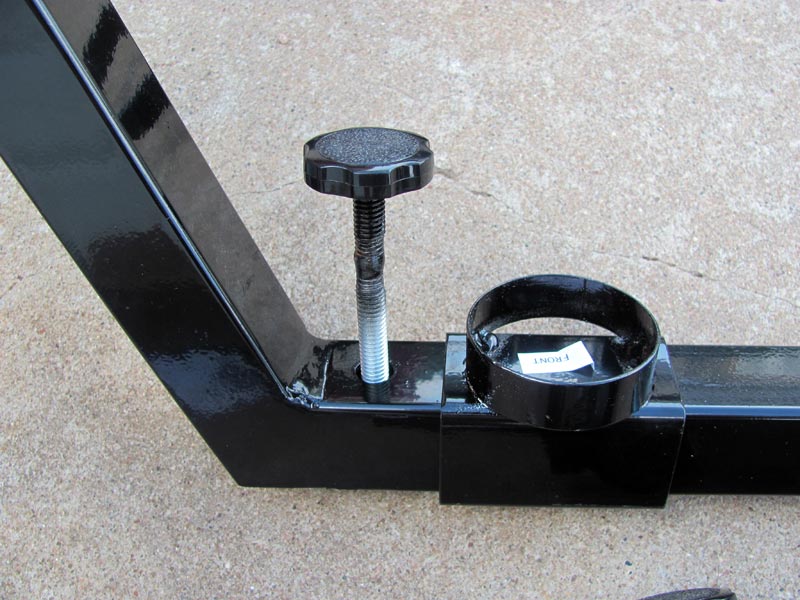
The smaller footpad slides over the rear axle but not over the t-bar.

The gooseneck is held firmly to the t-bar with two bolts/nuts in the pre-drilled holes of the center bar. There are three holes to allow length adjustment of the gooseneck from 32” to a reach of 38”. If more length is needed, you can contact ScopeBuggy and request an extension bar.
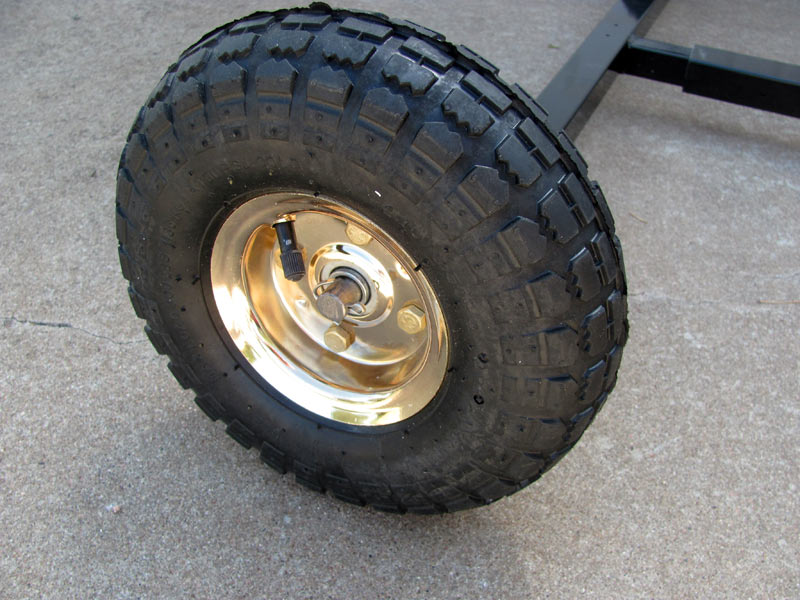
The front wheel is easily put in place with the bushing and axle. One side of the wheel requires a bushing and the other side has a bearing hub already in place. The wheels are made of gold anodized steel.
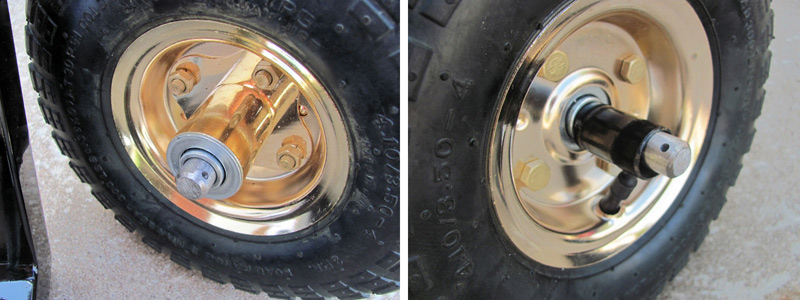
The instruction pamphlet assumes that you are knowledgeable with cotter pins. Nowhere in the instructions does it mention where (or how) you are to use them. It’s pretty self-explanatory though, as they are to be used to hold the wheels in place.

Expect a little bit of play between the wheel and the cotter pin. ScopeBuggy states this is normal and will not affect its performance. I will confirm that statement is true, having used the ScopeBuggy on several occasions.
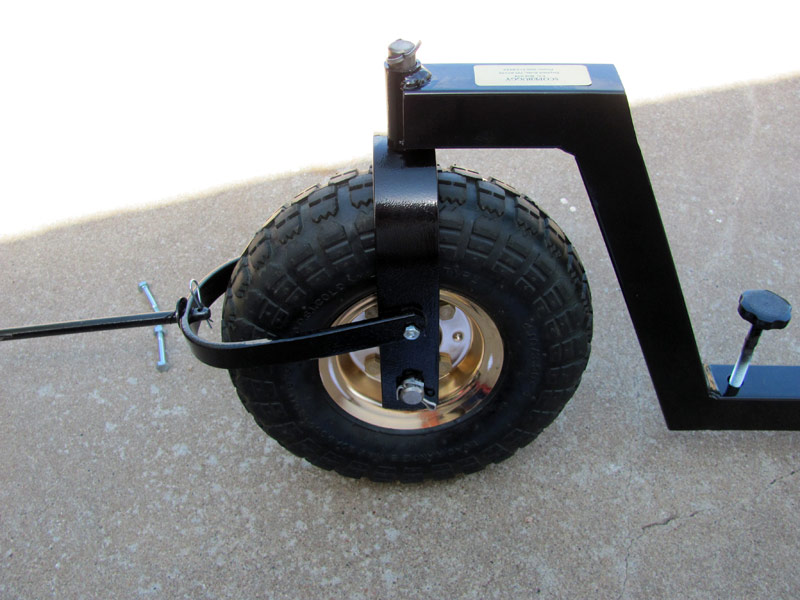
The photo below shows the yoke attached with the key pin.
Assembled ScopeBuggy – assembly took about 15-20 minutes after removing all materials from its box.

Putting the mount on the buggy:
To my dismay, the t-bar was too long for the feet of my mount. The t-bar was 30” wide and the two rear feet of my mount were only 23” apart.

Close up of the footpad and one of the rear feet of the mount:

I phoned Larry to explain the situation. He apologized and told me that he had upgraded my order to the larger ScopeBuggy based on the size telescope I had and that evidently the smaller foot pads were put in the box instead of the larger ones. I assumed that he meant the square base of the footpad needed to be larger to fit over the rear section of the t-bar.
When the new footpads arrived, the square bases of them were the same size as the original ones, only the round footpad sections of them were larger. I called Larry again and reiterated the measurements. Larry was very apologetic stating that he misunderstood the first time, although I’m certain the fault was likely mine for not explaining the problem very well. He told me the best thing to do was to cut the excess length off of both sides of the rear section of the t-bar with a hacksaw, being very careful to get the measurements correct. He set my mind to ease stating that to do so would not weaken the integrity of the buggy. For anyone wondering how the rear axles remain in place without the use of bolts to secure them to the t-bar (as the gooseneck is held in place), the weight of the tripod/mount is responsible for locking the axles in place. I have to admit I was a bit dubious until I used the ScopeBuggy several times and discovered they did indeed remain in place and didn’t slide outward, even with turning the buggy around corners.

The scope now fits firmly into all three footpads.

Larry told me to keep the larger footpads in case I might be able to find use for them at a later date.
I’ve read reviews that stated the handle of the buggy has potential for people to trip over it during the night. The handle that came with mine slips easily under the buggy when I turn the wheel ~ 180 degrees. If you find that yours doesn’t, the handle comes off easily by removing the key pin.
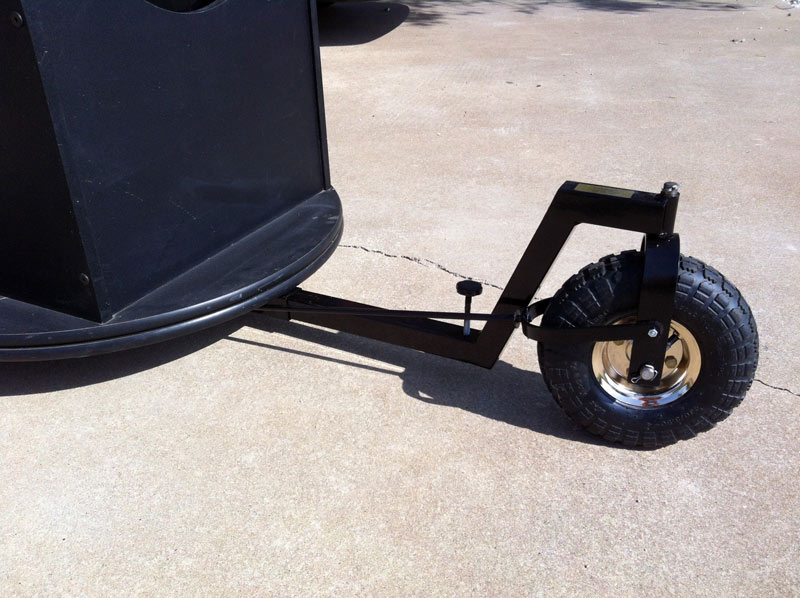
The three securing bolts can be screwed down to the ground to keep the buggy from moving while observing. I’ve heard that some people attach a crank handle onto them for faster turning.
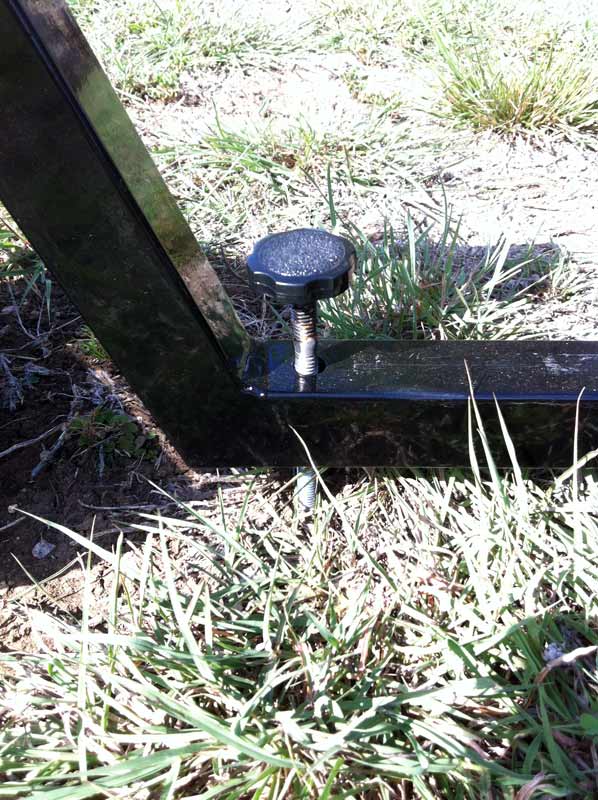
If you have rough terrain, you may want to keep in mind that there is a 1-½” clearance from the bottom of the ScopeBuggy bar to the ground. My yard is fairly uneven and rough but I have yet to encounter a problem with moving the scope around on the buggy. ScopeBuggy suggests using a bungee cord to secure your mount or tripod while moving the telescope. I tilt my scope down toward me and hold on to it with one hand while wheeling the buggy around in the yard for ease of mind.

How easily does everything pack up to take to another observing site? I simply remove the two rear axles (remember, no pins or bolts hold them onto the t-bar) and lay them on top of the gooseneck/t-bar section to the side of my mount. They take up very little space even with those 10” tires. I have a CRV and packed up my 16” reflector with its Dobsonian mount, my LXD 75, a refractor, and my other accessories and still had room to spare. You can barely spot one of the wheels of the buggy off to the right under the white step stool.

I looked at other carts and casters before purchasing this buggy. All of them had too small (and hard) of wheels that would have made it nearly impossible to use on anything but pavement, whereas the pneumatic rubber tires of the ScopeBuggy are perfect for rolling a scope across a yard or field to pick the best observing location that session. I also think the the three wheel design makes it more maneuverable. It’s very easy to steer and pull and there’s no worry of pushing the scope off the buggy like I’ve seen in other designs.
All in all, I’m very pleased with my ScopeBuggy and would certainly recommend it to others. It’s a great product with terrific customer service. Larry was very pleasant, helpful and supportive (and accessible!) by email and phone conversations.
The August issue of Sidereal Times for the Austin Astronomical Society is now available for download.

Click the following link for the PDF version: August 2012 issue (2.5 MB)
Inside this issue, you’ll find:
President’s note
Chair reports
Membership Renewal info
Astronomical League news
ASAE info from Al Traino
Astro App Reviews
Guest Spotlight – David Eicher
Image of the month
IDA Call to Action
Sharing the Sun report
Eldorado Star Party info
ToV report
In Remembrance – Sally Ride
Observing Targets
X-Bar Ranch report
Equipment update for Eagle Eye Observatory
AAS Public star party photos
Austin Under the Skies photos and report
Member gallery
Contact info
Please contact me if you’re interested in joining the club or wish for more information! It’s a very active club and has a great outreach program.


 PCW Memorial Observatory - Erika Rix