2013 01 05 – Eagle Eye Observatory

•January 8, 2013 • Leave a Comment

2013. A new year and with it, new resolutions of what we’d like to accomplish, new goals, or changes in our lives. I’ve got a full-page list for my 2013 resolutions and one of the items on the list is more outreach and to expand the types of outreach I do. Last year, some of the highlights were my first solo outreach with a cub scout group, a solar outreach with the Austin Planetarium, and several of the Austin Astronomical Society public outreach events…not to mention a few smaller private outreach gatherings. This year, I’d like to contact some of the local schools in my area for solar outreach, more sidewalk astronomy at parks, and to help out with more club events if time permits.

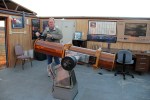
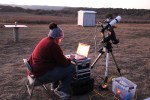
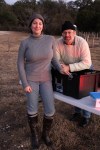
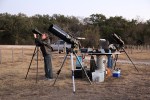
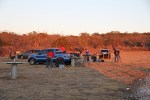
With all that in mind, this Saturday was the first public star party/outreach event of 2013 for our club, the Austin Astronomical Society. It was held at the Eagle Eye Observatory at the Canyon of the Eagles. It’s always a great time getting together with club members and meeting new people as they come to share the night skies with us.

IMG_4982

The following is a report of the star party from our club’s outreach chair, Dawn Davies.

Saturday January 5, 2013
AAS Public Star Party
Eagle Eye Observatory, Canyon of the Eagles
5:15 p.m. – 9:15 p.m.
Guests: 27

Closest Visitor – from Marble Falls, TX
Farthest Visitor – from Kentfield, CA
Other Cities Represented – Austin, Horseshoe Bay, McDade, and Pearland

Telescopes: 8
Observatory Operator: Terry
Temperatures: Low 50s moving toward high 30s by end of the night

Transparency and humidity made less than stellar skies, but seeing was very good and there wasn’t a cloud in the sky. I left the 16″ reflector at home this time and instead opted for my Maxscope solar telescope and an Astro-Tech 6″ RC for nighttime observing. I even managed a sketch of the Orion Nebula on very soggy paper and had spare time to make my rounds visiting everyone at their scopes. Typically when I bring the 16″, I’m very busy sharing the views. This night was quiet for me with the 6″ scope. I imagine part of that was because I set up near the edge of the field instead of my normal spot near the middle. Regardless, we had 27 guests that signed in and I thought that was wonderful given the cold weather of winter! This is certainly a good omen of things to come for the new year.

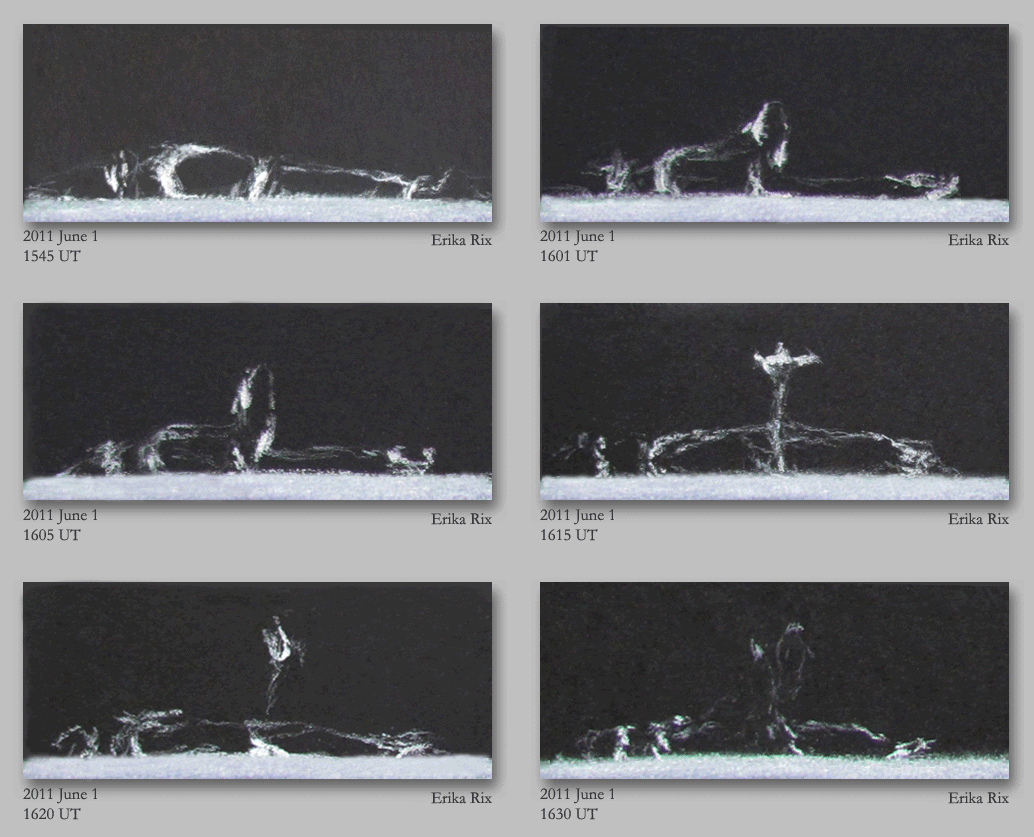
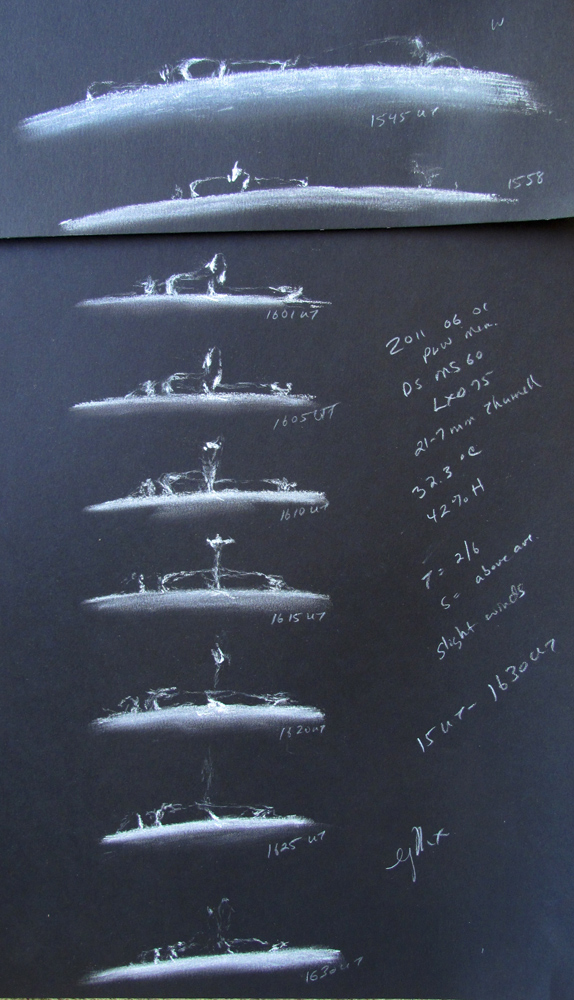
20110601 Erupting Prominence Animation

•December 28, 2012 • Leave a Comment

The animation was created in Photoshop CS2 from a sketch sequence last year of an erupting prominence.

PCW Memorial Observatory, Zanesville, Ohio USA – Erika Rix
Temp: 32.3C, Humidity 42%, SE winds 5mph
Seeing: Wilson 4, Transparency: 2/6
DS 60mm Maxscope, LXD75, 21-7mm Zhumell

Sketches created at the eyepiece with black Strathmore Artagain paper, white Conte’ crayon and pencil, Derwent charcoal pencil, black oil pencil, oil pastels.

2012 12 19 – 5.76 Day-Old Moon

•December 19, 2012 • Leave a Comment

I had every intention on sketching the Double Cluster as my first target of the night. It would have been a marathon session and by the time the faintest stars needed to be added, the Moon would have been long set. However, once I saw how beautiful the Moon was, I went back in the house to grab my lunar sketch kit and black paper.

2012 12 19, 0115 UT – 0250 UT 5.76-day old Moon
Erika Rix, Texas – http://www.pcwobservatory.com
AT6RC f/9 1370mm, LXD75, Hyperion 8-24mm Mark III, no filter, 57x
52F, 55% H, clear/calm, Antoniadi III with moments of I, T 2/6
Alt: 32deg 33, Az: 244deg 57´
Phase: 103degrees, Lunation: 5.76 d, Illumination: 38.7%
Lib. Lat: -06:11, Lib. Long: +06.53

It took me three attempts to begin the sketch as the first craters I added, Theophilus, Cyrillus, and Catharina, were drawn too large each time – this meant that all the other lunar features were disproportionately too close to each other and too small. By the third attempt, those initial craters were good enough to allow me to continue with the remainder of the sketch.

Earthshine was just bright enough to slightly lighten the non-illuminated portion of the Moon. No lunar features in that area could be seen, but what little bit of earthshine there was cast enough light to make out the entire globe rather than the crescent alone. The tips of the lunar terrain were very bright and opened up in front of my eyes as the terminator advanced. Those were the first features to be sketched after the initial earthshine and backdrop of the crescent was added to the paper. The tonal variances in the remainder of the sketch were added next followed by alternating the white Conte’ pastel pencil and gray charcoal pencil to depict the lunar features further in from the terminator.

20121218-resized-a

Eyepiece sketch on black Strathmore Artagain paper, white Conte’ crayon and pencil, Derwent watercolor pencil, black charcoal, black oil pencil.

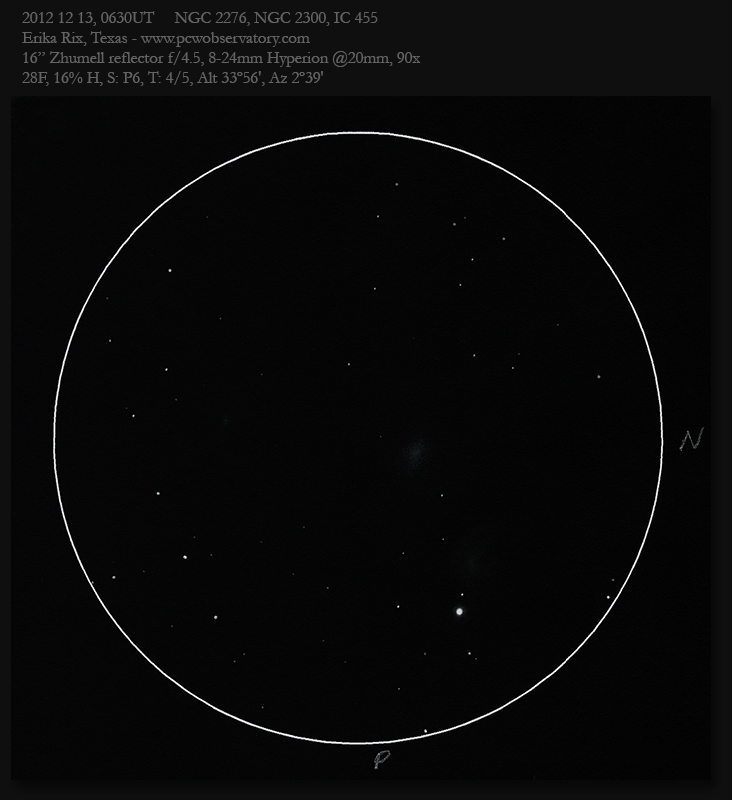
2012 12 13 – NGC 2276, NGC 2300, IC 455

•December 18, 2012 • Leave a Comment

(Click on the image below to view in higher contrast and resolution.)

20121213-NGC2276-2300-IC-455

Labeled

Labeled


NGC 2276, NGC 2300 and IC 455 make a nice trio of galaxies in the constellation Cepheus near Polaris.
Finder view from Starry Nights

Finder view from Starry Nights

NGC 2276 (Arp 25, UGC 3740 and also Arp 114 when combined with NGC 2300)

Galaxy SAB (r) bc II in Cepheus, RA 07h 27m 10.2s, Dec +85º 45′ 19″, 2.6’x2.5′, SB 13.8, 11.8 vm. Discovered by Friedrich August Theodor Winnecke in 1876. Approximately 110-150 million light-years away, depending on the source.

Faint, face-on spiral galaxy with a slightly brightened center. NE edge fainter and diffuse making it appear slightly elongated. Located 2 arcminutes ENE of magnitude 8.4 star. Arp made two entries for this object. One by itself as a spiral with one heavy arm and the other to include NGC 2300 with it as somewhat peculiar and possibly perturbed.

Arp’s image of Arp 114 that includes NGC 2276 and NGC 2300 – flip both vertically and horizontally to match sketch


NGC 2300 (UGC 3798, Arp 114 when paired with NGC 2276)

Galaxy SA0 in Cepheus, RA 07h 32m 19.7s, Dec +85º 42′ 33″, 2.8’x2.0′, SB 12.9, 11.1 vm. Discovered by Alphonse Louis Nicholas Borrelly in 1871.

Moderately bright, elongated west to east, brightened center that almost appears stellar, diffuse edges. NGC 2276 is 6 arcminutes NW of it with an 11th magnitude star centered between the two galaxies.


IC 455

Galaxy S0 in Cepheus, RA 07h 34m 57.7s, Dec +85º 32′ 16″, 1.1’x0.7′, 13.3 apparent magnitude, SB 12.9.

Stellar core, very faint. Located 10.5 arcminutes SSE of NGC 2300.

Eyepiece sketch on white photocopy paper with black super-fine felt tipped pen for and #2 pencil, blending stump for the nebulosity. Template is available for download: PCW Observation Form.

2012 12 13 – NGC 7027 / PK 34-3.1

•December 13, 2012 • Leave a Comment

20121213-ngc7027

Planetary nebula type 3a in Cygnus, 21h 07m 01.69s, +42º 14’10ʺ, 18ʺx10ʺ object size, 8.5 visual magnitude. Discovered by Jean Marie Edouard Stephan in 1878.

This planetary is small but fairly bright and easy to spot. It’s located in the northwest region of Cygnus, using Xi Cygni and Nu Cygni as reference points for star hopping. There’s a hint of bluish color and it appeared soft and slightly elongated NW-SE.

Eyepiece sketch on white photocopy paper with black super-fine felt tipped pen for and #2 pencil, blending stump for the nebulosity. Template is available at https://pcwobservatory.com/2012/11/09/general-observing-form/.

Related links:
http://www.ngcicproject.org/dss/dss_n7000.asp

Filters

•December 13, 2012 • 3 Comments

Filter Performance Comparisons For Some Common Nebulae – By David Knisely

Some Available Light Pollution And Narrow-Band Filters – By David Knisely

Specific filter passband information – By AndrĂ© Knöfel

Using Eyepiece Nebular Filters for Deep Sky Viewing – By Stephen R. Waldee

The Magic Horse Head Eyepiece – By Barbara Wilson. She explains how to determine the best eyepiece to use with your filter to observe the Horsehead Nebula.

2012 12 12 – NGC 6765 / PK 62+9.1

•December 12, 2012 • Leave a Comment

20121212-NGC6765-225x

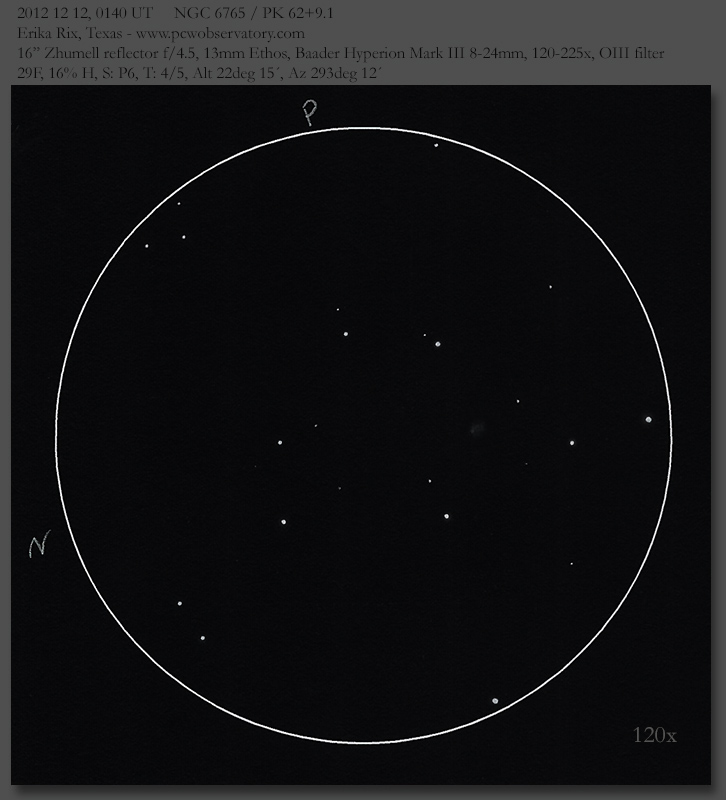
Planetary nebula type 5 in Lyra, 19h 11m 06.4s, +30º 32’43ʺ, 38 ʺ angular size, 12 visual magnitude. Discovered by Albert Marth in 1864.

There are a few nice planetary nebulae in the constellation Lyra – one in particular that comes to mind is M57, the famous Ring Nebula. NGC 6765 is an irregular planetary nebula found near globular cluster M56 just under half way between Sulafat and Alberio. It took a bit of effort for me to find it, but once the nearby star patterns were spotted, NGC 6765 became evident. Look for M56 and then make your way back to Sulafat in Lyra. You’ll find this object about 14 arcminutes SE of a triangular star pattern and 22 arcminutes north of magnitude 6.9 multiple star HIP94104. It’s in the center of three stars that form a triangle, two at 11 magnitude to the NE and SE with the third at magnitude 9.7 to the west.

NGC 6765 at 120x

NGC 6765 at 120x

It appeared as a very faint, small, elongated smudge. A UHC filter would have been very useful, but I had to make due with an OIII. It did enhance the nebulosity and the best magnification seemed to be between 120-225x with a smaller FOV. I could detect it with the 13mm, but it became enhanced with the Hyperion, especially at 225x.

There is a 10th magnitude central star. Visually, the northern edge of the nebula appeared almost stellar with 2-3 brightened areas with a faint halo around its entirety, fainter to the east and southeast.

Eyepiece sketch on white photocopy paper with black super-fine felt tipped pen for and #2 pencil, blending stump for the nebulosity. Template is available at https://pcwobservatory.com/2012/11/09/general-observing-form/.

Related links:
NGC/IC Project – NGC 6765

2012 12 11 – Moon, Venus and Mercury

•December 11, 2012 • Leave a Comment

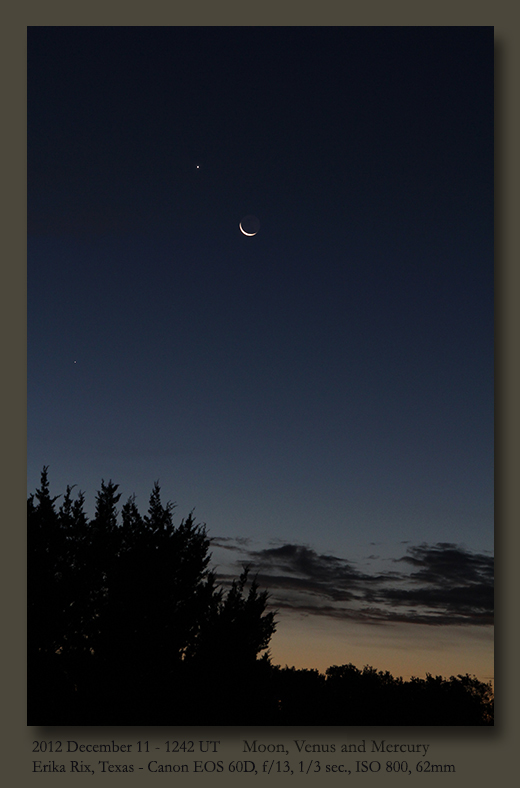
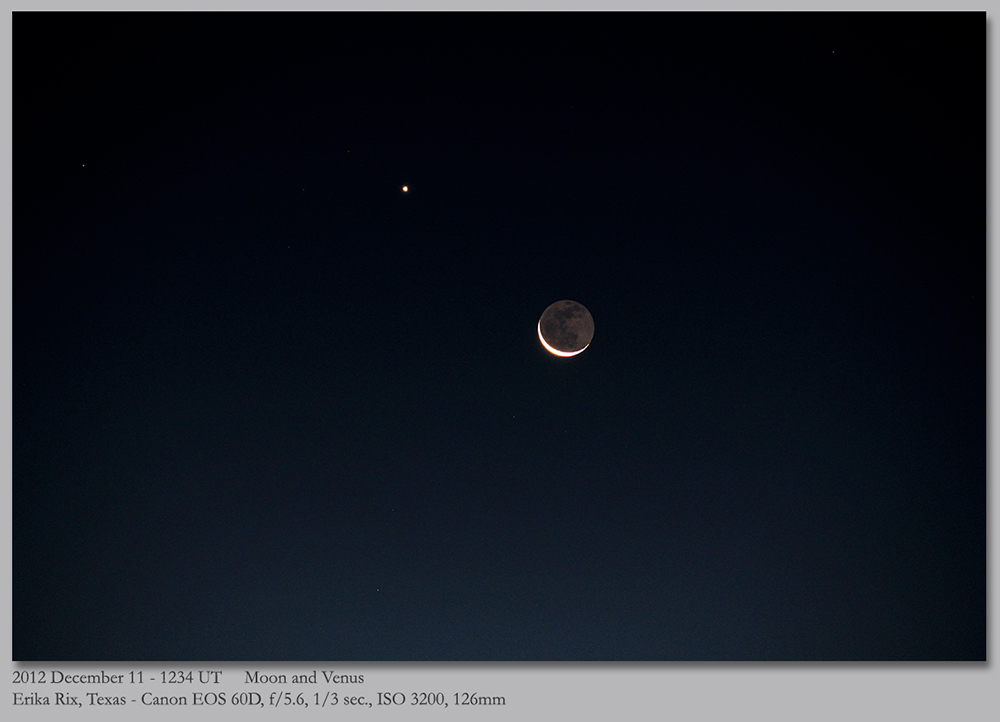
This morning before dawn, observers were treated to the beautiful sight of the Moon and Venus with an angular separation of under 2 degrees. The separation was 1.6 degrees at 1400 UT. Looking 6 degrees further southwest, Mercury added to the scene. Tomorrow (12th), Mercury will be 1.1 degrees north of the Moon at 0100UT with the Moon reaching perigee at 2300UT.

20121211-Moon-and-venus2

20121211-Moon-and-venus

Labeled version

Labeled version

December 2012 Issue – Sidereal Times

•December 4, 2012 • Leave a Comment

The December 2012 issue of Sidereal Times for the Austin Astronomical Society is now available for download.
ST201212
 

Click the following link for the PDF version: December 2012 issue (3 MB)

In this issue, you’ll find details on the December holiday party, December Observing Targets, IDA Conference 2012, Astronomy App review for MoonGlobe HD, Guest Spotlight – Steele Hill, Photo of the Month, TSP announcement, Compact Power Supply review, Sirius B report, and much more!

Please contact me if you’re interested in joining the club or wish for more information! It’s a very active club and has a great outreach program.

20121126 – 12 Day-Old Waxing Gibbous Moon

•November 27, 2012 • Leave a Comment

12-day old waxing gibbous Moon photo from the other night. Unfortunately it’s a soft image that was taken with my tripod instead of afocally on a telescope. I was too lazy to set up my scope for a sketching session and thought I would have a quick play with my camera instead. I can chalk it up to gaining experience and afterward, I settled down for the night with a good book on the couch.