
2005 – Collection of Lunar Sketches from the Archives » Crisium unfinished sketch – 2005 11 1
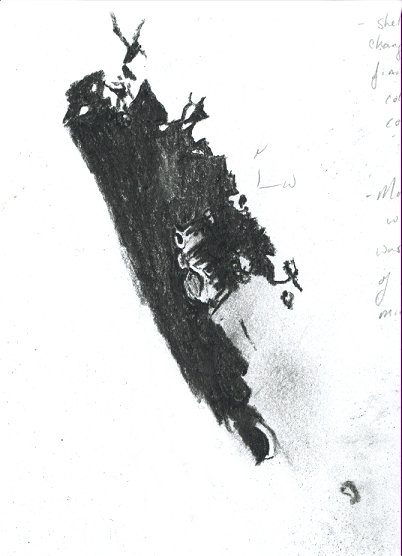
Crisium unfinished sketch – 2005 11 1
The first thing that caught my eye after I had set up my gear (although using the LX200 as it was already set up) was the western edge of Mare Crisium. The rough terrain forming a crescent moon shape itself was stunning. Just northwest of the sea of crises, Posidonius connected with le Monnier by means of Chacornac, resembling a baby rattle with Posidonius the rattle end. In June this summer, I was able to sketch this area, [url=http://www.cloudynights.com/photopost/showphoto.php?photo=3563&password=&sort=7&thecat=500]Posidonius, Chacornac sketch[/url], and although I didn’t see the quite the amount of shadows in the craterlets around Posidonius, it was not all that different from what I viewed this morning.
According to C. Wood (pg. 81 of Modern Moon), le Monnier was explored by Soviet Luna 21 Lundkhod rover. http://www.lpi.usra.edu/resources/lunar_orbiter/images/aimg/iv_078_h3.jpg
This led me to investigate further and the Virtual Moon Atlas had a nice write up allocating Luna 21 to a page just for itself: “Launch on 8 January 1973 / 6h 55mn (UT) from Baïkonour. Probe 4850 kg. Surface module 1814 kg with two ramps for Lunakhod 2 descent to soil. Radiocommanded vehicle from earth in real time.
Soft landing in Le Monnier crater. Lunakhod 2 is 2.2 m long. 1.6m wide and 1.35 m high with 8 wheels. Each with independent engine and brake. 840 kg mass. Solar panel electrical source. Internal heater with Polonium 210. Speed 1 to 2 km/h. Four cameras whom two stereoscopic.
Physical and mechanical lunar soil analysis with a soil tester at 1000 different locations. Chemical analysis at 25 different locations. Magnetometer. Radiometer. Total distance 37 km during 10.5 months. Sends more than 80 000 pictures whom 86 panoramas. Mission ends June 4. 1974.”
Next, working my way down Mare Fecunditatis, the areas were so smooth with the odd dorsa wrinkles in their glory. It was almost as they felt they needed to make a show for the lack of outstanding craters along the terminator. But once I hit the southern region, the dramatic effect of rugged terrain and shadowing reminded me the pores of charcoal used for BBQ grills. It was that lightweight, porous texture that appears that it could crumble at the slightest pressure. I didn’t hang around this area long enough to name features for a few reasons. Mare Crisium was beckoning me back and I couldn’t tear my eyes from the dramatic views to look at my Rukl.
Mare Crisium…did you know that it is the only lunar basin that doesn’t seep maria into the other mares? Why did I never notice this before? C Woods has a good write up starting on page 91 with all kinds of wonderful facts concerning what he titled Crisium Country. And how many rings can you count around this basin? Some suggest up to 7 rings, whereas Woods believes that four can be seen with ample evidence: Geminus, Cleomedes, Crisium, and a wrinkle ridge ring.
But what really caught my attention was the way he described the western view of Crisium a few days after the full moon. It was perfectly how I saw it this morning! I didn’t stay out long enough to witness the sun crossing over the massifs on the western ridge, but during the few hours I was out, the views changed quite a bit with every few minutes. Shadows were growing and filling in the maria and all the little treasures to be found in the bottom of that sea. Here’s a map from the Lunar Orbiter photos that will show nearly the view I started out with. The terminator is just a little east from the hours I viewed. But imagine it encroaching westward over Picard, Dorsa Oppel, and so forth. http://www.lpi.usra.edu/resources/lunar_orbiter/images/aimg/iv_191_h3.jpg
For example, when I began my sketch, Picard’s western edge was visible. Mind you, it only looked like the side view of a soft white curved contact lens. The whole inside and eastern edge of it was already flooded with darkness. Pierce and Swift were quite in their own glory to the North just on the edge of the terminator. The floor of Swift was completely darkened. Pierce at the start of the session had a lighter floor with darkness just starting to seep in. Both craters’ rims were completely visible. The massifs directly W-SW of these two little craters streaked long shadows resembling long thin fingers reaching the outer edges of Swift and Pierce. It was almost like wet paint streaking to the bottom of the painting. I’m assuming the main cause of this was due to the sharp edges around Prom. Olivium and Prom. Lavinium. Just above Yerks and the surrounding area, lots of little white glittery specks popped out of the blackness…looking like a diamond sun shooting prominences outward to light the area one last time before the flames are put out.
Dorsa Oppel was a thin darkened line that was only visible on the southern half of Crisium as the shadows had already covered the northern part of this ridge. And the entire western edge of Crisium was a crisp, jagged crescent.
Shadows were getting longer and wider. Soon Picard was not to be seen except for a slight lightened area where the bright lens used to be. Swift and Pierce lost the eastern rims of their shape, and the terminator line connecting the three was no longer a fluid, curvy, wave….but a crisper hardened line with sharp angles. The diamond suns were slowly doused almost as if to give all the glory to the massifs at the end of the morning. Ah, but I didn’t stay around for the final act.
What happened to the sketch, you ask? My fingers just couldn’t keep up with the ever changing Mare Crisium. So with a little laugh and slight shake of the head, I put the sketching pad down and just enjoyed the show.

 PCW Memorial Observatory - Erika Rix

